Key event
Battle of Poelcappelle
- Category:
- Military operations
- Front:
- Western Front
- Date:
- 9 October 1917
- Author:
- Natalia
- Battle:
- Battle of Poelcappelle
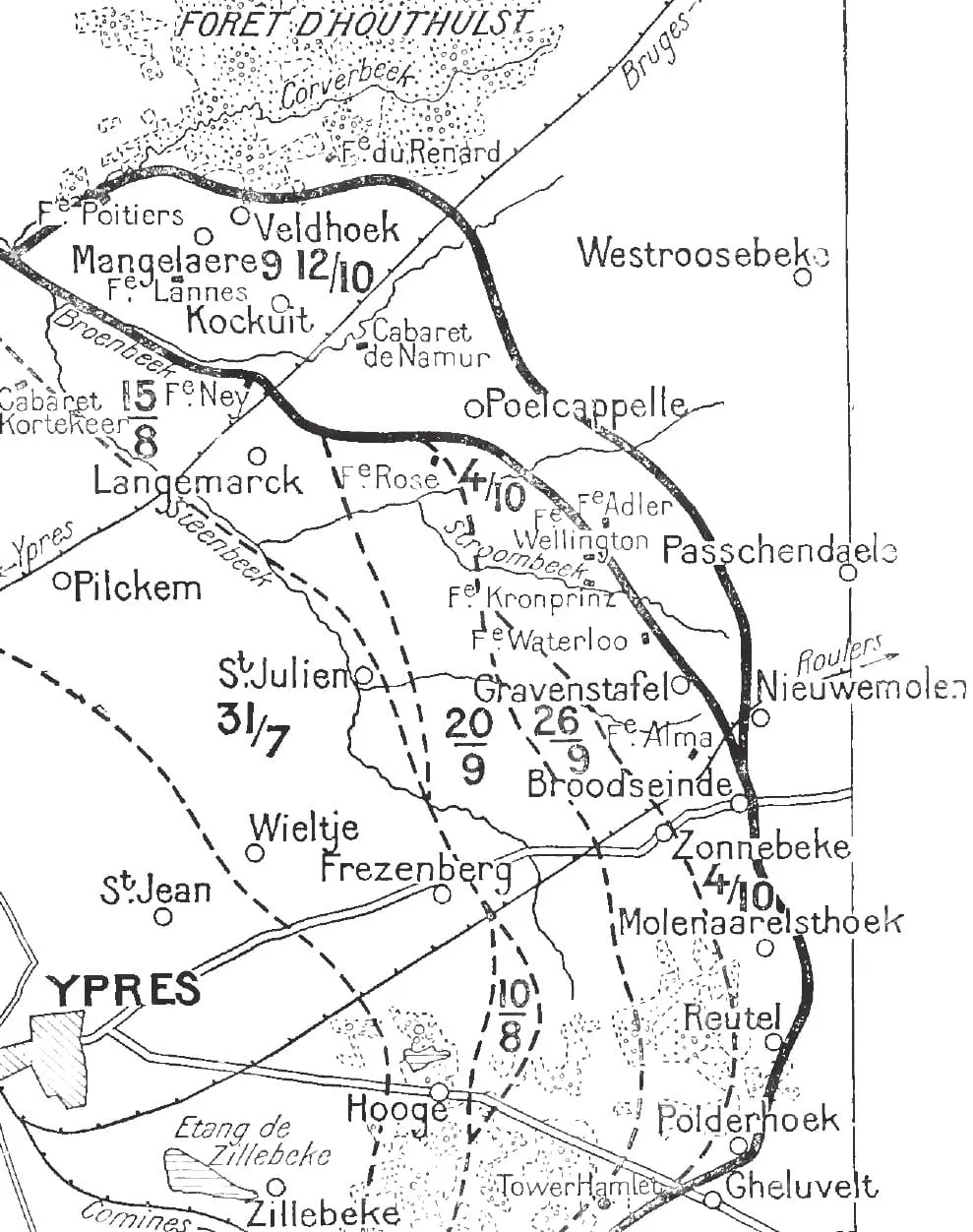
On 9 October 1917 at 5.20 a.m. the British artillery opened fire on a front about 12 kilometres long east and north-east of Ypres. Five days after the victory at Broodseinde, the armies of Generals Herbert Plumer and Hubert Gough, supported by the French, moved off on the next bound of the Third Battle of Ypres. This time nothing resembled the September attacks. After five days of rain the guns were stuck in the mud, the bombardment was thin and ragged, and the two British divisions that were to advance on the village of Passchendaele reached their starting positions after marching all night, some of them only after the attack had begun. By evening almost all the ground gained on the ridge and in front of the pillboxes on the Bellevue spur had been lost. On the lowlands to the north, however, the British and French advanced more than two kilometres, to the edge of Houthulst Forest.
A decision in the rain
After Broodseinde Field Marshal Douglas Haig came to believe that the German army in Flanders was close to collapse, and on 4 October itself he brought forward the next attacks from 10 and 13 October to 9 and 12 October. That same afternoon it began to rain. On 7 October there were downpours, and on 8 October at four in the afternoon, when the wind had begun drying the ground that morning, it poured again. The meteorologists held out no hope of improvement. That morning Plumer conferred with his corps commanders. The commander of I Anzac Corps, General William Birdwood, who knew that his divisions were at the end of their strength, hoped for a postponement but did not protest, because his corps had only to cover the flank. The commander of II Anzac Corps, General Alexander Godley, was in favour of attacking. Haig let the attack go ahead.
On the eve of the attack the chief of staff of the Second Army, General Charles Harington, assured the war correspondents that the sandy Passchendaele ridge was “as dry as pepper”, and spoke of the hope of bringing in the cavalry after one or two more bounds. One of the journalists noted after this briefing that the staff was making “a great, bloody experiment, a huge gamble”, and that he himself and most of his colleagues were “terribly anxious”.
A night on the duckboard tracks
The downpour lasted until midnight. At dusk two brigades of the British 66th Division, made up of Territorial units from Lancashire and sent into a great battle for the first time, and two brigades of the 49th Division from Yorkshire set out from around Frezenberg and Potijze. They had about four kilometres to cover and ten hours to do it in. The engineers had only managed to mark the route with tapes, pickets and lamps. In the darkness, between flooded shell holes, the columns lost their way and the men sank knee-deep in the mud. The war diary of the 2/8th Battalion, Lancashire Fusiliers, recorded that a march that usually took an hour and a half had taken eleven and a half hours, and the battalion reached the front twenty minutes after the attack had begun. At 2.30 a.m. both divisions reported that some battalions would not be in time, and staff officers were sent out to hurry on anyone who could still walk.
On the Australian side things looked little better. The divisions that had fought on 4 October had stayed in the line, and in the following days their men had carried ammunition, laid cables and slept in flooded shell holes without greatcoats. The 6th Brigade had about 600 men fit to fight left, and the companies of the 5th Brigade, which was to attack, numbered 50–60 men each.
The Passchendaele ridge and the Bellevue spur
When the guns thundered at 5.20 a.m., the Australian artillery officers waiting for the infantry of the 66th Division could see it nowhere. The commander of a leading battalion even concluded that the attack had been cancelled and went back to his dugout. The barrage was so weak that its line was hard to make out, and the shells sank into the mud. The men of the 197th Brigade went straight from the march, without rest, behind fire that had moved far ahead of them. Even so, on the ridge the German 195th Division put up a weak defence. Its men surrendered in their shell holes in whole groups, and at about ten part of the brigade reached the second objective, not far from the first houses of Passchendaele. According to some accounts a patrol found the village empty.
The trouble was on the left. The 49th Division bogged down in the valley of the Ravebeek stream, which the Second Army’s intelligence had judged impassable, and those who got across it found themselves facing a belt of uncut wire several dozen metres wide and the concrete pillboxes on the Bellevue spur. One battalion later reported that it had found “not a single German killed by the bombardment”. From these pillboxes German machine guns also raked the 66th Division in the flank. At about noon, when the rain stopped and visibility improved, officers of the 197th Brigade tried to swing back their flank to face Bellevue. The neighbouring units took this for a retreat and fell back, and the whole line after them, as far as the first objective. At about 1 p.m. an airman reported seeing the flares of both divisions on the final objectives. The brigade staffs did not believe it, but they were ordered to send up reserves to consolidate the supposed line. The British threw in more battalions, which fell in front of the Bellevue pillboxes. By the afternoon the two brigades of the 49th Division had lost about 2,500 men.
On the right wing the 2nd Australian Division covered the British from the direction of the Keiberg hill. Two weak battalions from New South Wales cleared the dugouts in the railway cutting with grenades and reached their objective, but were left alone, with no neighbours on their left. Company Sergeant-Major Raitt, who had flushed the fleeing Germans out of the dugouts, shortly afterwards found himself alone in the cutting among the dead and wounded and escaped along the railway. The Victorians of the 6th Brigade took Daisy and Dairy Woods only in the afternoon, outflanking them from the north. Meanwhile the 1st Australian Division made a raid on Celtic Wood to draw off the German artillery. Of 85 men, only fourteen came back unwounded the next day, and no trace was left of the missing.
The official Australian war correspondent Charles Bean, who that day was walking along the duckboards towards the front with the journalist Keith Murdoch, wrote in his diary that the men coming back along the Menin road were “white, drawn and absent” and put their feet down slowly, one in front of the other, as he had not seen since the winter on the Somme. An officer of the 28th Battalion told them the mud was “almost as bad as at Flers”. When Murdoch asked whether it was really as bad as that, the officer shook his head: “Oh no, we’ve never had anything like that yet.”
Success on the lowlands
It was different in the north, in the Fifth Army’s sector, where the ground was less churned up by shells. At the village of Poelcappelle (PL) itself, from which the battle took its name, brigades of the 48th and 11th Divisions, after fourteen hours of marching, ran into crossfire from undamaged pillboxes and from the ruins of the village. The fresh German 16th Division had moved forward during the night into shell holes just in front of the British line, so that the barrage passed over its head. The attack stalled at the brewery on the edge of the ruins, and Corporal William Clamp of the Yorkshire Regiment, who had taken the largest pillbox and brought out about twenty prisoners from it, was killed by a sniper’s bullet. He was awarded a posthumous Victoria Cross.
Further north, on the Broembeek stream, the 29th Division and the Guards Division attacked with much more success. Here the artillery had been moved forward and supplied, and the German infantry surrendered more readily. The 29th Division, with the battalion from Newfoundland that had gone with it into the Battle of Langemarck in August, broke up a counter-attack coming on in eight waves and by about ten stood on its final objective. The Guardsmen carried hundreds of mats and footbridges through the mud, crossed the Broembeek and advanced about 2.3 kilometres, to the edge of Houthulst Forest. On their left the French 2nd Division of General François Anthoine’s First Army, after a three-day bombardment, crossed the flooded valley behind a very slow barrage, took the hamlets of Veldhoek and Mangelare and several fortified farms, and before ten reached its objectives, losing, according to the available figures, fewer than 500 men. In the north the Allies took about 2,100 prisoners that day.
Evening
At dusk German counter-attacks struck over the Keiberg and against the 66th Division’s sector. The barrage broke them up, but during the night the British and Australians on the ridge withdrew still further, almost to their starting lines. At Poelcappelle the German 240th Division, thrown into a counter-attack at noon, recovered part of the ground. That same day Erich Ludendorff sent the divisions in the west a memorandum reproaching them for wasting counter-attack divisions in hasty counter-attacks. The Crown Prince of Bavaria, Rupprecht, noted that day that if the French struck on other sectors at the same time, the Supreme Command would be unable to send him fresh forces.
The losses were heavy. The 66th Division lost more than 3,000 men, the 49th Division about 2,600, and the 2nd Australian Division 1,253. In the Fifth Army losses are estimated at about 4,500. Hundreds of wounded were left in the mud in front of Bellevue and in the Ravebeek valley, where some drowned in flooded shell holes. Many of them were still lying there several days later.
In the evening reports were still reaching Plumer that units of the 66th Division were holding on near the first objective. Plumer reported to Haig that the line reached would give II Anzac Corps a good jumping-off point for the capture of Passchendaele on 12 October. In reality the front on the ridge had hardly moved, and the wire in front of Bellevue remained uncut. The next day Haig issued the order for the next attack. It was to be made by the 3rd Australian Division and the New Zealand Division, from the same line and against the same pillboxes.
Remember the articles you have read? Only in this browser; nothing is sent anywhere.How it works
Read ·
Spotted a mistake?Report an error
Meanwhile
(03)Elsewhere in the same days.
- 11 October 1917 · Eastern FrontOperation Albion beginsOn 11 October 1917 a German force with ten dreadnoughts and 19 transports sailed from Libau for the islands at the mouth of the Gulf of Riga.
- 12 October 1917 · Eastern FrontGermans take SaaremaaOn 12 October 1917 the Germans landed on Saaremaa and cut off the causeway to Muhu. By 16 October they held the whole island and over 10,000 prisoners.
- 12 October 1917 · PoliticsUnion government in CanadaOn 12 October 1917 Borden announced a coalition government of Conservatives and pro-conscription Liberals. The next day the first call-up was proclaimed.
Related events
(04)The same battle, people or subject.
- 16 August 1917 · Western FrontBattle of Langemarck (1917) beginsOn 16 August 1917 the British took the ruins of Langemarck near Ypres, but the Irish divisions bled at Frezenberg and the Gheluvelt plateau held out again.
- 26 September 1917 · Western FrontBattle of Polygon Wood beginsOn 26 September 1917 the Australians took Polygon Wood and the Butte near Ypres, and the British entered Zonnebeke. Artillery broke the German counter-attacks.
- 25 September 1917 · Western FrontEnd of the Battle of the Menin Road RidgeOn 25 September 1917 the Germans attacked at Ypres south of Polygon Wood and pushed back the 33rd Division. Plumer still kept the attack set for the morning.
- 20 September 1917 · Western FrontStart of the Battle of the Menin Road RidgeOn 20 September 1917 Plumer's armies advanced at Ypres behind a huge barrage. The Australians took Glencorse Wood and Nonne Bosschen and reached Polygon Wood.