Germany · The Central Powers
Erich Ludendorff
First Quartermaster General of the German Army (1916–1918), General of the Infantry
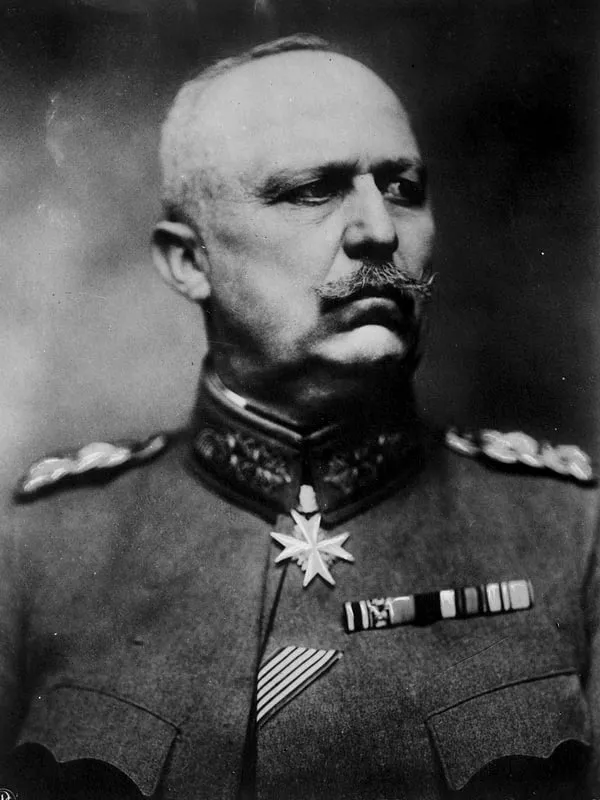
- Born:
- 9 April 1865, Kruszewnia near Poznań
- Died:
- 20 December 1937, Munich
- Author:
- Łukasz Skowroń
- Photo:
- Alexander Binder, domena publiczna, Wikimedia Commons

Erich Ludendorff was Germany’s most powerful soldier in the First World War. He made his name in the first week of the war at Liège, and then, as chief of staff to Paul von Hindenburg, led the German army to victories over the Russians at Tannenberg and at the Masurian Lakes. From August 1916, as First Quartermaster General, he effectively directed the whole German war effort, and increasingly the policy of the Reich as well. He was exceptionally hard-working and a master of staff craft, but he lacked political judgement and restraint. In the spring of 1918 he staked everything on the great offensives in the west, and when he lost, he himself demanded an armistice, only to blame the politicians for the defeat afterwards. After the war he became one of the leaders of the far right and a herald of the stab-in-the-back myth.
Before the war
He was born on 9 April 1865 in Kruszewnia near Swarzędz, into the family of a landowner of merchant origin and without a noble title. In the Prussian army, where the senior posts were usually held by the nobility, he was therefore an outsider who owed everything to hard work. He graduated from the cadet corps at Lichterfelde, was commissioned as an infantry second lieutenant in 1882, and after the War Academy joined the Great General Staff. From 1904 he worked in the mobilisation and operations section, and from 1908 he headed it. He was one of the closest collaborators of the Chief of Staff, Helmuth von Moltke, and helped to shape the changes to the plan for war with France, including the plan to seize the fortress of Liège quickly.
Ludendorff believed that the army was too small for a war on two fronts. Contrary to the custom that required staff officers to keep out of politics, he worked with nationalist organisations and pressed the Reichstag to approve a large expansion of the army. The law of 1913 brought much of what he wanted, but he himself was sent back to line service as commander of a fusilier regiment in Düsseldorf. He saw this as a punishment for his obstinacy. In April 1914 he was promoted to major general and took command of a brigade in Strasbourg.
Liège and Tannenberg
On mobilisation Ludendorff became deputy chief of staff of the 2nd Army and accompanied the brigades which, after the entry into Belgium, were to break through between the forts of Liège into the city on the night of 5–6 August 1914. When the commander of the 14th Brigade was killed, Ludendorff took command and led it into the city, and on 7 August he took the citadel. According to accounts, he drove up to its gate in a car and demanded its surrender. The forts held out for several more days, but Ludendorff became “the hero of Liège” and was one of the first officers of the war to receive the Pour le Mérite.
Two weeks later the General Staff needed an energetic officer in East Prussia, where the commander of the 8th Army had lost his nerve after a clash with the Russians. On 22 August Ludendorff became chief of staff of the 8th Army, with the retired general Paul von Hindenburg as its commander. They met at night on the train to Marienburg. They adopted a plan prepared by Lieutenant Colonel Max Hoffmann and in the Battle of Tannenberg surrounded and destroyed the army of Alexander Samsonov, and in September, in the Battle of the Masurian Lakes, drove the army of Paul von Rennenkampf out of East Prussia. Ludendorff was the operational brain behind these victories, although at critical moments of the Battle of Tannenberg he had moments of doubt, which Hindenburg’s calm overcame.
On the Eastern Front
In the autumn of 1914 the Hindenburg–Ludendorff partnership led the 9th Army to the Vistula, suffered a defeat at Warsaw and Dęblin, and in November struck at the Russians in the Battle of Łódź. Hindenburg became Commander-in-Chief in the East, and Ludendorff, promoted to lieutenant general, remained his chief of staff. Both were convinced that the war could be decided in the east by great encircling manoeuvres, and from the winter of 1914/1915 they waged open war against the Chief of the General Staff, Erich von Falkenhayn. In January 1915 Falkenhayn tried to split the pair by sending Ludendorff to be chief of staff of the new South Army in the Carpathians, but after Hindenburg intervened with the Kaiser, Ludendorff returned a few weeks later.
In February 1915, in the Winter Battle of Masuria, the Germans shattered the Russian 10th Army but failed to encircle it completely. In the summer Ludendorff proposed a deep thrust through Kovno and Vilna into the rear of the Russian forces withdrawing from Poland. Falkenhayn refused, and when the Germans attacked at Vilna in September, the Russians managed to withdraw. Ludendorff admitted that he positively hated Falkenhayn, and for the rest of his life he believed that Falkenhayn had squandered the chance to defeat Russia.
From the autumn of 1915 Ludendorff ran, from Kovno, the administration of occupied Lithuania, Courland and part of Belarus, known as Ober Ost. There he created a military state that was meant to be a model of “German work” in the east: it registered the population, regulated trade and travel, requisitioned food, timber and horses, and sent people to forced labour. In letters from this period he wrote of future German settlement in these lands.
The Third OHL
On 29 August 1916, after Romania entered the war, Kaiser Wilhelm II dismissed Falkenhayn. Hindenburg became Chief of the General Staff of the Field Army, and Ludendorff rejected the title of “second chief of staff” and demanded the post of First Quartermaster General with joint responsibility for all decisions. From then on it was he who ran the staff and issued orders, while Hindenburg represented the army and lent its decisions the weight of his authority.
Ludendorff reorganised the war on an unprecedented scale. In the west an elastic defence in depth was introduced and a new position was built, to which the Germans withdrew in the spring of 1917. The Hindenburg Programme and the Auxiliary Service Law were meant to mobilise the entire economy for war production. Ludendorff also founded a military photography and film office, and in December 1917 the UFA studio was created on his initiative. In the east he supported the Act of 5 November in the hope of Polish recruits, and in 1917 he agreed to Lenin’s journey through Germany to Russia, counting on the Bolsheviks to take Russia out of the war.
The most important political decisions of 1917–1918 were taken under his pressure. Together with the admirals he forced through unrestricted submarine warfare, although he reckoned with the United States entering the war. In July 1917 he and Hindenburg threatened to resign and brought about the fall of Chancellor Theobald von Bethmann Hollweg. His successor, Georg Michaelis, and the chancellors who followed no longer had the strength to stand up to the military. Also forced out were the head of the Kaiser’s civil cabinet and the Foreign Secretary, Richard von Kühlmann, who had dared to say in the Reichstag that the war could not be ended by military means alone. Ludendorff rejected a compromise peace. He sought a victory that would give Germany mastery of Europe, and vast annexations in the east, which the Treaty of Brest-Litovsk largely delivered.
1918
After Russia left the war, Ludendorff for the first time had numerical superiority in the west, but he knew it would disappear once masses of Americans arrived in France. He decided to settle the war in the spring of 1918. On 21 March he struck at the British in Operation Michael, using the new tactics of storm troops and a short, intense artillery bombardment. The Germans advanced several dozen kilometres, the furthest since 1914, but did not break the front enough to separate the British and the French. Asked about the aim of the operation, Ludendorff is said to have replied that he was punching a hole in the front and the rest would follow. Critics see in these words the essence of his mistake: the lack of a strategic objective.
The subsequent blows, on the Lys in April, on the Aisne in May and on the Matz in June, brought territorial gains and enormous losses, but none brought a decision. On 15 July Ludendorff attacked on both sides of Reims, and three days later the French and Americans went over to the counter-offensive in the Second Battle of the Marne. The initiative passed to the Allies. On 8 August the British, Australians, Canadians and French attacked at Amiens, and whole German units surrendered without a fight. Ludendorff called it “the black day of the German Army” and offered the Kaiser his resignation, which was not accepted. At the conference at Spa in mid-August he admitted that the enemy could no longer be forced to make peace by an offensive.
By the end of the summer Ludendorff was exhausted. He worked more than ten hours a day, flew into rages, and his worried colleagues brought a nerve specialist to headquarters. When the Bulgarian front was collapsing at the end of September and the Allies were attacking along the whole Western Front, on 28 September he told Hindenburg that an armistice must be requested at once. The next day both of them put this demand to the Kaiser. Ludendorff also supported the formation of a parliamentary government. He told staff officers that those to whom the army owed its present situation should join the government: “Now let them eat the soup they have cooked for us.”
Dismissal
In October Ludendorff changed his mind. The front was falling back but not disintegrating, and each of President Wilson’s notes was harder than the last. When the note of 23 October in effect demanded capitulation, Ludendorff wanted to break off the talks and fight on. A proclamation to the army that he signed together with Hindenburg called Wilson’s terms unacceptable. Chancellor Max von Baden threatened the resignation of the whole government if the general did not go. On 26 October, at Bellevue Palace, the Kaiser accepted Ludendorff’s resignation, but kept Hindenburg. Ludendorff refused to ride back in the same car as the field marshal and told officers that in two weeks there would no longer be a Kaiser in Germany.
After the war
After the outbreak of the revolution Ludendorff left for Sweden in disguise with a false passport, and there he wrote his memoirs. He returned in February 1919 and soon became one of the chief proponents of the stab-in-the-back myth, according to which the undefeated army had been betrayed by socialists, Jews and other “internal enemies”. In 1920 he took part in the Kapp Putsch, and on 9 November 1923 he marched beside Adolf Hitler at the head of the Beer Hall Putsch. At the trial he was acquitted. From 1924 to 1928 he was a member of the Reichstag for the far right, and in 1925 he stood in the presidential election, winning just over 1 per cent of the vote. The presidency went to his former superior, Hindenburg.
Under the influence of his second wife, Mathilde von Kemnitz, Ludendorff sank ever deeper into conspiracy theories about Freemasons, Jews, Jesuits and the Church, and he fell out with Hitler. He founded the Tannenberg League and his own publishing house. In 1935 he published the book “Der totale Krieg” (“The Total War”), in which he argued that in a future war the whole nation and economy must submit to a military leader. According to many accounts, he refused the rank of field marshal that Hitler wanted to confer on him. He died on 20 December 1937 in Munich. Against his wishes, Hitler gave him a state funeral. He was buried at Tutzing on Lake Starnberg.
Assessment
Historians agree in regarding Ludendorff as an outstanding organiser and tactician. Under his direction the German army revolutionised defence and attack, and the 1918 offensives achieved breakthroughs not seen in the west since 1914. As a strategist he fares much worse. The British historian David Stevenson and many other scholars stress that the spring offensives used up the army’s best forces without a clear aim, and that their failure hastened the Allied victory. In the view of some German historians it was precisely this “all-or-nothing gamble” that ruined an army that could have held out longer on the defensive.
His political role is judged even more harshly. Ludendorff believed that war is waged with all the means of the state and that politics must serve the army. Under his pressure Germany rejected a compromise peace and chose ever riskier courses, from submarine warfare to the Treaty of Brest-Litovsk. Historians still debate whether his demand for an armistice in September 1918 was an outburst of panic by an overworked man or a cold calculation to shift responsibility for the defeat onto parliament. The German historian Gerd Krumeich suggests that Ludendorff was counting only on a temporary ceasefire, after which the army could fight on. Whatever the answer, Ludendorff, who lost the war, did much to ensure that the Germans did not believe it, and the myth he helped to create poisoned the politics of the Weimar Republic.
Sources
Spotted a mistake?Report an error
Commanded in battles
(42)- 4–17 August 1914Battle of LiègeWestern Front
- 23–30 August 1914Battle of TannenbergEastern Front
- 5–15 September 1914First Battle of the Masurian LakesEastern Front
- 28 September – 8 November 1914Battle of Warsaw and DęblinEastern Front
- 7–22 February 1915Winter Battle in MasuriaEastern Front
- 9 September – 2 October 1915Battle of VilnaEastern Front
- 22 February – 5 April 1917German retreat to the Hindenburg LineWestern Front
- 9 April – 16 May 1917Battle of Arras (1917)Western Front
- 16 April – 9 May 1917Nivelle OffensiveWestern Front
- 31 July – 10 November 1917Third Battle of YpresWestern Front
- 21–23 March 1918Battle of St QuentinWestern Front
- 21 March – 5 April 1918Operation MichaelWestern Front
- 24–25 March 1918First Battle of BapaumeWestern Front
- 28 March 1918First Battle of Arras (1918)Western Front
- 4 April 1918Battle of the AvreWestern Front
- 5 April 1918Battle of the Ancre, 1918Western Front
- 9–29 April 1918Battle of the LysWestern Front
- 9–11 April 1918Battle of EstairesWestern Front
- 12–15 April 1918Battle of HazebrouckWestern Front
- 13–15 April 1918Battle of BailleulWestern Front
- 17–19 April 1918First Battle of Kemmel RidgeWestern Front
- 24–25 April 1918Battle of Villers-BretonneuxWestern Front
- 25–26 April 1918Second Battle of Kemmel RidgeWestern Front
- 29 April 1918Battle of the ScherpenbergWestern Front
- 27 May – 6 June 1918Third Battle of the AisneWestern Front
- 9–14 June 1918Battle of the MatzWestern Front
- 15 July – 6 August 1918Second Battle of the MarneWestern Front
- 20–31 July 1918Battle of the TardenoisWestern Front
- 23 July – 2 August 1918Battle of the Soissonnais and of the OurcqWestern Front
- 8–11 August 1918Battle of AmiensWestern Front
- 8–15 August 1918Battle of MontdidierWestern Front
- 8 August – 11 November 1918Hundred Days OffensiveWestern Front
- 17–29 August 1918Second Battle of NoyonWestern Front
- 18 August 1918Battle of Outtersteene RidgeWestern Front
- 21–23 August 1918Battle of Albert (1918)Western Front
- 21 August – 3 September 1918Second Battle of the SommeWestern Front
- 26–30 August 1918Battle of the Scarpe (1918)Western Front
- 31 August – 3 September 1918Second Battle of BapaumeWestern Front
- 2–3 September 1918Battle of the Drocourt–Quéant LineWestern Front
- 12 September – 12 October 1918Battles of the Hindenburg LineWestern Front
- 26 September – 11 November 1918Meuse–Argonne offensiveWestern Front
- 27 September – 1 October 1918Battle of the Canal du NordWestern Front
Mentioned in battles
(30)- Battle of Łódź
- Battle of Bolimów
- Battle of the Narew and Biebrza
- Second Battle of Przasnysz
- Siege of Kovno
- Siege of Novogeorgievsk
- Battle of Verdun
- Battle of the Somme
- Battle of the Transloy Ridges
- Battle of the Ancre Heights
- First Offensive Battle of Verdun
- Battle of the Ancre
- Battle of Vimy Ridge
- Battle of Mărăști
- Battle of Mărășești
- Battle of Langemarck (1917)
- Second Offensive Battle of Verdun
- Battle of Riga
- Battle of Polygon Wood
- Battle of Broodseinde
- Battle of Poelcappelle
- Operation Albion
- First Battle of Passchendaele
- Battle of La Malmaison
- Operation Faustschlag
- Battle of Noyon
- Battle of Rosières
- Second Battle of the Piave
- Battle of Kortrijk
- Battle of the Selle
Often appears with
People who appear in the same events.
On the timeline
(107)The 40 most important of 107 events. All tagged “Erich Ludendorff” (38) →
1914
1916
1917
January
April
- 09
- Key eventBattle of Arras (1917) beginsOn Easter Monday, 9 April 1917, the British and Canadians attacked at Arras. In one day they advanced 5 km and took thousands of prisoners.
- Key eventAssault on Vimy RidgeOn 9 April 1917, in a snowstorm, four Canadian divisions attacked Vimy Ridge. By evening they held almost all of it except the highest point, Hill 145.
August
September
October
November
1918
March
April
May
June
July
August
- 08
- Key eventBattle of Amiens beginsOn 8 August 1918, in fog, Canadians, Australians and tanks broke the front at Amiens, taking over 15,000 prisoners. Ludendorff called it the "black day".
- Key eventStart of the Battle of MontdidierOn 8 August 1918 Debeney's French First Army attacked alongside the British at Amiens. It took Moreuil and crossed the Avre, but did not reach Arvillers.