1918: The Allied counter-offensive
Second Battle of Bapaume
- Dates:
- 31 August – 3 September 1918
- Front:
- Western Front
- Location:
- The heights east and south-east of Bapaume, from Bullecourt and Vaulx-Vraucourt through Bancourt, Frémicourt, Beaulencourt, Le Transloy, Morval and Sailly-Saillisel to Mont Saint-Quentin and Péronne on the Somme, Pas-de-Calais and Somme departments (France)On the battle map →
- Sides:
- United Kingdom, New Zealand and AustraliaDouglas Haig, Julian Byng, Henry Rawlinson, George Harper, Cameron Shute, John Monash
- Result:
- British victory. The Third Army drove the Germans from their positions east of Bapaume, and the Australians of the Fourth Army took Mont Saint-Quentin and Péronne. Together with the breaking of the Drocourt–Quéant Line this forced the Germans to retreat behind the Canal du Nord, towards the Hindenburg Line.
- Author:
- Natalia
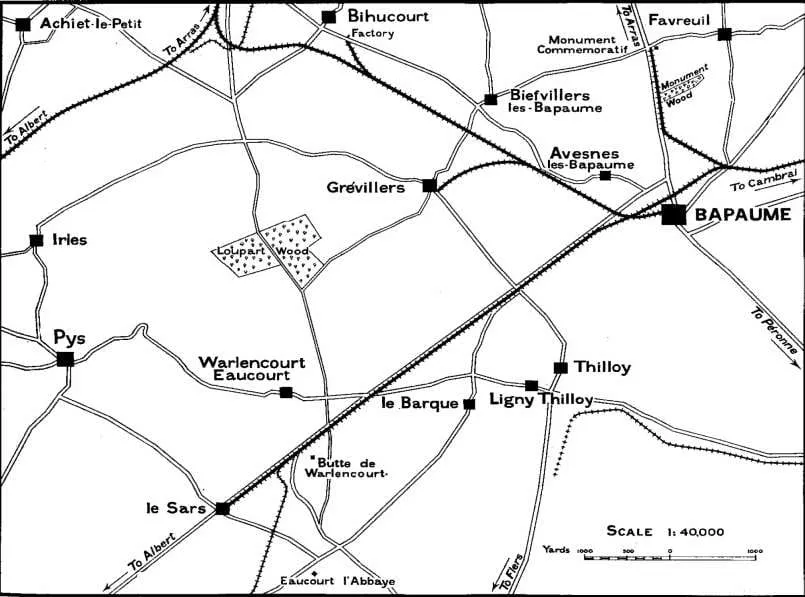
The Second Battle of Bapaume closed the second stage of the great British offensive of the summer of 1918, later called the Hundred Days Offensive. From 21 August the British Third Army of General Julian Byng and the left wing of the Fourth Army had crossed the old Somme battlefield, and on 29 August the New Zealanders entered abandoned Bapaume. The Germans then stood on a new line: along the Somme to Péronne, and further north across the heights near Mont Saint-Quentin, Morval, Le Transloy and Frémicourt. They hoped to hold it, as well as the Drocourt–Quéant Line further north, through the winter. In four days, from 31 August to 3 September, the Australians stormed Mont Saint-Quentin and Péronne, divisions of the Third Army drove the Germans from the ridges beyond Bapaume, and the Canadians broke the Drocourt–Quéant Line. On 2 September the German command decided to retreat to the positions from which its offensive had started in March.
Name and dates
The name “Second Battle of Bapaume” and the dates 31 August – 3 September 1918 were fixed in 1921 by the British Battles Nomenclature Committee. It placed the battle among the Second Battles of the Somme 1918, alongside the Battle of Albert of 21–23 August, and listed the capture of Mont Saint-Quentin and the occupation of Péronne by the Australians as part of it. The committee provided no name for the fighting of 24 and 25 August.
Many sources, however, count the battle differently. A British chronology of the war places its start on 21 August. Field Marshal Douglas Haig in his dispatch of December 1918 called the whole advance of the Third Army and the left wing of the Fourth Army from 21 August to 1 September the “Battle of Bapaume”. The history of the New Zealand Division treats it the same way, and some modern accounts follow them, for example the English Wikipedia, which gives the dates 21 August – 3 September. The British official history considered the committee’s division artificial. Its author, James Edmonds, wrote that the Battle of Albert in fact lasted until 29 August, and that the fighting at the turn of August and September would more aptly be called the Battle of Péronne and Bapaume. On this page we keep to the committee’s dates. The ordinal number distinguishes the battle from the First Battle of Bapaume of 24–25 March 1918, in which the Germans took the town.
Background
After the Battle of Amiens Haig shifted the weight of the attack north of the Somme, where the Germans did not expect an attack and the ground suited tanks. On 21 August the Third Army advanced, and from 23 August the Third and Fourth Armies attacked together on a front of more than 50 kilometres. Within a week they had recovered Albert, Thiepval, Pozières, Miraumont and Grévillers, places that had been fought over for weeks on end in the Battle of the Somme in 1916. On 26 August, further north, the First Army went over to the attack in the Battle of the Scarpe. The same day the German command ordered the front to be shortened. On the night of 28/29 August the Germans fell back behind the Somme south of Péronne, and north of the river gave up Bapaume. East of the town they stood on the Péronne–Morval–Le Transloy–Frémicourt line. According to the British official history, for the first time since 22 August their guns were no longer dispersed for delaying actions but were again concentrated for determined defence.
On 29 August Marshal Ferdinand Foch gathered the Allied commanders and urged them to “continue the pursuit”. Haig ordered the First Army to attack the Drocourt–Quéant Line south of the Scarpe, and the Third and Fourth Armies to pin down the Germans on their sectors. The Third Army was also to push vigorously with its left wing, in close co-operation with the First Army. On the Fourth Army’s sector the commander of the Australian Corps, General John Monash, put forward a bold plan on 30 August: instead of forcing the Somme at Péronne itself, to cross a few kilometres further west and take from the north-west Mont Saint-Quentin, the hill that dominated the town and the crossings. General Henry Rawlinson thought it too daring with such weak forces, but agreed.
Opposite the Third Army still stood the German Seventeenth Army of General Otto von Below, and opposite the Australians and III Corps the Second Army of General Georg von der Marwitz. Both had been reinforced in recent days with fresh divisions, but many of these were already badly depleted.
Course
31 August: Mont Saint-Quentin. The night was pitch dark and units struggled to reach their jumping-off positions. At 5 a.m. the Australian 5th Brigade of the 2nd Australian Division, only 70 officers and 1,250 men strong, left the bridgehead it had seized the previous day east of Cléry and attacked Mont Saint-Quentin. There was no time for a full barrage. According to the official history only about 550 men took part in the assault itself, with two hundred in reserve, yet they took more than 700 prisoners. The attack came as a complete surprise and the Australians took the village of Mont Saint-Quentin and Feuillaucourt. At about 7 a.m., however, a counter-attack by units of the 2nd Guard Division and two other German divisions pushed them back to trenches along the Péronne–Bouchavesnes road. They held on there all day, beating off attacks with grenades, while Monash moved further brigades across the river. On their left the 3rd Australian Division reached the ridge near Bouchavesnes, and the 58th and 47th Divisions of III Corps took Marrières Wood, capturing nearly 400 prisoners. Private George Cartwright of the Australian 33rd Battalion, who single-handedly captured a machine gun and took nine prisoners, received the Victoria Cross.
On the Third Army’s front 31 August was a quieter day. V and IV Corps did not attack, and both sides kept up heavy artillery fire. At about 5 a.m. the Germans attacked the New Zealand Division at Bancourt and Frémicourt. According to the New Zealand history the attack was preceded by a reconnaissance by three or four tanks, which did not attack, however, and turned back. German regimental histories write that the tanks meant for this attack did not arrive in time. The Germans pushed the New Zealanders back a few hundred metres, but machine-gun fire and guns firing over open sights stopped them. At about 7 a.m. the New Zealanders recovered the lost positions, and two groups of about 50 Germans each that had got into their rear were taken prisoner or broken up. The withdrawing tanks were mistakenly fired on by German riflemen, and two of them got stuck and fell into New Zealand hands on 2 September. On the army’s left wing VI Corps took Écoust-Saint-Mein and Longatte for the second time, and XVII Corps retook most of Bullecourt.
1 September. The Australians took the positions on Mont Saint-Quentin and north of it, and almost all of Péronne. On the Third Army’s front, V Corps of General Cameron Shute began with a night attack by the 21st Division on Beaulencourt, which surprised the Germans and brought in 126 prisoners at a cost of five killed and fifty wounded. At 4.45 a.m. the Welsh 38th Division took Morval, and in the evening, together with the 18th Division of the Fourth Army, Sailly-Saillisel. The British official history calls this a long and hard day for the 38th Division. The 17th Division’s attack on Le Transloy failed. In General George Harper’s IV Corps the New Zealanders advanced at 4.55 a.m., under a barrage from seven artillery brigades, onto the ridge beyond Bancourt. The Victoria Cross was won there by Sergeant John Grant of the 1st Wellington Battalion, who took three machine-gun nests in turn. VI Corps cleared Vaulx-Vraucourt, and XVII Corps took Bullecourt and Hendecourt, and during the night Riencourt-lès-Cagnicourt with 380 prisoners. Haig regarded 1 September as the end of the second stage of the offensive.
2 September. The Canadian Corps of the First Army broke the Drocourt–Quéant Line, and divisions of the Third and Fourth Armies advanced along the whole front north of the Somme. In IV Corps the 42nd Division took Villers-au-Flos, and the 5th Division surrounded Beugny on three sides. The 17th Division entered abandoned Le Transloy, where it found more than 30 machine guns and trench mortars but only two Germans, and in the evening took Rocquigny. At about noon the German command, driven from the line it had meant to hold through the winter and threatened on the northern flank of the Somme line, decided to retreat about 25 kilometres, to the positions held before the March offensive.
3 September. The Germans withdrew during the night of 2/3 September, in stages, starting from the northern wing. The night was very dark, and only at dawn did it become clear that along the whole front from the Canadians to V Corps the enemy had vanished. In the morning airmen confirmed the retreat, and at 10.08 a.m. Byng ordered the corps to pursue the Germans with strong advanced guards of all arms. On the left wing the 63rd (Royal Naval) Division occupied abandoned Quéant and Pronville and came up to the Canal du Nord, where it met German machine guns on the western bank of the canal, which was dry at that point.
Casualties
The British official history gives no separate tally of losses for these four days. Haig stated in aggregate that from 21 August to 1 September 23 British divisions of the Third and Fourth Armies took more than 34,000 prisoners and 270 guns. According to the history of the New Zealand Division, IV Corps lost more than 600 officers and almost 11,000 other ranks in the same period, the New Zealand Division alone about 400 killed and about 1,850 wounded. On the German side some regiments shrank to a single battalion, and battalions to two companies.
Significance
The battle ended the struggle for the Somme line. The capture of Mont Saint-Quentin and Péronne by the Australians, in which Rawlinson had not at first believed, deprived the Germans of their hold on the river, and the Third Army’s advance onto the heights beyond Bapaume, together with the Canadians’ breaking of the Drocourt–Quéant Line, dashed the hope of wintering quietly in front of the Hindenburg Line. The Germans had to fall back faster than they intended, to the positions from which they had set out for Amiens in March.
For the British army it was further proof of change. The New Zealand history stresses that the German rearguards, with well-sited machine guns, defended themselves stubbornly and allowed most of the guns to be withdrawn. The British official history notes, however, that in open fighting British troops now had a clear advantage over the Germans, even when outnumbered, and that their artillery was stronger and better supplied. Older soldiers were surprised at how easily they crossed ground whose capture in 1916 had cost months of fighting and heavy losses.
Spotted a mistake?Report an error