Germany · The Central Powers
Georg von der Marwitz
Commander of II Cavalry Corps (1914), the Beskiden Corps (1915), the Second Army (1916–1918) and the Fifth Army (1918), general of cavalry
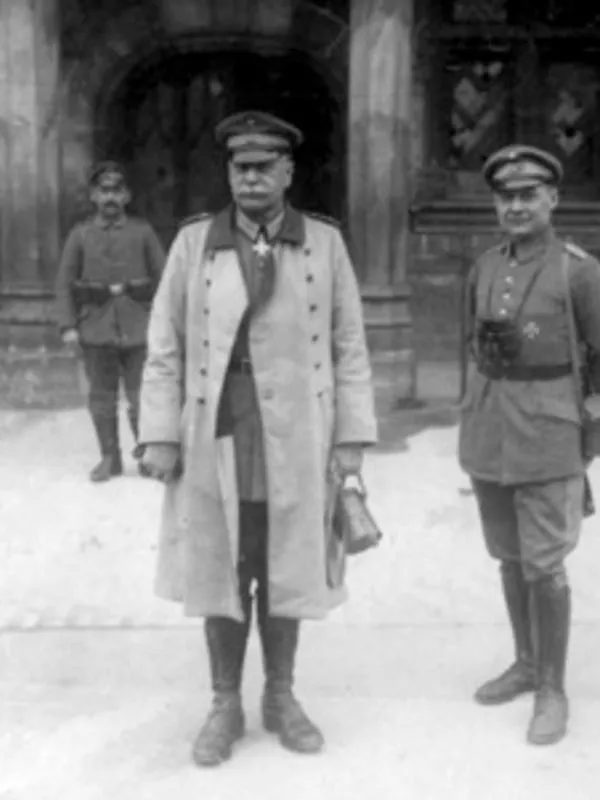
- Born:
- 7 July 1856, Nożynko (Klein Nossin) near Słupsk
- Died:
- 27 October 1929, Unichowo (Wundichow) in Pomerania
- Author:
- Natalia
- Photo:
- autor nieznany, domena publiczna, Wikimedia Commons

Georg von der Marwitz was one of the last great cavalrymen of the Prussian army and one of the few German generals who held commands on both fronts in every phase of this war. In August 1914 he led a cavalry corps ahead of the armies marching through Belgium on Paris; in 1915 he fought in the Carpathians and in Galicia; and from the end of 1916 he commanded the Second Army on the Somme. His name is linked with two battles in which British tanks played the leading role: Cambrai in November 1917, where after the initial surprise he managed to recover most of the lost ground, and Amiens on 8 August 1918, the day Ludendorff called the black day of the German army.
Before the war
He came from an old noble family of the Neumark. He was born on 7 July 1856 (according to some sources on 3 July) on his father’s estate at Klein Nossin, today Nożynko, in the former district of Stolp (Słupsk) in Pomerania. In 1875, after the cadet corps in Potsdam, he became a second lieutenant in the 2nd Guards Uhlan Regiment in Berlin. In 1881 he married a daughter of the then Prussian Minister of War, General Georg von Kameke. In 1883–1886 he studied at the War Academy, and then served alternately on the staff and in the cavalry. He commanded the 3rd Guards Uhlan Regiment, was chief of staff of XVIII Corps and commander of the 1st Guards Cavalry Brigade. In 1911 he took over the 3rd Infantry Division, and in 1912 he became Inspector General of Cavalry, that is, the foremost specialist in this arm in the Prussian army. He was a musical man and for a time sang in the Berlin Sing-Akademie.
1914: cavalry in the west
On the outbreak of war the inspectorate general ceased to exist, and Marwitz took over II Cavalry Corps, three cavalry divisions which were to reconnoitre the way ahead of the right wing of the German armies. On 12 August his horsemen, charging again and again against the Belgian positions, were repulsed by Belgian cavalry fighting dismounted, supported by infantry and machine guns, in the Battle of Halen. At the end of August his divisions covered the march of the First Army of General Alexander von Kluck, and on 26 August at Le Cateau they were among the first to strike the British II Corps. Their patrols approached Lille, which in the city itself gave rise to rumours that it had been occupied.
After the Battle of the Marne Marwitz’s corps took part in the Race to the Sea. In October it tried to break through between La Bassée and Armentières, but was stopped by the French cavalry. Once the front had frozen into trenches, large cavalry formations lost their purpose, and in December 1914 the corps was disbanded.
1915–1916: in the east
At the turn of 1914 and 1915 Marwitz took over the newly formed XXXVIII Reserve Corps, which in February 1915 fought in the Winter Battle in Masuria. Immediately afterwards the corps was moved to the Carpathians to help Austria-Hungary. As the Beskiden Corps it took up position at the turn of March and April on the Laborec, where after the fall of Przemyśl the Russians were trying to cross the mountains into Hungary. With counter-attacks in the snow it stabilised the front in the Winter Battle in the Carpathians. As early as 7 March, after the fighting in Masuria, he had received the Pour le Mérite, and in May the oak leaves to it.
After the breakthrough at Gorlice the Beskiden Corps advanced through Galicia in the offensive: in June at Przemyśl and at Lviv, in July in the new Bug Army in the battles of Masłomęcz and Grabowiec in the Lublin region. In the autumn of 1915 Marwitz fell seriously ill and had to interrupt his service for several weeks. On his return he took over VI Corps on the Western Front.
In the summer of 1916 he was summoned to the east again. After the Austro-Hungarian front in Volhynia had been broken by the Brusilov offensive, General Alexander von Linsingen entrusted him with a force which at the end of June counter-attacked the Russian salient towards Lutsk. Marwitz’s group did not recover the city, and in mid-July the Russians pushed it back to the Lipa. In October 1916 Marwitz became adjutant general to Kaiser Wilhelm II.
1917: Cambrai
On 17 December 1916 he took over the Second Army on the Somme, in the army group of Crown Prince Rupprecht of Bavaria. In the spring of 1917 his troops withdrew to the Hindenburg Line, devastating the ground they gave up. For most of the year the Second Army’s sector at Cambrai was regarded as quiet and was thinly held.
On 20 November 1917 the British attacked there without an artillery preparation, with several hundred tanks. Although two days earlier British prisoners had revealed that an attack was being prepared, the Second Army command did not expect an attack on such a scale, and on the front of the attack there were in effect only two divisions with little artillery. The British penetrated several kilometres, and for a few days it seemed that a breakthrough would follow. The Germans, however, brought up reinforcements by rail, held the Bourlon ridge, and on 30 November the Second Army struck from two sides at the flanks of the British salient. After a short bombardment with gas, infantry in small storm groups, supported by low-flying aircraft, penetrated deep into the British lines. By 7 December the Battle of Cambrai had ended roughly where it had begun. For the British it was a disappointment; for the Germans, proof that storm-troop methods worked in the west as well.
1918: from Michael to Amiens
In Operation Michael the Second Army attacked in the centre, towards Péronne. On 21 March 1918 it broke through the British lines, and a few days later took Bapaume and Péronne. Marwitz reported that the enemy was beaten wherever he had been met, but his troops advanced ever more slowly across the ruined battlefield of the Somme. The further attacks on Amiens, on the Avre on 4 April and at Villers-Bretonneux on 24 April, where tanks fought each other for the first time in history, broke down against the defence of the Australians and the British. On 4 July the Australians of General John Monash took Hamel.
By the summer the Second Army was exhausted. Marwitz considered only two of his divisions fully fit for battle, and the trenches south of the Somme were shallow and poorly wired. On 8 August the British Fourth Army, with Canadians and Australians, attacked in fog with hundreds of tanks. In the Battle of Amiens the Second Army’s front gave way within a few hours, and thousands of soldiers surrendered without a fight. The Supreme Army Command looked for culprits in the Second Army command, especially its chief of staff, General Erich von Tschischwitz. The Second Army was placed under a new army group of General Max von Boehn. At the end of August and the beginning of September it fell back under the pressure of the British and the Australians, who took Mont Saint-Quentin and Péronne, all the way to the Hindenburg Line.
Verdun and the end of the war
On 22 September 1918 Marwitz moved to the Fifth Army at Verdun, in the army group of General Max von Gallwitz. A few days later the Americans and the French began the Meuse–Argonne offensive. Marwitz’s troops, anchored on the Argonne forest and the hills above the Meuse, inflicted heavy losses on the Americans for several weeks. In his diary he wrote that the soldiers were paralysed by fear of the tanks more than by their actual strength. At the beginning of November, however, the Americans broke through his front, and the Germans began to fall back behind the Meuse. After the armistice he led his troops home. On 20 November he rode at their head through Luxembourg.
After the war
In December 1918 he left the army and withdrew from public life. He settled on his inherited estate of Wundichow, today Unichowo in Kashubia, and died there on 27 October 1929. His wartime letters were published in 1940 by Tschischwitz.
Assessment
Marwitz was a typical representative of the Prussian military elite: an experienced and energetic commander who won recognition both in the east and in the west. In 1915 his Beskiden Corps was one of the formations that saved Austria-Hungary from collapse in the Carpathians. The counter-attack at Cambrai ranks among the best-executed German operations of 1917.
British and Australian historians, however, remember him mainly as a defeated commander. At Cambrai he let himself be surprised, although he had indications of the enemy’s preparations (for several days, though, fog hampered aerial reconnaissance), and at Amiens he commanded an army whose weakness he knew but could not remedy, while after the defeat Ludendorff refused to allow a withdrawal behind the Somme. The German high command looked for those to blame for the defeat of 8 August in his army’s staff, but the real cause was the exhaustion of the troops after the spring offensives and the Allies’ superiority in tanks, aircraft and artillery. Marwitz, a cavalryman by training, witnessed the end of an era in which cavalry decided the fate of battles, and the beginning of a new one in which machines decided it.
Sources
Spotted a mistake?Report an error
Commanded in battles
(21)- 26 August 1914Battle of Le CateauWestern Front
- 23 January – 15 April 1915Winter Battle in the CarpathiansEastern Front
- 17–22 June 1915Recapture of LvivEastern Front
- 22 February – 5 April 1917German retreat to the Hindenburg LineWestern Front
- 20 November – 7 December 1917Battle of CambraiWestern Front
- 21–23 March 1918Battle of St QuentinWestern Front
- 21 March – 5 April 1918Operation MichaelWestern Front
- 24–25 March 1918First Battle of BapaumeWestern Front
- 26–27 March 1918Battle of RosièresWestern Front
- 4 April 1918Battle of the AvreWestern Front
- 5 April 1918Battle of the Ancre, 1918Western Front
- 24–25 April 1918Battle of Villers-BretonneuxWestern Front
- 4 July 1918Battle of HamelWestern Front
- 8–11 August 1918Battle of AmiensWestern Front
- 8–15 August 1918Battle of MontdidierWestern Front
- 21–23 August 1918Battle of Albert (1918)Western Front
- 21 August – 3 September 1918Second Battle of the SommeWestern Front
- 31 August – 3 September 1918Second Battle of BapaumeWestern Front
- 12 September – 12 October 1918Battles of the Hindenburg LineWestern Front
- 18 September 1918Battle of ÉpehyWestern Front
- 26 September – 11 November 1918Meuse–Argonne offensiveWestern Front
Mentioned in battles
(02)Often appears with
People who appear in the same events.