1918: The Allied counter-offensive
Battles of the Hindenburg Line
- Dates:
- 12 September – 12 October 1918
- Front:
- Western Front
- Location:
- The Hindenburg Line zone and its outpost area from the Canal du Nord and the Sensée marshes west of Cambrai through Havrincourt, Épehy, Bellicourt and Bellenglise to the Saint-Quentin area, departments of Pas-de-Calais, Nord and Aisne (France)On the battle map →
- Sides:
- United Kingdom (with Canada, Australia and New Zealand), United States and FranceFerdinand Foch, Douglas Haig, Julian Byng, Henry Rawlinson, Henry Horne, Arthur Currie, John MonashGerman EmpireErich Ludendorff, Rupprecht, Crown Prince of Bavaria, Max von Boehn, Otto von Below, Georg von der Marwitz
- Result:
- Allied victory. The British First, Third and Fourth Armies broke through the whole Hindenburg Line between Cambrai and Saint-Quentin and came out into open country. The Germans lost Cambrai and fell back to the Selle, and their high command demanded an armistice.
- Author:
- Natalia
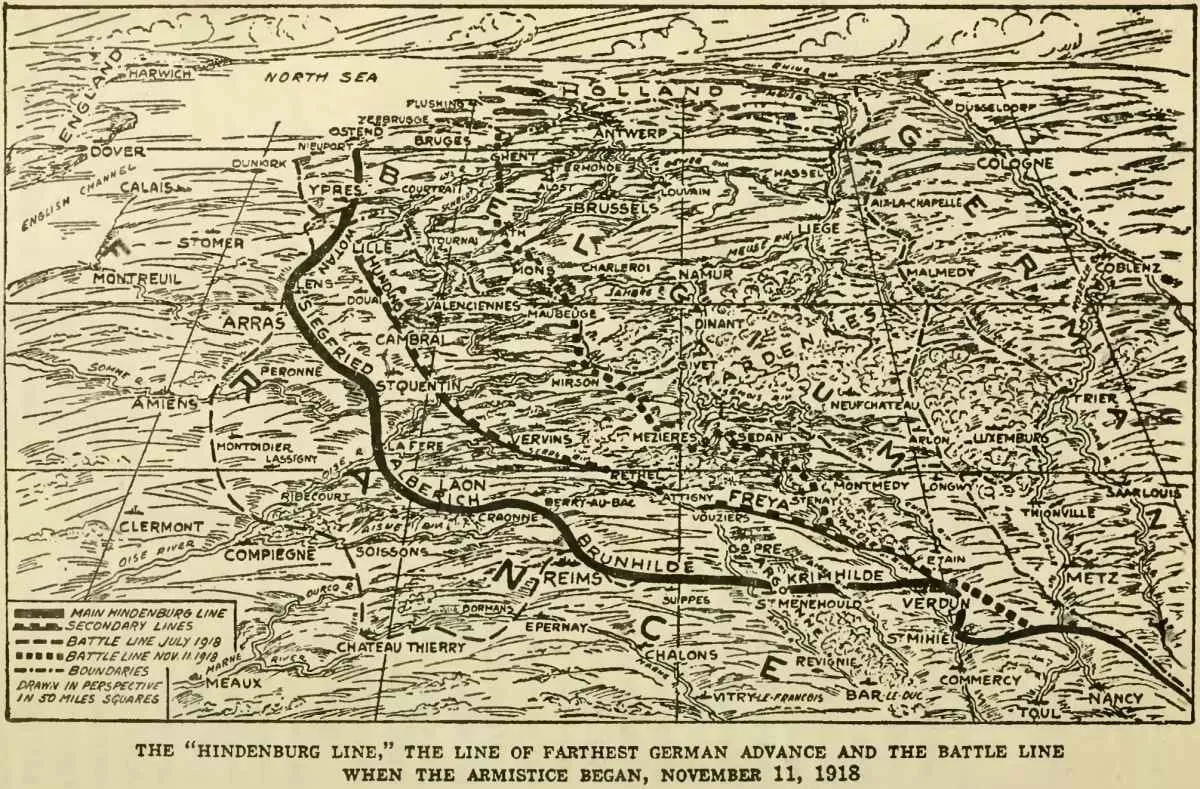
The Battles of the Hindenburg Line is the British name for a series of attacks in which, in the autumn of 1918, the British First, Third and Fourth Armies, and with them Canadians, Australians, New Zealanders and two American divisions, captured the strongest German position on the Western Front. The Hindenburg Line, which the Germans called the Siegfriedstellung, had been under construction since the autumn of 1916 and was regarded as almost impregnable. First, on 12 and 18 September, the British drove the Germans out of its outpost zone at Havrincourt and Épehy. At the end of September, as part of the great Allied offensive along the whole front, they broke through it on the Canal du Nord and on the St Quentin Canal, and at the beginning of October they took the last line behind it and occupied Cambrai. The defeat on this position was one of the reasons why the German Supreme Army Command demanded an immediate armistice from the government.
Name and dates
The British Battles Nomenclature Committee distinguished “the Battles of the Hindenburg Line” and dated them 12 September – 12 October 1918. It counted six battles among them: Havrincourt (12 September), Épehy (18 September), the Canal du Nord (27 September – 1 October), the St Quentin Canal (29 September – 2 October), the Beaurevoir Line (3–5 October) and Cambrai (8–9 October), as well as the pursuit to the river Selle (9–12 October). James Edmonds’s British official history notes that the fighting at Havrincourt and Épehy was only a preparation for the main attack. During the war Haig’s General Headquarters called the whole operation “the battle of Cambrai and St Quentin”, and Field Marshal Douglas Haig, in his despatch of December 1918, described separately “the battle of Havrincourt and Épehy” (12–18 September) and “the battle of Cambrai and the Hindenburg Line” (27 September – 5 October).
This page keeps to those dates. Edmonds points out that the boundaries between the battles are arbitrary: the Germans had already abandoned the line at Cambrai on the night of 8–9 October, so in his view that day too should rather be counted as part of the pursuit than of the Battle of Cambrai. The main sources for this page are volumes IV and V of the British official history (Military Operations France and Belgium 1918) and Haig’s despatches.
The Hindenburg Line
The Germans built the Siegfriedstellung in the autumn and winter of 1916, and in the spring of 1917 they fell back onto it from the Somme and the Ancre. The position was not a single line of trenches but a belt of fortifications which, according to Haig’s despatch, was from 6 to 9 kilometres deep. In the north, between Arras and Havrincourt, it rested on the Canal du Nord, and in the south on the St Quentin Canal, which the British also called the Scheldt Canal. Here the canal ran through deep cuttings, in places almost 20 metres deep, and between Bellicourt and Vendhuile it passed through a tunnel about 5.5 kilometres long. The Germans dug shelters into the sides of the cuttings and hid concrete machine-gun posts there, and reserves were quartered in the tunnel, connected by shafts to the trenches on the surface. In front of the canal ran two heavily wired trench lines, behind it the Hindenburg Line proper, a double line, and about 3.7 kilometres further on a second double line, the Beaurevoir–Fonsomme Line, with concrete shelters. In the outpost zone the Germans held the old British line of 1917, with villages turned into fortresses, such as Épehy and Le Verguier.
In November 1917 the British broke through this position at Cambrai, but a German counter-attack took back most of their gains. In March 1918 the German armies set out from the Hindenburg Line on their great offensive, and half a year later they had to return to it.
Background
After the Battle of Amiens in August 1918 the Allies were attacking on an ever longer front. The British Third and Fourth Armies retook the old Somme battlefield, and on 2 September the Canadians broke through the Drocourt–Quéant Line near Arras. The German command then ordered the armies to withdraw to the positions held before the March offensive. By 8 September the Germans stood on the line Vermand–Épehy–Havrincourt and further along the Canal du Nord. Facing the British were the 17th Army of General Otto von Below, from the army group of Crown Prince Rupprecht of Bavaria, and the 2nd Army of General Georg von der Marwitz, from the army group of General Max von Boehn. Edmonds quotes the account of Boehn’s chief of staff, who warned Ludendorff that the Hindenburg Line had been badly neglected, had little wire, and that the troops were in such a state that it could not be held for long. He proposed a withdrawal straight away to the much shorter Antwerp–Meuse line. Ludendorff refused.
On 3 September Marshal Ferdinand Foch issued his plan for further operations. The British were to attack in the general direction of Cambrai and Saint-Quentin, the French centre was to push the Germans back beyond the Aisne and the Ailette, and the Americans were first to eliminate the Saint-Mihiel salient and then, together with the French Fourth Army, to strike between the Meuse and the Argonne towards Mézières. In time an attack by Belgian, British and French troops in Flanders was added. Four great blows were to fall on the Germans one after another, so that they could not shift their reserves. The watchword of this offensive became the words attributed to Foch, “Tout le monde à la bataille!” (“Everyone into battle!”).
For Haig the decision was not easy. His armies had been fighting without a break since 8 August and, although their losses were small in relation to their gains, in total they were heavy. On 1 September the Chief of the Imperial General Staff, General Henry Wilson, warned him in a confidential telegram that the War Cabinet would be anxious if the army suffered heavy losses in an unsuccessful attack on the Hindenburg Line. Haig later wrote that a failed assault on so well known a position would have raised the flagging morale of the German army and people. He was, however, convinced that the British attack was the most important part of Foch’s plan and that the moment was favourable. During a visit to London in the first half of September he argued that the war had changed its character and that a decision might come very quickly.
Course of the battles
The outpost zone, 12–26 September. On 12 September, the day of the American attack at Saint-Mihiel, the Third Army of General Julian Byng took, in the Battle of Havrincourt, the village of Havrincourt and Trescault, advanced bastions of the Hindenburg Line. On 18 September at 7 a.m., in pouring rain, the Fourth Army of General Henry Rawlinson and the right wing of the Third Army attacked on a front of about 27 kilometres from Holnon to Gouzeaucourt. In the Battle of Épehy the Australians of the 1st and 4th Divisions took the old British outpost line and reached the heights from which the main position could be seen, and III Corps cleared Épehy after heavy fighting. The French First Army on the right flank hardly attacked at all. According to Haig, between 12 and 18 September fifteen British divisions defeated twenty German ones and took almost 12,000 prisoners and 100 guns. By 26 September the British had taken the rest of the outpost zone in local attacks.
The Canal du Nord, 27 September – 1 October. On the night of 26–27 September the artillery of all three armies opened fire along the whole front, but in the morning only the First and Third Armies attacked. This was meant to mislead the Germans about the direction of the main blow. At 5.20 a.m. the Canadian Corps of General Arthur Currie crossed a dry stretch of the Canal du Nord near Mœuvres on a narrow front and then fanned out to the north and east. By evening the Canadians had taken Bourlon and Bourlon Wood, which had been bitterly fought over in 1917, and the divisions of the Third Army crossed the canal further south and took Ribécourt and Flesquières. On the first day more than 10,000 prisoners and 200 guns were taken. In the following days the Canadians, beating off strong counter-attacks, approached Cambrai from the north, and the Third Army crossed the Scheldt Canal at Marcoing and Masnières.
The St Quentin Canal, 29 September – 2 October. The Fourth Army’s attack was preceded by a bombardment from 1,044 field guns and 593 heavy guns, lasting more than two days from the evening of 26 September. On the first night the German batteries and headquarters were drenched with shells of BB gas, almost identical to the German mustard gas. According to many accounts this was the first time the British used this gas. On 29 September at 5.50 a.m., in thick fog, IX Corps, the American II Corps and III Corps attacked on a front of about 19 kilometres. The greatest fame was won by the British 46th Division from the Midlands, whose men, wearing life-jackets, crossed the canal at Bellenglise by swimming, on rafts and over footbridges the Germans had not had time to blow up. That day it took more than 4,000 prisoners and 70 guns. Above the tunnel the American 30th Division took Bellicourt, while the 27th Division, under heavy flanking fire, was held up before Bony and suffered heavy losses. The plan for the Australians to pass through the Americans and carry on did not work: the 3rd and 5th Australian Divisions of General John Monash had to fight their own way to the main line. By 1 October the breach had been widened, and the French First Army occupied Saint-Quentin.
The Beaurevoir Line, 3–5 October. On 3 October the Fourth Army took the last prepared position, the Beaurevoir–Fonsomme Line, on the Sequehart–Le Catelet sector. On 5 October the Australians of the 2nd Division took Montbrehain. The fight for Montbrehain is regarded as the last battle of the Australian infantry in this war. That same day Beaurevoir fell, and the right wing of the Third Army crossed the canal and occupied the Hindenburg Line beyond it. According to Haig, between 27 September and 5 October thirty British and two American divisions and one cavalry division fought thirty-nine German divisions and took more than 36,000 prisoners and 380 guns.
Cambrai, 8–9 October. On 8 October at 4.30 and 5.10 a.m. the Third and Fourth Armies attacked on a front of more than 27 kilometres from Sequehart to south of Cambrai and pushed through unfinished German trenches into open country. The Germans counter-attacked, even with tanks, but by evening their resistance was weakening. At about 2.30 a.m. on 9 October they began to withdraw. Canadian patrols entered Cambrai from the north and met in the town patrols of the British 57th Division coming from the south. By the evening of 9 October the British were about 5 kilometres east of the town and not far from Le Cateau.
The pursuit to the Selle, 9–12 October. From 9 October the Fourth, Third and First Armies followed the retreating Germans across open country, with cavalry helping the advance. On 9 October the British occupied Bohain and approached Caudry, and in the following days they reached the river Selle near Le Cateau. There the Germans stood on the defensive again. On 11 October Haig decided that the Selle line would have to be attacked in an organised assault, and difficulties in bringing up ammunition and food over the railways the Germans had destroyed forced it to be postponed until 17 October. Here the committee ended the Battles of the Hindenburg Line.
Casualties
The British official history does not give casualties separately for the Battles of the Hindenburg Line, only for longer periods. The best-known figures are those for prisoners: according to Haig, almost 12,000 between 12 and 18 September and more than 36,000 between 27 September and 5 October, together with almost 500 guns. The divisions storming the strongest sectors suffered heavily, such as the Canadians in the fighting north of Cambrai and the American 27th Division before Bony.
Significance
Haig wrote in his despatch that the attacks in which his armies crossed the Canal du Nord and broke the Hindenburg Line closed the first stage of the British offensive. The German defence on the last and strongest prepared position had been shattered, and between the British armies and Maubeuge, towards the main German railway lines behind the front, there were no more prepared fortifications, only woods and rivers. The Hermann Line, to which Ludendorff now wanted to withdraw, was only just being built.
The breakthrough coincided with Bulgaria’s defeat on the Macedonian front and with the American and French attack in the Argonne. On the evening of 28 September Erich Ludendorff and Paul von Hindenburg decided to demand an armistice, and on 29 September, the day of the attack on the St Quentin Canal, Ludendorff declared at a conference at Spa that the army’s situation required an immediate armistice. The Germans fought on for more than another month, but the Battles of the Hindenburg Line settled that the war would end in 1918 and not, as the Allies had still assumed in the summer, in 1919.
Spotted a mistake?Report an error
Battles and phases
(06)- 12 September 1918Battle of HavrincourtOn 12 September 1918 Byng's Third Army took Havrincourt and Trescault, outlying bastions of the Hindenburg Line, opening the battles of the Hindenburg Line.
- 18 September 1918Battle of ÉpehyOn 18 September 1918 the British Fourth Army and part of the Third took the outworks of the Hindenburg Line. The Australians went furthest; Épehy fell late.
- 27 September – 1 October 1918Battle of the Canal du NordOn 27 September – 1 October 1918 Currie's Canadians crossed a dry stretch of the Canal du Nord, took Bourlon Wood and closed in on Cambrai.
- 29 September – 2 October 1918Battle of the St Quentin CanalOn 29 September – 2 October 1918 the British Fourth Army, with Americans and Australians, broke through the Hindenburg Line on the St Quentin Canal.
- 3–5 October 1918Battle of the Beaurevoir LineOn 3–5 October 1918 the British Fourth Army took the Beaurevoir Line, the Hindenburg Line's last position. Australians fought their last action at Montbrehain.
- 8–9 October 1918Battle of CambraiOn 8–9 October 1918 the British Third and Fourth Armies, with Americans, broke the last German positions at Cambrai, and the Canadians entered the burning town.