1918: The Allied counter-offensive
Battle of the St Quentin Canal
- Dates:
- 29 September – 2 October 1918
- Front:
- Western Front
- Location:
- The sector of the Hindenburg Line along the St Quentin Canal, from Vendhuile through the tunnel under Bellicourt to Bellenglise and Le Tronquoy, north of Saint-Quentin, Aisne department (France)On the battle map →
- Sides:
- United Kingdom, Australia and United StatesDouglas Haig, Henry Rawlinson, John Monash, Walter Braithwaite, George ReadGerman EmpireMax von Boehn, Adolph von Carlowitz
- Result:
- Allied victory. The Fourth Army broke through the main position of the Hindenburg Line on a front of a dozen or so kilometres, and the 46th Division forced the canal, taking about 4,200 prisoners. By 2 October the British and Australians stood before the Beaurevoir Line, the last position of the system.
- Author:
- Natalia
The Battle of the St Quentin Canal was the most important of the Battles of the Hindenburg Line and one of the decisive engagements of the last months of the war on the Western Front. On the morning of 29 September 1918 the British Fourth Army of General Henry Rawlinson attacked the strongest sector of the German position, where its front moat was formed by the deep St Quentin Canal, while the canal’s underground stretch beneath Bellicourt served the Germans as a gigantic shelter. The attack over the tunnel, entrusted to two inexperienced American divisions and two Australian ones, stalled in bloody fighting for the outpost positions. Success came where it was least expected: in the fog the British 46th Division ran down to the canal, crossed the water on lifebelts taken from the cross-Channel ferries, captured the bridge at Riqueval intact and by the afternoon had taken more than four thousand prisoners. Within four days the Fourth Army took the main position and the support position of the Hindenburg Line on a front of a dozen or so kilometres and stood before its last line, at Beaurevoir.
Name and dates
The British Battles Nomenclature Committee distinguished the “Battle of the St Quentin Canal” (Battle of the St. Quentin Canal) of 29 September – 2 October 1918 as part of the Battles of the Hindenburg Line. The British official history adopts the same dates. The fighting for the last German position, from 3 to 5 October, was named separately by the committee as the Battle of the Beaurevoir Line. Some accounts, including the English-language Wikipedia, extend the battle to 10 October, combining it with the fighting at Beaurevoir and with the Battle of Cambrai. The attack across the canal at Bellenglise is sometimes called the Battle of Bellenglise, and the attack of the Americans and Australians the Battle of the Bellicourt Tunnel. Times are given according to British sources.
The canal and the tunnel
The St Quentin Canal, opened in 1810, links the basins of the Somme and the Oise with the Scheldt. From Saint-Quentin it runs north, and between Bellicourt and Vendhuile it passes under the hills through a tunnel about 5.7 km long, called the Riqueval tunnel by the French and the Bellicourt tunnel by the British. When in 1916–1917 the Germans built the Siegfriedstellung, to which they withdrew in the spring of 1917, they incorporated the canal into their defences. South of the tunnel, at Bellenglise and Riqueval, it ran in a cutting with steep sides, in places fifteen metres high. The channel was about 10 m wide, its walls faced with brick to a height of about three metres, and barbed wire was strung in the water and on the banks. The main German line ran behind the canal, while in front of it, on the western bank, the Germans also had a line of trenches and machine-gun nests covering the crossings. The British official history compared the canal to the moat of a fortress.
Above the tunnel the canal was no obstacle, so here the Germans built their strongest defences: five lines of trenches, each behind several belts of wire. The tunnel itself, connected to the trenches by galleries, was a shelter for reserves safe from shellfire. According to Monash, the Germans had brought dozens of barges into it, which served as quarters and stores. Behind the main position ran two more: the support position, called by the British the Le Catelet–Nauroy Line, and the reserve position, later named the Beaurevoir Line. At the end of September both were weaker, often single trenches with unfinished wire.
Background
In the spring of 1918 the Germans had come out of these positions to launch their offensive and in the fog pushed back from Saint-Quentin the British Fifth Army. After the Battle of Amiens and the Second Battle of the Somme they were returning to them under Allied pressure. In September the British Fourth Army, advancing across the old British lines of March, took in the Battle of Épehy on 18 September most of the German outpost line in front of the Hindenburg Line. At the end of September Marshal Ferdinand Foch threw all the Allied armies into the attack in turn, day after day: on 26 September the Americans and French began the Meuse–Argonne offensive, on 27 September the British First and Third Armies struck across the Canal du Nord towards Cambrai, and on 28 September the Belgians and British set off in Flanders. The Fourth Army was to strike last, on 29 September, in the centre of the line.
Facing it stood the German Second Army, which at the end of September had been taken over by General Adolph von Carlowitz, the successor of General Georg von der Marwitz, who had been transferred to Verdun, in the army group of General Max von Boehn. The British estimated that the Germans had seven divisions on the sector under attack and could bring up six more within three days. Most of them had been worn down by the fighting of August and September.
The plan
Rawlinson entrusted the main blow to General John Monash, commander of the Australian Corps. After half a year of fighting the Australian divisions were badly depleted, so Rawlinson gave Monash the American II Corps of General George Read: the 27th Division (from the New York National Guard) and the 30th Division (from the National Guard of Tennessee and both Carolinas). These were the only two divisions of the American Expeditionary Forces that General Pershing had left with the British Army. Each had twice as much infantry as a British division, but neither had yet fought in a major battle, and their artillery was supplied by the British. More than two hundred Australian officers and NCOs were attached to help them. Under Monash’s plan the Americans, with tanks, were to cross the main position above the tunnel and take the Le Catelet–Nauroy Line, after which the Australian 3rd and 5th Divisions were to pass through them and continue the advance towards the Beaurevoir Line.
Rawlinson made a significant change to the plan. At the request of General Walter Braithwaite, commander of IX Corps, he decided that, simultaneously with the attack above the tunnel, the 46th (North Midland) Division would cross the canal directly at Bellenglise and Riqueval. Monash considered this too risky, and many officers of the division itself doubted it would succeed. The sappers prepared collapsible boats, floating footbridges made of petrol tins and cork, mud mats, ropes and ladders, and three thousand lifebelts were collected from the cross-Channel ferries. On 28 September the troops rehearsed the crossing on the Somme. The staffs were helped by a German defence plan for the sector from the Oise to Bellicourt, captured on 8 August in a headquarters near Amiens, which marked the dugouts, machine-gun positions, command posts and depots.
The artillery preparation began at 10.30 p.m. on 26 September and lasted until the moment of the attack. The Fourth Army had 1,044 field guns and 593 medium and heavy guns. Until six in the morning of 27 September it shelled the German batteries and headquarters with shells filled with British mustard gas, marked BB. According to the official history this was the first delivery of the gas, about 30,000 shells, and Haig decided to use it at once. Then for two days and nights the artillery destroyed fortifications, the entrances to tunnels and dugouts, telephone exchanges and wire.
On 27 September the American 27th Division tried to take the remaining German outposts in front of its sector: the Quennemont and Gillemont farms and a hill known as the Knoll. Haig preferred to spare the Americans for the main attack, but Rawlinson insisted. The attack, in rain and fog, failed, and in the evening it was not known where the forward groups of American soldiers, including wounded, were. Rawlinson refused to postpone the main attack or change the fire plan, because he feared confusion and the shelling of his own men. The barrage in front of the 27th Division was therefore to start on 29 September from a line about a kilometre ahead of its jumping-off positions, and the Americans had to fight their way up to it through the fortified farms on their own, with the help of additional tanks.
Course of the battle
29 September. After a stormy night the morning was fine, but a thick fog, forecast by the army meteorologists, lay over the ground. Together with the smoke of screens and gunfire it made air observation impossible. At 4.50 a.m. the 27th Division moved off, and at 5.50 a.m. the whole Fourth Army. On the IX Corps sector three Staffordshire battalions of the 137th Brigade ran down the slope to the canal close behind the barrage, which moved twice as fast as usual, and took the trenches on the western bank. They crossed the shallower, silted stretch in the south on rafts, by ropes and by a footbridge the Germans had not had time to destroy, and in the north on lifebelts and planks. A company of the 1/6th Battalion, North Staffordshire Regiment, under Captain A. H. Charlton rushed the bridge at Riqueval, shot the German sappers running to blow it up and captured it intact. After the crossing the brigade went on behind the barrage, rounding up Germans in the dugouts. In the tunnel at Bellenglise it took about 800 men prisoner. The 138th and 139th Brigades crossed the canal behind it. When the fog lifted, the advance was halted by the fire of a German battery on the far bank, and then the commander of the 1/6th Battalion, Sherwood Foresters, Lieutenant-Colonel Bernard Vann, an Anglican clergyman, personally led the men forward to the attack. For this he was awarded the Victoria Cross, posthumously, as he was killed a few days later. By 3.30 p.m. the 46th Division had taken all its objectives, and soon afterwards Magny-la-Fosse and Lehaucourt. In the evening the 32nd Division passed through it and occupied Le Tronquoy.
Above the tunnel the attack went much worse. The American 30th Division crossed the main German position in the fog, took Bellicourt and the southern entrance to the tunnel, and its leading units reached Nauroy. The inexperienced soldiers, however, pushed forward without clearing the trenches and dugouts, and behind their backs German machine-gun nests came back to life. On the left wing the 27th Division, without the cover of the barrage, was held up in front of the Quennemont and Gillemont farms and the Knoll. Tanks of the American 301st Battalion, which fought in British machines, drove into a forgotten British minefield from March or were knocked out by guns sited for direct fire. Groups of Americans who had broken through to the Hindenburg Line were surrounded. The Australians of the 3rd and 5th Divisions, who at about nine were to pass through the American lines, instead found themselves fighting for positions that should already have been taken. The Australian official historian Charles Bean wrote that at about ten Monash’s plan had “gone with the wind”, and from then on the attack was directed by battalion and company commanders at the front. After a renewed attack at 3 p.m. the Australians took both farms and the support position south of Bony, and the 8th Brigade briefly reached Joncourt. By the end of the day the Fourth Army had driven a wedge about five kilometres deep on its right wing and taken most of the main position of the Hindenburg Line and about half of the support position. Rawlinson decided to withdraw the Americans to rest and to bring in XIII Corps in place of the exhausted III Corps.
30 September. In bad weather, which again limited air support, the 1st Division took Thorigny and Talana Hill and joined up with the 32nd Division above the tunnel at Le Tronquoy, opening the way for the French XV Corps. In the evening the 32nd Division took Levergies with about 400 prisoners. The Australians, who could not count on full artillery support because it was not known where cut-off groups of Americans still were, retook the main position trench by trench towards Bony with grenades and bayonets. Haig complained to Foch about the slowness of the neighbouring French First Army of General Debeney, whose left wing was to cover the British right wing. During the night the German Eighteenth Army, south of this sector, fell back to a new line east of Saint-Quentin, abandoning the town.
1 October. In better weather the Australian 5th Division, together with the 32nd Division, took Joncourt and then Estrées and stood on the ridge in front of the Beaurevoir Line, while the 3rd Division at last took Bony and the high ground above the northern entrance to the tunnel. In the afternoon the 2nd Battalion of the Manchester Regiment of the 32nd Division broke into the Beaurevoir Line and held a stretch of about 1,300 m of it despite counter-attacks during the night. Among those fighting there was Second Lieutenant Wilfred Owen, one of the most important English war poets, awarded the Military Cross for that day. Sequehart was taken in the evening, but in the face of a counter-attack from two sides it had to be abandoned. That day the French entered Saint-Quentin, abandoned by the Germans.
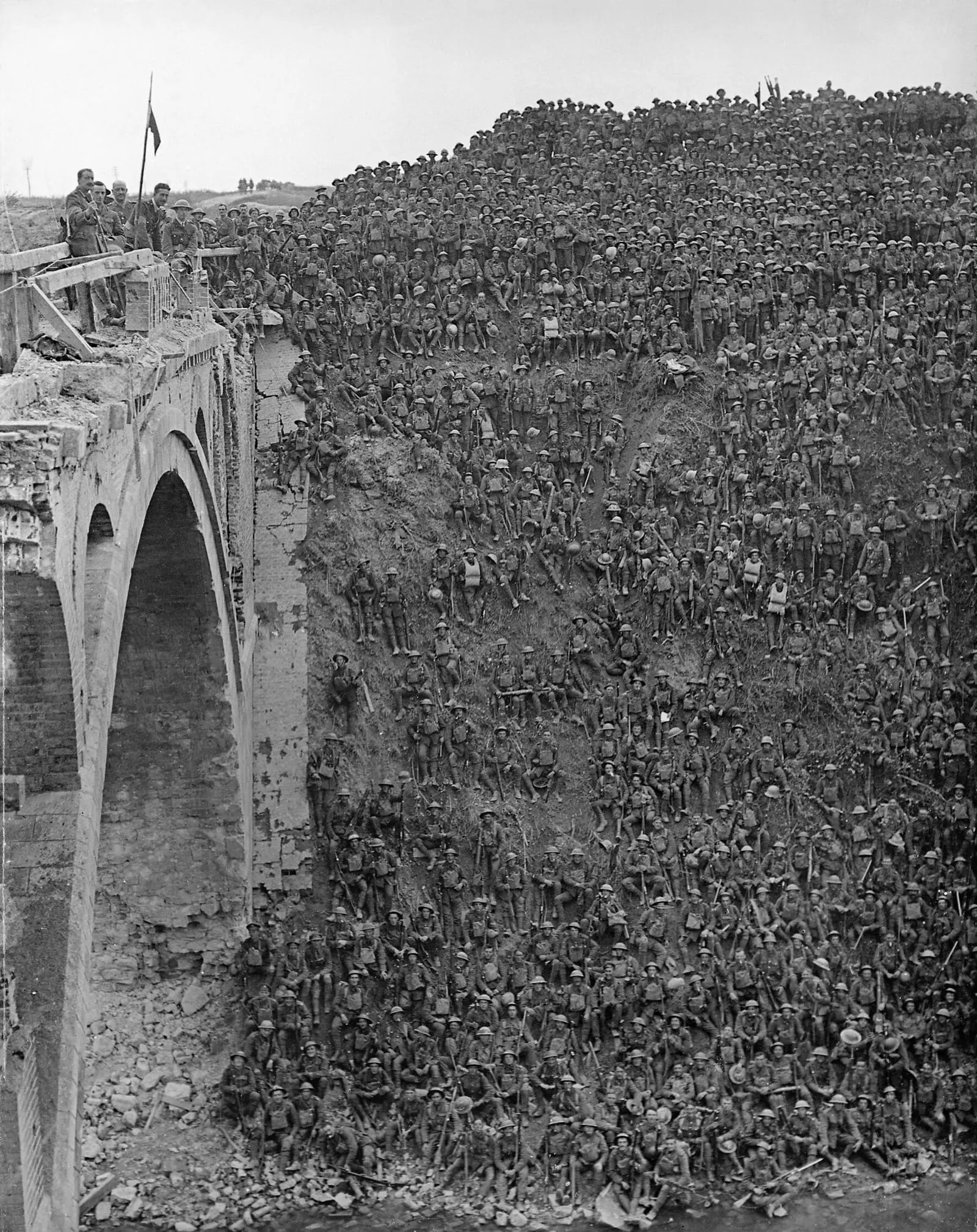
2 October. On the Fourth Army’s front there was hardly any further progress. The 32nd Division once again took and lost Sequehart, and the Germans counter-attacked but did not win back the breach in the Beaurevoir Line. The Australian 3rd and 5th Divisions were relieved by the British 50th Division and the Australian 2nd Division and went to rest. That day Brigadier-General J. V. Campbell addressed the soldiers of the 137th Brigade from the bridge at Riqueval, and the photograph of the Staffordshire men crowded on the banks of the canal became one of the best-known photographs of the war. On 3 October the Fourth Army attacked the Beaurevoir Line, and on 5 October the Australian 2nd Division took Montbrehain. It was the Australians’ last battle of the war.
Casualties
According to the British official history, on 29 September IX Corps took about 5,100 prisoners and 90 guns, of which 4,200 prisoners and 72 guns fell to the 46th Division, which lost fewer than 800 men. In September the Fourth Army as a whole took almost 21,500 prisoners and 245 guns. The Americans paid the highest price. According to Bean, the 27th Division lost about 5,000 men on 27–30 September, including, according to its commander, General John O’Ryan, about 1,500 in the preliminary attack of 27 September alone. According to the American Battle Monuments Commission, its 107th Infantry Regiment suffered on 29 September the heaviest losses in a single day of any American regiment in the war. The losses of the 30th Division were much smaller, and the Australian War Memorial puts Australian losses at about 2,500 men. German losses cannot be separated out. Several German divisions were shattered, and the 65th Infantry Regiment of the 185th Division came out of the battle, according to its own history, with a strength of three officers and forty men.
Significance
The Battle of the St Quentin Canal opened a way for the British through the Hindenburg Line at its strongest point. Together with the crossing of the Canal du Nord at Cambrai and the attacks in Flanders and in the Argonne, it showed the German Supreme Army Command that the army no longer had a position on which it could spend the winter. As the British were crossing the canal on 29 September, Ludendorff and Hindenburg at Spa were demanding that the Kaiser and the government apply immediately for an armistice. After the breaking of the Beaurevoir Line at the beginning of October the Allied armies came out into open country, so far untouched by the war.
The crossing by the 46th Division, a Territorial division from the Midlands that had suffered defeat at the Hohenzollern Redoubt in 1915 and at Gommecourt in 1916, is regarded as one of the greatest feats of the British Army in the war. Monash called it an “astounding success”. For the Americans the battle was a painful baptism of fire. Their courage won the admiration of the Australians, but their lack of experience in clearing captured ground cost many lives. The American dead were buried in the military cemetery near Bony, and above the tunnel at Bellicourt stands an American monument honouring the soldiers of both divisions and of the other units that fought alongside the British.
Spotted a mistake?Report an error