1918: The Allied counter-offensive
Battle of the Canal du Nord
- Dates:
- 27 September – 1 October 1918
- Front:
- Western Front
- Location:
- The sector of front west and north-west of Cambrai, from the unfinished Canal du Nord between Mœuvres and Sains-lès-Marquion through Bourlon Wood and village, Flesquières and Graincourt to the outskirts of Cambrai, Tilloy and Blécourt, Pas-de-Calais and Nord departments (France)On the battle map →
- Sides:
- United Kingdom and CanadaDouglas Haig, Henry Horne, Julian Byng, Arthur CurrieGerman EmpireErich Ludendorff, Rupprecht, Crown Prince of Bavaria, Otto von Below
- Result:
- British and Canadian victory. The Canadian Corps forced the canal and took Bourlon Wood and the Marcoing Line, and the Third Army broke through the Hindenburg Line south-west of Cambrai. Neither the city itself nor the crossings of the Scheldt Canal north of it were taken.
- Author:
- Natalia
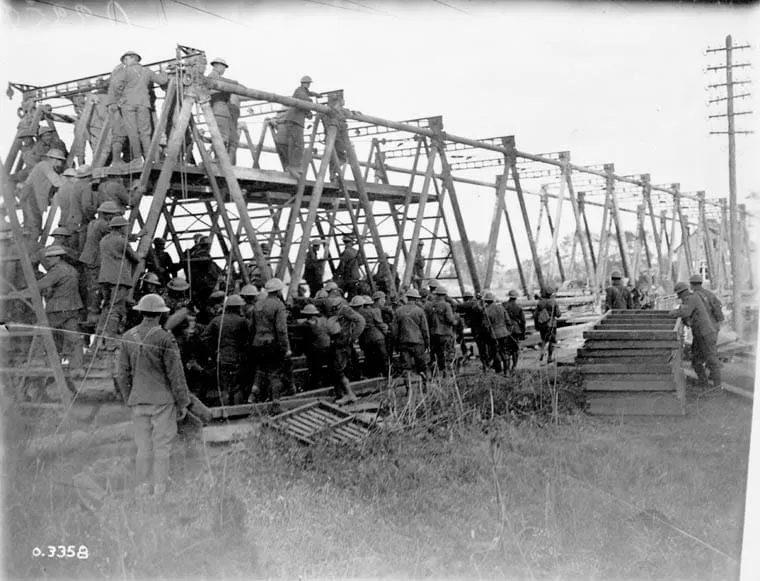
The Battle of the Canal du Nord was one of the four great blows with which the Allies attacked the Germans along the whole Western Front at the end of September 1918. On 27 September at 5.20 a.m. the Canadian Corps of General Arthur Currie, part of the British First Army, crossed the dry bed of the unfinished canal on a narrow front of only two and a half kilometres, and then fanned out to a width of almost nine kilometres. That same day the Canadians took the village of Bourlon and Bourlon Wood, for which the British had fought in vain in the autumn of 1917, while on their right the Third Army of General Julian Byng broke into the last positions of the Hindenburg Line west of the Scheldt Canal. Within two days the two armies had torn a breach in the German defences nearly 20 kilometres wide and nearly 10 kilometres deep. The following days of heavy fighting before Cambrai, from 28 September to 1 October, brought only small gains of ground, but they tied down a dozen or so German divisions and prepared the capture of the city in October.
Name and dates
The name “Battle of the Canal du Nord” and the dates 27 September – 1 October were assigned after the war by the British Battles Nomenclature Committee. According to the committee it formed part of a larger group of actions called the Battles of the Hindenburg Line, which also includes the battles of Havrincourt and Épehy, the Battle of the St Quentin Canal, the Battle of the Beaurevoir Line and the Battle of Cambrai 1918. At British headquarters at the time people spoke of the “Battle of Cambrai–St Quentin” and its phases. It should not be confused with the Battle of Cambrai of 1917 or with the Battle of Cambrai of 8–10 October 1918, in which the city itself was taken.
The name of the canal remains French because Polish literature has no accepted equivalent: the literal translation “Kanał Północny” is the Polish name of the North Channel between Ireland and Scotland. The main sources for this page are the British official history (James Edmonds, Military Operations France and Belgium 1918, volume V) and the Canadian official history (G. W. L. Nicholson, Canadian Expeditionary Force 1914–1919). Both also describe as part of the battle the fighting of the Third Army’s XVII, VI and IV Corps, which attacked together with the Canadians to the south of them.
Background
On 2 September the Canadian Corps broke through the Drocourt–Quéant Line, the northern extension of the Hindenburg Line. That same day the German Supreme Army Command ordered the Seventeenth Army of General Otto von Below to withdraw behind the river Sensée and the Canal du Nord, and further south the other armies fell back to the positions they had held before the spring offensive. The Canadians now faced a new obstacle. The construction of the Canal du Nord, which was to link the river Oise with the canals of Flanders and the Scheldt, had been interrupted by the war, and in 1918 it was completed to varying degrees in different places. North of the village of Sains-lès-Marquion the Germans had blown the bridges and flooded the already marshy ground on both sides of the Arras–Cambrai road. South of the road, on a stretch of almost four kilometres to Mœuvres, the ground was firm and the canal dry. There it was about 35–40 metres wide, with a western bank three to three and a half metres high and a lower eastern bank of about one and a half metres, both faced with brick.
Beyond the canal the Germans had built three fortified positions. A few hundred metres from the eastern bank ran the Canal du Nord Line, protected above all by dense wire. About one and a half kilometres further on lay the Marquion Line, and behind it, on a hill, rose Bourlon Wood, with the village of Bourlon on its north-western edge and Fontaine-Notre-Dame on its south-eastern edge. The hill dominated the whole area, and its oaks, among the few left in northern France, had not yet been destroyed by shellfire and made aerial photographs hard to read. The last prepared position before Cambrai was the Marcoing Line, which for much of its length rested on the Scheldt Canal and crossed the Arras road near Raillencourt. South of Mœuvres, on the Third Army’s front, the canal was only partly excavated and dry as far as the tunnel under Havrincourt Wood. Here it was crossed by the Hindenburg Line and its second position (the Hindenburg Support), and most of Byng’s troops already stood on its eastern bank.
On 3 September Marshal Ferdinand Foch presented a plan for a general offensive from the Meuse to the English Channel. Instead of striking at a single point, the Allies were to attack at four points on successive days: the Americans and French between the Meuse and the Argonne, the British towards Cambrai and Saint-Quentin, and in Flanders the army group of King Albert. The first of these blows, the Meuse–Argonne offensive, began on 26 September. On 15 September Field Marshal Douglas Haig set out to his army commanders his intention of a joint attack by the First and Third Armies on Cambrai, and on 22 September he issued orders: the First Army of General Henry Horne was to take Bourlon Wood on 27 September and cover the left flank of the Third Army, which was to reach the Scheldt Canal, while on 29 September the Fourth Army was to attack the St Quentin Canal. The British commanders knew the price of an attack on the Hindenburg Line. At the end of August the Chief of the Imperial General Staff had warned Haig that the War Cabinet would be uneasy if the army suffered heavy losses without success, and on 21 September the Secretary of State for War reminded him of the difficulty of finding replacements. Haig judged, however, that the moment was favourable and decided to attack.
Currie considered that a frontal attack from the positions he held, across the flooded marshes, had no chance. At his request the corps boundary was moved about 2.4 km south so as to take in the dry stretch of the canal opposite Inchy-en-Artois. The whole corps thus had to pass through a bottleneck and then deploy on a broad front. In the first phase the 4th Canadian Division of General David Watson and the 1st Canadian Division of General Archibald Macdonell were to cross the canal and take the Marquion Line, the village of Bourlon and the wood, which was to be enveloped from the north and the south, as well as the high ground behind it. In the second phase the 3rd Canadian Division and the British 11th Division were to join the attack, and all four divisions were to reach the Scheldt Canal north-east of Cambrai and the Sensée Canal. No preliminary bombardment was planned, but from 18 September the heavy artillery cut the wire. The engineers prepared ready-made bridge spans in advance, together with columns of lorries to bring them up to the canal. According to Currie, a few days before the attack Byng went over his plans, judged them the best possible in the circumstances and asked: “Old man, do you think you can do it?”
According to Nicholson, the sector of the Canadian attack was held by the German 12th and 187th Divisions and part of the dismounted 7th Cavalry Division, with further divisions nearby, including the 1st Guard Reserve Division near Bourlon. Edmonds notes that south of the Sensée the Germans had more divisions than the attackers.
Course of the battle
27 September. It rained during the night, and the morning was cloudy and dark. At 5.20 a.m. the infantry advanced behind a creeping barrage. On the right flank the Canadian 10th Brigade crossed the dry bed between Inchy and Mœuvres together with eight tanks and took the Canal du Nord Line and the Marquion Line as planned. The 4th Canadian Division, however, had an exposed right flank, because the neighbouring British 52nd Division of XVII Corps could not keep up, and it came under fire from the flank. The 87th Battalion broke into Bourlon before ten o’clock, and the 54th went round the wood from the north. The plan to envelop the wood from the south collapsed because the 102nd Battalion had to cover the flank along the Bapaume road. By the evening the Canadians stood just west of Fontaine-Notre-Dame and the wood had been cleared. On the left flank the 1st Canadian Division crossed the canal quickly and smoothly. Its 1st Brigade reached its final objective soon after one in the afternoon, and the 3rd Brigade wheeled north, took Sains-lès-Marquion and Marquion and cleared the eastern bank of the canal. The engineers began building bridges even before the first objective had been taken, and by the evening guns and lorries were already crossing the canal. In the afternoon the British 11th Division joined the attack and by the evening took Épinoy and Oisy-le-Verger, while the Canadian 2nd Brigade occupied Haynecourt and reached the road from Cambrai to Douai.
In the Third Army the attack went more slowly. XVII Corps of General Charles Fergusson, with the 52nd, 63rd (Royal Naval) and 57th Divisions, cleared the banks of the canal and by four in the afternoon took Graincourt and Anneux, but in the evening its left flank was still nearly three kilometres behind the Canadians. VI Corps crossed the dry canal and the second position of the Hindenburg Line. The 3rd Division took Flesquières and Ribécourt, and units of the 62nd Division briefly reached the outskirts of Marcoing. IV Corps, which on Byng’s orders set off a few hours later, achieved the least. Even so, as Edmonds writes, that day the Third Army broke through carefully prepared defences, which on the Somme in 1916 would have been regarded as a great victory. According to the lists, seven Victoria Crosses were awarded for that day alone. One of them went to the commander of the 1st Battalion, Grenadier Guards, Lieutenant-Colonel John Vereker, Viscount Gort, who, twice wounded and despite loss of blood, directed his battalion’s attack near Flesquières until he collapsed. In 1939–1940 he commanded the British Expeditionary Force in France. During the night of 27–28 September Below ordered a withdrawal behind the Sensée and to the rear “Hagen” position, running from Aubigny-au-Bac through Marcoing.
28 September. Currie ordered the advance to continue so as not to give the Germans time to organise a defence in front of Cambrai. The fresh 3rd Canadian Division of General Frederick Loomis took Fontaine-Notre-Dame and after heavy fighting broke into the Marcoing Line between the Arras and Bapaume roads. Lieutenant Milton Gregg of the Royal Canadian Regiment, twice wounded, led his men through a narrow gap in uncut wire, and when grenades ran out he brought them up himself under fire. He received the Victoria Cross for this, and after the war became a Canadian minister. The 4th Division took Raillencourt and Sailly and beat off counter-attacks all day. The toughest resistance came from the Württemberg 26th Reserve Division, the same one that a month earlier had held up the Canadians on both sides of the Arras–Cambrai road. The 1st Canadian Division and the 11th Division gained little. On the Third Army’s front the fighting went better: its left flank reached the Scheldt Canal from Marcoing northwards and seized small bridgeheads on the far side. Edmonds writes that at six o’clock that evening Ludendorff came to Hindenburg at Spa and told him that an armistice must be requested.
29 September. On this day, further south, the Fourth Army attacked on the St Quentin Canal. The Canadians were to cross the Scheldt Canal north-east of Cambrai, but gained little. The 3rd Division took the suburb of Sainte-Olle and reached the edge of Neuville-Saint-Rémy and the Douai road. The 72nd Battalion took Sancourt with about 250 prisoners, and a small party of its men even broke into Blécourt and came back with several dozen prisoners, but heavy fire forced the battalion to fall back. According to Nicholson this day cost the Canadians 2,089 killed, wounded and missing.
30 September – 1 October. On 30 September the Canadian 7th Brigade took most of the village of Tilloy, but the attack on Blécourt and the crossings at Ramillies and Eswars broke down because the smoke screen failed and German guns on the ridge near Abancourt pounded the exposed battalions. On 1 October at five in the morning all four of Currie’s divisions attacked together. According to Nicholson, the corps artillery fired 7,000 tons of ammunition that day. The 1st Canadian Division took Blécourt, Cuvillers and Bantigny, but under flanking fire and counter-attacks by six battalions of fresh divisions it had to give them up. The Canadians gained about one and a half kilometres and took the high ground east of Tilloy, from which Cambrai and the Scheldt valley could be seen. South of the city the Third Army widened its bridgehead beyond the canal: the New Zealanders took Crèvecœur and the 3rd Division Rumilly. In the afternoon Horne ordered Currie to halt the attack and consolidate the positions won, as his troops had been fighting without a break for five days.
Casualties
Nicholson states that in five days of fighting the Canadian Corps took more than 7,000 prisoners and 205 guns. According to Edmonds, from 27 September to 7 October the Canadian Corps lost 707 officers and 12,913 other ranks killed, wounded and missing, and the British XXII Corps 86 officers and 1,840 other ranks. In that period the right wing of the First Army took 8,010 prisoners, 200 guns and 714 machine guns. These sources do not give the Third Army’s losses for the days of the battle alone in a single table. German losses are not known, but regimental histories show their scale: the German 188th Infantry Regiment, which defended the approaches to Bourlon Wood, called 27 September “the blackest day of the regiment”, after which only “a small handful of men” was left of it. According to Nicholson, by the end of September the Germans had thrown nine complete divisions and parts of three more against the Canadians, most of which soon had to be withdrawn.
Significance
The crossing of the Canal du Nord is regarded as one of the best-prepared operations of the Canadian Corps and strengthened Currie’s reputation as one of the ablest corps commanders in the British Army. Passing the whole corps through a bottleneck, the engineers’ rapid bridging and artillery moved up behind the infantry made it possible to overcome an obstacle that only a few weeks earlier had been considered almost impassable. The attack of the First and Third Armies covered from the north the Fourth Army’s blow on the St Quentin Canal and, together with it, broke the Hindenburg Line, which the Germans regarded as a limit beyond which they must not retreat. The heavy fighting before Cambrai tied down many German divisions needed on other sectors. It also coincided with the darkest days of the German high command, which in the last days of September concluded that the war could no longer be won.
Cambrai itself fell only on 9 October, after a further attack. The Canadians are commemorated by a memorial on the hill by Bourlon Wood, overlooking the battlefield.
Spotted a mistake?Report an error