1918: The Allied counter-offensive
Battle of the Drocourt–Quéant Line
- Dates:
- 2–3 September 1918
- Front:
- Western Front
- Location:
- A strip of front south-east of Arras on both sides of the Arras–Cambrai road, from Étaing on the Sensée in the north through Dury, Cagnicourt and Villers-lès-Cagnicourt to Quéant in the south, east to the Canal du Nord, Pas-de-Calais department (France)On the battle map →
- Sides:
- United Kingdom and CanadaDouglas Haig, Henry Horne, Arthur Currie, Julian Byng, Charles FergussonGerman EmpireErich Ludendorff, Rupprecht, Crown Prince of Bavaria, Otto von Below
- Result:
- Canadian–British victory. The Drocourt–Quéant Line was broken along the whole sector attacked, and on the night of 2/3 September the Germans withdrew behind the Sensée and the Canal du Nord. The Canadian Corps took about 6,000 prisoners and lost over 5,600 men.
- Author:
- Natalia
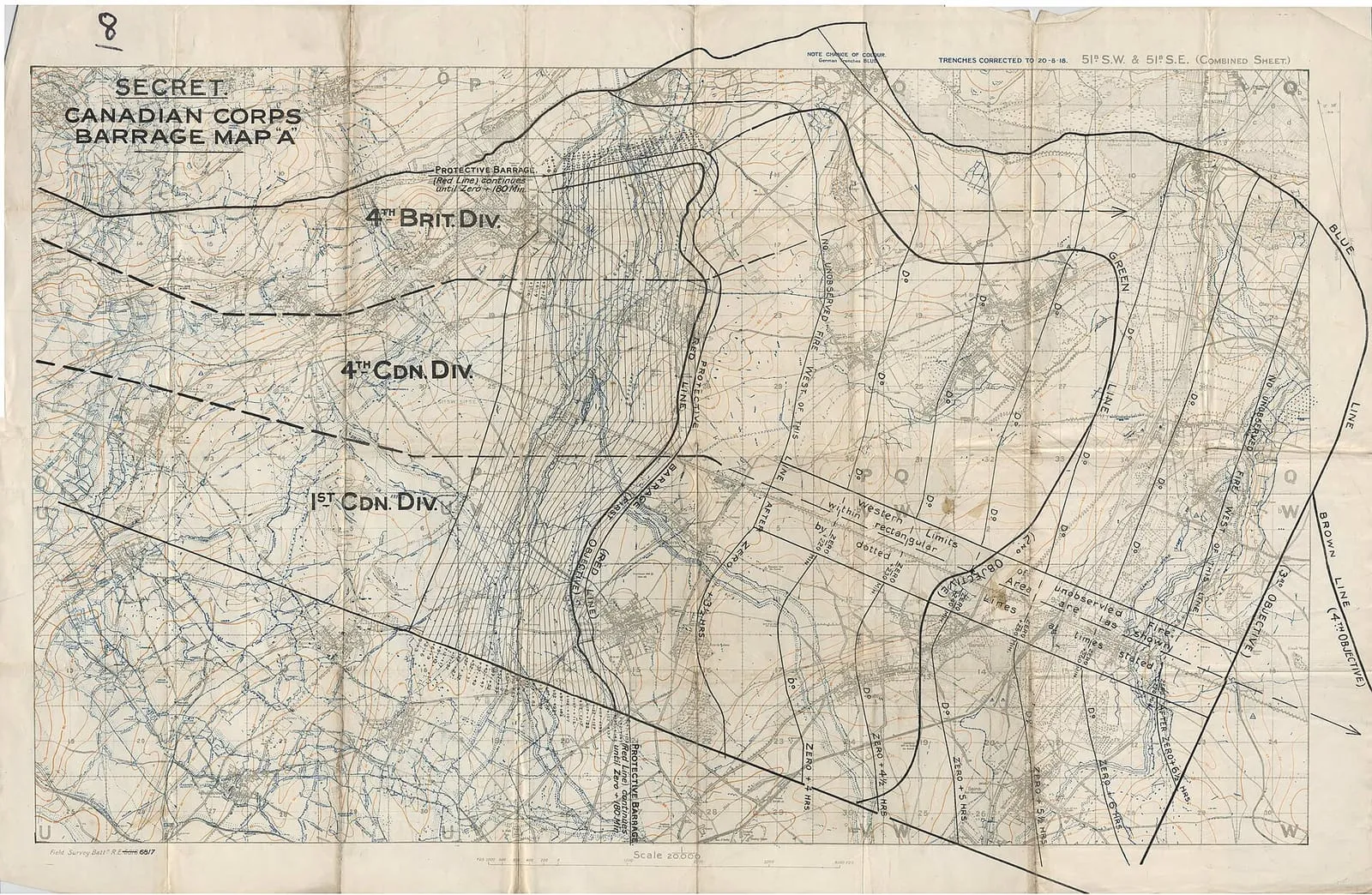
The Battle of the Drocourt–Quéant Line was the assault in which, on 2 September 1918, the Canadian Corps of General Arthur Currie, part of the British First Army, broke through the strongest German position east of Arras. The Drocourt–Quéant Line, which the Germans counted as part of the Wotan position, was the northern extension of the Hindenburg Line and barred the way to the Douai plain and to Cambrai. After a week of heavy fighting on the Scarpe the Canadians attacked it at dawn, crossed both its trench lines within a few hours, and by evening had also taken the switch position behind it and the villages of Cagnicourt and Villers-lès-Cagnicourt. To their right the British XVII Corps of the Third Army broke into the southern end of the line, where it joined the Hindenburg Line. That same day the German Supreme Army Command ordered a retreat: during the night the Germans broke contact with the Canadians and fell back behind the Sensée and the Canal du Nord, and further south to the positions from which they had launched their spring offensive in March.
Name and dates
The name “Battle of the Drocourt–Quéant Line” and the dates 2–3 September 1918 were fixed after the war by the British Battles Nomenclature Committee. The battle closes the group of the “Second Battles of Arras 1918” (26 August – 3 September), which also includes the Battle of the Scarpe of 26–30 August. The British chronology of the war dates it the same way. The actual assault lasted one day, 2 September; by 3 September the Germans had already withdrawn and the fighting was limited to the pursuit to the Canal du Nord. The main sources for this page are the British official history (James Edmonds, Military Operations France and Belgium 1918, vol. IV) and the Canadian official history (G. W. L. Nicholson, Canadian Expeditionary Force 1914–1919).
The line takes its name from two places at its ends: the mining town of Drocourt south-east of Lens and the village of Quéant, where it joined the Hindenburg Line. The Germans called it the Wotan position (Wotan-Stellung). Edmonds notes that although it was spoken of as a “line”, it was in reality a position made up of several lines.
Background
The Germans built the Drocourt–Quéant Line in 1917, behind the Hindenburg Line to which they had withdrawn in the spring of that year. It was meant to secure the rear of the positions at Arras and Lens. In April 1917, in the Battle of Arras, the British failed to reach it, and after the German offensive of March 1918 it lay far behind the front. When the Germans began to fall back in August, it became their last prepared position in that area.
After the victory at Amiens, Field Marshal Douglas Haig shifted the weight of the offensive further and further north. On 21 August General Julian Byng’s Third Army attacked, and on 26 August General Henry Horne’s First Army, with the Canadian Corps brought up from Amiens. In the Battle of the Scarpe the Canadians retook Monchy-le-Preux and broke the Fresnes–Rouvroy line, but lost over 5,500 men in three days. On 29 August, after a conference with Marshal Ferdinand Foch, who urged them to “continue the pursuit”, Haig ordered the First Army to attack the Drocourt–Quéant Line south of the Scarpe and exploit success as far as Bourlon Wood and the Sensée. The Third and Fourth Armies were to pin the Germans on their own sectors, the Third Army above all by attacking with its left wing alongside the Canadians. In the last days of August Haig received a telegram from the Chief of the Imperial General Staff, General Henry Wilson, warning that the War Cabinet would be anxious if the army suffered heavy losses in an unsuccessful attack on the Hindenburg Line. He did not show it to his army commanders and did not change his orders.
On 30 August Horne and Currie agreed that the line could not be attacked hastily: they had to wait until everything was ready “and then go all out”. Over the following days the Canadians won favourable jumping-off positions. On 30 August the 1st Canadian Brigade, attacking from the neighbouring corps’ sector, surprised the defenders of the switch near Vis-en-Artois; on 31 August the 8th Battalion took the Ocean Work strongpoint, and on 1 September the 5th Battalion took the Crow’s Nest hill, from which a large part of the German position could be seen. For several days heavy howitzers cut the wire. The Germans, sensing an attack, counter-attacked up to the last moment.
Position and plan
The Drocourt–Quéant Line consisted of a front line and a support line, each of two trenches with concrete shelters and machine-gun nests, protected by dense belts of barbed wire. The front line usually ran along a crest or a forward slope with a good field of fire, and the support line along the reverse slope. The village of Dury was built into the position itself. Behind it ran the Buissy Switch (Buissy Switch), which linked the Drocourt–Quéant Line with the support line of the Hindenburg Line and ran south-east in front of the villages of Villers-lès-Cagnicourt and Buissy. The hardest part was expected to be crossing Mont Dury, whose forward slopes, crest and reverse slope were covered by machine guns sited in depth.
Currie decided to break the line at its most sensitive point, on both sides of the Arras–Cambrai road, and then extend the attack to the flanks and roll up the German trenches to the north and south. On the right wing, south of the road, General Archibald Macdonell’s 1st Canadian Division attacked with two brigades, in the centre General David Watson’s 4th Canadian Division, and on the left wing, by the Sensée marshes, the British 4th Division. At the last moment its commander declared that after the losses of the previous days he could attack with only one brigade, so the 4th Canadian Division took over half of its sector, and its 10th Brigade had to march about 16 kilometres during the night to its new positions. In reserve stood the British 1st Division and General Raymond Brutinel’s motorised force. The first objective was the Cagnicourt–Dury line, already beyond the support line, the second the heights above the Canal du Nord. Six companies of Mark V tanks were allotted to the attack, and twenty field and eleven heavy brigades of artillery. The noise of the tanks assembling during the night was drowned out by aircraft circling over the front.
General Charles Fergusson’s XVII Corps, the left wing of the Third Army, had no tanks and did not attack the line frontally. Its 57th Division was to pass behind the Canadians through the breach, turn south and roll up the trenches opposite the corps, while the 52nd Division and the 63rd (Royal Naval) Division were to follow it towards Quéant and Inchy.
On the German side stood General Otto von Below’s Seventeenth Army, part of the army group of Crown Prince Rupprecht of Bavaria. According to Edmonds the sector attacked was held by at least seven divisions, including two Guard reserve divisions. The Germans counted on holding this line, together with the line on the Somme, through the winter.
Course of the battle
2 September. The night was dark and dry. At 5 a.m., exactly at dawn, the barrage opened and the infantry went over the top. On the right wing the 3rd Canadian Brigade of the 1st Division quickly reached the wire. The entanglements were mostly cut or crushed by the tanks, and where they were not, they were cut by hand under cover of smoke laid by the tanks. Many Germans surrendered at once. By 7.30 a.m. the 13th Battalion had taken its stretch of the support line, and the 14th Battalion had taken Cagnicourt, pulling so many prisoners out of the cellars that they would have made up a whole battalion, and had reached the Buissy Switch. The 16th Battalion had a harder time: the British 57th Division had not yet come up and its exposed right flank came under heavy machine-gun fire. Its commander, Lieutenant-Colonel Cyrus Peck, went forward alone through the fire to reconnoitre, turned tanks back to cover the flank and led the battalion on. For that day he received the Victoria Cross, as did Lance Corporal William Metcalf of the same battalion, an American who under fire guided a tank onto the German positions. To the left the 2nd Brigade went through both lines of the position with the tanks, but beyond them, out of range of the barrage, the 10th Battalion was held up in front of the Buissy Switch and the fortified village of Villers-lès-Cagnicourt. The village was taken in the afternoon, and the switch itself only at 11 p.m., after hand-to-hand fighting with regiments of the 1st Guard Reserve Division.
The 4th Canadian Division also went through both lines relatively easily, though its tanks were late. The 10th Brigade, despite its night march, took Dury after hard fighting, capturing about 120 prisoners there, and by 7.30 a.m. had reached its objective. But when the battalions of the 12th Brigade crossed the bare crest of Mont Dury, they ran into the fire of machine guns sited in depth, beyond the reach of the barrage, while German guns on the ridge between Buissy and Saudemont fired over open sights. The second phase of the attack, without a barrage and without tanks, stalled a few hundred metres beyond the road from Dury to Cambrai. On the left wing the British 4th Division took its part of both lines, but fire from the village of Étaing and the wood south of it prevented it from going further. Brutinel’s motorised force was unable to break through along the Cambrai road. According to Nicholson, false reports of its progress meant that the artillery did not resume fire on the strip along the road, and the Canadians attacking from Dury paid for this with heavy losses.
On XVII Corps’ sector, at about 6.30 a.m., the artillery lifted its fire southwards and the 57th Division moved down the forked trenches of the front line. It took both branches, and its battalion of the Royal Munster Fusiliers went on eastwards. At 8.45 a.m. the 52nd Division attacked and, along the Hindenburg front line, reached the very outskirts of Quéant by 3 p.m. The 63rd (Royal Naval) Division, without artillery support, fought its way south-east all day. In the evening its Drake Battalion crossed the support line of the Hindenburg Line near Pronville, and a night attack on Inchy failed. The commander of Drake Battalion, Commander Daniel Beak, received the Victoria Cross for a whole series of actions at the turn of August and September.
By evening the Drocourt–Quéant Line had been broken along the whole sector attacked, on a front of about 6.5 kilometres according to Nicholson. The Canadians had not reached the heights above the Canal du Nord, and Étaing remained in German hands. Seven Canadians received the Victoria Cross for that day: besides Peck and Metcalf, Sergeant Arthur Knight of the 10th Battalion (posthumously), Private Walter Rayfield of the 7th Battalion, Private Claude Nunney of the 38th Battalion (who soon died of wounds), Private John Young of the 87th Battalion and Captain Bellenden Hutcheson, a doctor attached to the 75th Battalion. Nicholson calls this a measure of the ferocity of the fighting.
At about midday, or according to another account after 2 p.m., the German Supreme Army Command acknowledged defeat. Driven from a line it had meant to hold through the winter, and threatened on the northern flank of the Somme line, where the Australians had just taken Mont Saint-Quentin and Péronne, it ordered a retreat. The Seventeenth Army was to fall back that same night behind the Sensée and the Canal du Nord, the Second Army the following night to the Hindenburg Line, and the Eighteenth and Ninth Armies in turn after them, so that by 9 September the whole salient won in March would be given up. At the same time the Germans were completing the evacuation of the Lys salient in Flanders. Paul von Hindenburg later counted this retreat among the “painful decisions” of the first week of September.
3 September. On the evening of 2 September the division commanders reported to Currie their heavy losses and the difficulty of continuing the attack without preparation. With Horne’s agreement Currie therefore called off the general attack and ordered only that contact be kept with the enemy and that they follow if he began to withdraw. But the Germans left during the night, and in the morning an airman who flew over the battlefield at a height of 90 metres did not see a single German soldier west of the canal. At 5 a.m. the British 4th Division occupied Étaing and then reached Lécluse by the Sensée marshes. The 4th Canadian Division occupied Rumaucourt, Écourt-Saint-Quentin, Saudemont and Récourt, and the 1st Division Buissy and Baralle, and in the evening it reached the west bank of the canal opposite Sains-lès-Marquion. All the bridges had been destroyed and the east bank was strongly held. On XVII Corps’ sector the 63rd Division found Quéant and Pronville abandoned and occupied Inchy, and further south the Third Army took up the pursuit along its whole front and came up to the Canal du Nord and the Hindenburg Line. By 4 September the Canadian Corps held all the ground west of the canal.
Losses
According to the Canadian official history, from 1 to 3 September the Canadian Corps lost 297 officers and 5,325 other ranks killed, wounded and missing. From 1 to 4 September it took about 6,000 unwounded prisoners. These sources do not give separately the losses of the British divisions fighting under Currie’s command and in XVII Corps. German losses are not known in full. Edmonds cites regimental histories showing that the 2nd Guard Reserve Regiment, defending Villers-lès-Cagnicourt, lost 566 men, and the neighbouring 1st Guard Reserve Regiment 646.
Significance
Breaking the Drocourt–Quéant Line was one of the most important victories of the Hundred Days Offensive. The British official history writes that the effect was immediate: the German Supreme Army Command acknowledged defeat. The retreat covered the whole front from near Lens to the Aisne, and the Germans lost their hope of wintering quietly in front of the Hindenburg Line. The Australian historian Charles Bean judged that the main cause of Erich Ludendorff’s decision was precisely the blow struck by the Canadians and the Third Army at the junction of the Drocourt–Quéant Line with the Hindenburg Line, and that the loss of Péronne was a secondary cause. Edmonds adds that 2 September showed that machine-gun nests and fortified positions still cost time and men, but could be overcome.
For the Canadians it was a victory on the scale of Amiens. On 3 September Currie wrote in his diary that he did not know whether 8 August or “yesterday” had been the greater victory, but inclined to the latter. He particularly praised the 1st Canadian Division, which within a few days had gone through the Fresnes–Rouvroy line and the Drocourt–Quéant Line. Ahead of the corps now lay the Canal du Nord, and beyond it Cambrai. Beside the road from Arras to Cambrai, at the highest point where the captured line crossed it, there stands today a Canadian memorial commemorating the breakthrough.
Spotted a mistake?Report an error