German Empire · The Central Powers
Rupprecht, Crown Prince of Bavaria
Commander of the 6th Army (1914–1916) and of Army Group "Crown Prince Rupprecht" (1916–1918), field marshal
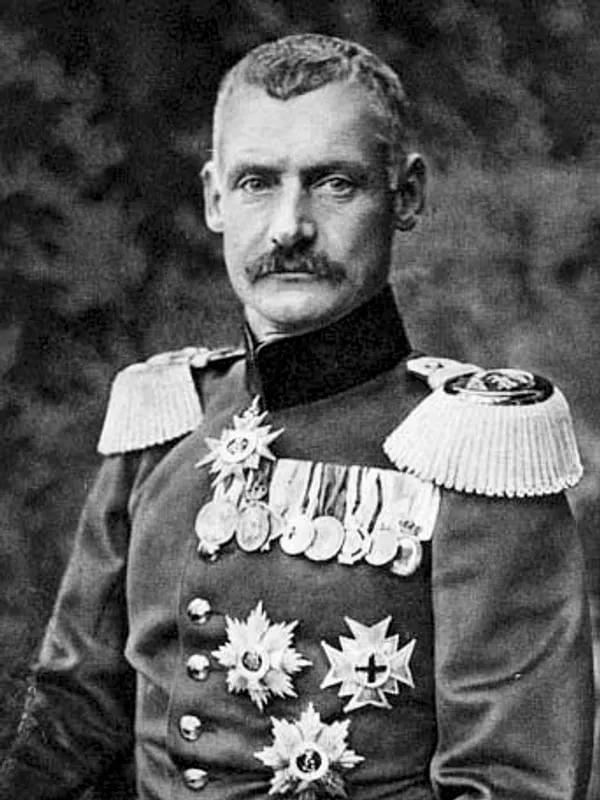
- Born:
- 18 May 1869, Munich (Bavaria)
- Died:
- 2 August 1955, Leutstetten near Starnberg
- Author:
- Natalia
- Photo:
- Bernhard Dittmar, domena publiczna, Wikimedia Commons

Rupprecht, Crown Prince of Bavaria, fought on the Western Front throughout the war, first as commander of the 6th Army and from 1916 as commander of an army group that held the sector facing the British, from the Somme to the sea. It was his troops who bore the battles of Arras, Messines and Passchendaele in 1917, and in the spring of 1918 they led the great offensives against the British. He owed his command to his birth, but unlike other princes in generals’ uniforms he proved a competent commander. He kept an extensive diary, today one of the most valuable sources for the history of the war in the west, and earlier than most German generals he understood that Germany would not win this war.
Before the war
He was born on 18 May 1869 in Munich, the eldest son of Prince Ludwig of the Wittelsbach dynasty, later King Ludwig III. He was the first member of the royal house to attend a public grammar school. He joined the Bavarian Army, but interrupted his service to study in Munich and Berlin in 1889–1891, and then graduated from the Bavarian War Academy. He travelled widely, among other places to India, China and Japan, and wrote books about these journeys. He was a connoisseur and collector of art. In 1900 he married Princess Marie Gabrielle, who died in 1912.
He rose through every rank of the military career; from 1906 he commanded the I Bavarian Corps in Munich, and in 1913 he became a colonel general and army inspector. In November 1913 his father became king and Rupprecht crown prince.
1914: Lorraine and Flanders
On 2 August 1914 he took command of the 6th Army, made up mainly of Bavarian troops, which was deployed in Lorraine. His chief of staff was the Bavarian general Konrad Krafft von Dellmensingen. Under the German plan the 6th and 7th Armies were to fall back and draw the French deep into Lorraine, so as to tie down as many of their forces as possible far from the decisive right wing. When, however, the French armies advanced deep into German Lorraine, Rupprecht and his staff extracted from the Chief of the General Staff, Helmuth von Moltke, permission to counter-attack. On 20 August his army struck at Morhange and Sarrebourg and threw the French back across the border. The victory in Lorraine made him a hero in Germany.
Moltke allowed him to press on against the French fortifications. The pursuit, however, came to a halt on the Mortagne, and the attack on the heights of the Grand Couronné before Nancy from 4 September cost the Bavarians heavy losses and brought no success. Historians often count this offensive among Moltke’s mistakes: it tied down troops that were missing on the right wing on the Marne. In the same weeks Rupprecht suffered a personal blow. On 27 August his eldest son and heir, the 13-year-old Luitpold, died of poliomyelitis.
After the Marne the new Chief of the General Staff, Erich von Falkenhayn, moved the 6th Army to the right wing, where both sides were trying to outflank each other to the north. Rupprecht fought the French in Picardy, and from the beginning of October at Arras, Lens and La Bassée. At the end of October his army attacked the British between La Bassée and Messines in the First Battle of Ypres. Relations with Falkenhayn soon soured. Rupprecht could not stand the Chief of Staff’s Prussian air of superiority and resented him for taking away his divisions at will.
1915: defence in Artois
Throughout 1915 the 6th Army stood on the defensive in Artois and French Flanders. In March it repelled the British attack at Neuve Chapelle, in May and June the British at Aubers and Festubert and the French in the Second Battle of Artois, and in the autumn the attacks at Loos and in the Third Battle of Artois. In August he received the Pour le Mérite. In November 1915 General Hermann von Kuhl became his chief of staff, and the two worked together until the end of the war.
Rupprecht was also a politician. He thought of enlarging Bavaria, among other things by Alsace, and of weakening Prussia’s predominance in the Reich. According to his entry in the “Neue Deutsche Biographie”, from as early as the autumn of 1915 he began to move from hopes of a victorious peace to support for a compromise peace, although other biographers stress that as late as 1916 he still believed victory was possible.
1916: the Somme and the army group
Rupprecht considered the attack on Verdun, France’s strongest fortress, a mistake. In the summer of 1916, when the British and French struck on the Somme, he wrote to the Kaiser’s military cabinet that Falkenhayn had lost the army’s confidence, and so contributed to his fall. On 1 August 1916 he was made a field marshal, and on 28 August he took command of a new army group named after him. It comprised the armies from the Somme to the Flanders coast, which stood almost entirely opposite the British. A day later Paul von Hindenburg became Chief of the General Staff, and Erich Ludendorff the de facto director of the war.
1917: Alberich, Arras, Flanders
In the winter of 1916/1917 the staff of Rupprecht’s army group, led by Kuhl, prepared the withdrawal of the troops to a new, shorter position, called by the British the Hindenburg Line. The retreat codenamed “Alberich”, carried out in February and March 1917, went smoothly, but it was accompanied by the systematic destruction of the abandoned ground: houses and roads were blown up, wells poisoned and the population deported. Rupprecht opposed destruction on such a scale. He believed it would bring Germany into disrepute and yield no military advantage. He even considered resigning, but his position did not allow him to do so.
On 9 April the British attacked at Arras, and the Canadians took Vimy Ridge. Rupprecht noted in his diary that the 6th Army, against his express wishes, had not kept its reserves close enough to the front. On 7 June the Messines ridge was blown up by mines, and his troops lost a position that Kuhl had earlier advised against defending. From July to November the army group fought off the Third Battle of Ypres. Rupprecht recorded the divisions’ losses and called the rain that turned the battlefield into a swamp his “most effective ally”. In November and December his 2nd Army repelled the British attack at Cambrai and in a counter-attack regained part of the lost ground.
The year 1917 confirmed his conviction that the war could not be won. “We have underestimated all our enemies one after another, and now we are doing the same with the Americans,” he wrote. He was even prepared to cede to France the part of Alsace-Lorraine inhabited by a French population, but neither Ludendorff nor his own father would hear of it.
1918: the great offensives and the retreat
The plan for the spring offensive of 1918 was drawn up partly at Rupprecht’s headquarters. Kuhl proposed a blow in Flanders; Ludendorff chose an attack on the Somme. When Rupprecht asked about its operational objective, Ludendorff is said to have replied: “We will punch a hole. The rest will follow.” On 21 March two armies of Rupprecht’s group, the 17th and the 2nd, launched Operation Michael. Despite huge gains of ground the attack brought no decision, and on 5 April Rupprecht recorded in his diary “the unpleasant fact that our offensive has come to a complete standstill”. On 9 April his troops attacked on the Lys and took Armentières, Bailleul and Mount Kemmel, but did not reach Hazebrouck and the hills near Cassel. The main offensive in Flanders, codenamed “Hagen”, was repeatedly postponed, and after the Allied counter-offensive on the Marne in July it was finally abandoned.
From the Battle of Amiens on 8 August, Rupprecht’s armies fell back step by step. In August and September 1918 he pressed his father and the chancellor, Georg von Hertling, to seek peace, but Hertling procrastinated. During the night of 7–8 November a republic was proclaimed in Munich, and the Wittelsbachs lost the throne. Rupprecht, who learnt of the revolution in Brussels, laid down his command on 11 November, the day of the armistice.
After the war
For several months he stayed outside Bavaria, and from the end of 1919 he lived in Berchtesgaden. The Allies placed him on the list of those accused of war crimes, but the case, handed over to the German courts, went no further. After his father’s death in 1921 he became head of the House of Wittelsbach and never renounced his claim to the throne, but he rejected ideas of a coup d’état. In 1923 he helped persuade Gustav von Kahr not to support Hitler’s putsch. He was an opponent of Nazism and protested against the abolition of Bavaria’s separate status. In 1939 he left for Italy. In 1944 he went into hiding in Florence from the Gestapo, while his wife and children were imprisoned in concentration camps; all of them survived. He died on 2 August 1955 in Leutstetten near Starnberg and was buried with the honours due to a monarch in the Theatine Church in Munich.
Assessment
Rupprecht is one of the few commanders from ruling families whom historians judge as genuine commanders rather than mere figureheads. He prepared himself thoroughly before the war, understood positional warfare, knew how to listen to experienced chiefs of staff and was able to stand up to them. Part of his armies’ successes is attributed to Krafft von Dellmensingen and Kuhl, and strategic decisions were made over his head, first by Falkenhayn, then by Ludendorff. Almost every study of the war on the Western Front draws on his diary, although his entries also have a political dimension and were sometimes written with posterity in mind.
Critics point to the costly offensive in Lorraine in 1914, to which he himself contributed, and to his part in the intrigues against Falkenhayn, whose cautious assessment of Germany’s chances he himself later came to share. More than his military mistakes, however, historians are interested in his sober judgement. Earlier than most generals he saw that the Allies’ material superiority could not be overcome, he opposed the scorched-earth policy and urged a compromise peace, but he did not have enough power to change anything.
Sources
Spotted a mistake?Report an error
Commanded in battles
(81)- 7–25 August 1914Battle of the FrontiersWestern Front
- 14–25 August 1914Battle of LorraineWestern Front
- 25 August – 3 September 1914Battle of the MortagneWestern Front
- 4–12 September 1914Battle of the Grand CouronnéWestern Front
- 15 September – 19 October 1914Race to the SeaWestern Front
- 22–25 September 1914First Battle of AlbertWestern Front
- 22–26 September 1914First Battle of PicardyWestern Front
- 27 September – 12 October 1914First Battle of ArtoisWestern Front
- 10 October – 2 November 1914Battle of La BasséeWestern Front
- 12 October – 2 November 1914Battle of Messines (1914)Western Front
- 13 October – 2 November 1914Battle of ArmentièresWestern Front
- 19 October – 22 November 1914First Battle of YpresWestern Front
- 29–31 October 1914Battle of GheluveltWestern Front
- 11 November 1914Battle of Nonne BosschenWestern Front
- 20–21 December 1914Defence of GivenchyWestern Front
- 10–13 March 1915Battle of Neuve ChapelleWestern Front
- 9 May 1915Battle of Aubers RidgeWestern Front
- 9 May – 18 June 1915Second Battle of ArtoisWestern Front
- 15–25 May 1915Battle of FestubertWestern Front
- 25 September – 8 October 1915Battle of LoosWestern Front
- 25 September – 15 October 1915Third Battle of ArtoisWestern Front
- 1 July – 18 November 1916Battle of the SommeWestern Front
- 19–20 July 1916Battle of FromellesWestern Front
- 9 September 1916Battle of GinchyWestern Front
- 15–22 September 1916Battle of Flers–CourceletteWestern Front
- 25–28 September 1916Battle of MorvalWestern Front
- 26–28 September 1916Battle of Thiepval RidgeWestern Front
- 1–18 October 1916Battle of the Transloy RidgesWestern Front
- 1 October – 11 November 1916Battle of the Ancre HeightsWestern Front
- 13–18 November 1916Battle of the AncreWestern Front
- 22 February – 5 April 1917German retreat to the Hindenburg LineWestern Front
- 9–12 April 1917Battle of Vimy RidgeWestern Front
- 9 April – 16 May 1917Battle of Arras (1917)Western Front
- 9–14 April 1917First Battle of the Scarpe (1917)Western Front
- 23–24 April 1917Second Battle of the Scarpe (1917)Western Front
- 28–29 April 1917Battle of ArleuxWestern Front
- 3–17 May 1917Battle of BullecourtWestern Front
- 3–4 May 1917Third Battle of the Scarpe (1917)Western Front
- 7–14 June 1917Battle of Messines (1917)Western Front
- 31 July – 2 August 1917Battle of Pilckem RidgeWestern Front
- 31 July – 10 November 1917Third Battle of YpresWestern Front
- 15–25 August 1917Battle of Hill 70Western Front
- 16–18 August 1917Battle of Langemarck (1917)Western Front
- 20–25 September 1917Battle of the Menin Road RidgeWestern Front
- 26 September – 3 October 1917Battle of Polygon WoodWestern Front
- 4 October 1917Battle of BroodseindeWestern Front
- 9 October 1917Battle of PoelcappelleWestern Front
- 12 October 1917First Battle of PasschendaeleWestern Front
- 26 October – 10 November 1917Second Battle of PasschendaeleWestern Front
- 20 November – 7 December 1917Battle of CambraiWestern Front
- 21–23 March 1918Battle of St QuentinWestern Front
- 21 March – 5 April 1918Operation MichaelWestern Front
- 24–25 March 1918First Battle of BapaumeWestern Front
- 28 March 1918First Battle of Arras (1918)Western Front
- 5 April 1918Battle of the Ancre, 1918Western Front
- 9–29 April 1918Battle of the LysWestern Front
- 9–11 April 1918Battle of EstairesWestern Front
- 10–11 April 1918Battle of Messines (1918)Western Front
- 12–15 April 1918Battle of HazebrouckWestern Front
- 13–15 April 1918Battle of BailleulWestern Front
- 17–19 April 1918First Battle of Kemmel RidgeWestern Front
- 18 April 1918Battle of BéthuneWestern Front
- 25–26 April 1918Second Battle of Kemmel RidgeWestern Front
- 29 April 1918Battle of the ScherpenbergWestern Front
- 8–11 August 1918Battle of AmiensWestern Front
- 8–15 August 1918Battle of MontdidierWestern Front
- 8 August – 11 November 1918Hundred Days OffensiveWestern Front
- 18 August 1918Battle of Outtersteene RidgeWestern Front
- 21–23 August 1918Battle of Albert (1918)Western Front
- 21 August – 3 September 1918Second Battle of the SommeWestern Front
- 31 August – 3 September 1918Second Battle of BapaumeWestern Front
- 2–3 September 1918Battle of the Drocourt–Quéant LineWestern Front
- 12 September 1918Battle of HavrincourtWestern Front
- 12 September – 12 October 1918Battles of the Hindenburg LineWestern Front
- 27 September – 1 October 1918Battle of the Canal du NordWestern Front
- 28 September – 2 October 1918Fifth Battle of YpresWestern Front
- 8–9 October 1918Battle of CambraiWestern Front
- 14–19 October 1918Battle of KortrijkWestern Front
- 17–25 October 1918Battle of the SelleWestern Front
- 1–2 November 1918Battle of ValenciennesWestern Front
- 4 November 1918Battle of the SambreWestern Front
Mentioned in battles
(03)Often appears with
People who appear in the same events.
On the timeline
(38)1914
August
September
- 22
- Key eventFirst Battle of Picardy beginsOn 22 September 1914 General de Castelnau's new French Second Army attacked north of the Oise. The Race to the Sea had begun.
- Key eventFirst Battle of Albert beginsIn September 1914 the French and Germans clashed at Albert and Bapaume. On the heights above the Somme a front formed that held until the Somme battle of 1916.