1917: Flanders
Battle of Poelcappelle
- Dates:
- 9 October 1917
- Front:
- Western Front
- Location:
- The Ypres (Ieper) salient from Reutel and the Broodseinde ridge through the Ravebeek valley, the Bellevue spur and the village of Poelcappelle (Poelkapelle) to the edge of Houthulst Forest, West Flanders (Belgium)On the battle map →
- Sides:
- United Kingdom, Australia and NewfoundlandDouglas Haig, Herbert Plumer, Hubert GoughFranceFrançois AnthoineGerman EmpireRupprecht, Crown Prince of Bavaria, Friedrich Sixt von Armin
- Result:
- Inconclusive. On the Passchendaele ridge and the Bellevue spur the attack was repulsed, but in the north the British and French advanced 2–2.5 km, to Houthulst Forest.
- Author:
- Natalia
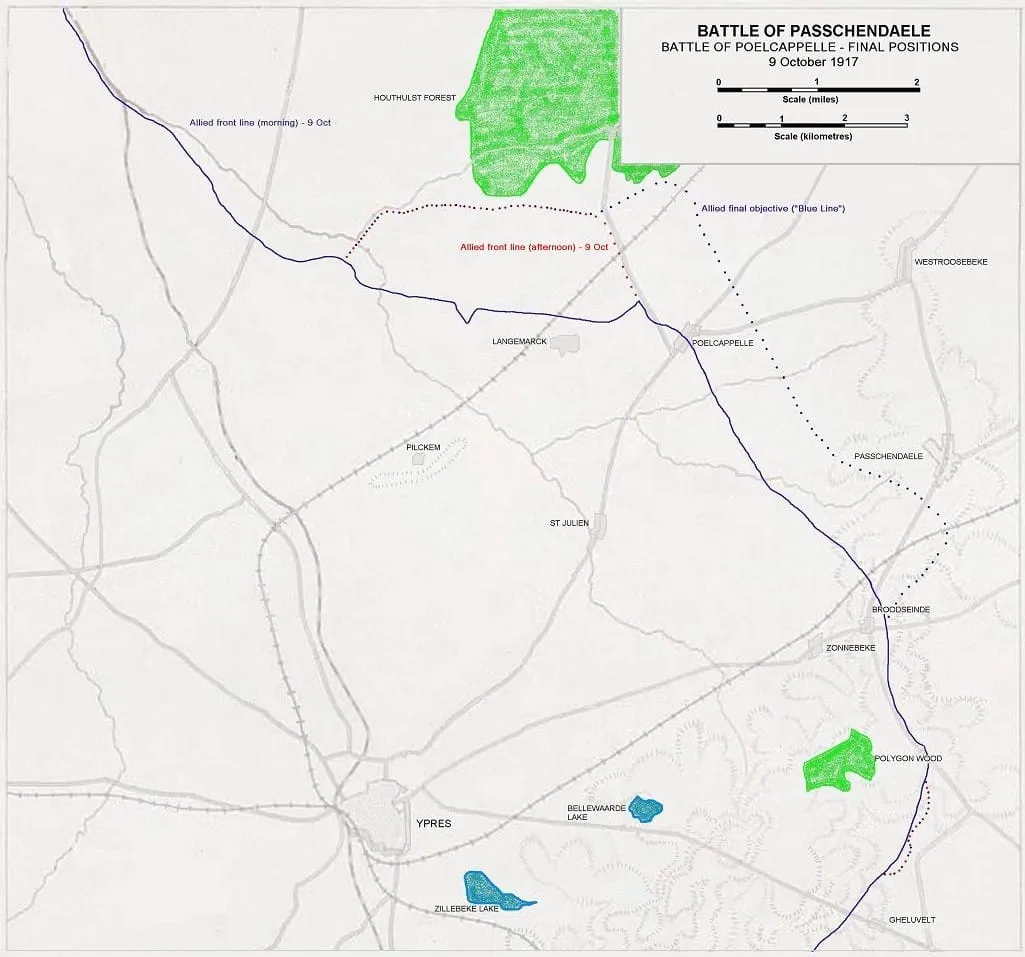
The Battle of Poelcappelle was the first October attack of the Third Battle of Ypres and the first serious failure since September of General Herbert Plumer’s method. At 5.20 a.m. on 9 October 1917, only five days after the victory at Broodseinde, Plumer’s British Second Army and General Hubert Gough’s Fifth Army, supported in the north by the French, attacked on a front of about 12 kilometres, from Reutel to Houthulst Forest. After five days of rain the artillery was stuck in the mud, and the two British divisions that were to take the approaches to the village of Passchendaele had marched to their jumping-off positions all night and set off exhausted, some of them late. On the ridge and in front of the concrete pillboxes on the Bellevue spur the attack broke down, and most of the ground taken in the morning was given up. On the lowlands in the north, where the ground was less churned by shells, the British Guards Division, the 29th Division and the French 2nd Division advanced more than two kilometres, to the edge of Houthulst Forest. False reports of success led the command to set the next attack for as early as 12 October.
Name and dates
The British Battles Nomenclature Committee classed the fighting of 9 October 1917 as the sixth of the eight battles of Ypres in 1917 and named it after the village of Poelcappelle (PL) (today Poelkapelle, part of the municipality of Langemark-Poelkapelle), which lies east of Langemarck, in the Fifth Army’s sector. A month earlier, on 11 September, the French fighter ace Georges Guynemer had gone missing over this village. The name is somewhat misleading, because the village itself was fought over that day only at the edge of the battlefield, while the main objective lay several kilometres further south-east, on the Passchendaele ridge. That is why Charles Bean’s Australian official history calls this attack simply “Passchendaele I” and the fighting of 12 October “Passchendaele II”, which differs from the British numbering. The battle lasted one day. The Germans counted it as part of the Battle of Flanders (Flandernschlacht).
Background
After Plumer’s three successful “bites”, on the Menin Road on 20 September, at Polygon Wood on 26 September and at Broodseinde on 4 October, Field Marshal Douglas Haig concluded that the German army in Flanders was weakening and losing heart. As early as 28 September he told his army commanders that they would soon have to move from limited steps to a deeper advance, and ordered infantry reserves, tanks and cavalry to be prepared to exploit a breakthrough towards Moorslede and the ridge north of Passchendaele. Plumer and Gough thought the commander-in-chief overestimated German weakness, but loyally accepted his plan. The next attacks were to go in on 10 and 13 October. On the evening of 4 October, impressed by the success at Broodseinde, Haig brought them forward to 9 and 12 October. The first was to bring the troops to the approaches of Passchendaele, the second to take the village.
Meanwhile, on the afternoon of 4 October, it began to rain. Drizzle continued through 5 October, there were showers on 6 October, and on 7 October violent downpours swept over. On 8 October a drying wind blew, but at 4 p.m. the rain came down again and lasted until midnight. The plank roads along which the guns were moved sank into the mud or floated away, and the only road from Westhoek to Zonnebeke, along which I Anzac Corps was to haul its heavy artillery, gave way under the first guns. On 5 October the corps commander, General William Birdwood, reported to Plumer that moving the artillery on the planned scale was impossible. The Australian divisions that had fought on 4 October had not been relieved, and between bouts of fighting their men carried ammunition, laid telephone cables and slept in flooded shell holes. According to Bean, the 6th Australian Brigade had dwindled to 600 men fit to fight and the 7th Brigade to 800. On 7 October Haig did call off the afternoon exploitation planned for 9 October, but he did not stop the attack itself. On the morning of 8 October Plumer conferred with his corps commanders. Birdwood hoped for a postponement but did not protest, because his corps had a subsidiary task, while the commander of II Anzac Corps, General Alexander Godley, was in favour of attacking. Bean called this decision the most questioned of Haig’s career.
On the German side, too, methods were changed after the defeat of 4 October. On 7 October the headquarters of General Friedrich Sixt von Armin’s 4th Army cancelled its recent order to thicken the front line. The forward zone was again to be held by sparse outposts, ready to withdraw, and the artillery was to smother the ground behind them with fire. The front-line divisions at Broodseinde and Passchendaele, shattered on 4 October, were replaced by fresh ones. The 233rd Division faced I Anzac Corps, the 195th Division and part of the 16th Division faced II Anzac Corps, and the 119th Division defended Houthulst Forest. Behind them waited the counter-attack divisions (Eingreifdivisionen).
Plan and forces
The main attack was entrusted to Godley’s II Anzac Corps, though this time without the Australian and New Zealand divisions, which were being saved for 12 October. The British 66th Division, made up of Territorial units from Lancashire and making its debut in a major battle, was to advance along the ridge north of the Ypres–Roeselare railway and halt at the first houses of Passchendaele, and the 49th (West Riding) Division from Yorkshire on both sides of the swampy valley of the Ravebeek stream, on the Bellevue spur. Second Army intelligence described this valley on 7 October as “saturated with water, quite impassable”, to be avoided “at all times and by all troops”. On the right flank the 2nd Australian Division was to cover the 66th Division from the direction of the Keiberg hill, and further south still X Corps attacked at Polderhoek Château and Reutel. In the north the Fifth Army’s XVIII Corps attacked with brigades of the 48th and 11th Divisions towards the Poelcappelle spur, and XIV Corps with the 4th Division, the 29th Division and the Guards Division towards Houthulst Forest. On the left flank General François Anthoine’s French First Army attacked with the 2nd Division of I Corps.
On paper the artillery was as strong as in the previous attacks, but in practice much of it never reached its positions. II Anzac Corps’ field guns were still west of the Steenbeek stream, on makeshift platforms that tilted in the mud with every shot. Instead of the roughly 90 guns the 66th Division was supposed to have, one of its field artillery brigades brought 25 guns into action, and the other could not fire until the attack began. Ammunition was brought up on mules, and a journey that had earlier taken an hour now took anything from a few hours to more than ten. From 5 to 9 October rain and low cloud made air observation impossible, so the German batteries behind the ridge remained undetected and the wire in front of the pillboxes uncut. In the north, in the sector of XIV Corps and the French, where the ground was less devastated, the artillery was moved and supplied much better.
Course
Night of 8–9 October: the march through the mud. Two brigades of the 66th Division and two of the 49th Division set off at dusk from near Frezenberg and Potijze, about four kilometres from the start line. They had ten hours for the approach, twice the time needed. The engineers had only managed to mark the paths with tapes, stakes and lamps, and in the downpour the routes turned into a quagmire. Pack animals trampled the stakes into the mud, and the men lost their way in the dark among the shell holes. According to the war diary of the 2/8th Battalion, Lancashire Fusiliers, a march that would normally have taken an hour and a half lasted eleven and a half. The brigades of XVIII Corps took fourteen and a half hours to reach their positions. At 2.30 a.m. both divisions of II Anzac Corps reported that some battalions would not arrive in time and that the whole 197th Brigade on the right flank would be late. Staff officers were sent to hurry forward anyone who could still go faster. The rain stopped around midnight.
The Passchendaele ridge. At 5.20 a.m. the barrage began, but it was so weak and ragged that its line was hard to make out, and the shells sank into the mud without exploding. Men of the 197th Brigade reached the tapes when the barrage had already moved on, and set off after it without a rest. One junior officer, his head bandaged, later told an Australian officer on his way to the rear that his men “could hardly stand up and hold a rifle”. Even so, resistance on the sandy ridge was weak. Soldiers of the German 195th Division surrendered in the shell holes, and at about ten o’clock part of the brigade reached the second objective. A patrol reportedly found the village of Passchendaele empty. But when the rain stopped and visibility improved, German machine guns on the Bellevue spur opened fire on the brigade’s exposed left flank. Around noon officers tried to swing the flank round to face this fire, and neighbouring units took the movement for a retreat and fell back. The whole line before Passchendaele returned to the first objective. The division’s left brigade, the 198th, struggled through mud and flooded trenches north of the Ravebeek and was stuck 200–300 metres short of the first objective.
The Bellevue spur. The 49th Division managed to assemble in time, but that did it little good. The 148th Brigade bogged down in the swamp on both sides of the Ravebeek, and the barrage, advancing a hundred yards every six minutes, drew away from the infantry. A report of the 1/4th Battalion, York and Lancaster Regiment, stated that “not a single German killed by the shelling” had been found. The 146th Brigade took the Peter Pan pillboxes and crossed by the bridge on the Gravenstafel road several hundred metres up the spur, but at about 9.30 a.m. it was stopped by a belt of uncut wire 25–40 yards deep in front of the concrete Bellevue pillboxes, part of the German Flandern I line. One party got to within 40 metres of the pillboxes. Further attempts, including an attack from the flank, broke down under machine-gun fire from the pillboxes and from shell holes. At about 1 p.m. an airman reported seeing flares of both divisions on the final objective, some of them even beyond the Bellevue wire. The brigade staffs had their doubts, but were ordered to send reserves to consolidate the supposedly captured line. The 147th Brigade was thrown into the fight, and its patrols at night immediately ran into the Germans. In the afternoon both brigades of the 49th Division stood near the first objective, having lost about 2,500 killed, wounded and missing. An evening attack by the 66th Division on its lost objective was prevented by German barrage fire.
Keiberg and Celtic Wood. The 2nd Australian Division was to cover the 66th Division from the south. The 5th Brigade from New South Wales, whose companies numbered 50–60 men each, sent its 17th and 20th Battalions along the railway to the northern edge of the Keiberg hill. The Australians cleared the railway cutting, took several posts and the ruins of Rhine farm, capturing several dozen Germans, but they were too few to drive out all the defenders from between their posts. On their left they could see no one from the 66th Division. The Germans kept coming back into their lines, and the mauled posts at the top of the cutting had to be abandoned. The 6th Brigade from Victoria was held up in the morning in front of Daisy Wood and Dairy Wood, but in the afternoon it went round them from the north and took its objective. At dusk the Germans counter-attacked across the Keiberg, and the barrage broke them up, but during the night, when the 66th Division fell back still further, the Australians withdrew their advanced posts to Defy Crossing. The division lost 1,253 men. Further south the 1st Australian Division carried out a diversionary raid on Celtic Wood. Of the 85 men, only 14 came back unwounded the next day. The missing were never found, and their names appeared on no list of prisoners, which gave rise to the Celtic Wood mystery, still debated in Australia today.
X Corps. At the southern end of the attack a brigade of the 5th Division reached the ruins of Polderhoek Château, but mud clogged its rifles and fire from Gheluvelt drove it back to its starting positions. The 7th Division, on the other hand, completed the capture of the hamlet of Reutel, which had been fought over since 4 October, and held it despite shelling all night.
Fifth Army: Poelcappelle. In the XVIII Corps sector the fresh German 16th Division had moved forward at night into shell holes just in front of the British start line, so that the barrage passed over its heads. The brigades of the 48th and 11th Divisions, exhausted by the night march, ran into crossfire from untouched pillboxes and from the ruins of Poelcappelle. On the left flank the attack halted 100–200 metres beyond the start line, by the brewery on the edge of the village, and when the men fell back to regroup, the neighbouring units went with them. On the right flank resistance was weaker and some ground was taken. After the fighting both sides collected their wounded during a local truce. Corporal William Clamp of the 6th Battalion, Yorkshire Regiment, who at the second attempt bombed the largest concrete pillbox, brought out about twenty prisoners and a machine gun, and then attacked snipers’ nests, was killed that day by a sniper’s bullet and was posthumously awarded the Victoria Cross. To the left of XVIII Corps a brigade of the 4th Division advanced only slightly beyond the village of Poelcappelle, past the Houthulst road.
Fifth Army: the Broembeek and Houthulst Forest. Further north, on the lowlands by the Broembeek stream, the attack succeeded. The 29th Division, with the Newfoundland battalion on its left flank, advanced in three bounds, with an hour’s pause to consolidate after each. On the right flank machine guns at Olga farm inflicted heavy losses on it, but the first objective was reached on time, and about 200 prisoners were taken at the Condé House pillboxes. A German counter-attack, coming on in eight waves, was broken up by rifle fire and the barrage for the last bound, after which, at about ten o’clock, the division stood on its final objective. The Newfoundlanders crossed the Broembeek, took the dugouts in the embankment of the Staden railway and reached their objective, and in the afternoon they repulsed two counter-attacks, giving up only about 200 yards. Three men of the division won the Victoria Cross for that day, among them Private Frederick Dancox of the 4th Battalion, Worcestershire Regiment, who got behind a concrete machine-gun post and brought out about 40 Germans. The Guards Division carried 355 mats and 180 footbridges through the mud to cross the Broembeek. Crossing the stream proved easier than expected, because the Germans nearby were ready to surrender. The Guardsmen advanced about 2.3 kilometres, to the Veldhoek–Vijwegen ridge below Houthulst Forest, and together with the French took the village of Koekuit. Lance-Sergeant John Rhodes of the 3rd Battalion, Grenadier Guards, who single-handedly captured a pillbox with nine Germans, was awarded the Victoria Cross.
The French. The French artillery shelled the German positions east and south-east of Houthulst Forest for three days. At 5.30 a.m. the barrage moved off very slowly across a “sea” of mud. The 2nd Division crossed the flooded valley at the mouth of the Broembeek, took the hamlets of Veldhoek and Mangelare on the edge of the forest as well as several fortified farms and pillboxes, and before ten o’clock reached its objectives, advancing on average about two kilometres. According to the available data it lost fewer than 500 men, and I Corps took about 300 prisoners. Despite low cloud and strong wind, French airmen machine-gunned the German infantry from low altitude.
In the air and on the German side. Despite the bad weather, airmen of the British Royal Flying Corps flew fifteen contact patrols and seventeen patrols watching for counter-attacks. They called down artillery on targets 354 times by wireless. The crews of No. 9 Squadron, flying over XIV Corps through the line of their own barrage, lost five airmen. On the German side, at noon the command threw the 240th counter-attack Division at the breach near Poelcappelle. Its units advanced under “tremendous” shellfire and recaptured some ground. The fighting died down late in the evening, and on the main sector night counter-attacks pushed the British almost back to their start lines. That same day Erich Ludendorff circulated a memorandum to the divisions in the west, accusing them of wasting the counter-attack divisions in hasty, badly organised counter-attacks.
Losses
No source gives the losses of 9 October alone in a consistent way. According to tabulations based on the official histories, the 66th Division lost 3,119 killed, wounded and missing, the 49th Division 2,585, and the 2nd Australian Division, according to Bean, 1,253. Fifth Army losses are estimated at about 4,500. The British official history gives 10,973 men for the Fifth Army for 9–14 October, that is, including the First Battle of Passchendaele. The French lost several hundred men. In all, the Allies probably lost more than 12,000 men in a single day. In the north, below Houthulst Forest, the British and French took about 2,100 prisoners.
Many wounded were left on the battlefield. In the Ravebeek valley some drowned in flooded shell holes. An Australian lieutenant who crossed the slope in front of Passchendaele on 12 October found about fifty living soldiers of the 66th Division there, some of whom had been lying out for four days, and the next day some were still waiting for help. Men of the New Zealand Division, which took over the 49th Division’s sector on 10–11 October, found the battlefield strewn with its wounded, starving and untended.
The German official history gives about 35,000 killed, wounded and missing for the 4th Army, including 13,000 missing, for the period 1–10 October, that is, including the Battle of Broodseinde. The Germans regarded 9 October as a costly defensive success. According to the history of one German regiment, the mud proved an ally of the defenders, because in the soft ground the British shelling lost much of its force.
Significance
The battle ended Plumer’s run of victories. An attack launched only five days after the previous one, with the artillery stuck in the mud, without air observation and with the infantry exhausted before the fighting began, showed that the method of limited steps did not work when its basic conditions were missing. Even so, on the evening of 9 October, while parts of the 66th Division were still holding on near the first objective and airmen were reporting flares on the final objectives, Plumer, probably after talking to Godley, reported to Haig that the line reached would give II Anzac Corps a “sufficiently good jumping-off line” for taking Passchendaele on 12 October. Gough was sceptical, because XVIII Corps had warned him that II Anzac Corps was not as far forward as it believed. On 10 October Haig issued the order for the next attack before anyone really knew what had happened at Bellevue. The New Zealand Division and the 3rd Australian Division set off three days later from the same line, through the same wire, and suffered even heavier losses.
On the German side the defensive victory brought no relief. The heir to the Bavarian throne, Crown Prince Rupprecht, wrote on 9 October that if the French attacked on the Aisne and in Champagne at the same time as the British, the supreme command would no longer be able to send him fresh forces. Two days later he wrote that his troops in Flanders were “in rather considerable confusion”, that their quality was steadily declining, and that no measure helped against the superiority of the British artillery, so all that was left to him was to buy time with successive withdrawals. An order of Sixt von Armin of 11 October called for “the severest measures” against soldiers who were slipping away to the rear in growing numbers even on quiet days.
On the lowlands in the north the British and French stood below Houthulst Forest, but on the Passchendaele ridge, which was the real objective, the front barely moved. The battle, less well known than the fighting of 12 October and the Canadian attack at the turn of October and November, has remained in historiography an example of how success can lead a command to abandon proven methods. Bean wrote that for some of the war correspondents, who on the evening of 8 October heard Second Army staff assure them that the sandy ridge was “as dry as pepper”, the situation held “the germ of classic tragedy”.
Spotted a mistake?Report an error