Germany · The Central Powers
Friedrich Sixt von Armin
Commander of the IV Corps (1911–1917) and of the German Fourth Army in Flanders (1917–1918), General of Infantry
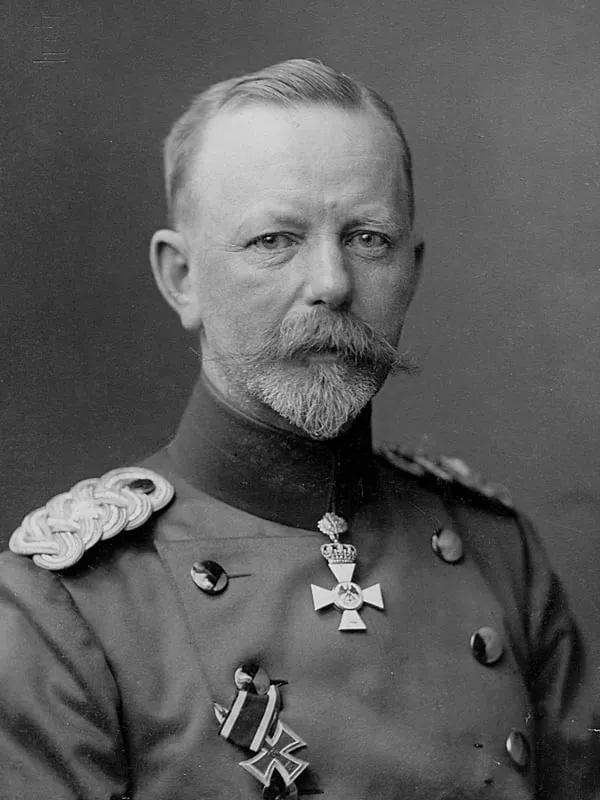
- Born:
- 27 November 1851, Wetzlar (Prussia)
- Died:
- 30 September 1936, Magdeburg
- Author:
- Łukasz Skowroń
- Photo:
- autor nieznany, CC BY-SA 3.0, Wikimedia Commons

Friedrich Sixt von Armin fought the British for longer than almost any other German general. His IV Corps met them as early as Mons and Le Cateau in August 1914, held them off at Loos in 1915 and on the Somme in 1916. From March 1917 until the end of the war Sixt von Armin commanded the Fourth Army in Flanders, which bore the brunt of the Third Battle of Ypres, the longest and most exhausting offensive of the British Army in this war. In Germany he was called the “Lion of Flanders”. Even so, he is today one of the least known German army commanders, in the shadow not only of Hindenburg and Ludendorff, but also of his own chief of staff, Fritz von Loßberg. In texts, British ones included, his name was often wrongly spelt “Sixt von Arnim”.
Before the war
He was born on 27 November 1851 in Wetzlar, the son of a lieutenant-colonel of the Prussian army whose family came from Switzerland. Straight after his school-leaving examination, in July 1870, he joined the 4th Guards Grenadier Regiment as an officer cadet. A month later, on 18 August, at the Battle of Gravelotte–St Privat, he was severely wounded in both legs and received the Iron Cross.
After the war he had a typical career as a General Staff officer, interspersed with service with the troops. He was chief of staff of the Württemberg XIII Corps and of the Guards Corps, and commanded an infantry regiment in Detmold. From 1903 to 1908, as a major-general, he headed the General Department of the Prussian Ministry of War, which was responsible for the army’s armament. He then took over the 13th Division in Münster, and in 1911 succeeded Hindenburg as commander of the IV Corps in Magdeburg. In 1882 he married the daughter of the Prussian General of Artillery Julius von Voigts-Rhetz. Two of his sons became officers.
1914–1916: the corps
In August 1914 the IV Corps marched on the right wing of the German invasion, in the First Army of General Alexander von Kluck. On 20 August it entered Brussels, and three days later at Mons it came up against the British. On 26 August its divisions, alongside the cavalry of General Georg von der Marwitz, were the first to attack General Smith-Dorrien’s II Corps at Le Cateau. The corps made the whole march on Paris and took part in the Battle of the Marne. In 1914 one of the general’s sons, Lieutenant Friedrich Wilhelm, was killed in France.
At the end of September, during the Race to the Sea, the IV Corps was transferred to the Sixth Army in Artois. It fought at Arras and La Bassée, and then for almost two years held the front in Artois. In 1915 it defended itself in the Second Battle of Artois, and in September at Loos, where the British used gas for the first time: its divisions then lost the small town of Loos, but stopped the British reserves and retook most of the Hohenzollern Redoubt.
In July 1916 the corps was sent to the Somme. On the morning of 14 July, the day on which the British took Bazentin Ridge in a surprise night attack, Sixt von Armin took command of the sector from Longueval to the Ancre. He found it in a critical state: as he wrote, “there were no rear positions, switch lines or communication trenches”. The commander of the Second Army, General Fritz von Below, gave him all the available reserves. For almost two weeks Group Sixt von Armin held the British back in Delville Wood, at Longueval and at Pozières, and on 26 July it handed the front over to the next corps. In September and early October the corps returned to the Somme a second time. On 10 August, on Below’s recommendation, Sixt von Armin received the Pour le Mérite.
He described his experiences of July in a lengthy report that covered everything from tactics in attack and defence, through communications and armament, to transport and rations. At the end of August the British captured his copy, and on 30 September 1916 Haig’s intelligence circulated it through the army in translation as “Experiences of the IV German Corps in the Battle of the Somme during July 1916”. In this way his conclusions also became known to British staff officers.
Fourth Army: Messines and Passchendaele
On 1 March 1917 Sixt von Armin took over from Duke Albrecht of Württemberg the Fourth Army, which defended Flanders from the coast to the area of Armentières. He was subordinate to the army group of Crown Prince Rupprecht of Bavaria. From the spring it was clear that the British were preparing an attack, but the Fourth Army staff underestimated the threat to the exposed Wytschaete salient. In April Rupprecht’s chief of staff proposed abandoning the salient, but the corps and division commanders objected. On 7 June, after the explosion of huge mines, the Second Army of General Herbert Plumer took the whole Messines Ridge in a single day. The German official history later judged that the mistaken assessment of British intentions was Sixt von Armin’s most serious error. The supreme command then gave him as chief of staff Colonel Fritz von Loßberg, the best German specialist in defence, who had been Below’s chief of staff on the Somme and chief of staff of the Sixth Army at Arras in the spring.
Loßberg rebuilt the defence in depth: a thin front line, behind it further positions and bunkers, and behind the front counter-attack divisions, ready to strike the attackers once they had gone beyond the range of their own artillery. When on 31 July the Fifth Army of General Hubert Gough began the Third Battle of Ypres, this system worked. On Pilckem Ridge and at Langemarck German counter-attacks retook ground, and rain and mud did the rest. On 3 August Sixt von Armin received the oak leaves to the Pour le Mérite.
In September Plumer changed his method. At the Menin Road, in Polygon Wood and at Broodseinde the British infantry took shallow strips of ground under cover of very heavy artillery and dug in at once, while the German counter-attack divisions ran into the barrage. The Fourth Army tried to adapt, at times thickening its front line, at times thinning it out, and suffered heavy losses. In October more and more soldiers slipped away to the rear, and on 11 October Sixt von Armin ordered “the severest measures” against them. The crisis was ended only by the autumn weather once again. After further attacks at Passchendaele the Canadians took the ruins of the village in November, but the front did not break, and the ports on the Belgian coast remained in German hands. On 25 December Sixt von Armin received the Order of the Black Eagle, the highest Prussian decoration.
1918: Kemmel and retreat
In April 1918 the Fourth Army attacked for the first time in a long while. In the plan for the offensive in Flanders it had been allotted several blows, but after Operation Michael Ludendorff no longer had enough divisions and heavy artillery, so only one remained. On 9 April the Sixth Army routed the Portuguese on the Lys, and on 10 April Sixt von Armin’s divisions crossed the river in fog and retook Messines Ridge, and then took Armentières and Bailleul. The British abandoned the Ypres salient, won with such difficulty, together with Passchendaele. On 25 April his troops, with the help of fresh divisions, stormed Mount Kemmel, defended by the French, the highest point in the area. Four days later, however, the attack on the Scherpenberg and Mont Rouge collapsed under Allied fire, and the Battle of the Lys petered out.
In the autumn the roles were reversed. On 28 September the Belgians, British and French under King Albert I, in the Fifth Battle of Ypres, retook all the high ground around the town within a few days. In October, at Kortrijk, they broke the front of the Fourth Army, which had to abandon the whole Belgian coast with its submarine bases and fall back to the Scheldt, and then towards the Antwerp–Meuse position. After the armistice Sixt von Armin took over from Rupprecht the command of the whole army group and led it out of Belgium into Germany. He completed its demobilisation in Paderborn, and on 2 January 1919 he retired.
After the war
He spent the rest of his life in Magdeburg, where he readily spoke at ceremonies and veterans’ gatherings. In 1924 the radical wing of the ex-servicemen’s association Stahlhelm tried to make him leader of the organisation in place of Franz Seldte, but without success. He kept out of politics and wrote no memoirs. He died on 30 September 1936 in Magdeburg and was buried with military honours. Barracks in Magdeburg bore his name, and in the days of the Bundeswehr so did barracks in his native Wetzlar. His son Hans-Heinrich, a lieutenant-general, was taken prisoner at the Battle of Stalingrad and died in captivity in 1952.
Assessment
Sixt von Armin was a staff-trained, matter-of-fact and experienced commander who knew his opponent well. His report from the Somme was valuable enough for the British to circulate it in their own army. Assessing his command in 1917 is made harder by the fact that the defence of Flanders is traditionally credited above all to Loßberg, who described it in detail in his memoirs after the war. Both men in fact shared the title of “Lion of Flanders”, together with the commander of the Marine Corps Flanders, Admiral Ludwig von Schröder. The German historian Markus Pöhlmann notes that Sixt von Armin himself left no memoirs and remains in the shadow of the more famous commanders of his era.
The balance of his war is mixed. At Messines in June 1917 his army suffered one of the most painful defensive defeats of the German army on the Western Front. In the following months, however, it withstood the longest British offensive in Flanders, and in April 1918 it recovered all the ground lost in 1917 and took Mount Kemmel. These gains can hardly be counted as his personal success, though: the offensive in Flanders was weakened from the start by a lack of reserves, and in the autumn the Fourth Army gave everything up in a few weeks, when the German forces were already exhausted.
Sources
Spotted a mistake?Report an error
Commanded in battles
(23)- 26 August 1914Battle of Le CateauWestern Front
- 25 September – 8 October 1915Battle of LoosWestern Front
- 14–17 July 1916Battle of Bazentin RidgeWestern Front
- 15 July – 3 September 1916Battle of Delville WoodWestern Front
- 23 July – 3 September 1916Battle of Pozières RidgeWestern Front
- 7–14 June 1917Battle of Messines (1917)Western Front
- 31 July – 2 August 1917Battle of Pilckem RidgeWestern Front
- 31 July – 10 November 1917Third Battle of YpresWestern Front
- 16–18 August 1917Battle of Langemarck (1917)Western Front
- 20–25 September 1917Battle of the Menin Road RidgeWestern Front
- 26 September – 3 October 1917Battle of Polygon WoodWestern Front
- 4 October 1917Battle of BroodseindeWestern Front
- 9 October 1917Battle of PoelcappelleWestern Front
- 12 October 1917First Battle of PasschendaeleWestern Front
- 26 October – 10 November 1917Second Battle of PasschendaeleWestern Front
- 9–29 April 1918Battle of the LysWestern Front
- 10–11 April 1918Battle of Messines (1918)Western Front
- 13–15 April 1918Battle of BailleulWestern Front
- 17–19 April 1918First Battle of Kemmel RidgeWestern Front
- 25–26 April 1918Second Battle of Kemmel RidgeWestern Front
- 29 April 1918Battle of the ScherpenbergWestern Front
- 28 September – 2 October 1918Fifth Battle of YpresWestern Front
- 14–19 October 1918Battle of KortrijkWestern Front
Often appears with
People who appear in the same events.