United Kingdom · The Entente
Douglas Haig
Commander-in-Chief of the British armies in France and Flanders (1915–1919), field marshal
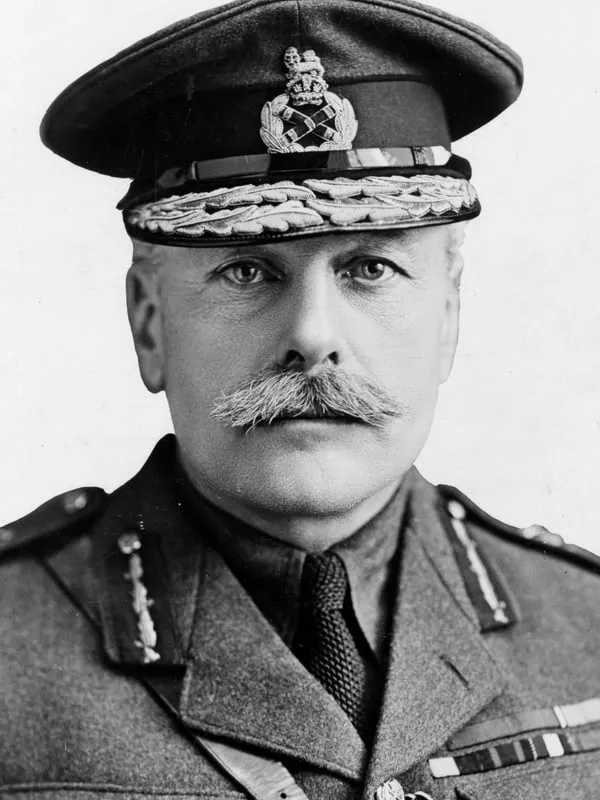
- Born:
- 19 June 1861, Edinburgh (Scotland)
- Died:
- 29 January 1928, London
- Author:
- Łukasz Skowroń
- Photo:
- Library of Congress, domena publiczna, Wikimedia Commons

Sir Douglas Haig, a field marshal from 1917 and Earl Haig from 1919, commanded the largest army in British history for three years, from December 1915 to the end of the war. At its peak nearly two million soldiers from the British Isles and the Dominions fought under his orders on the Western Front. He led them into the Battle of the Somme, at Arras and Passchendaele, survived the German offensive in the spring of 1918, and in the autumn led the victorious attacks that forced Germany to ask for an armistice. No other British commander of the war arouses such controversy. To some he was the architect of victory, to others a “butcher” who sent hundreds of thousands of men to their deaths in the hope of a breakthrough that never came.
Before the war
He was born on 19 June 1861 in Edinburgh, the youngest child of John Haig, owner of a well-known whisky distillery. He was educated at Clifton College, then from 1880 to 1883 studied at Oxford, where he devoted himself more to riding and polo than to his studies. In 1884 he entered the military college at Sandhurst, where he passed out top of his year, and in 1885 he was commissioned as a lieutenant in the 7th Hussars. He was a reserved, taciturn and very hard-working officer who spoke badly but organised superbly. At his second attempt he gained entry to the Staff College at Camberley.
In 1898 he fought in the Sudan under Kitchener, among other places at Atbara and Omdurman. In the Boer War he was chief of staff of the cavalry under John French, to whom he had lent money a year earlier to pay off his debts, and later commanded a column and the 17th Lancers. In 1904, aged 42, he was the youngest major-general in the army. In 1905 he married Dorothy Vivian, a maid of honour to the Queen, which strengthened his ties with the court. From 1906 to 1909 at the War Office he helped the Secretary of State for War, Richard Haldane, with his reforms: the creation of the Territorial Force and of an expeditionary force ready to be sent to the Continent. After three years in India, in 1912 he took over the Aldershot Command, whose troops were to become I Corps in the event of war.
1914: I Corps
At the council of war on 5 August 1914 Haig warned that the war would be a long one and advised against rashly sending the whole small professional army abroad. Even then he doubted French, and on 11 August he told King George V that he had grave doubts about his temper and military knowledge. His diary from these weeks survives only in a typed version, so some historians suspect that he later revised it.
At Mons on 23 August I Corps saw little fighting. During the retreat a night skirmish at Landrecies caused nervousness at its headquarters, and Haig’s exaggerated report alarmed French. A day later, while Smith-Dorrien’s II Corps was fighting at Le Cateau, I Corps retreated separately, on the other side of the Forest of Mormal. Haig took part in the battles of the Marne and of the Aisne, and in October his corps was moved to Flanders. In the First Battle of Ypres it was he who defended the most threatened sector east of the town. On 31 October, when the line broke at Gheluvelt, he rode out on the Menin Road to show himself to the retreating soldiers. By mid-November, of the roughly 18,000 men of I Corps fewer than 3,000 remained fit to fight. The belief that Haig had saved Ypres made him the army’s most highly regarded commander. In November he was promoted to full general, and when at the end of December the forces were divided into two armies, he took over the First Army.
1915: from Neuve Chapelle to Loos
The First Army carried out all the major British attacks of 1915. At Neuve Chapelle in March a short, concentrated bombardment allowed the village to be taken, but the breakthrough was not exploited. Haig drew the lesson that reserves had to be brought in faster. The attack on Aubers Ridge in May, on a wider front and against stronger defences, collapsed, and it was followed by the exhausting Battle of Festubert. Haig took an interest in innovations that might help: he worked with Hugh Trenchard’s airmen on photographing the trenches from the air, and at Loos he insisted on the use of chlorine.
He considered the ground at Loos unsuitable, but once the government agreed to the offensive he came to believe a breakthrough was possible. On 25 September his army took the first German position, but French’s reserves arrived too late. Haig wrote to Kitchener and told the King and Haldane that it was French who had lost the battle. Together with French’s chief of staff, General William Robertson, he worked for his removal. Not everyone considers this fair. Some historians point out that Haig himself had pressed for an attack in unfavourable conditions and that his own plan also contained mistakes. His appointment was announced on 10 December, and on 19 December 1915 he took over command of the British armies in France from French.
The Somme
Haig was convinced that the war could be won only on the Western Front, by defeating the main German forces. In this conviction he was supported by Robertson, Chief of the Imperial General Staff in London from December. He would have preferred to strike in Flanders to recover the Belgian coast, but at the request of Joffre he agreed to a joint offensive on the Somme, which after the opening of the Battle of Verdun was also meant to relieve the French. Haig hoped for a breakthrough, while the commander of his Fourth Army, General Henry Rawlinson, preferred limited “bite and hold” attacks. The compromise between the two concepts meant that the artillery fire was spread over too many targets.
On 1 July 1916 the British Army lost more than 57,000 men, the most in a single day in its history. Haig continued the battle for more than four months. He shifted the weight of the attack to the southern flank, where successes had been achieved, and on 15 September at Flers–Courcelette he sent tanks into battle for the first time in history. By mid-November the British had advanced at most about 10 kilometres, losing more than 419,000 men according to the official history. Haig’s supporters stress that on the Somme an army of volunteers learned how to fight, and that the Germans suffered losses from which, as their commanders admitted, they never recovered. Critics see the battle as indecisive slaughter. On 1 January 1917 the King made Haig a field marshal.
Lloyd George, Arras and Passchendaele
From December 1916 the Prime Minister was David Lloyd George, who trusted neither Haig nor the strategy of great offensives. He could not dismiss him, because the field marshal had the backing of the King, the Conservatives and part of the press. So he tried to restrict him. At the Calais conference in February 1917 he sought to subordinate him to the French commander-in-chief, General Robert Nivelle. It ended in a compromise for the duration of the spring offensive. Haig had to support it with an attack at Arras, which began on 9 April with the capture of Vimy Ridge but then turned into costly fighting. The Nivelle offensive collapsed, and mutinies broke out in the French Army.
Now Haig could carry out his Flanders plan. On 7 June General Herbert Plumer’s Second Army took Messines Ridge after the explosion of huge mines. Yet Haig entrusted the main offensive not to the methodical Plumer but to the younger and more impetuous General Hubert Gough. The Third Battle of Ypres began on 31 July, and almost from the first day the attacks bogged down in rain and mud. In September and early October Plumer achieved a series of successful limited attacks, but Haig, persuaded by his intelligence chief John Charteris that the Germans were on the verge of exhaustion, continued the offensive in ever worse conditions, until the Canadians took the ruins of Passchendaele in November. The battle cost each side about a quarter of a million men. Its aims also included drawing the Germans away from the French Army, weakened by the mutinies, and, as the Admiralty argued, seizing the submarine bases on the coast.
At Cambrai in November hundreds of tanks broke through the Hindenburg Line, but a German counter-attack took back most of the British gains. After this disappointment the government forced Haig to remove his closest associates, including Charteris and his chief of staff Launcelot Kiggell. In February 1918 Lloyd George also got rid of Robertson, and Haig, to the bitterness of his ally, did not stand up for him.
1918: from defeat to victory
On 21 March 1918 the Germans launched Operation Michael and routed Gough’s British Fifth Army, which held a long, weakly fortified front recently taken over from the French. Within a few days the Germans were approaching Amiens, and a gap threatened to open between the British and the French. Haig then demanded that a resolute general take charge of the operations of both armies. At Doullens on 26 March coordination was entrusted to Ferdinand Foch. Haig later claimed the credit for this appointment, and there is still debate over how reliable his account of those days is and whether he had considered a retreat towards the ports. On 9 April the Germans struck on the Lys in Flanders. Two days later Haig issued an order of the day in which he told his men to fight “with our backs to the wall” and to hold every position to the last man. The front held.
In the summer the tide turned. At Amiens on 8 August Canadians, Australians and British troops of Rawlinson’s Fourth Army broke through the German front, and Erich Ludendorff called it the black day of the German Army. Haig, against Foch’s wishes, halted the attack when it began to lose momentum and struck elsewhere. Blow followed blow, alternating between different sectors of the front. On 31 August the Chief of the Imperial General Staff, Henry Wilson, warned him in a “personal” telegram not to incur unnecessary losses in assaulting the Hindenburg Line. Haig understood this as a sign that the government would dismiss him in the event of failure, and attacked nonetheless. At the end of September his armies broke the Hindenburg Line, and on 29 September, the day of the assault on the St Quentin Canal, the German Supreme Army Command demanded that the government request an armistice. From 18 July to the end of the war Haig’s forces took more than 188,000 prisoners, not much fewer than all the French, American and Belgian armies together. The historian Gary Sheffield called this Hundred Days Offensive the greatest victory in the history of the British Army. In October, asked about the terms of the armistice, Haig warned that the German Army was not broken and advised moderate demands.
After the war
The government treated him coolly. Haig refused a viscountcy, which he regarded as an affront because the dismissed French had received the same, and used this refusal to force better provision for demobilised soldiers. In 1919 he was made an earl, received the thanks of both Houses of Parliament and £100,000. Until January 1920 he commanded the forces at home. He devoted the rest of his life to veterans. He brought about the unification of their organisations into the British Legion, founded in 1921, of which he was president, and the creation of the fund bearing his name, which raised money from the sale of poppies on the anniversary of the Armistice. He died of a heart attack in London on 29 January 1928. His funeral was a day of national mourning, and his coffin was carried on the same gun carriage that had borne the Unknown Warrior in 1920. He was buried at Dryburgh Abbey in Scotland, under a modest stone modelled on soldiers’ headstones.
Assessment
In his lifetime and just after his death Haig was a hero. The American commander John Pershing called him the man who won the war. Opinion turned after the publication of Lloyd George’s “War Memoirs” in the 1930s, in which the former Prime Minister described him as intellectually and temperamentally unequal to the task. The military historian Basil Liddell Hart, in time his bitter critic, accused him of sacrificing hundreds of thousands of men to his own ambition. From the 1960s, after Alan Clark’s book “The Donkeys” and the musical “Oh! What a Lovely War”, Haig became in the British mind the symbol of the general who, from a safe château behind the front, sent soldiers against the machine guns.
Some historians defended him. John Terraine, in a biography of 1963, argued that Haig pursued the only possible strategy and that the high losses resulted from the fact that after 1916 the British Army was fighting the main German forces. Gary Sheffield and John Bourne stress that under his command the army underwent an enormous transformation and by 1918 had become the most modern force on the front, with tanks, aircraft and precise artillery. Critics such as Robin Prior and Trevor Wilson point out that Haig too often disregarded the weather and the state of the battlefield, set objectives beyond the reach of the artillery, assigned the cavalry tasks it could not carry out, and dragged attacks on long after they had ceased to make sense. They add, however, that these mistakes were not his alone, and Tim Travers points rather to the rigidity of the whole pre-war officer corps. The dispute over Haig is thus, at bottom, a dispute over whether the victory of 1918 could have been achieved at a lower cost.
Sources
Spotted a mistake?Report an error
Commanded in battles
(79)- 23 August 1914Battle of MonsWestern Front
- 12–15 September 1914First Battle of the AisneWestern Front
- 19 October – 22 November 1914First Battle of YpresWestern Front
- 21–24 October 1914Battle of Langemarck (1914)Western Front
- 29–31 October 1914Battle of GheluveltWestern Front
- 11 November 1914Battle of Nonne BosschenWestern Front
- 20–21 December 1914Defence of GivenchyWestern Front
- 10–13 March 1915Battle of Neuve ChapelleWestern Front
- 9 May 1915Battle of Aubers RidgeWestern Front
- 9 May – 18 June 1915Second Battle of ArtoisWestern Front
- 15–25 May 1915Battle of FestubertWestern Front
- 25 September – 8 October 1915Battle of LoosWestern Front
- 2–13 June 1916Battle of Mount SorrelWestern Front
- 1 July – 18 November 1916Battle of the SommeWestern Front
- 1–13 July 1916Battle of Albert (1916)Western Front
- 14–17 July 1916Battle of Bazentin RidgeWestern Front
- 19–20 July 1916Battle of FromellesWestern Front
- 23 July – 3 September 1916Battle of Pozières RidgeWestern Front
- 3–6 September 1916Battle of GuillemontWestern Front
- 9 September 1916Battle of GinchyWestern Front
- 15–22 September 1916Battle of Flers–CourceletteWestern Front
- 25–28 September 1916Battle of MorvalWestern Front
- 26–28 September 1916Battle of Thiepval RidgeWestern Front
- 1–18 October 1916Battle of the Transloy RidgesWestern Front
- 1 October – 11 November 1916Battle of the Ancre HeightsWestern Front
- 13–18 November 1916Battle of the AncreWestern Front
- 22 February – 5 April 1917German retreat to the Hindenburg LineWestern Front
- 9–12 April 1917Battle of Vimy RidgeWestern Front
- 9 April – 16 May 1917Battle of Arras (1917)Western Front
- 9–14 April 1917First Battle of the Scarpe (1917)Western Front
- 23–24 April 1917Second Battle of the Scarpe (1917)Western Front
- 28–29 April 1917Battle of ArleuxWestern Front
- 3–17 May 1917Battle of BullecourtWestern Front
- 3–4 May 1917Third Battle of the Scarpe (1917)Western Front
- 7–14 June 1917Battle of Messines (1917)Western Front
- 31 July – 2 August 1917Battle of Pilckem RidgeWestern Front
- 31 July – 10 November 1917Third Battle of YpresWestern Front
- 15–25 August 1917Battle of Hill 70Western Front
- 16–18 August 1917Battle of Langemarck (1917)Western Front
- 20–25 September 1917Battle of the Menin Road RidgeWestern Front
- 26 September – 3 October 1917Battle of Polygon WoodWestern Front
- 4 October 1917Battle of BroodseindeWestern Front
- 9 October 1917Battle of PoelcappelleWestern Front
- 12 October 1917First Battle of PasschendaeleWestern Front
- 26 October – 10 November 1917Second Battle of PasschendaeleWestern Front
- 20 November – 7 December 1917Battle of CambraiWestern Front
- 21–23 March 1918Battle of St QuentinWestern Front
- 21 March – 5 April 1918Operation MichaelWestern Front
- 24–25 March 1918First Battle of BapaumeWestern Front
- 28 March 1918First Battle of Arras (1918)Western Front
- 5 April 1918Battle of the Ancre, 1918Western Front
- 9–29 April 1918Battle of the LysWestern Front
- 9–11 April 1918Battle of EstairesWestern Front
- 10–11 April 1918Battle of Messines (1918)Western Front
- 12–15 April 1918Battle of HazebrouckWestern Front
- 13–15 April 1918Battle of BailleulWestern Front
- 17–19 April 1918First Battle of Kemmel RidgeWestern Front
- 18 April 1918Battle of BéthuneWestern Front
- 24–25 April 1918Battle of Villers-BretonneuxWestern Front
- 29 April 1918Battle of the ScherpenbergWestern Front
- 8–11 August 1918Battle of AmiensWestern Front
- 8–15 August 1918Battle of MontdidierWestern Front
- 8 August – 11 November 1918Hundred Days OffensiveWestern Front
- 18 August 1918Battle of Outtersteene RidgeWestern Front
- 21–23 August 1918Battle of Albert (1918)Western Front
- 21 August – 3 September 1918Second Battle of the SommeWestern Front
- 26–30 August 1918Battle of the Scarpe (1918)Western Front
- 31 August – 3 September 1918Second Battle of BapaumeWestern Front
- 2–3 September 1918Battle of the Drocourt–Quéant LineWestern Front
- 12 September 1918Battle of HavrincourtWestern Front
- 12 September – 12 October 1918Battles of the Hindenburg LineWestern Front
- 18 September 1918Battle of ÉpehyWestern Front
- 27 September – 1 October 1918Battle of the Canal du NordWestern Front
- 29 September – 2 October 1918Battle of the St Quentin CanalWestern Front
- 3–5 October 1918Battle of the Beaurevoir LineWestern Front
- 8–9 October 1918Battle of CambraiWestern Front
- 17–25 October 1918Battle of the SelleWestern Front
- 1–2 November 1918Battle of ValenciennesWestern Front
- 4 November 1918Battle of the SambreWestern Front
Mentioned in battles
(14)Often appears with
People who appear in the same events.
On the timeline
(167)The 40 most important of 167 events. All tagged “Douglas Haig” (62) →
1914
1915
1916
June
July
September
October
- 01
- Key eventStart of the Battle of the Transloy RidgesOn 1 October 1916 the British Fourth Army attacked on the Somme at Eaucourt l’Abbaye and the Flers Line, aided by tanks and New Zealanders. Next day it rained.
- Key eventStart of the Battle of the Ancre HeightsOn 1 October 1916 the Canadians attacked Regina Trench beyond the Thiepval ridge on the Somme. Uncut wire and German marines repelled almost the whole assault.
November
December
1917
February
April
- 09
- Key eventBattle of Arras (1917) beginsOn Easter Monday, 9 April 1917, the British and Canadians attacked at Arras. In one day they advanced 5 km and took thousands of prisoners.
- Key eventAssault on Vimy RidgeOn 9 April 1917, in a snowstorm, four Canadian divisions attacked Vimy Ridge. By evening they held almost all of it except the highest point, Hill 145.