Key event
Battle of Loos begins
- Category:
- Military operations
- Front:
- Western Front
- Date:
- 25 September 1915
- Author:
- Łukasz Skowroń
- Battle:
- Battle of Loos
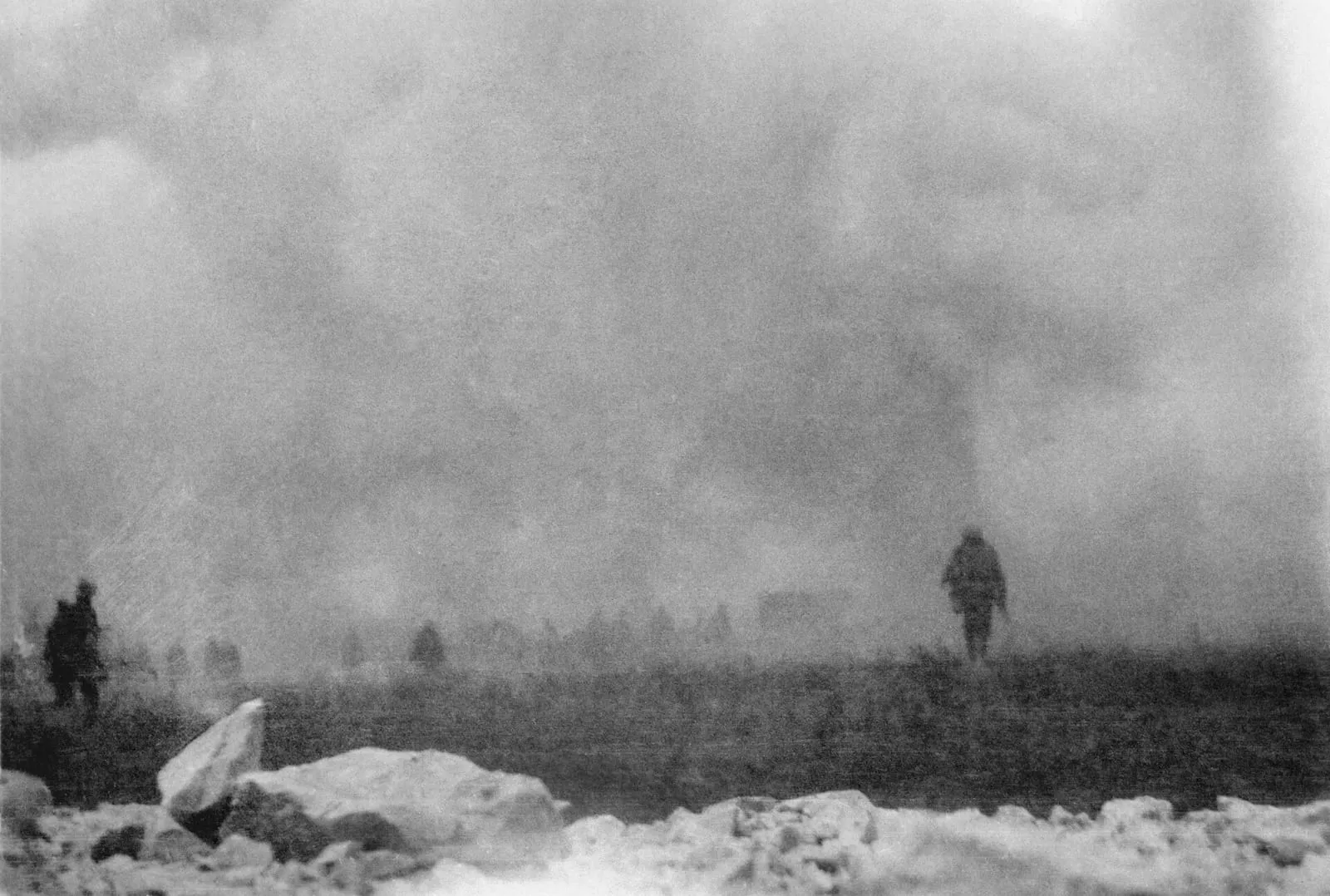
At 5.50 a.m. on 25 September 1915 British sappers in the front-line trenches between Grenay and the La Bassée Canal turned on thousands of cylinders of chlorine. Forty minutes later six divisions of General Douglas Haig’s First Army went over the top against the German trenches in the coalfield north of Lens. So began the Battle of Loos, the British part of the great autumn offensive of the Allies, which on the same day was also launched in Champagne and at Vimy. For the first time the British used poison gas on a large scale, and for the first time they sent divisions of Lord Kitchener’s New Armies into a major battle. By midday they had taken Loos, Hill 70, the Hohenzollern Redoubt and the Fosse 8 colliery, but the reserves that were to go on reached the vicinity of the front only in the evening.
The wind
Everything depended on the wind. The British had too few guns and shells to destroy the German defences. The four-day preparatory bombardment, from 21 to 24 September, in places did not even cut the wire. Gas was to make up for the missing artillery: to flow out of the cylinders, drift across no man’s land and overcome the defenders. According to the British official history, Haig had nearly 5,500 cylinders with 150 tons of chlorine at his disposal. The Germans had used gas at Ypres five months earlier, but the British had never yet released so large a cloud. In May at Festubert there had at most been talk of individual gas grenades.
During the night the wind dropped and veered from south-east to south-west. At 3 a.m. the First Army’s meteorologist, Captain Ernest Gold, told Haig that conditions were still favourable but uncertain, and that it was best to act as early as possible. Haig set the opening of the cylinders for sunrise, at 5.50, and the infantry assault for 6.30. When he left his headquarters at about 5 a.m., it was almost calm. At his request an aide-de-camp lit a cigarette, and the smoke drifted lazily to the north-east. At 5.15 Haig gave the order to proceed according to plan. A moment later he began to waver, and one of his officers telephoned I Corps headquarters to ask whether everything could still be stopped. General Hubert Gough replied that it was too late.
At 5.50 the artillery opened a hurricane bombardment, and a yellowish-white cloud of gas mixed with smoke, 10–15 metres high, rolled out of the trenches. The Germans were taken by surprise. They had stood to during the night, but at dawn, when nothing happened, some of the defenders went back to their dugouts. The wind, however, was very weak. In front of Loos and the Hohenzollern Redoubt the cloud reached the German trenches fairly well. In the centre of the front some of the gas blew back onto the British, and by the canal, in the 2nd Division’s sector, the release of gas was abandoned because it was drifting back. The soldiers wore the first British gas masks, flannel bags soaked in chemicals in which it was almost impossible to breathe, so many took them off.
Loos and Hill 70
At 6.30 the infantry left the trenches. On the right flank the Territorial 47th (London) Division had only to take the German front line and screen the rest of the attack on the side facing Lens. It did so quickly, in a cloud of smoke, and according to the British official history men of the London Irish Rifles battalion kicked a football ahead of them. To their left the 15th (Scottish) Division of the New Armies attacked. As they left their trenches, the Scottish battalions were raked by machine guns that had survived the bombardment. Some of the men halted, dazed by gas that had settled in their own trenches. The piper of the 7th Battalion of the King’s Own Scottish Borderers, Daniel Laidlaw, then marched up and down the parapet playing to rouse the men to the attack. Wounded, he went on playing, and was awarded the Victoria Cross for it.
The Scots crossed the German trenches and burst into Loos. They fought for every house and cellar, but soon after 8 the whole village, with the two steel towers of the pithead dominating the surrounding country, was in British hands. The intermingled battalions pressed on uphill to Hill 70 and crossed its summit. Here a mistake was made. Instead of heading east, towards the German second position, some 1,500 men swung south-east, towards the suburbs of Lens and a strongpoint on the eastern slope of the hill. There they were stopped by fire from the houses of the miners’ settlement. In the afternoon the Germans, reinforced by reserves, retook the redoubt on the summit, and the Scots dug in on the western slope.
The Hohenzollern Redoubt
In the centre of the front the right brigade of the 1st Division was held up for several hours in front of uncut wire by a solitary tree (Lone Tree) in no man’s land. The gas blew back onto its trenches here, and the defenders fired at the British lying in front of the wire. The left brigade, meanwhile, went on towards Hulluch. Only at about 2.30 p.m., when a battalion from the reserve got into the Germans’ rear, did more than 160 defenders at Lone Tree surrender. North of the road from Vermelles to Hulluch the 7th Division, one of the original divisions of the British Expeditionary Force, crossed the first position and reached the quarries near Hulluch, where it was stopped by fire from the German second position.
The greatest success was achieved by the 9th (Scottish) Division, the first of the New Army divisions to arrive in France, in May. Facing it lay the Hohenzollern Redoubt, a powerful work pushed out in front of the German line, and behind it the Fosse 8 colliery with a tall slag heap from which the Germans could see the whole battlefield. Here the gas worked best: most of the defenders abandoned the redoubt before the assault. The Scots took the redoubt, the colliery and the slag heap, and some of them went on even further and broke into the German second position opposite Haisnes. The division’s left wing, however, bled to death under fire from Madagascar Trench. In the far north, by the canal, the attack of the 2nd Division, which the gas had not helped, collapsed completely. Its battalions returned to their own trenches.
The reserves
At about 7 a.m. reports of the capture of the German front line began to reach Haig’s headquarters. Haig immediately sent an officer to the Commander-in-Chief, Field Marshal Sir John French, to ask for the reserves: XI Corps with two new divisions, the 21st and the 24th, and the Guards Division. French wanted to keep them in his own hands until he saw where the attack had succeeded. He had spent the night in a château near Lillers, connected with his staff only through the French telephone network and with no wire communication with the armies. Only at 9.30 did he agree to let the 21st and 24th Divisions move forward. Both divisions had arrived from England a few weeks earlier and had not yet been in the trenches. After a night march along crowded roads they reached their assembly area towards morning, tired, and their leading brigades set off at about 11.15. By the time they approached the front after dark, the Germans had already manned their second position.
In the evening the First Army held the German front line along almost the whole sector from Loos to the Hohenzollern Redoubt, but in improvised trenches broken by gaps. According to the British official history it lost 470 officers and about 15,000 men that day, roughly a sixth of those who took part in the fighting. The official history later concluded that in the morning the Germans had been in retreat and one more strong blow would have been enough to drive them out of the second position, but the Commander-in-Chief had kept the reserves too far back. That day, south of the British, the French Tenth Army attacked at Vimy, and in Champagne the Second Battle of Champagne began. Haig ordered the fresh divisions to attack the German second position on the morning of 26 September.
Remember the articles you have read? Only in this browser; nothing is sent anywhere.How it works
Read ·
A voice from the front
“Everybody seems very high spirited out here and grumbling is a thing of the past. I suspect that the weather is reason. Day after day is glorious — though night after night is cold. […] Love to the dear — I wish I were going to see you both again soon.”
Spotted a mistake?Report an error
Meanwhile
(04)Elsewhere in the same days.
- 25 September 1915 · MilitaryJames Wolfe Murray dismissedOn 25 September 1915 Gen. James Wolfe Murray ceased to be Chief of the Imperial General Staff. For almost a year he had remained in Kitchener's shadow.
- 25 September 1915 · Balkan FrontBulgaria begins mobilisationIn late September 1915 hundreds of thousands of reservists poured into Bulgarian barracks. Rifles and uniforms were short, and zeal was lower than in 1912.
- 25 September 1915 · Balkan FrontSerbia promises Dojran and Gevgelija to GreeceUnder 25 September 1915 the British chronology records that Serbia promised Greece the Dojran and Gevgelija area. Pašić hoped to win Greek help this way.
- 26 September 1915 · MilitaryArchibald Murray becomes Chief of the Imperial General StaffOn 26 September 1915 Gen. Archibald Murray became Chief of the Imperial General Staff. For three months he tried to give the General Staff its voice back.
Related events
(04)The same battle, people or subject.
- 8 October 1915 · Western FrontEnd of the Battle of LoosOn 8 October 1915 the Germans tried to retake Loos and their lost trenches. The Allies repulsed them, and British nomenclature ends the battle that day.
- 15 May 1915 · Western FrontStart of the Battle of FestubertAt 11.30 p.m. on 15 May 1915 the British 2nd Division and the Garhwal Brigade attacked the Germans at Festubert, the first British night attack of the war.
- 15 December 1915 · Western FrontResignation of John FrenchUnder 15 December 1915 a chronology records Field Marshal French's resignation. The government forced him to give up the British command in France after Loos.
- 19 December 1915 · Western FrontHaig becomes commander of British forces in FranceOn 19 December 1915 General Douglas Haig took over command of the British Expeditionary Force from John French. He was to command it until the end of the war.