United Kingdom · The Entente
John French
Commander-in-Chief of the British Expeditionary Force (1914–1915), field marshal
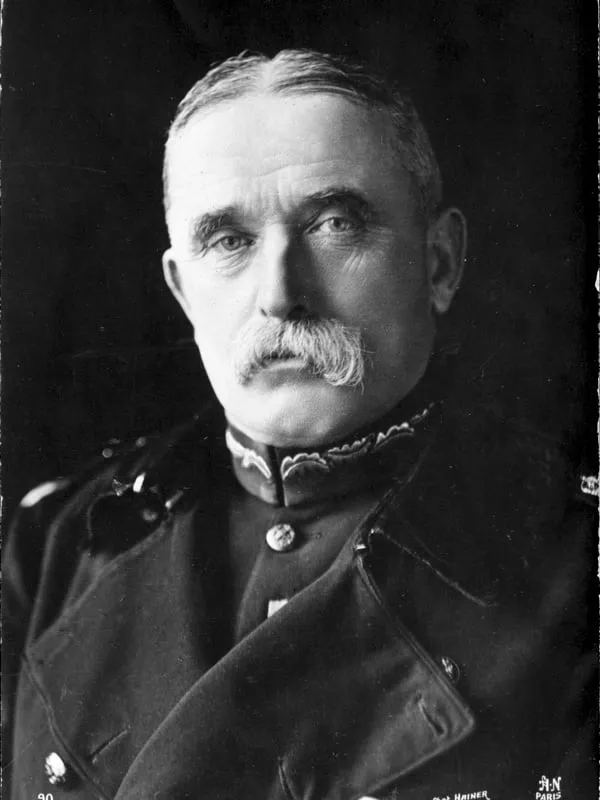
- Born:
- 28 September 1852, Ripple (Kent, England)
- Died:
- 22 May 1925, Deal Castle (Kent)
- Author:
- Łukasz Skowroń
- Photo:
- Hainer, Paris, domena publiczna, Wikimedia Commons

Field Marshal Sir John French commanded the British Expeditionary Force for the first year and a half of the war: from its departure for France in August 1914, through Mons, the Marne and Ypres, to the failed offensive at Loos in the autumn of 1915. He was a brave cavalryman, popular with the men, who had made his name in the Boer War, but war on the Continent proved beyond his experience and temperament. He quarrelled with the French, with the Secretary of State for War Lord Kitchener and finally with his own subordinates, one of whom, Douglas Haig, took his place. He later commanded the defence of the British Isles and from 1918, as Lord Lieutenant, governed Ireland.
Before the war
He was born on 28 September 1852 at Ripple in Kent, into the family of a naval officer. The family came from Ireland, from Frenchpark in County Roscommon, and French always regarded himself as an Irishman. At 14 he joined the Royal Navy, but he suffered from seasickness and a fear of heights, so in 1870 he transferred to the army. From 1874 he served in the 19th Hussars. He rose quickly, fought in the Sudan in 1884–1885 in the unsuccessful expedition to relieve General Gordon, and later commanded his regiment. In 1899 he was saved from bankruptcy, the result of speculation in mining shares, which would have forced him out of the army, by a loan of £2,500 from a junior officer, Captain Douglas Haig.
Fame came with the Second Boer War. On 21 October 1899 he won the action at Elandslaagte, and in February 1900 his cavalry division broke through the Boer lines with a charge at Klip Drift and on 15 February entered besieged Kimberley. His chief of staff at the time was Haig. He returned home a national hero, commanded the corps at Aldershot, became Inspector-General of the Forces in 1907, and on 15 March 1912 was appointed Chief of the Imperial General Staff, the professional head of the British Army. In June 1913 he received his field marshal’s baton.
In the spring of 1914 his career was interrupted by the so-called Curragh incident. When officers in Ireland declared that they would not obey an order to use force against Ulster, French signed a document giving assurances that the army would not be used to crush opposition to Home Rule. The government repudiated it, and on 6 April 1914 French had to resign. He had, however, long been earmarked to command the expeditionary force in the event of war, and in August he received the post.
1914: from Mons to the Marne
On 4 August 1914 French became Commander-in-Chief of the British Expeditionary Force. At the council of war on 5 August he even considered operating from Antwerp, but in the end the pre-war plan of concentration around Maubeuge was adopted. On 14 August he crossed to France. Lord Kitchener instructed him to cooperate with the French but not to come under their orders, and to avoid excessive losses, since the force was Britain’s only field army.
From the outset his relations with his neighbour on the right, the commander of the French Fifth Army Charles Lanrezac, went badly. Neither spoke the other’s language, and their very first meeting on 17 August ended in mutual dislike. At Mons on 23 August French was slow to believe reports of German strength and was still thinking of an advance that evening, but after Lanrezac’s withdrawal he had to order a retreat. On 26 August General Horace Smith-Dorrien’s II Corps, against his wishes, gave battle at Le Cateau. French believed the corps had been shattered and overestimated its losses.
In the last days of August he lost confidence in his allies. On 30 August he informed Joseph Joffre that his troops must leave the front for several days, even up to ten, and rest behind the Seine. The alarmed government sent Kitchener to Paris. On 1 September, at the British embassy, the minister ordered French to remain in the line. French felt humiliated, especially as Kitchener had come in field marshal’s uniform, and he never forgave him. On 5 September Joffre came to his headquarters at Melun and begged him to take part in the counter-offensive with the words “Monsieur le Maréchal, it is France who implores you”. Deeply moved, French replied that his soldiers would do everything humanly possible. On the Marne the British advanced into the gap between the armies of Kluck and Bülow, though they moved cautiously and slowly, and then reached the Aisne.
1914: Flanders
In the autumn French supported moving the force north, closer to the Channel ports. From 13 October his headquarters were at Saint-Omer. Together with Ferdinand Foch he believed that only weak German forces stood opposite, and he planned an advance on Roulers and Menin. Instead the British ran into new German armies and in the First Battle of Ypres defended themselves for a month with the last of their strength. On 31 October, when the front broke at Gheluvelt, French had no reserves left and drove to ask Foch for help. He later wrote that he had lived through the worst half-hour of his life.
At Ypres the old professional army bled to death. By the end of November the force had lost about 90,000 men. On 1 November at Dunkirk Kitchener proposed to Joffre that French be replaced by General Ian Hamilton, but Joffre refused. In November French confided to Haig that he thought he had suffered a heart attack, and the doctors ordered him to rest. At the end of December his forces were divided into two armies: Haig’s First Army and Smith-Dorrien’s Second Army.
1915: offensives and the shell crisis
French believed that the Western Front could be broken and opposed the transfer of troops to other theatres. At the meeting of the War Council on 13 January 1915 he pressed for reinforcements for an offensive in Flanders, but the politicians chose the Dardanelles. At Neuve Chapelle in March 1915 Haig’s First Army took the village, but the breakthrough was not exploited. In April, in the Second Battle of Ypres, French backed costly counter-attacks, and when Smith-Dorrien proposed on 27 April a withdrawal to a shorter line, he relieved him of command of the troops in the Ypres salient and gave it to General Herbert Plumer, who soon carried out a similar withdrawal. On 6 May Smith-Dorrien, whom French had detested for years, also had to give up the Second Army and return home.
On 9 May the attack on Aubers Ridge collapsed within a few hours. French decided that the lack of high-explosive shells was to blame and resolved to strike at Kitchener. He passed information to The Times correspondent Charles Repington, whose article appeared on 14 May, and his confidants showed the same documents to David Lloyd George and the opposition leaders. The shell scandal contributed to the fall of the Liberal government and the formation of a coalition, in which army supply was taken over by the Ministry of Munitions. Kitchener, however, remained in office, and French gained in him an even more implacable opponent.
Loos and dismissal
In the summer of 1915 there was more and more talk in London of his recall. He was criticised by Kitchener, by King George V and by his own chief of staff, General William Robertson, who wrote to London that the commander-in-chief changed his mind from day to day. French agreed to a joint offensive with the French in Artois, although the ground at Loos seemed unfavourable to him. On 25 September Haig’s First Army broke through the first German position, but the reserves, which French had kept under his own control far behind the front, arrived too late. The next day two inexperienced New Army divisions were routed. The Battle of Loos cost the British more than 50,000 men.
Haig blamed French for the failure and said so openly, including to the King. When French’s dispatch was published on 2 November, stating that he had released the reserves as early as 9.30 a.m., Haig demanded a correction. Prime Minister Herbert Henry Asquith decided that French had to go but wanted to spare him humiliation. Through Viscount Esher he offered him a peerage and a new post at home. French’s resignation reached the Prime Minister on 6 December and was announced in mid-December. He gave up command at noon on 18 December and was succeeded by Haig, although French had recommended Robertson.
Commander at home
From December 1915 French was the first Commander-in-Chief, Home Forces, responsible for defence against invasion, the training of drafts and air defence. In January 1916 he was created Viscount French of Ypres. In April 1916, after the outbreak of the Easter Rising, he sent two brigades to Ireland and chose General John Maxwell, who put down the rebellion.
He regarded the new post as a demotion and remained a bitter critic of Haig. In November 1916 the King rebuked him and told him to stop disparaging Haig. Prime Minister Lloyd George, however, was glad to hear his advice. In October 1917, during the fighting at Ypres, French submitted a memorandum to the War Cabinet in which he challenged the optimistic estimates of German losses produced at Haig’s headquarters, called further offensives on the Western Front a gamble, and advised waiting for the Americans and creating an Allied Supreme War Council.
Lord Lieutenant of Ireland
In May 1918, at the height of the crisis caused by the announcement of conscription in Ireland, French became Lord Lieutenant of Ireland. He agreed on condition that he would be a “military viceroy”. On the night of 17–18 May, on his orders, the leaders of Sinn Féin were arrested on charges of a plot with Germany, the evidence for which proved flimsy. Radicals such as Michael Collins remained at large, and support for independence grew. After the war French served as viceroy through most of the Irish War of Independence. He demanded martial law, and on 19 December 1919 near Dublin he narrowly escaped an IRA assassination attempt. He stepped down on 30 April 1921.
After the war
In 1919 he published his memoirs, “1914”, written with the help of a journalist. The book, full of inaccuracies and attacks on Kitchener, Haig and Smith-Dorrien, caused a storm, and Smith-Dorrien called it largely fiction. In 1921 French retired, and in 1922 he was created Earl of Ypres. He spent his last years as honorary Captain of Deal Castle in Kent, where he died of cancer on 22 May 1925. At the funeral in Westminster Abbey the pall-bearers included Haig, Robertson and Smith-Dorrien. His remains were laid to rest in his native Ripple.
Assessment
French aroused strong feelings. The soldiers loved him, which could never be said of Haig. Edward Spears, a liaison officer in 1914, wrote of him as a brave man who kept his head in danger, but who, once he had lost confidence in someone, ceased to take any account of them. Men from Haig’s circle, as well as the British official historian James Edmonds, judged him mercilessly as a vain, old-fashioned cavalryman. Winston Churchill, on the other hand, believed that French had a deeper feel for war than Haig and would not have driven the army into such long slaughters.
Modern historians agree that in 1914 he failed at the most important moments. Richard Holmes, his biographer, admits that he had “an undisciplined mind and a volatile personality”, but writes that history has treated him too harshly and that his influence on the soldiers helped the force survive the retreat. Brian Bond called him a gallant fighting general who found himself out of his depth. Max Hastings judges him far more severely and accuses him of collapsing after Le Cateau. Some scholars, such as Ian Beckett, point out that French grasped sooner than Haig that the war had become a gigantic siege in which artillery was decisive.
Sources
Spotted a mistake?Report an error
Commanded in battles
(22)- 7–25 August 1914Battle of the FrontiersWestern Front
- 23 August 1914Battle of MonsWestern Front
- 6–12 September 1914First Battle of the MarneWestern Front
- 12–15 September 1914First Battle of the AisneWestern Front
- 15 September – 19 October 1914Race to the SeaWestern Front
- 10 October – 2 November 1914Battle of La BasséeWestern Front
- 12 October – 2 November 1914Battle of Messines (1914)Western Front
- 13 October – 2 November 1914Battle of ArmentièresWestern Front
- 19 October – 22 November 1914First Battle of YpresWestern Front
- 21–24 October 1914Battle of Langemarck (1914)Western Front
- 29–31 October 1914Battle of GheluveltWestern Front
- 11 November 1914Battle of Nonne BosschenWestern Front
- 10–13 March 1915Battle of Neuve ChapelleWestern Front
- 17 April – 5 May 1915Fighting for Hill 60Western Front
- 22 April – 25 May 1915Second Battle of YpresWestern Front
- 24 April – 4 May 1915Battle of St. JulienWestern Front
- 8–13 May 1915Battle of Frezenberg RidgeWestern Front
- 9 May 1915Battle of Aubers RidgeWestern Front
- 9 May – 18 June 1915Second Battle of ArtoisWestern Front
- 15–25 May 1915Battle of FestubertWestern Front
- 24–25 May 1915Battle of Bellewaarde RidgeWestern Front
- 25 September – 8 October 1915Battle of LoosWestern Front
Mentioned in battles
(04)Often appears with
People who appear in the same events.
On the timeline
(51)The 40 most important of 51 events. All tagged “John French” (14) →
1914
August
September
October
- 19
- Key eventFirst Battle of Ypres beginsOn 19 October 1914 a British attack on Menin ran into new German corps. This was how the First Battle of Ypres began.
- British complete their move to FlandersOn 19 October 1914 Haig's I Corps finished detraining near Hazebrouck. The whole British army, moved from the Aisne, now stood in Flanders.
December
1915
January
- 24
- Murray leaves the BEF staffOn 24 January 1915 John French sent the BEF chief of staff, General Archibald Murray, on sick leave. The next day he demanded his resignation.
- Robertson ceases to be BEF quartermaster generalOn 24 January 1915 General William Robertson stepped down as Quartermaster General of the BEF to take over as chief of staff from Murray.
March
May
- 25
- End of the Battle of FestubertOn 25 May 1915 the London 47th Division took a German trench at Festubert and French decided to halt the offensive. Ten days of fighting cost 16,600 men.
- Asquith's coalition governmentOn 25 May 1915 Herbert Asquith formed a government with the Conservatives and Labour. Purely Liberal rule ended; Lloyd George took the Ministry of Munitions.