Key event
Battle of La Bassée begins
- Category:
- Military operations
- Front:
- Western Front
- Date:
- 10 October 1914
- Author:
- Łukasz Skowroń
- Battle:
- Battle of La Bassée
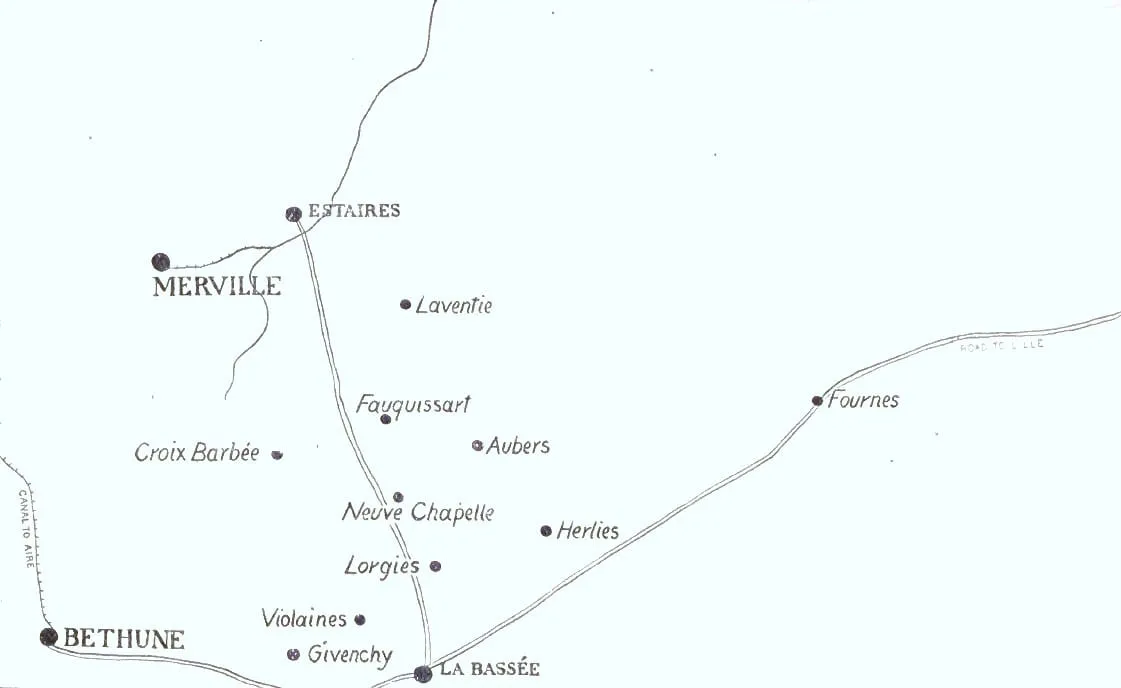
On 10 October 1914, according to the official British chronology, the Battle of La Bassée began. That day the British II Corps of General Horace Smith-Dorrien, freshly moved from the Aisne, was approaching Béthune by a rapid march to take its place on the left wing of the French armies. In this way the British entered the last stage of the Race to the Sea, which over the following weeks was to be decided on the plains of French and Belgian Flanders.
The British in the north
From the beginning of October the British Expeditionary Force had been secretly leaving the Aisne front. II Corps, made up of the 3rd and 5th Divisions, arrived by train in the Abbeville area on 8 and 9 October. The commander of the British army, Field Marshal John French, did not wait for the whole army to assemble. On the evening of 8 October he ordered Smith-Dorrien to move east the next day and reach the left wing of the French Tenth Army near Béthune.
The situation in the north was uncertain. The French Tenth Army had just held Arras, but its left wing ended at Vermelles, south of the La Bassée Canal. Further north, as far as Dunkirk, there were only French cavalry and Territorial divisions, while German cavalry corps were ranging deep to the west. That same day Antwerp fell, freeing further forces for the Germans.
10 October
General Ferdinand Foch, who was coordinating the French armies in the north, handed over to the British buses that could carry almost 10,000 soldiers. Thanks to them, and by forced marching, the divisions of II Corps covered about 35 kilometres from their billets on 10 October and by evening stood around Diéval and Pernes, north-east of Saint-Pol. Their flanks were covered by the British cavalry divisions, which were to secure the line from Merville to Hazebrouck, from where the German cavalry had recently withdrawn. Around Saint-Omer another corps, III Corps, began to detrain.
That same day French met Foch at his headquarters in Doullens. They agreed that the French and British forces in the north would go over to a joint advance eastwards, with the British to outflank Lille from the north. The Allies hoped finally to get ahead of the Germans in the race and reach the rear of their right wing.
First clashes
II Corps went into action only two days later. On 11 October it reached Béthune and took over a sector along the canal from the French cavalry. On the morning of 12 October news came that the French XXI Corps had lost Vermelles. Smith-Dorrien, not wanting to lose contact with the French, directed his divisions straight east, towards La Bassée. In front of the British stretched a flat, marshy plain criss-crossed by ditches, hedges and canals, and German cavalry and Jäger defended every farm.
The very first days showed that there was no question of quickly outflanking the Germans. On 13 October the Germans retook the village of Givenchy, and II Corps lost almost a thousand men that day. Instead of a manoeuvre began weeks of bloody fighting for every village between Givenchy and Neuve-Chapelle. The Germans held La Bassée until the autumn of 1918.
Remember the articles you have read? Only in this browser; nothing is sent anywhere.How it works
Read ·
A voice from the front
“It was very puzzling to make out what was happening, for we had not even the vaguest idea where the rest of our own Army was, let alone the French or Germans. Nobody seemed to know anything, except that we should probably soon be fighting again.”
Spotted a mistake?Report an error
Meanwhile
(04)Elsewhere in the same days.
- 10 October 1914 · PoliticsKing Carol I of Romania diesOn 10 October 1914 King Carol I of Romania, a backer of the alliance with Germany, died. His nephew Ferdinand I, closer to the Entente, took the throne.
- 9 October 1914 · Eastern FrontRelief of PrzemyślOn 9 October 1914 cavalry of General Boroević's Third Army reached Przemyśl. After a failed assault the Russians drew back from the fortress behind the San.
- 9 October 1914 · Eastern FrontBattles of Warsaw and Dęblin beginOn 9 October 1914 the Germans reached the Vistula and moved on Warsaw. The British chronology dates the start of the battles of Warsaw and Dęblin to this day.
- 11 October 1914 · War at seaSinking of the cruiser PalladaOn 11 October 1914 the German U-26 torpedoed the Russian cruiser Pallada at the entrance to the Gulf of Finland. The ship blew up with all hands.
Related events
(04)The same battle, people or subject.
- 11 October 1914 · Western FrontThe British retake MervilleThe British chronology records the recapture of Merville on 11 October 1914. The British 1st Cavalry Division took the Lys town, linking up with the French.
- 12 October 1914 · Western FrontBattle of Messines beginsOn 12 October 1914 Allenby's British cavalry took the Mont des Cats in Flanders. The battle for the Messines ridge south of Ypres had begun.
- 2 November 1914 · Western FrontEnd of the Battle of La BasséeOn 2 November 1914 the Battle of La Bassée ended. The Indian Corps took over the front between Givenchy and Fauquissart from the exhausted British II Corps.
- 8 October 1914 · Western FrontFoch takes command in FlandersAccording to the British chronicle, on 8 October 1914 Foch took command of the Allied forces in Flanders. In practice his role was above all to coordinate them.