1915: The autumn offensive – Loos and Champagne
Battle of Loos
- Dates:
- 25 September – 8 October 1915
- Front:
- Western Front
- Location:
- The coalfield north of Lens, between Grenay and the La Bassée Canal, around the villages of Loos (today Loos-en-Gohelle), Hulluch and Auchy-les-Mines, Pas-de-Calais department, FranceOn the battle map →
- Sides:
- United KingdomJohn French, Douglas Haig, Henry Rawlinson, Hubert Gough, Richard HakingGerman EmpireRupprecht, Crown Prince of Bavaria, Friedrich Sixt von Armin, Eberhard von Claer
- Result:
- German defensive victory. The British took Loos and a salient up to about 3 kilometres deep, but did not break the German second position and lost more than twice as many men as the defenders.
- Author:
- Łukasz Skowroń
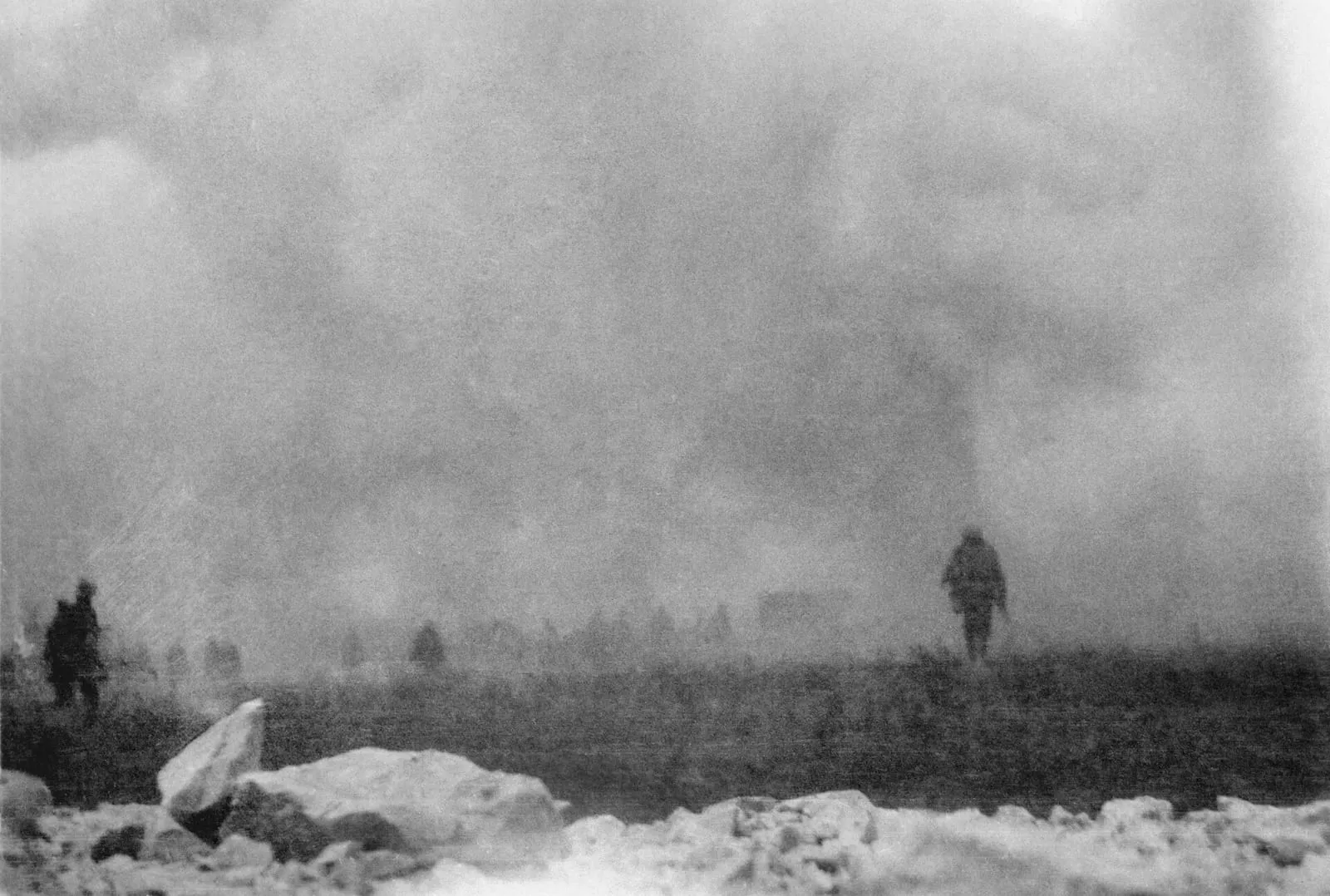
The Battle of Loos was the largest British offensive of 1915 and the British part of the great Allied autumn offensive on the Western Front. On 25 September 1915 six divisions of General Douglas Haig’s First Army went into the attack in the coalfield north of Lens, behind a cloud of chlorine released from more than 5,000 cylinders. It was the first time the British had used poison gas on such a scale and the first time they had thrown divisions of the New Armies, the volunteers recruited by Lord Kitchener in 1914, into a great battle. On the first day they took the village of Loos, Hill 70 and the Hohenzollern Redoubt and in several places went through the whole German first position. The reserves that were to exploit this success, however, stood far behind the front. When on the following day two inexperienced divisions attacked the second position, they were shattered within a few hours. The fighting dragged on into October and cost the British about 50,000 men. The dispute over who was to blame cost the commander of the British Expeditionary Force, Field Marshal John French, his post.
Name and dates
On this page we use the dates 25 September – 8 October 1915. That is how the battle was defined by the British Battles Nomenclature Committee set up after the war. On 8 October the Germans made their last great counter-attack, which the British beat off. The committee named the fighting for the Hohenzollern Redoubt from 13 to 19 October separately as the Actions of the Hohenzollern Redoubt.
James Edmonds’s British official history did not adopt this division. It saw no reason to change the name and treats the October attacks as part of the Battle of Loos. It counts losses up to 16 October. In the end Haig gave up a further offensive only on 4 November, when the autumn rain and German shelling had destroyed the jumping-off trenches for the next attack, planned for 7 November. The preparatory artillery bombardment lasted from 21 to 24 September.
Background
The plan of the autumn offensive was the work of the commander-in-chief of the French army, General Joseph Joffre. He wanted to strike simultaneously in Champagne and in Artois, tear open the German front and force the Germans to retreat. The British were to attack north of the French Tenth Army, which was once again advancing on Vimy Ridge. At the Calais conference in July London was still arguing that in 1915 the West should stay on the defensive. The change came in August. Russia was losing, fortress after fortress was falling, and the Secretary of State for War, Lord Herbert Kitchener, decided that the Russians had to be relieved. During a visit to France he told French that the British must act “with all energy” and do everything to help the French, “even though, by doing so, we suffered very heavy losses”. On 21 August, the day after the fall of Novogeorgievsk, he confirmed this by telegram.
Neither French nor Haig wanted to fight in this place. The ground north of Lens was flat and treeless, built over with rows of miners’ cottages, pithead towers and slag heaps, from which the Germans had excellent observation. The British official history writes that it is hard to imagine a less promising place for a great offensive. Haig believed he had too few heavy guns and too little ammunition to destroy the German defences. Joffre and General Ferdinand Foch, however, insisted that the British attack precisely here, next to the French.
The Germans had been fortifying this sector all summer. Behind the first position, with strongpoints such as the Hohenzollern Redoubt, they built a second one, several kilometres further back, generally behind a ridge, out of sight of the British artillery observers. It was held by General Friedrich Sixt von Armin’s IV Corps and part of VII Corps of the Sixth Army of Crown Prince Rupprecht of Bavaria. According to the British official history, at first only 13 battalions stood in the sector of the attack, about 10,000–11,000 men of the 117th and 14th Divisions, against 75,000 British.
Gas and the plan
Since guns and shells were in short supply, Haig decided to replace part of the artillery with gas. The British, who at Ypres in April had themselves fallen victim to German chlorine, formed special companies of Royal Engineers over the summer under Lieutenant-Colonel Charles Foulkes. By 19 September almost 5,500 steel cylinders containing 150 tonnes of chlorine had been sent to France. About 8,000 soldiers carried them on their backs at night into the front-line trenches. The gas was to flow out of the cylinders through pipes laid over the parapet, and the wind was to carry it onto the German trenches together with smoke from smoke candles and shells. Everything therefore depended on the weather. Haig also prepared a fallback plan: in a bad wind only two divisions were to attack.
The attack, on a front about 10 kilometres long from Grenay opposite Lens to the La Bassée Canal, was to be made by two corps. General Henry Rawlinson’s IV Corps, with the Territorial 47th (London) Division, the New Army 15th (Scottish) Division and the 1st Division, was to take Loos, Hill 70 and the road to Hulluch. General Hubert Gough’s I Corps, with the 7th Division, the 9th (Scottish) Division, the first New Army division sent to France, and the 2nd Division, was to attack the Hohenzollern Redoubt, the Fosse 8 colliery with its slag heap, which the British called the Dump, and the quarries near Hulluch. In the rear waited the commander-in-chief’s reserve: General Richard Haking’s XI Corps with the Guards Division and two New Army divisions freshly arrived from England, the 21st and 24th, as well as the Cavalry Corps.
These reserves were the subject of the most important misunderstanding of the battle. Haig built his plan on the assumption that the 21st and 24th Divisions would be just behind the front and under his orders from the first moment, so he threw all six divisions of I and IV Corps into the first assault. French wanted to keep the reserve in his own hands. He did not trust the inexperienced divisions and intended to commit them only once he saw where the attack had succeeded. At a conference on 18 September he announced that the whole reserve would remain in the area of Lillers, more than 25 kilometres from the front. After Haig’s protests he agreed to move two divisions closer, but still did not place them under the orders of First Army.
25 September
For four days, from 21 to 24 September, the British artillery fired more than 250,000 shells, several times more than before Festubert, but still too few to destroy the defences and cut the wire everywhere. During the night before 25 September the wind weakened and changed direction. For several hours Haig hesitated over whether to use the gas. At 5.15 a.m. he gave the order, and at 5.50 a.m. the cylinders were opened. In the south and centre of the front the cloud mostly drifted towards the Germans, who were completely unprepared for it. Elsewhere it hung over no man’s land or blew back onto the British trenches. In the sector of the 2nd Division by the canal the gas could not be released towards the Germans at all.
At 6.30 a.m. the infantry left the trenches. On the right flank the Londoners of the 47th Division quickly took the German trenches and formed a defensive flank facing Lens, along two long slag heaps called the Double Crassier. One of the battalions went into the attack kicking a football ahead of it. The Scots of the 15th Division suffered heavy losses from machine-gun fire, but after 8 a.m. they took Loos and soon afterwards broke onto Hill 70. Instead of going east, towards the German second position, the intermingled battalions swung south-east in the confusion, over the summit towards the suburbs of Lens, and were driven back with losses. By evening the Germans had recovered the redoubt on the top of the hill. In the centre the 1st Division was held up for several hours in front of uncut wire by a solitary tree (Lone Tree), where the gas had blown back onto the British. Further north the 7th Division reached the quarries near Hulluch, and the 9th Division took the Hohenzollern Redoubt and Fosse 8, and its units even broke into the German second position. The attack of the 2nd Division by the canal collapsed completely.
In the morning it seemed that the front was breaking. The reserves, however, did not arrive. French had spent the night in a château near Lillers, without a telephone link to the army. The 21st and 24th Divisions had marched to their assembly positions all night along crowded roads and reached them exhausted, towards dawn. French released them only at 9.30 a.m., and their leading brigades set off at about 11.15 a.m. When they came near the front in the evening, the Germans had already manned the second position and brought up reinforcements. On the first day, according to the British official history, First Army lost about 15,500 men, almost a sixth of the soldiers who took part in the fighting. On the same day the French attacked in Champagne and at Vimy, and in subsidiary operations the British also attacked at Bois Grenier, Pietre and Bellewaarde.
26–27 September
During the night the Germans recaptured the quarries near Hulluch. On the morning of 26 September the 21st and 24th Divisions, which after the night marches had hardly slept and had long gone without a hot meal, were ordered to attack the German second position between the Bois Hugo wood and Hulluch. At 11 a.m. a dozen or so battalions advanced in regular waves across open ground, with weak artillery support. The German wire was intact, and machine guns fired from both flanks. After a few hours the battalions, which had lost most of their officers, began to fall back. The retreat eventually spread over almost the whole sector and stopped only at the former German front line. The two divisions lost more than 8,000 men in the battle, most of them on that one day. According to German accounts the defenders called the ground in front of their second position the “field of corpses of Loos” (Leichenfeld von Loos). That day the commander of the 7th Division, General Thompson Capper, was mortally wounded.
The Guards Division plugged the gap. On 27 September the Germans recaptured Fosse 8 and the Dump, and the commander of the 9th Division, General George Thesiger, was killed when he went to check the situation at the Hohenzollern Redoubt. In the afternoon the 2nd Guards Brigade took Chalk Pit Wood, but the attack on the Puits 14 bis colliery and Hill 70 broke down under machine-gun fire from Bois Hugo. It was then that 18-year-old Second Lieutenant John Kipling of the 2nd Battalion, Irish Guards, went missing, the only son of the writer Rudyard Kipling. His father searched for traces of him for years. The grave that the war graves commission attributed to him in 1992 was later doubted by some researchers.
To 8 October
After 27 September both sides brought up reinforcements. The German Guard Corps arrived from Russia. The French IX Corps took over the sector near Loos from the British, and the British 28th Division and the New Army 12th Division entered the fighting. On 2 October the commander of the latter, General Frederick Wing, was killed, the third British divisional commander to fall in this battle. On 3 October the Germans recaptured the Hohenzollern Redoubt. A joint attack with the French Tenth Army was postponed several times because the French were not ready in time. On the afternoon of 8 October the Germans struck first, with several regiments from the Double Crassier to the canal, to recover Loos and the lost trenches. The attack was beaten off, according to British estimates with a loss of about 3,000 men.
On 13 October the British tried once more to retake the Hohenzollern Redoubt and the quarries, again after releasing gas. The Territorial 46th (North Midland) Division lost almost 3,800 men in this attack, most of them in the first ten minutes. The poet Charles Sorley was also killed in October. Until early November the fighting was only with grenades for individual stretches of trench.
Losses
According to the British official history, from 25 September to 16 October, excluding the subsidiary attacks, the British lost 2,013 officers and 48,367 other ranks, in all more than 50,000 killed, wounded and missing. About 7,000 of them fell in the attacks from 13 October. About 800 officers and 15,000 men were killed or went missing without trace. Including the subsidiary attacks, losses exceeded 59,000–61,000 men according to various tallies. More than 20,000 of the fallen with no known grave are commemorated today by the memorial at Loos.
German losses were clearly smaller. The British official history, on the basis of data from the German military archives, gives for the main units in this sector from 21 September to 10 October 441 officers and 19,395 other ranks, of whom fewer than 5,000 were killed. Other tallies estimate German losses at Loos at about 26,000.
Significance
On the first day of the battle the British were closer to breaking the German front than ever before in this war. Gas and surprise allowed several divisions to go through the first position. There were not enough guns and shells, however, to destroy the defences and support the attack on the second position, and gas proved a capricious weapon, dependent on the wind. Above all, the handling of the reserves failed. The British official history states plainly that the commander-in-chief kept them too far from the front and that because of this the attack, which had begun so promisingly, came to a halt.
At Loos Kitchener’s volunteer divisions bled on a large scale for the first time. The 15th and 9th Scottish Divisions each lost 6,000–7,000 men. News of the losses reached almost every Scottish small town, and the defeat of the 21st and 24th Divisions became a byword in the army for bad command. Haig, in a letter to Kitchener and then in conversation with the King, blamed French. French, in a dispatch published in early November, claimed that he had handed the reserves to Haig as early as 9.30 a.m. Haig protested, and the dispute became a political affair. In December 1915 French stepped down, and Haig took over command of the British Expeditionary Force.
Spotted a mistake?Report an error