United Kingdom · The Entente
Herbert Kitchener
Secretary of State for War of the United Kingdom (1914–1916), field marshal
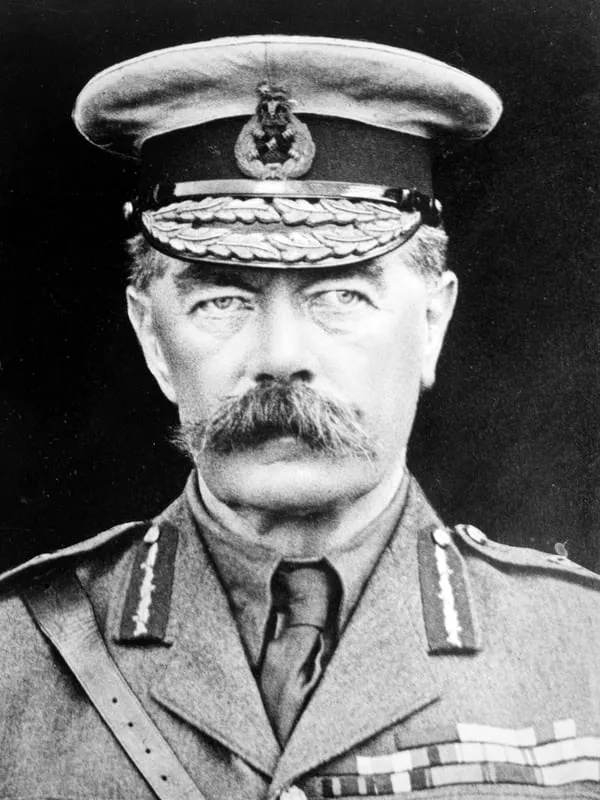
- Born:
- 24 June 1850, Gunsborough near Listowel (County Kerry, Ireland)
- Died:
- 5 June 1916, The sea off the west coast of Orkney
- Author:
- Natalia
- Photo:
- Elliott & Fry, domena publiczna, Wikimedia Commons

Horatio Herbert Kitchener, 1st Earl Kitchener, known as Lord Kitchener, was in 1914 the most famous soldier of the British Empire. The conqueror of the Sudan and a commander in the Boer War, he took over the War Office in the first days of the war and was one of the few who claimed from the outset that the conflict would last for years. From a small professional army he built the mass volunteer New Armies, and his face on a recruiting poster became one of the symbols of the war. As a minister, however, he was a difficult colleague who could neither share power nor work with politicians, and the shell crisis and the defeat at the Dardanelles undermined his position. He died in June 1916, when the ship taking him to Russia struck a mine.
Before the war
He was born on 24 June 1850 at Gunsborough near Listowel in County Kerry, Ireland, into the family of an English officer who had bought land there. He spent his childhood in Ireland and Switzerland, and then studied at the military academy at Woolwich. During the Franco-Prussian War he served as a volunteer in a French ambulance unit, for which he was reprimanded, because Britain was neutral. In 1871 he was commissioned into the Royal Engineers. For several years he surveyed Palestine and Cyprus, learned Arabic, and from 1883 served in the Egyptian Army, which was being rebuilt by British officers. In 1892 he became its commander-in-chief, the sirdar.
In 1896–1898 he methodically retook the Sudan from the Mahdi’s successors, building a railway as he went. On 2 September 1898 he routed their army at Omdurman, and a few days later, during the Fashoda incident, he forced the French to withdraw from the Upper Nile. He was created Baron Kitchener of Khartoum. In the Boer War he was chief of staff to Field Marshal Frederick Roberts, and from November 1900 commander-in-chief. In fighting the Boer guerrillas he burned farms and confined the civilian population in concentration camps, in which tens of thousands of women and children died. At the peace negotiations in 1902, however, he argued for milder terms than the governor, Alfred Milner.
In 1902–1909 he was Commander-in-Chief in India and reorganised the army there. His dispute with the Viceroy, George Curzon, over control of military affairs ended in 1905 with Curzon’s resignation. In 1909 Kitchener became a field marshal. He did not get the post of Viceroy of India that he coveted, and from 1911 he was British Consul-General in Egypt, in reality its ruler. In June 1914 he was created an earl. He was a solitary man and never married. He surrounded himself with a group of young officers devoted to him, but got on badly with his equals.
Secretary of State for War
The outbreak of war found him on leave in England. On 3 August he was already on a ship to France on his way back to Cairo when the Prime Minister, Herbert Henry Asquith, called him back. He was appointed on 5 August, and on 6 August he took over the War Office. A serving field marshal in the cabinet was a rare exception in British tradition, but the press and public opinion demanded precisely him.
Kitchener surprised his colleagues at once. While most politicians and generals expected a short war, he declared that it would last at least three years and consume millions of men. As early as 7 August he called for the first hundred thousand volunteers, and on 21 August the War Office ordered the first New Army to be formed from them. Kitchener did not trust the Territorial Force, so he built the new divisions from scratch, attached to the regular regiments. According to many historians this was a mistake, because the Territorial staffs and barracks could have speeded up the expansion of the army. The response exceeded all expectations. By the end of 1915 some 2.5 million volunteers had come forward, and from September 1914 a poster with his image and the slogan “Lord Kitchener Wants You” was in circulation. For lack of weapons, uniforms and instructors, the recruits drilled for a long time in civilian clothes.
At the war council on 5 August Kitchener argued that the expeditionary force should concentrate further from the border, around Amiens, fearing that at Maubeuge it would find itself in the path of the main German thrust. He was outvoted. He did, however, keep two of the six divisions at home, which according to some historians saved the force from even heavier losses. He instructed the commander of the force, John French, to cooperate with the French but not to come under their orders. When after Le Cateau French wanted to withdraw his troops from the front behind the Seine, Kitchener came to Paris on 1 September and ordered him to stay in the line. The two field marshals had known each other since the Boer War and from then on were enemies.
Kitchener was also thinking about the war with Turkey. On 31 October 1914 he promised Hussein, the Sharif of Mecca, protection and help if the Arabs supported Britain. This letter became the starting point for the talks out of which, two years later, the Arab Revolt grew.
The Dardanelles
At the beginning of 1915 Kitchener concluded that the Western Front had become a siege line that could not be broken, and he did not want to send the New Armies to France before they were ready. When Grand Duke Nicholas asked for relief for Russia, on 13 January he supported the naval attack on the Dardanelles proposed by Winston Churchill, because in case of failure the bombardment could be broken off. For a long time, however, he hesitated to send ground troops. In February he withdrew his consent to sending the regular 29th Division, which he released only in March, and on 12 March he gave command to General Ian Hamilton with very general instructions. After the fleet’s defeat on 18 March a land operation began, which became bogged down on the Gallipoli beachheads. Kitchener feared an evacuation to the end, believing it would damage Britain’s prestige in the Muslim world.
The shell crisis and the loss of power
In the spring of 1915 the Western Front was short of shells, especially high-explosive ones. After the failed attack at Aubers, French, convinced that Kitchener wanted to get rid of him, passed information about the shortages to the press. On 14 May The Times described the shell crisis, and on 21 May Lord Northcliffe’s Daily Mail accused Kitchener outright of a “tragic blunder”. Public opinion, however, sided with the minister, and copies of the paper were burned on the London Stock Exchange. In the coalition government formed on 25 May Kitchener kept the War Office, but the production of munitions was taken over by David Lloyd George’s new Ministry of Munitions.
In the summer Kitchener still preferred to stay on the defensive on the Western Front until the New Armies were ready. At the Calais conference on 6 July he agreed with Joffre on only limited attacks. Russia’s defeats in the summer of 1915, however, changed his mind, and in August he agreed to a great offensive, even though neither French nor Douglas Haig liked the ground at Loos. At a meeting of the Dardanelles Committee he said that war had to be made as one must, and not as one would like. The defeat at Loos sealed French’s fate.
By the autumn of 1915 his cabinet colleagues had had enough of Kitchener. They accused him of not telling them the whole truth, of deciding everything himself, of not using the General Staff and of being unable to discuss strategy. As the supply of volunteers dried up, pressure grew to introduce conscription, which Kitchener had long avoided. In October he agreed that recruiting should be directed by Lord Derby. On 4 November he left for the Dardanelles, and Asquith hoped to keep him there as commander in the East. Kitchener, rumour had it, took the seals of office with him so that he could not be dismissed in his absence. On the spot he inspected the beachheads and inclined towards their partial evacuation. In December the government decided to abandon Gallipoli, and the evacuation was completed in January 1916 almost without loss.
After his return Kitchener had to accept the loss of control over strategy. General William Robertson accepted the post of Chief of the Imperial General Staff on condition that he, and not the minister, would advise the government on operations. Kitchener was left with recruiting, armament and supply of the army. In January 1916 conscription was introduced. Kitchener also played a part in the removal of French and the appointment of Haig, for whom on 28 December 1915 he signed the instructions for the following year. He agreed reluctantly to the plan for a great offensive on the Somme, preferring limited attacks that would wear the Germans down, but in the end he supported it in the cabinet.
The last mission
In May 1916 Kitchener agreed to go to Russia to discuss arms deliveries, credits and joint plans with Tsar Nicholas II and his ministers. On 2 June he also met some two hundred MPs who had criticised his management of the War Office and explained his decisions to them. He left the meeting with their thanks. On 5 June 1916 he sailed from the Scapa Flow base aboard the cruiser Hampshire for Arkhangelsk. In the evening, during a storm, off the west coast of Orkney, the ship struck a mine laid by the German submarine U-75 and sank within a quarter of an hour. Kitchener died with his staff and almost the entire crew, and his body was never found.
The news shook the Empire. Haig is said to have asked how they would manage without him, and for many ordinary people he had been the guarantee of victory. Some politicians, however, received his death with relief. The sudden end of so famous a figure gave rise to many conspiracy theories, about treachery, spies and a bomb on board, but none has been confirmed. The War Office was taken over in July by Lloyd George. Among other places named in his honour was the Canadian town of Berlin in Ontario, renamed in 1916 as Kitchener.
Assessment
His contemporaries judged him in sharply different ways. The Cabinet Secretary, Maurice Hankey, wrote that within eighteen months Kitchener had built from scratch and fully equipped a national army capable of facing the greatest military power in the world. General Ian Hamilton, on the other hand, called him a “master of makeshifts” who hated organisation and destroyed it. Archibald Murray, Chief of the Imperial General Staff in 1915, considered him unfit to be a minister, and Asquith doubted his truthfulness. Kitchener was left with the image of an autocrat who had held all the army’s affairs in his hands for too long.
Since the 1970s, when new archives were opened, historians have partly rehabilitated him. George Cassar and others stress that he correctly foresaw the nature of the war, prepared the ground for the expansion of the arms industry and created the army without which Britain could not have taken over the main burden of the fighting on the Western Front in 1916. His critics accuse him of neglecting the Territorial Force by creating the New Armies from nothing, of delaying the expansion of shell production and of handling the Dardanelles affair irresolutely. They agree, however, that the New Armies, which fought on the Somme, at Arras and at Ypres, were his greatest achievement.
Sources
Spotted a mistake?Report an error
Mentioned in battles
(13)Often appears with
People who appear in the same events.
On the timeline
(69)1914
1915
January
February
March
May
June
July
August
September
October
- 28
- Bryan Mahon takes command of British forces in the BalkansOn 28 October 1915 Gen. Bryan Mahon became commander of the British forces in the Balkans. His Irishmen in Salonika were only preparing to move into Serbia.
- Charles Monro takes command at GallipoliOn 28 October 1915 General Charles Monro took command of the Gallipoli forces on Imbros. Three days later he advised London to evacuate the peninsula.
November
- 04
- Kitchener leaves for the DardanellesOn the night of 4/5 November 1915 Lord Kitchener left London to decide the fate of Gallipoli on the spot. Asquith took charge of the War Office.
- Monro and Birdwood receive new commandsOn 4 November 1915 Kitchener gave General Birdwood the command at Gallipoli and moved General Monro, who had advised evacuation, to Salonika.
- 10
- Indian Corps leaves FranceOn 10 November 1915 the Indian Corps was finally relieved on the front in France. Its two infantry divisions set off via Marseilles for Mesopotamia.
- Kitchener arrives at the DardanellesOn 10 November 1915 Lord Kitchener held talks at Mudros on the fate of Gallipoli. After seeing the beachheads he leaned towards a partial evacuation.
December
- 15
- Last Entente troops leave MacedoniaIn mid-December 1915 the last Entente troops left Serbian Macedonia. The Bulgarians halted at the Greek border and the Allies fell back towards Salonika.
- Resignation of John FrenchUnder 15 December 1915 a chronology records Field Marshal French's resignation. The government forced him to give up the British command in France after Loos.
- 22
- Kiggell replaces RobertsonOn 22 December 1915 Gen. Launcelot Kiggell became Chief of the General Staff of the BEF in succession to William Robertson, who was leaving for London.
- Resignation of Archibald MurrayOn 22 December 1915 Gen. Archibald Murray stepped down as Chief of the Imperial General Staff. He left behind a plan to concentrate forces in France.
1916
January
February
- 16
- War Office takes over air defenceOn 16 February 1916 the air defence of London passed from the Admiralty to Field Marshal John French, and soon after that of the whole country.
- War Office takes over the Mesopotamian campaignIn mid-February 1916 control of operations in Mesopotamia passed from the Government of India and the India Office to the War Office in London.
- 21
- Dismissal of Henry SclaterOn 21 February 1916 Gen. Henry Sclater ceased to be Adjutant-General of the British Army. His place at the War Office was taken by Nevil Macready.
- Macready leaves the BEF staffOn 21 February 1916 General Nevil Macready ceased to be Adjutant-General of the BEF. He had handled its manpower since the first days of the war in France.