United Kingdom · The Entente
Arthur Balfour
First Lord of the Admiralty (1915–1916), Foreign Secretary of the United Kingdom (1916–1919)
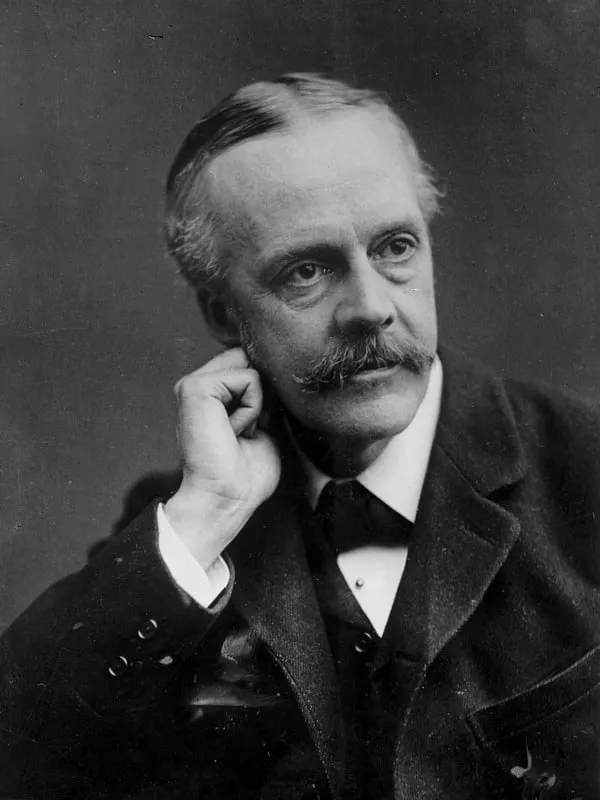
- Born:
- 25 July 1848, Whittingehame (Scotland)
- Died:
- 19 March 1930, Woking (England)
- Author:
- Natalia
- Photo:
- Bain News Service, domena publiczna, Wikimedia Commons

Arthur James Balfour was one of the few politicians who influenced British war policy throughout the war, even though he began it as a member of the opposition. A former Conservative Prime Minister, a philosopher and a master of parliamentary debate, in 1914 he joined Herbert Henry Asquith’s War Council, in May 1915 he replaced Winston Churchill at the Admiralty, and in December 1916, in David Lloyd George’s government, he took over the Foreign Office. In that post he passed the Zimmermann telegram to the Americans, went to Washington after the United States entered the war, and signed the declaration on a “national home” for the Jews in Palestine that bears his name to this day.
Before the war
He was born on 25 July 1848 at Whittingehame in the Scottish county of East Lothian, into a very wealthy family. His mother came from the Cecil family, and his uncle, Lord Salisbury, was a long-serving Conservative Prime Minister. After Eton and Trinity College, Cambridge, Balfour entered the House of Commons in 1874. For a long time he was regarded as a dilettante who dabbled in politics between philosophy, music and tennis, but as Chief Secretary for Ireland in 1887–1891 he surprised everyone with a toughness for which the Irish nationalists called him “Bloody Balfour”.
In July 1902 he succeeded his uncle as Prime Minister. His government concluded the Entente cordiale with France, and Balfour himself created the Committee of Imperial Defence, which from then on brought politicians, admirals and generals together in planning for war. He supported the naval reforms of Admiral John Fisher. A split among the Conservatives in the dispute over tariffs led him to hand power to the Liberals in December 1905, and in the 1906 election he suffered a heavy defeat. He led the party until 1911, when, after lost elections and the struggle over the powers of the House of Lords, he made way for Andrew Bonar Law. He nevertheless remained one of the most respected politicians in the country.
An opposition man in the War Council
After the outbreak of war the Conservatives suspended their disputes with the government, and Balfour became an informal adviser to the Liberal ministers. In November 1914 he joined the new War Council as the only representative of the opposition. Churchill kept him informed on naval matters. At the meeting of 28 January 1915 Balfour listed the advantages of an attack on the Dardanelles: taking the straits would cut the Turkish army in two, put Constantinople under the control of the Allies and open the way for Russian grain.
First Lord of the Admiralty
The crisis of May 1915, brought on by Fisher’s resignation and the shortage of shells, led to the formation of a coalition government. The Conservatives demanded Churchill’s removal from the Admiralty, and Churchill himself named Balfour as his successor. At the end of May Balfour took over the Admiralty. He was the only Conservative in that government to receive a department that was decisive for the conduct of the war. With the new First Sea Lord, Admiral Henry Jackson, he formed a calm and harmonious team, quite unlike the impetuous duo of Churchill and Fisher.
Balfour also sat on the Dardanelles Committee and on the War Committee. At the end of December 1915 it was he who confidentially informed the fleet commander, Admiral John de Robeck, of the decision to abandon Cape Helles. Critics, however, accused him of being too passive at the Admiralty. In April 1916, after the bombardment of Lowestoft and Yarmouth by German battlecruisers, he had to promise in a letter to the mayors of both towns that the fleet would be redeployed so that another raid would be very dangerous for the enemy.
The best-known episode of his tenure was the Battle of Jutland. The first British communiqué, which Balfour wrote himself and which reached the press on the evening of 2 June 1916, was restrained and candid: it listed all the British ships sunk and spoke cautiously about German losses. The public, which had been waiting for a second Trafalgar, took it as an admission of defeat, and the Germans proclaimed a victory. The Admiralty then had to explain that the fleet still commanded the North Sea. In the autumn of 1916, as the submarine war became ever more threatening, Balfour carried out the biggest changes in the naval command since the start of the war. On 29 November he announced that Admiral John Jellicoe would become First Sea Lord and that Admiral David Beatty would take over the Grand Fleet.
Foreign Secretary
In the December crisis of 1916 Balfour, although he was ill and although Lloyd George had earlier wanted to remove him from the Admiralty, sided with Asquith’s rival. After the Prime Minister’s resignation he took part in the conference with King George V, and his agreement to take the Foreign Office was one of the pillars on which Lloyd George built his government. He did not join the five-man War Cabinet, although he often attended its meetings, and the Prime Minister often handled important diplomatic matters through his own advisers, bypassing the Foreign Office.
On 23 February 1917 Balfour handed the United States ambassador Walter Hines Page the text of the Zimmermann telegram, intercepted and decoded by British intelligence. When in April the United States declared war on Germany, he led a mission to Washington to agree cooperation between the new allies. He talked with President Woodrow Wilson and his adviser Colonel Edward House, passed them the texts of the Entente’s secret agreements, and at the beginning of May addressed both houses of Congress.
On the Polish question he was cautious. As late as 1916 he warned that an independent Polish state separating Russia from Germany might, in a future war, cut France off from help from the east. After the February Revolution, when the Provisional Government itself promised Poland independence, Balfour telegraphed to Petrograd that Britain fully associated itself with this. In the autumn of 1917 his ministry recognised the Polish National Committee, and in June 1918 Britain signed the Versailles declaration on an independent Poland with access to the sea. In August 1918 Balfour signed the declaration by which London recognised the Czechoslovaks as an allied nation.
The Balfour Declaration
On 2 November 1917 Balfour signed a letter to Lord Rothschild assuring him that the government viewed with favour the establishment in Palestine of “a national home for the Jewish people”, without prejudice to the rights of the non-Jewish communities. The Balfour Declaration was the fruit of many years of effort by the Zionists, above all Chaim Weizmann, whom Balfour had known since 1906 and who had made a great impression on him. At the War Cabinet meeting of 31 October, however, Balfour argued mainly on political grounds: the declaration was to win Jewish opinion in Russia and America over to the Allied cause and to forestall similar steps by Germany. It concerned a country that still belonged to Turkey and whose Arab inhabitants nobody had consulted.
After the war
In 1919 Balfour was, alongside Lloyd George, the chief British delegate at the peace conference in Paris. After the signing of the Treaty of Versailles he handed the Foreign Office to Lord Curzon but remained in the government as Lord President of the Council. At the Washington Conference of 1921–1922 he represented the Empire in the negotiations on the limitation of naval armaments. In 1922 he was created Earl of Balfour. In 1925 he went to Palestine for the opening of the Hebrew University in Jerusalem. In 1925–1929 he was again Lord President of the Council in Stanley Baldwin’s government, and in 1926 he chaired the committee of the Imperial Conference that recognised the dominions as equal to Britain. He died on 19 March 1930 at his brother’s house in Woking and was buried at the family home of Whittingehame.
Assessment
Balfour divides historians to this day. His contemporaries admired his intelligence and composure, but reproached him for a cool detachment from people and affairs, known as “the Balfour manner”. Wartime critics believed that at the Admiralty he merely administered instead of preparing the fleet for the fight against submarines. Other historians point out that he was one of the few politicians during the war to pass from government to government without losing authority, and that his presence in Lloyd George’s Cabinet gave the Prime Minister the confidence of the Conservatives and of the allies.
The most lasting, and at the same time most contested, trace of his work remains the declaration of 1917. For Israelis it is the first international recognition of the Jews’ right to rebuild their homeland; for Palestinians, the beginning of the loss of their land. Historians argue whether Balfour was guided above all by wartime calculation, by a conviction of a historical debt to the Jews, or by British interest in the Middle East. Most agree that in 1917, like the whole government, he did not foresee how hard it would be to reconcile the two promises contained in a single sentence of his letter.
Sources
Spotted a mistake?Report an error
Mentioned in battles
(01)Often appears with
People who appear in the same events.
On the timeline
(69)The 40 most important of 69 events. All tagged “Arthur Balfour” (11) →