1916: The war at sea
Battle of Jutland
- Dates:
- 31 May – 1 June 1916
- Front:
- War at sea
- Location:
- North Sea off the western coast of the Jutland Peninsula, from the area of the Jutland Bank at the entrance to the Skagerrak to the Horns Rev reefs in the south (from several dozen to over a hundred nautical miles off the coast of Denmark)On the battle map →
- Sides:
- United KingdomJohn Jellicoe, David Beatty, Hugh Evan-Thomas, Horace HoodGerman EmpireReinhard Scheer, Franz von Hipper
- Result:
- Inconclusive. The Germans sank 14 British ships for the loss of 11 of their own and slipped away from the Grand Fleet, but did not break British supremacy in the North Sea or the blockade.
- Author:
- Łukasz Skowroń
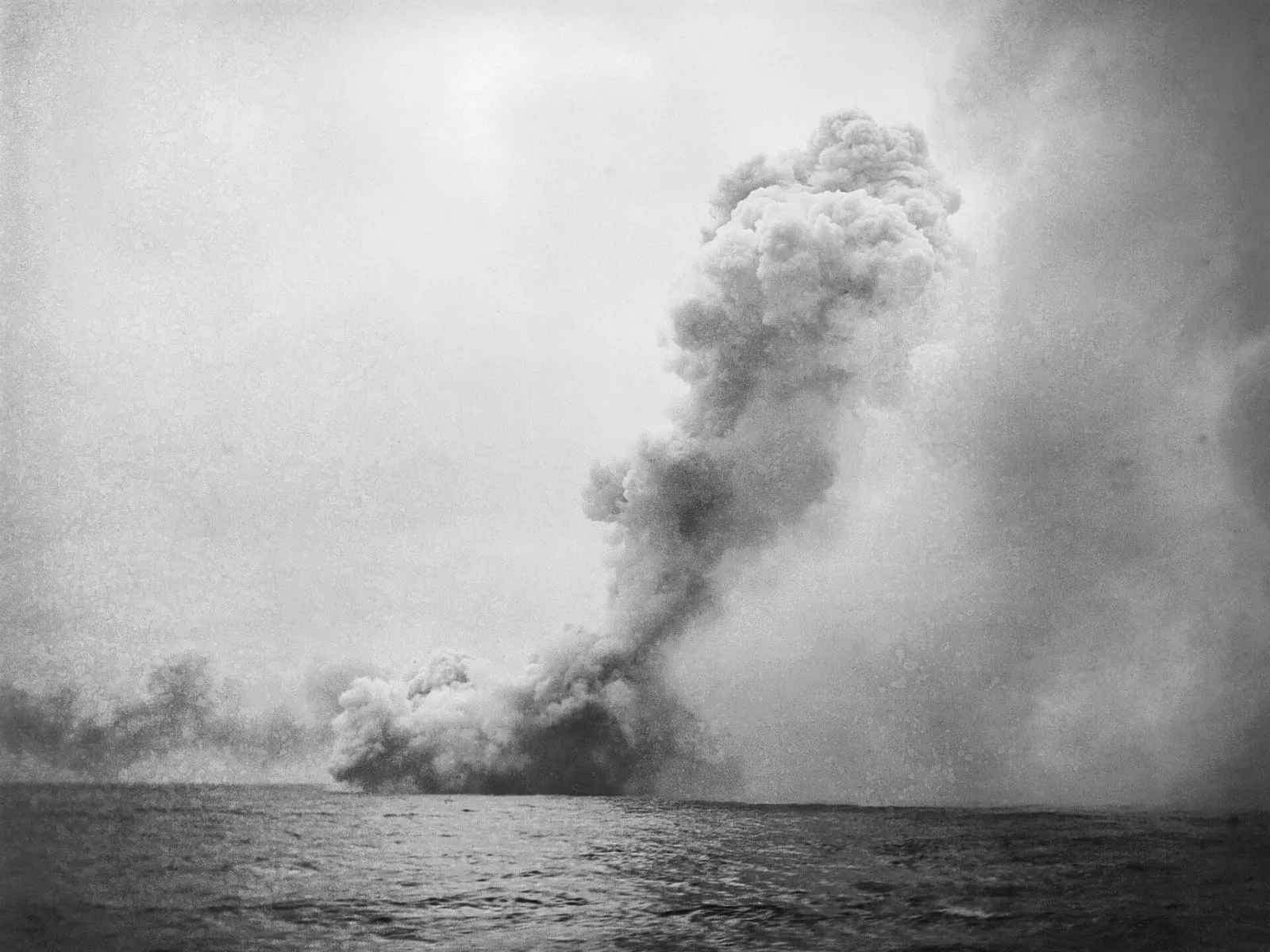
The Battle of Jutland was the only clash in the First World War between the main forces of the British Grand Fleet and the German High Seas Fleet, and the greatest battle of the age of the battleship. On the afternoon of 31 May 1916, in the North Sea off Jutland, the battlecruisers of Vice-Admiral David Beatty ran into the squadron of Vice-Admiral Franz von Hipper and lost two ships within a few dozen minutes. Hipper lured them under the guns of the whole German fleet, and Beatty in turn led the Germans straight onto the battleships of Admiral John Jellicoe. Twice within an hour the German commander, Admiral Reinhard Scheer, found himself in a trap, and twice he broke out of it by turning his whole fleet about under cover of a smokescreen. During the night he forced his way through the British destroyers behind the Grand Fleet, and by the morning of 1 June he was safe off the Horns Rev reefs. The British lost three battlecruisers, three armoured cruisers, eight destroyers and more than six thousand men; the Germans a battlecruiser, an old battleship, four light cruisers, five torpedo boats and about 2,500 men. Both sides claimed victory, and the dispute over who really won continues to this day.
Name and dates
In Britain and in Poland the battle is called the Battle of Jutland (Battle of Jutland), after the peninsula off whose western coast it was fought. The Germans call it the Battle of the Skagerrak (Skagerrakschlacht), after the strait towards which their fleet was heading. We adopt the dates 31 May – 1 June 1916. The first shots were fired on 31 May at 2.28 p.m., when the British light cruiser Galatea opened fire on German torpedo boats, and the last night and morning engagements ended on 1 June at about 2.30 a.m. At 3.30 a.m. the German fleet reached Horns Rev, and by noon Jellicoe had ended his fruitless search for damaged enemy ships and turned back to base.
Following the British official history by Julian Corbett, we give times in Greenwich Mean Time, which the Royal Navy kept. German accounts give later times, usually by an hour, which is why the same events are sometimes dated differently in the literature. The times in the British sources themselves also often differ by a few minutes, because each ship recorded them by its own clock.
Background
From January 1916 the High Seas Fleet was commanded by Admiral Scheer, an advocate of bolder action than his predecessors. He did not intend to take on the whole Grand Fleet, which had a clear superiority over the Germans, but wanted to lure parts of it out to sea and destroy them with superior forces. The first such attempt was the raid on Lowestoft in April. In May the situation seemed even more favourable to the Germans. After the crisis over the sinking of the Sussex, the submarine war against merchant shipping had been suspended, so the U-boats could cooperate with the fleet. The country, exhausted by the blockade and the slaughter at Verdun, expected some success from the navy on which it had spent enormous sums before the war.
Scheer planned a bombardment of Sunderland, the port nearest to Beatty’s battlecruiser base at Rosyth. Hipper’s battlecruisers were to draw the British from Rosyth onto Scheer’s battleships, and more than a dozen U-boats, stationed off the British bases from 15 May, were to attack the ships coming out of them. One of them, U-75, also laid mines off the western coast of the Orkneys. Airships were needed for reconnaissance, but for many days the weather prevented them from taking off, and the operation was also delayed by repairs to Seydlitz, damaged off Lowestoft. Since the U-boats would soon have to return, on 30 May Scheer chose the alternative plan. Hipper was to sail north along the coast of Denmark and show himself off Norway, as if hunting British cruisers and merchant ships in the Skagerrak, while the main force followed several dozen miles behind him. At the urgent request of Rear-Admiral Franz Mauve, Scheer also took along six old Deutschland-class battleships, although they were slower than the rest of the fleet.
The British once again knew that something was afoot. The decryption of German signals in the Admiralty’s Room 40, possible since the capture of the codebooks from the cruiser Magdeburg, indicated that the fleet was assembling in the Jade roads, though it did not reveal the aim of the operation. Jellicoe himself was in fact preparing a similar plan to lure the Germans out at the beginning of June, with a cruiser raid into the Kattegat. On 30 May at 5.40 p.m. the Admiralty ordered the Grand Fleet to sea. Before 10.30 p.m. the whole fleet was under way: Jellicoe from Scapa Flow, Vice-Admiral Martyn Jerram’s 2nd Battle Squadron from the Cromarty Firth, Beatty from Rosyth. The British had thus put to sea before the Germans had even left port. The German U-boats failed to torpedo anyone, and their reports convinced Scheer that the British squadrons had put to sea separately and for different purposes.
Hipper left the Jade during the night of 30–31 May, followed by Scheer. The Admiralty, however, made a fateful mistake. As was customary for the duration of an operation, Scheer had transferred his flagship’s call sign to the wireless station at Wilhelmshaven. According to an often-quoted account, an officer from the Admiralty’s Operations Division asked the cryptanalysts only where this call sign was transmitting from, and was told: from the Jade. At noon on 31 May Jellicoe therefore received a signal that, according to radio direction-finding, the German flagship had still been in port at 11.10 a.m. Jellicoe and Beatty therefore expected at most another cruiser raid and were in no hurry, and from then on Jellicoe lost his confidence in information from London.
Forces
According to the most frequently quoted figures, the Grand Fleet put to sea with 151 ships: 28 dreadnoughts, 9 battlecruisers, 8 armoured cruisers, 26 light cruisers, 78 destroyers, a seaplane carrier and a minelayer. The High Seas Fleet numbered 99 ships: 16 dreadnoughts, 6 pre-dreadnoughts, 5 battlecruisers, 11 light cruisers and 61 torpedo boats. The British also had a clear advantage in firepower, as their largest guns were of 343 and 381 mm calibre, while the German ones were at most 305 mm. The German ships, on the other hand, were better armoured and divided into more watertight compartments, and their shells penetrated armour more effectively.
The British forces sailed in two groups. In the north were Jellicoe’s 24 dreadnoughts with his flagship Iron Duke, armoured and light cruisers, and the 3rd Battlecruiser Squadron of Rear-Admiral Horace Hood (Invincible, Inflexible and Indomitable), which happened to be at Scapa Flow for gunnery practice. In exchange Beatty had been given Rear-Admiral Hugh Evan-Thomas’s 5th Battle Squadron, the four newest and fastest Queen Elizabeth-class battleships (Barham, Valiant, Warspite and Malaya) with 381 mm guns. Together with Beatty’s six battlecruisers (his flagship was Lion), this force was sailing about 70 nautical miles south-south-east of Jellicoe. Hipper had five battlecruisers: Lützow (the flagship), Derfflinger, Seydlitz, Moltke and Von der Tann, and Scheer was sailing about 50 miles behind him.
Course: the battlecruiser action
First contact. At about 2 p.m. Beatty, seeing no enemy, began to turn north as planned, to meet Jellicoe. At the same time the light cruiser Elbing of Hipper’s force sent torpedo boats to inspect the Danish steamer N.J. Fjord. Their smoke was spotted from the west by the British Galatea, which was sailing on the eastern wing of Beatty’s screen. At 2.20 p.m. she reported “enemy in sight”, and at 2.28 p.m. she opened fire. According to Scheer, without this chance steamer the two fleets might have missed each other. The British official history, however, considers that an encounter would have taken place anyway, only in conditions less favourable to the Germans.
Beatty turned south-east to cut the Germans off from their bases. His signal, made by flags, did not reach Evan-Thomas, however, whose battleships fell behind by nearly 10 miles. At about 3.10 p.m. a Short 184 seaplane took off from the carrier Engadine, with Flight Lieutenant Frederick Rutland and the observer G.S. Trewin. Before 3.30 p.m. it sighted the German light cruisers and reported their position by wireless. This is considered the first reconnaissance flight by an aircraft in a fleet battle in history. Its reports, however, were not passed on to Beatty, and after a fuel line failed the aircraft had to come down on the water.
The run to the south. At about 3.20–3.30 p.m. the two battlecruiser forces sighted each other. Hipper, in accordance with his task, turned back to the south-east to draw the British onto Scheer’s battleships. Beatty set off after him. At about 3.48 p.m. both sides opened fire at a range of about 15 kilometres. The British, whose guns had the longer range, waited too long, and against the bright western sky their ships were perfectly visible. In addition, because of a misunderstood signal, two British ships fired at the same target, and for nearly ten minutes Derfflinger was able to fire undisturbed without being shot at.
At about 4 p.m. a shell from Lützow pierced “Q” turret on Lion. Major Francis Harvey of the Royal Marines, mortally wounded, managed to order the magazine doors to be closed and the magazine flooded. The fire that engulfed the turret a moment later did not reach the cordite, and Harvey was posthumously awarded the Victoria Cross. A few minutes later, at the rear of the line, Indefatigable, hit by salvoes from Von der Tann, blew up and sank. Of more than a thousand men of her crew, according to most sources, two survived.
From about 4.08 p.m. Evan-Thomas’s battleships entered the fight, and their long-range fire began to tell on the Germans. At 4.26 p.m., however, Queen Mary fell victim to the concentrated fire of Derfflinger and Seydlitz. The ship was torn apart by a massive explosion, and a column of smoke rose above the spot where she sank. More than 1,260 men were killed; according to various sources between nine and about twenty survived. According to the memoirs of Lion’s captain, Ernle Chatfield, Beatty then said to him: “There seems to be something wrong with our bloody ships today.” Meanwhile the destroyers of both sides clashed between the lines. The British sank the torpedo boats V 27 and V 29, and one of their torpedoes hit Seydlitz, but two British destroyers, Nestor and Nomad, were also disabled and later sunk.
The run to the north. At 4.33 p.m. Commodore William Goodenough, who was sailing ahead of Lion in the cruiser Southampton, reported that he could see battleships to the south-east. It was the whole High Seas Fleet, which Beatty had believed to be in port. Goodenough approached to within roughly 12 kilometres to identify and count the ships, and only then turned away under a hail of shells. His reports were among the most valuable of the whole battle. At 4.40 p.m. Beatty turned north, now to lead the Germans himself under Jellicoe’s guns. Evan-Thomas again read the signal too late, and his battleships turned under the fire of the leading German dreadnoughts. Barham and Malaya were badly hit, but the powerful battleships withstood the bombardment and themselves dealt heavy blows to the Germans, especially to Hipper’s battlecruisers. At about 4.50 p.m. Jellicoe, having learnt of the German battleships, reported to the Admiralty that a fleet action was imminent.
Course: the fleet action
The deployment of the Grand Fleet. Jellicoe sent Hood’s battlecruisers ahead. At about 5.30 p.m. his light cruiser Chester ran into the light cruisers of Rear-Admiral Friedrich Bödicker and came under heavy fire. Among the dead was sixteen-year-old Jack Cornwell, who stayed at his gun to the end and was posthumously awarded the Victoria Cross. Hood rushed to the rescue, and his heavy guns turned the cruiser Wiesbaden into a burning wreck. Hipper’s torpedo boats sank the destroyer Shark, whose commander, Commander Loftus Jones, was also posthumously awarded the Victoria Cross. Hipper, convinced that he had the main British force in front of him, turned back towards Scheer.
At about 6 p.m. Beatty sighted Jellicoe’s battleships. The commander-in-chief was sailing in six columns of four ships each and had to form them into a single line of battle without knowing exactly where the enemy was. Both admirals’ reckonings of their positions were out by several miles, and the reports were unclear. To the question, asked twice, “Where is the enemy’s battle fleet?”, Beatty replied only at 6.14 p.m., when he himself saw the German battleships to the south-west. Within a few minutes Jellicoe took the decision regarded as crucial for the whole battle. At 6.15 p.m. he deployed the fleet into line on the port wing, the one farther from the enemy. Deployment on the starboard wing would have exposed his oldest ships to concentrated fire and torpedo attacks during the manoeuvre. As a result, the long line of British dreadnoughts emerged from the mist across the Germans’ course, “crossing the T”.
The manoeuvre took place amid enormous crowding and confusion. Beatty’s battlecruisers were cutting across the front of the battleships, while the destroyers and cruisers of both fleets raced to their stations. The place was later called “Windy Corner”. Rear-Admiral Robert Arbuthnot, with the armoured cruisers Defence and Warrior, went in to finish off the wreck of Wiesbaden and ran straight under the guns of the German battlecruisers and battleships. At 6.20 p.m. Defence blew up and sank with her entire crew of more than 900 men. Warrior, badly damaged, survived only because at that very moment the rudder of the battleship Warspite jammed. The ship made two circles under the nose of the German fleet, drawing its fire onto herself.
Hood’s death and Scheer’s first turn. Hood placed his three battlecruisers at the head of the British line and from a range of about 8 kilometres showered Lützow and Derfflinger with shells. Two hits below the waterline sealed the fate of Hipper’s flagship. At 6.30 p.m., however, the mist revealed Invincible, and several German salvoes hit her in a midships turret. The battlecruiser broke in two, and her bow and stern stuck out of the water for some time. Of more than a thousand men, six survived; Hood himself was killed. Hipper, whose ship could no longer fight, transferred to a torpedo boat.
Scheer realised that he had fallen into a trap: from the mist to the north and east long arcs of guns were firing at his ships, while he himself could see little. At 6.33 p.m. he ordered a manoeuvre that the Germans had been practising for years for exactly this eventuality: a simultaneous 180-degree turn by all ships (Gefechtskehrtwendung), under the cover of torpedo boats and a smokescreen. Within a few minutes the German fleet vanished from British sight. Jellicoe did not set off in direct pursuit, as he feared torpedoes and mines. He steered south-east and then south, to place himself between the Germans and their bases. At about 6.54 p.m. the battleship Marlborough was hit by a torpedo, most probably fired from the disabled Wiesbaden, but was able to carry on.
The second turn and the “death ride”. At about 6.55 p.m. Scheer, to the surprise of the British, turned east again. He himself later wrote that he had wanted to surprise the enemy with a blow at the centre of his line. The British official history considers that he was rather hoping to slip past astern of the Grand Fleet and had misjudged its position. At about 7.10 p.m. his leading ships again ran into the British line, which this time crossed their course even more precisely. Under the fire of more than a dozen battleships, Scheer ordered a turn for the third time. To cover it, he threw his torpedo boats and the remaining battlecruisers at the British line with the order: “Battlecruisers, at the enemy, ram!” The Germans later called this attack the “death ride” (Todesritt). The ships of Captain Johannes Hartog of Derfflinger took dozens of hits, and Derfflinger lost two turrets. At about 7.20 p.m. Scheer recalled them, once his battleships had turned away.
On seeing the torpedo boat attack, Jellicoe turned his fleet away, first by two and then by another two points. According to figures in the literature, none of the several dozen torpedoes fired found its mark, but the distance between the fleets increased, and the Germans once again vanished in the smoke. In this phase of the battle the torpedo boats S 35 and V 48 were sunk. This manoeuvre later became the British commander’s most criticised decision, because his opponents believed it had cost the British their last chance of destroying the High Seas Fleet before nightfall.
Dusk. The sun set at about 8.07 p.m. At about 8.20 p.m. Beatty’s battlecruisers attacked Hipper’s ships for the last time, and Mauve’s old battleships shielded them with their own hulls. Scheer turned once more, this time to the west, and the day battle came to an end. The main forces of both fleets exchanged fire for a very short time in total, and at the crucial moments the British battleships saw only individual silhouettes of the German fleet in the mist and smoke.
Course: the night and 1 June
Jellicoe did not want to fight a decisive battle at night, for which his fleet was not prepared, and in the dark it was easy to mistake one’s own ships for the enemy’s. He decided to sail south and resume the battle at dawn, with the enemy between himself and the open sea. He stationed all his destroyers five miles astern of the battleships. The Germans had three routes home: past the Horns Rev reefs, west of Heligoland, or along the Frisian coast. At 9.14 p.m. Scheer, determined to break through by the shortest route whatever the cost, ordered a course for Horns Rev and called for airships over the reefs at dawn. Room 40 intercepted both orders. The Admiralty passed the course on to Jellicoe but omitted the call for airships. The signal reached him late, and it gave a position for the German fleet that seemed implausible to him. So he did not change course.
During the night the High Seas Fleet cut across the rear of the Grand Fleet, leaving behind it a trail of short, violent engagements at ranges of a few hundred metres, in the glare of searchlights and star shells. At about 10.35 p.m. Goodenough’s cruisers clashed with German light cruisers. A torpedo from Southampton sank the old cruiser Frauenlob, taking more than 300 men down with her. From about 11.20 p.m. one destroyer of the 4th Flotilla after another attacked the German line and was destroyed in turn. The flotilla leader Tipperary burned, and with her died the flotilla’s commander, Captain Charles Wintour. The destroyer Spitfire collided with the German battleship Nassau and returned to port with a piece of her plating on deck. The light cruiser Elbing, avoiding torpedoes, was rammed by the battleship Posen, and Rostock was hit by a torpedo. The Germans later scuttled both themselves. The armoured cruiser Black Prince, which had lost contact with the fleet in the afternoon, sailed straight into the German battleships at about midnight. Within minutes she was turned into a burning wreck and blew up with her entire crew of about 850 men. The destroyers Ardent, Fortune and Turbulent were also lost, and Sparrowhawk, after collisions with her own ships, had to be scuttled in the morning.
At about 2 a.m. the Germans sank the wreck of Lützow with a torpedo, after torpedo boats had taken off more than a thousand men of her crew. At about 2.10 a.m. the last major attack was made by Captain Anselan Stirling’s 12th Flotilla. One of its torpedoes hit the pre-dreadnought Pommern, which blew up and sank with her entire crew of more than 800 men. Stirling’s reports of German battleships, like most of the night observations of British ships, did not reach Jellicoe. The battleships at the rear of the British line did see the firing, and some also saw German ships, but they took it to be the repulse of destroyer attacks and did not report it. Three British submarines lay on the bottom not far from the Germans’ course, but they had orders not to move until 2 June and knew nothing of the battle. Scheer’s torpedo boats, too, although he had sent them out during the night to search for the Grand Fleet, did not carry out a single attack.
At dawn Jellicoe turned north, hoping to sight the enemy. By 3.30 a.m., however, the enemy was already at Horns Rev. At about 5.30 a.m. the battleship Ostfriesland struck a mine there, laid by the British minelayer Abdiel during the operation of 4 May, but reached port. The badly damaged Seydlitz, her bows deep in the water, limped to the mouth of the Jade only after a day and a half and ran aground there. At about 4.15 a.m. Jellicoe received an Admiralty signal showing that at 2.30 a.m. the German fleet had been only 16 miles from Horns Rev, and he realised that the chance had gone. Until late morning his ships searched in vain for damaged German ships, and then returned to their bases. In the morning the crew of the badly damaged Warrior abandoned ship and went aboard Engadine, which had been towing her through the night. Wiesbaden, which had drifted all night as a burning wreck, sank in the early hours of 1 June. Only one member of her crew survived.
Losses
According to the most frequently quoted figures, the British lost 14 ships with a combined displacement of about 113,000 tons: three battlecruisers (Indefatigable, Queen Mary, Invincible), three armoured cruisers (Defence, Warrior, Black Prince) and eight destroyers (Nestor, Nomad, Shark, Tipperary, Ardent, Fortune, Turbulent, Sparrowhawk). About 6,100 men were killed, 674 wounded and 177 taken prisoner. Most of the casualties were the crews of the six large ships that sank with almost everyone on board.
The Germans lost 11 ships with a displacement of about 61,000–62,000 tons: the battlecruiser Lützow, the pre-dreadnought Pommern, four light cruisers (Wiesbaden, Frauenlob, Elbing, Rostock) and five torpedo boats (V 27, V 29, V 48, S 35 and V 4, the cause of whose sinking on the morning of 1 June is still uncertain). About 2,550 men were killed and more than 500 wounded. Many German ships, however, were very badly damaged. Seydlitz and Derfflinger returned to service only after several months of repairs, whereas Jellicoe reported as early as the evening of 2 June that his fleet was ready to put to sea.
The chronology on which our timeline is based lists only the large ships as sunk: on the British side Indefatigable, Invincible, Queen Mary, Black Prince, Defence and Warrior, on the German side Pommern, Lützow, Wiesbaden, Rostock, Frauenlob and Elbing. This list is correct, but it omits the destroyers and torpedo boats of both sides.
Significance
The first communiqués brought the Germans a triumph. They announced a great “victory of the Skagerrak”, concealing for several days the loss of Lützow and of the cruisers Elbing and Rostock. Kaiser Wilhelm II spoke of a new chapter in world history, and Scheer and Hipper were awarded the Pour le Mérite. In Britain, which had expected a new Trafalgar, the Admiralty’s first, very restrained communiqué was received like news of a defeat. The figures did indeed favour the Germans: the smaller fleet had inflicted twice as heavy losses on the stronger one and returned to port.
In the longer term, however, the battle changed nothing in the strategic situation. The Grand Fleet still ruled the North Sea, and the blockade of Germany went on. The High Seas Fleet put to sea several more times, but never again fought a decisive battle with the Grand Fleet. As early as the beginning of July Scheer wrote to the Kaiser that even the most successful battle at sea would not force Britain to make peace, and that only a submarine war against her trade could do so. A New York newspaper’s summing-up is often quoted: the German fleet has assaulted its jailer, but is still in jail.
In Britain the battle gave rise to a dispute lasting many years. Beatty’s supporters accused Jellicoe of excessive caution, especially the turn away from the torpedo attack and the decision to avoid fighting at night. Jellicoe’s supporters reproached Beatty for having dispersed his forces, allowed himself to be cut off from Evan-Thomas’s battleships and failed to inform the commander-in-chief of the enemy’s position. Historians also point to systemic failings: unreliable flag signalling, poor handling of intelligence by the Admiralty, inferior armour-piercing shells that broke up on German armour and, above all, dangerous practices in the handling of propellant charges. According to present-day research, it was these, and not armour that was too thin, that caused the British battlecruisers to blow up after hits on their turrets. The battle also revealed the limitations of the new means of reconnaissance. The seaplane from Engadine and the German airships, which sighted British squadrons on the morning of 1 June, failed to influence its course, and the decisive role was played by reports from ships and by signals intercepted by both sides.
Spotted a mistake?Report an error