United Kingdom · The Entente
David Beatty
Commander of the battlecruisers (1913–1916) and of the Grand Fleet (1916–1919), Admiral of the Fleet
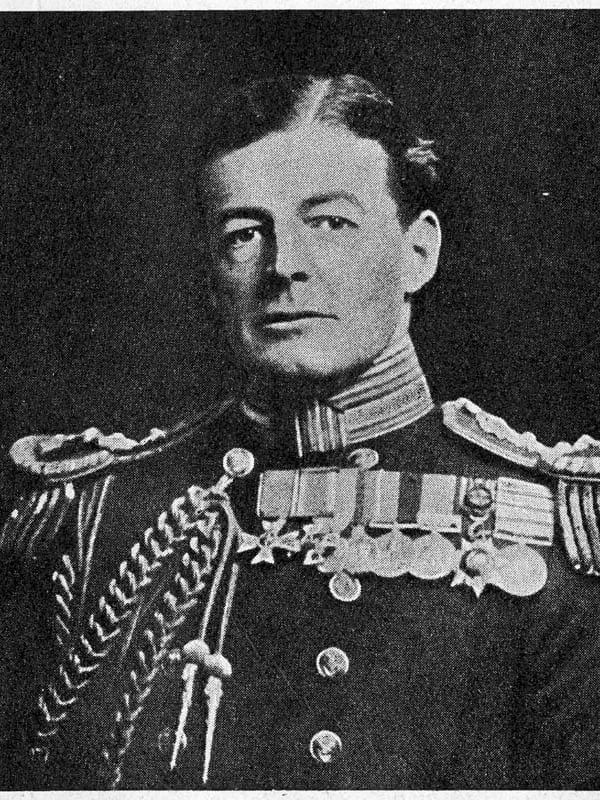
- Born:
- 17 January 1871, Stapeley near Nantwich (England)
- Died:
- 12 March 1936, London
- Author:
- Natalia
- Photo:
- Speaight Ltd, domena publiczna, Wikimedia Commons

David Beatty was the most popular British admiral of the First World War. Young, handsome, his cap tilted rakishly to one side, he was seen by the press and the public as a new Nelson. As commander of the battlecruisers he led them into action in the Heligoland Bight, at the Dogger Bank and at Jutland, where his force lost two ships in less than half an hour but drew the German fleet under the guns of Jellicoe’s battleships. From the end of 1916 he commanded the entire Grand Fleet, and on 21 November 1918 he received the surrender of the German High Seas Fleet. His boldness won admiration, but his failings in command and signalling, and after the war his efforts to shape an account of Jutland favourable to himself, still divide historians today.
Before the war
He was born on 17 January 1871 at Stapeley near Nantwich in Cheshire, into an Anglo-Irish family. His father, a former hussar officer, bred and trained horses, and the boy rode and hunted from childhood. In 1884 he joined the training ship Britannia. He was not a model cadet, but thanks to his mother’s connections he was posted to the flagship of the Mediterranean Fleet, which was commanded by a son of Queen Victoria.
Africa brought him fame. In 1896–1898 he commanded gunboats on the Nile in Horatio Kitchener’s campaign against the Mahdists in the Sudan, and at Omdurman he met a young cavalry officer, Winston Churchill. For the Sudan he was promoted to commander over the heads of several hundred more senior lieutenants. In 1900 he fought the Boxers at Tientsin, where he was wounded in the arm, and later that same year, at the age of 29, he was promoted to captain. In 1901 he married Ethel Tree, the divorced daughter of the American millionaire Marshall Field. His wife’s fortune gave him an independence no other naval officer enjoyed, but the marriage in time became an unhappy one.
On 1 January 1910, by a special decision, since he did not yet have the required sea time, he was made a rear-admiral. It is often written that he was the youngest British admiral since Nelson. He then turned down the post he was offered as second-in-command of the Atlantic Fleet and nearly wrecked his career. He was rescued by Churchill, who as First Lord of the Admiralty made him his naval secretary in January 1912 and on 1 March 1913 gave him command of the 1st Battlecruiser Squadron. In his orders to his captains Beatty wrote that they were to show initiative and not fear responsibility, and that the admiral’s instructions would be as general as possible. His flagship was the battlecruiser Lion.
1914–1915: Heligoland and the Dogger Bank
On 28 August 1914 light cruisers and destroyers from Harwich attacked German patrols in the Heligoland Bight and got into difficulties. Beatty, called to their aid, took the battlecruisers deep into the Bight despite the risk of running into mines and submarines. His heavy guns sank the light cruisers Cöln and Ariadne. The Germans lost three light cruisers in the battle, the British not a single ship. The first victory at sea made him a hero.
The following months brought disappointments. In November and December the German battlecruisers of Rear-Admiral Franz von Hipper bombarded Yarmouth and then Scarborough, Hartlepool and Whitby. On the second occasion Beatty’s force was close, but because of a badly worded signal from his flagship the light cruisers broke off the action and the Germans escaped in the mist. On 24 January 1915, forewarned by intelligence, Beatty caught Hipper at the Dogger Bank. In the chase the armoured cruiser Blücher was sunk, but Lion, badly hit, fell out of line. Beatty’s signals, made by flags and misread by his second-in-command, Rear-Admiral Archibald Moore, led all the ships to concentrate their fire on the sinking Blücher, while the rest of the German force got away. The country celebrated a victory, but Beatty knew that the chance of a far greater success had been lost. Fisher blamed Moore, who was soon moved to a secondary post. Beatty, by contrast, kept his flag lieutenant Ralph Seymour, who was responsible for the signals, and in the view of many historians did not draw sufficient lessons from the weaknesses of his own signalling.
At the beginning of 1915 the battlecruisers were reorganised as the Battle Cruiser Fleet, based at Rosyth, and Beatty, by then a vice-admiral, answered directly to the commander of the Grand Fleet, Admiral John Jellicoe. The two admirals’ relations were correct, but their temperaments differed greatly.
Jutland
On 31 May 1916 Beatty sailed from Rosyth with six battlecruisers and the four newest battleships of Rear-Admiral Hugh Evan-Thomas. In the Battle of Jutland it was he who first made contact with Hipper. His signal to change course did not reach Evan-Thomas, and the battleships fell nearly 10 miles behind, so the battlecruisers entered a duel with Hipper without their support. The British opened fire too late, distributed their targets badly and shot worse than the Germans. Within half an hour Indefatigable and Queen Mary blew up and sank. According to the recollections of Lion’s captain, Ernle Chatfield, Beatty then said: “There seems to be something wrong with our bloody ships today”. He did not turn away, however, and fought on.
When the light cruiser Southampton reported the approach of the entire High Seas Fleet, Beatty turned north and led the Germans straight onto Jellicoe’s battleships, of whose presence they were unaware. In the view of most historians he carried out this part of his task very well. His reporting was worse. For a long time Jellicoe did not know where the enemy was, and to the question of where the German battle fleet was, Beatty replied only once he had seen it himself. In the evening his battlecruisers fired on Hipper’s ships for the last time. The Battle Cruiser Fleet lost three ships in the battle, including Rear-Admiral Hood’s Invincible, which was sailing with Jellicoe’s battleships that day, and thousands of men.
After the battle Beatty believed that Jellicoe had been too cautious and had thrown away the chance to destroy the Germans. Jellicoe’s supporters in turn reproached Beatty for the dispersal of his forces, poor signalling and the weak gunnery training of his ships. Post-war investigations showed that the explosions of the battlecruisers were caused above all by dangerous practices in the storage and handling of propellant charges, tolerated for the sake of a high rate of fire, on Beatty’s ships among others.
Commander of the Grand Fleet
When Jellicoe moved to the Admiralty at the end of November 1916, Beatty succeeded him in command of the Grand Fleet, with promotion to acting admiral. He was 45 and younger than many of the admirals he commanded. Contrary to the expectations of his supporters, he did not seek battle at any price. He concluded that, since the Germans were waging unrestricted submarine warfare and destroyers were in short supply, the fleet should not risk a battle in enemy waters, and in January 1918 the Admiralty adopted this view. He did, however, revise the battle instructions, giving squadron commanders more freedom, and laid stress on gunnery and night training. In December 1917 American battleships joined the Grand Fleet and placed themselves under his orders, and in April 1918 he moved the fleet’s main base from Scapa Flow to Rosyth.
The Grand Fleet fought no further fleet action. In November 1917 British cruisers clashed inconclusively with German ones in the Heligoland Bight, and German ships twice destroyed convoys to Norway, in October and in December 1917. When Jellicoe was dismissed at the end of 1917, Beatty, on cool terms with him since Jutland, wrote to him that he had received the news with consternation, but after a conversation with the new First Lord of the Admiralty did not get in touch for a month.
After the armistice Beatty agreed the terms of internment with a German envoy on 15–16 November 1918. On 21 November the High Seas Fleet sailed into the Firth of Forth between two lines of the Grand Fleet, ready for action in case of treachery. In the evening Beatty made a signal that the German flag was to be hauled down at sunset and not hoisted again without permission, although the ships were only interned, not surrendered. The Germans long held this against him.
After the war
In 1919 Beatty became Admiral of the Fleet and received an earldom and, like Field Marshal Douglas Haig, a parliamentary grant of £100,000. On 1 November 1919 he became First Sea Lord and held the office until 1927, longer than anyone else. He took part in preparing the Washington Treaty of 1922, which gave the British and American fleets equal strength, and defended the building of the Singapore base and of cruisers against budget cuts, including against Churchill as Chancellor of the Exchequer. As First Sea Lord he influenced the official accounts of the Battle of Jutland and demanded changes that showed his battlecruisers in a better light and Jellicoe’s caution in a worse one. The controversy he thus ignited was fought out for years afterwards by officers and writers on both sides.
In November 1935, ill with heart trouble and influenza, he went against his doctors’ advice and served as a pallbearer at Jellicoe’s funeral. He died in London during the night of 11–12 March 1936. Some sources give the date as 11 March; his biographer Stephen Roskill points to the early hours of 12 March. Against his wishes he was buried in St Paul’s Cathedral rather than beside his wife.
Assessment
Beatty was a brave, energetic and charismatic commander who could inspire men and was not afraid of risk. In the Heligoland Bight and at Jutland alike he took quick decisions that benefited his side, and as commander of the Grand Fleet he maintained the fleet’s discipline and morale through two difficult years of inactivity. His biographer Roskill also considered that his greatest achievement after the war was preserving the strength and spirit of the navy in a time of deep budget cuts.
Historians, however, reproach him for repeated signalling failures, which at the Dogger Bank and at Jutland cost the British a fuller victory, for the weak gunnery training of his ships and for disregarding the rules of ammunition safety. His post-war efforts to promote a version of events favourable to himself are also judged critically. Many writers believe that his fame as a pre-war and wartime hero owed much to his character and style rather than to tactical achievement, and that in a direct comparison with Jellicoe he was the better leader but the lesser professional.
Sources
Spotted a mistake?Report an error
Commanded in battles
(04)Often appears with
People who appear in the same events.