1916: The war at sea
Attack on Lowestoft and Yarmouth
- Dates:
- 24–25 April 1916
- Front:
- War at sea
- Location:
- North Sea, from the Heligoland Bight along the Frisian Islands to the coast of Suffolk and Norfolk (Lowestoft, Great Yarmouth) and the Terschelling bankOn the battle map →
- Sides:
- United KingdomReginald Tyrwhitt, John Jellicoe, David BeattyGerman EmpireReinhard Scheer, Friedrich Bödicker
- Result:
- Inconclusive. The Germans shelled Lowestoft and badly damaged the cruiser Conquest, but destroyed no part of the British fleet, and the battlecruiser Seydlitz struck a mine.
- Author:
- Natalia
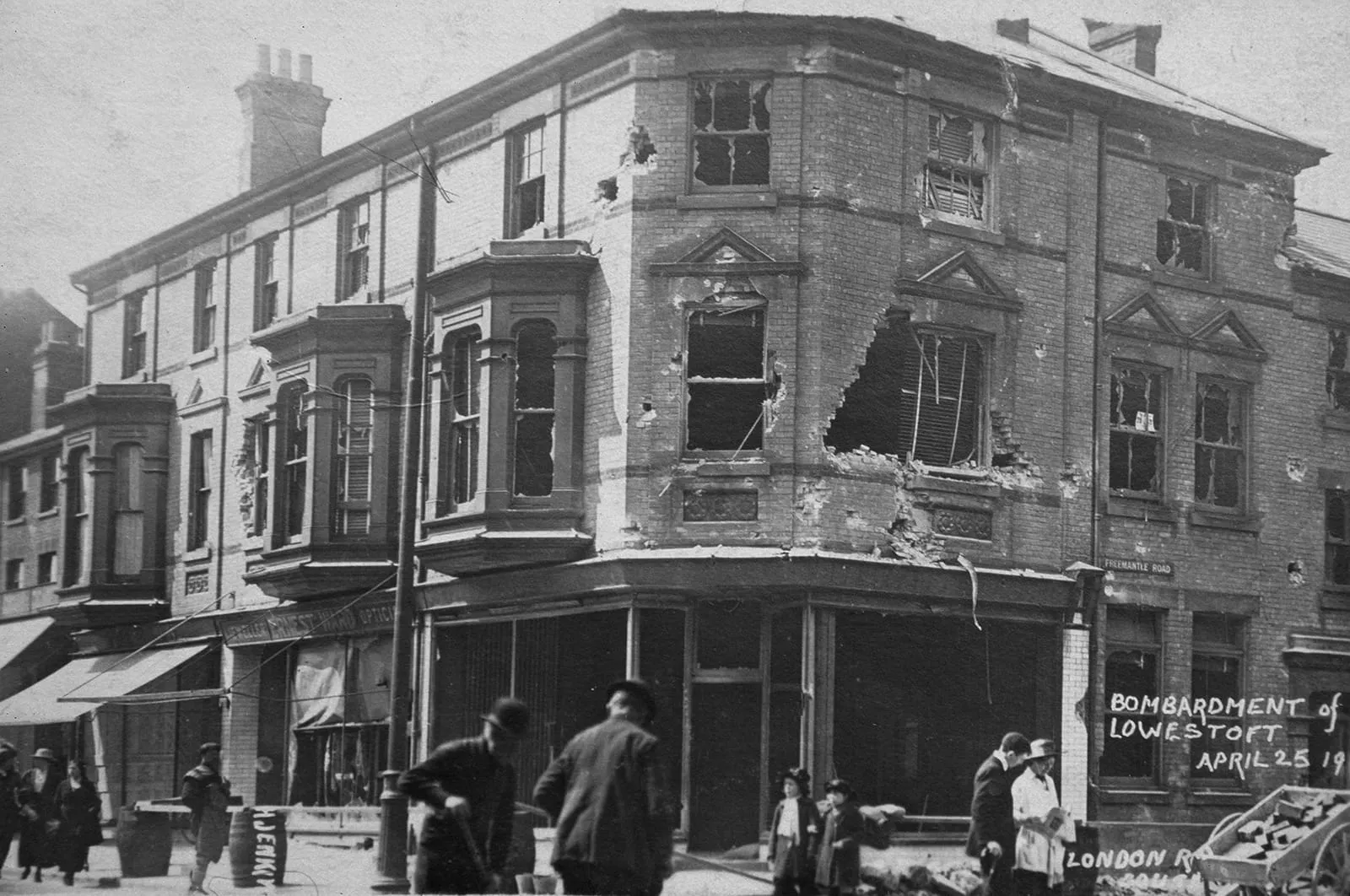
The attack on Lowestoft and Yarmouth was the first sortie by German battlecruisers against the English coast in more than a year. On 24 April 1916 the entire German High Seas Fleet put to sea. During the night German airships circled over eastern England, and at dawn on 25 April four battlecruisers under Rear-Admiral Friedrich Bödicker shelled the port of Lowestoft for over ten minutes and fired a few salvoes towards Great Yarmouth. Commodore Reginald Tyrwhitt’s light forces from Harwich rushed to meet the raiders and lost several dozen men, but the Germans withdrew before the Grand Fleet could arrive from the north. The raid coincided with the outbreak of the rising in Ireland.
Name and dates
British writers most often call the operation the Lowestoft Raid (Lowestoft Raid) or the bombardment of Yarmouth and Lowestoft; German ones the shelling of Lowestoft and Great Yarmouth. Since Yarmouth suffered very little, and the whole operation also included an airship raid and fighting at sea, we use the name “attack on Lowestoft and Yarmouth”.
On this page we use the dates 24–25 April 1916: the German fleet put to sea at noon on 24 April, Easter Monday, and returned to base on 25 April. Times are given in British time (Greenwich). German accounts, reckoned in Central European Time, shift them by an hour, so that, for example, the start of the shelling of Lowestoft, at 4.10 a.m. according to the British official history, falls “at 5 in the morning” in Admiral Scheer’s account.
Background
Since January 1916 the High Seas Fleet had been commanded by Admiral Reinhard Scheer, an advocate of bolder action than his predecessor. He did not intend to take on the whole Grand Fleet, but wanted to lure parts of it out to sea and destroy them with superior forces. The British, who thanks to decrypting German signals in Room 40 usually knew when the fleet was coming out, nonetheless kept their main forces far to the north: Admiral John Jellicoe’s battleships at Scapa Flow and Vice-Admiral David Beatty’s battlecruisers at Rosyth. Since the raid on Yarmouth and the bombardment of Scarborough and Hartlepool in 1914, the east coast of England had been guarded only by light ships from Harwich, submarines from Yarmouth and old coast-defence vessels.
Scheer chose two ports in Suffolk and Norfolk as his targets. He later wrote that Lowestoft was a base for British minesweepers and minelayers, and Yarmouth a base for submarines operating towards the Heligoland Bight, and that the shelling and the night airship raid were meant to induce the British to send out forces the Germans could defeat. The battlecruisers were to shell the towns for no more than half an hour and then return at once to the main force, waiting in the open sea north of the island of Terschelling. The commander of the battlecruisers, Vice-Admiral Franz von Hipper, was ill, so the I Scouting Group was led by Rear-Admiral Friedrich Bödicker.
The sortie was also linked to the Irish question. Irish conspirators preparing a rising for Easter had asked the Germans for arms and for some action to distract the British. The Germans sent a ship with arms to Ireland, scuttled by her own crew on 22 April, and a submarine landed Roger Casement ashore. Many historians believe the date of the raid was chosen to coincide with the outbreak of the rising. Scheer himself does not mention Ireland at all in his memoirs, and the British official history admits that his real motives remain unclear.
Course
24 April. At noon the German forces left the Jade estuary. Five battlecruisers, Seydlitz (Bödicker’s flagship), Lützow, Derfflinger, Moltke and Von der Tann, were screened by six light cruisers and two fast torpedo-boat flotillas. Behind them came Scheer’s three battleship squadrons. Two submarines of the Flanders Flotilla lay in wait off Lowestoft, and others took station off the mouth of the Firth of Forth. In the afternoon, at about 3.50 p.m. German time, Seydlitz struck a mine near the island of Norderney, on a route swept by minesweepers two nights earlier. The explosion killed 11 sailors and about 1,400 tons of water flooded into the hull. The ship turned back to base at 15 knots, and Bödicker transferred to a torpedo boat and then to Lützow. For fear of further mines the fleet continued along the Frisian coast, where it could be seen by observers on the Dutch islands.
The British knew in any case that the Germans were coming out. The Grand Fleet had just returned from an unsuccessful sortie into Danish waters, during which the battlecruisers Australia and New Zealand had collided in fog, and was coaling. At 3.50 p.m. the Admiralty placed it at two hours’ notice, and in the evening, when intercepted signals showed that the German battlecruisers were heading for Yarmouth, Jellicoe and Beatty put to sea. A heavy gale delayed the battleships’ advance from the north, and the destroyers could not keep up with them. That same day Admiral Reginald Bacon was laying a minefield off the Belgian coast. The Admiralty ordered him to break off the operation and bring his ships back to defend the Strait of Dover.
Night of 24/25 April. Eight of the navy’s newer airships under Peter Strasser set out over England with orders to attack London. Strong winds and cloud drove them off course. The airmen reported bombing Norwich, Lincoln, Harwich and Ipswich, but in reality the bombs fell mainly on villages and fields in Norfolk and Suffolk. According to the British official history the damage was slight and the casualties few.
Morning of 25 April. Commodore Tyrwhitt left Harwich at about midnight with three light cruisers, Conquest, Cleopatra and Penelope, and over a dozen destroyers. Knowing from Admiralty signals that the Germans were making for Yarmouth, he steamed straight towards them, although with such a force he could not hope to win. At about 3.50 a.m. he sighted German light cruisers and battlecruisers. He turned south to draw the Germans after him, but Bödicker would not be drawn off. At 4.10 a.m. his four battlecruisers opened fire on Lowestoft from a range of about 10–13 kilometres. After a little over ten minutes they moved north to Yarmouth, where in the mist they fired only a few rounds.
At 4.30 a.m. Tyrwhitt, who had turned north again, opened fire on the light cruisers Rostock and Elbing. They drew him towards the battlecruisers, which at 4.45 a.m. appeared some ten-odd kilometres from the British. Tyrwhitt turned away, but within a few minutes a salvo of heavy shells hit Conquest. Twenty-five men were killed and more than a dozen wounded, and the ship lost her aerials, though she could still steam at 20 knots. The destroyer Laertes was also hit. After a quarter of an hour or so the Germans ceased fire and made off eastwards towards their battleships. On the way the torpedo boat G 41 sank the armed trawler King Stephen, the same one that in February had refused to rescue the crew of the airship L 19, and took her crew prisoner.
Tyrwhitt set off after them, but at 8.40 a.m. the Admiralty recalled him. On the way back, at about 10 a.m., Penelope was hit by a torpedo that damaged her rudder, and the German submarine UB-18 sank the British submarine E22. The British submarines, deployed off Yarmouth and along the Germans’ line of retreat, never once managed to get within firing range. Beatty’s battlecruisers were still several hours’ steaming from the German fleet when, before noon, the Admiralty called off the pursuit. The High Seas Fleet returned to port.
Losses
In Lowestoft shells destroyed or damaged about 200 houses. According to research by the local war museum four people were killed there, three civilians and one serviceman, and 19 were wounded. Some studies give three killed. Yarmouth was barely touched. The Royal Navy lost the submarine E22 with almost all her crew, 25 killed on Conquest and a few men on smaller patrol vessels. The trawler King Stephen was sunk. The cruisers Conquest and Penelope and the destroyer Laertes were damaged.
The Germans lost 11 men on Seydlitz. The battlecruiser was under repair until the end of May. The airships returned without loss. That same day the submarine UB-13 of the Flanders Flotilla failed to return from patrol, but she was most probably lost on the British barrage off the Belgian coast, not in connection with the raid.
Significance
In military terms the raid achieved little for either side. The Germans failed to destroy a single part of the British fleet and very nearly lost Seydlitz. The British, although they knew the enemy had come out, once again failed to intercept the raiders. The British official history rated Tyrwhitt highly: instead of the planned half hour, the shelling lasted barely half that time, and without his intervention Lowestoft would have suffered far more.
The political consequences were greater. In Germany the raid was greeted with joy as proof that the British no longer ruled their own waters. That same day Scheer received word that after the sinking of the Sussex submarines were to fight merchant ships only under prize rules. He decided that they could not fight that way and withdrew them from the trade war, assigning them to operations with the fleet. In Britain the raiders’ impunity provoked a wave of criticism. The First Lord of the Admiralty, Arthur Balfour, assured the mayors of Lowestoft and Yarmouth in a letter that the forces at home would be redeployed so that a further raid would be very dangerous for the enemy. At the beginning of May the 3rd Battle Squadron of old King Edward VII-class battleships and the dreadnought Dreadnought were moved from Rosyth to the Thames estuary.
The sortie against Lowestoft was the last attempt of its kind before the Battle of Jutland. Scheer wanted to have Seydlitz back for his next operation, so he waited for the end of her repairs. At the end of May the High Seas Fleet put to sea again, this time towards the Skagerrak.
Spotted a mistake?Report an error