Germany · The Central Powers
Peter Strasser
Commander of the Naval Airship Division (1913–1918), from 1916 Führer der Luftschiffe, Fregattenkapitän
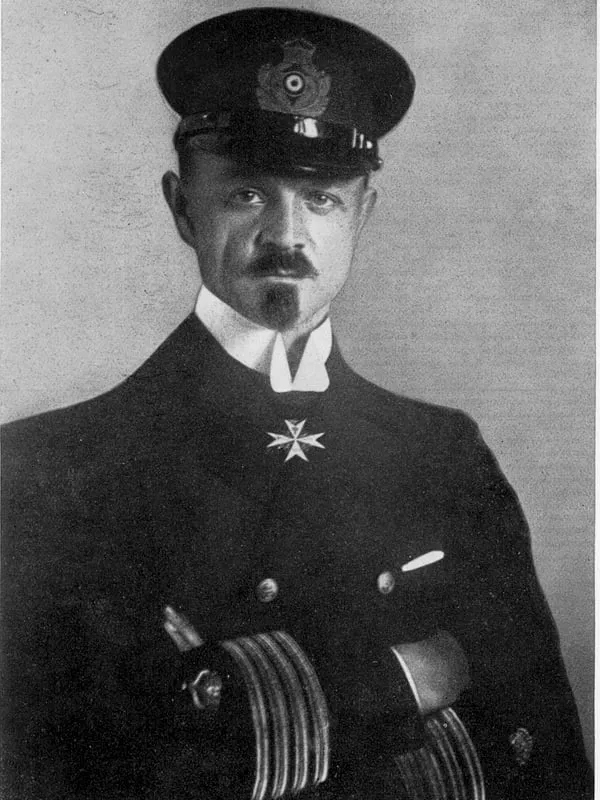
- Born:
- 1 April 1876, Hanover (Prussia)
- Died:
- 5 August 1918, North Sea off the Norfolk coast (England)
- Author:
- Natalia
- Photo:
- P. Strasser, domena publiczna, Wikimedia Commons

Peter Strasser led the German navy’s airship service throughout the war. He took it over in 1913, when after two disasters it had only a handful of men and not a single airship, and he left it as a force of several thousand men and more than a dozen bases. His Zeppelins scouted over the North Sea for the High Seas Fleet, but they went down in history above all as bombers. From January 1915 to August 1918 Strasser planned, and often personally led, the raids on England. He believed that large airships could bomb Great Britain effectively, even as aircraft and anti-aircraft guns destroyed them ever more easily. He was killed aboard the newest Zeppelin, L 70, shot down over the sea off the Norfolk coast during the last airship raid of the war.
Before the war
He was born on 1 April 1876 in Hanover, the son of an architect. He finished secondary school in Bruchsal in Baden, where his family had moved. According to German sources he joined the Kaiserliche Marine as a cadet in 1894; some English biographies give 1891. At the end of the 1890s he became an officer. He served on cruisers and battleships, including in the Far East, and specialised in gunnery. He was regarded as an outstanding gunnery officer, and before 1913 he worked in the Imperial Naval Office in the department dealing with naval and coastal artillery.
The naval airship service was then in crisis. On 9 September 1913 the navy’s first airship, L 1, went down in a storm off Heligoland, and with it died the commander of the service, Korvettenkapitän Friedrich Metzing. At the end of September 1913 Strasser, an energetic and brave officer with no experience whatever of aviation, was chosen as Metzing’s successor. A few weeks later, on 17 October, the navy’s second airship, L 2, burst into flames in the air during a trial flight near Berlin. Most of the experienced men died in the two disasters, and opponents of airships in the navy demanded that the service be disbanded. Strasser learned to fly on the civilian Zeppelin Sachsen, and his closest adviser became Hugo Eckener of the Zeppelin company, who before the war trained all German airship crews. In May 1914 the navy received a third airship, L 3. On the eve of the war it was the navy’s only serviceable airship.
1914–1915: from reconnaissance to bombing
At the beginning of the war the naval airships patrolled the North Sea, watching for British warships, mines and submarines. More airships quickly arrived, and Strasser built bases for them, the most important of which was established at Nordholz near Cuxhaven. From the start, however, he was an advocate of raids on England. The obstacle was Emperor Wilhelm II, who for a long time refused to allow the bombing of the British Isles, and of London in particular. The navy obtained consent for attacks on military targets on the coast at the beginning of January 1915.
On 19 January 1915 Strasser sent three airships over England, flying himself in L 6, which turned back in bad weather. The other two bombed Great Yarmouth and King’s Lynn. Four people were killed, and no military target was hit. In February the navy lost L 3 and L 4 off the coast of Denmark. In July the emperor, under pressure from the Admiralty Staff, agreed to raids on the City of London, on condition that historic buildings such as St Paul’s Cathedral be spared. The first joint expedition against the capital in August, however, ended in failure and the loss of L 12. Strasser would not be discouraged and kept sending more. In September and October the naval airships reached London, and the raid of 13 October on the theatre district killed several dozen people.
1916: the great raids
In January 1916 command of the High Seas Fleet passed to Admiral Reinhard Scheer, an advocate of bolder action, in whose plans airship raids were to support fleet sorties. Scheer valued Strasser but, according to some authors, tried without success to curb his drive for independence. On 31 January nine airships set off for central England. Strasser flew in L 11. The Midlands raid showed how unreliable navigation was: commanders reported bombing Liverpool and Sheffield, while the bombs fell on small towns in Staffordshire and Derbyshire. Strasser himself, who could make out no military target below, brought his bombs back. H. A. Jones, author of the British official history of the war in the air, later praised his high sense of duty. On the way back L 19 was lost, and a British fishing trawler did not rescue its crew.
Strasser demanded as much of himself as of his subordinates and regularly flew over England aboard one of his airships. When in April Hipper’s battlecruisers bombarded Lowestoft and Yarmouth, eight airships under his command were to attack London at the same time. At Jutland the airships, which took off late because of the weather, played no significant part, although on the morning of 1 June several of them sighted British squadrons. In the summer the new, huge R-class Zeppelins, the so-called super-Zeppelins, capable of carrying several tons of bombs, entered service.
The autumn of 1916, however, brought a turning point in favour of the defence. On the night of 2–3 September sixteen navy and army airships set out for London, the largest expedition of the war, and the shooting down of the army’s SL 11 showed that a night fighter with incendiary ammunition could destroy a hydrogen-filled ship. Now Strasser’s airships fell victim. Near London L 32 went down in flames and L 33 came down in Essex, L 31 was shot down with the most famous of his commanders, Heinrich Mathy, and at the end of November L 34 and L 21 were lost in a single night. After these losses the army practically gave up airship raids on Great Britain, but the navy intended to continue them. At the end of November 1916 the emperor appointed Strasser Führer der Luftschiffe (Leader of Airships), which confirmed his independent command over the naval airships. When the German air force was created that same month, his service remained outside it.
1917–1918: at the limit of the possible
Strasser’s answer to aircraft was altitude. In 1917 his Zeppelins, lightened and fitted with new engines, flew at 5,000–6,000 metres, where they were almost out of reach of the defences. Their crews, however, suffered there from frost and thin air, above the clouds they could not find their targets, and they were helpless against high-altitude winds. In March 1917, while Strasser was flying in L 42, the wind carried his airships over France, where L 39 was shot down. In June aircraft destroyed L 48, of a new type built precisely to escape them, and with it died one of Strasser’s closest collaborators, Viktor Schütze. In July Strasser was promoted to Fregattenkapitän, and on 20 August he received the Pour le Mérite, presented to him in person by Scheer.
In October 1917 the Silent Raid ended in disaster: a gale at high altitude carried four airships over France, where they were shot down, captured or lost, and another crashed on landing in Germany. In November the naval airship L 59 made its flight to East Africa with supplies for the troops of Paul von Lettow-Vorbeck. Recalled over the Sudan, it returned to Bulgaria, but it demonstrated the extraordinary range of the Zeppelins. On 5 January 1918 a series of explosions and fires at the Ahlhorn base destroyed four Zeppelins and one Schütte-Lanz airship. In July British aircraft from the carrier Furious burned two more in their shed at Tondern. Even so, Strasser led new expeditions in March and April 1918. On the night of 12–13 April his airships’ bombs killed people on British soil for the last time, among other places in Wigan.
Death
On 5 August 1918, with the barometer falling and the weather bad, Strasser sent five airships over England and himself flew in L 70, the newest and most powerful Zeppelin built during the war. In the evening, over the sea off the Norfolk coast, it was attacked by an Airco DH.4 flown by Major Egbert Cadbury, with Captain Robert Leckie at the machine gun. Incendiary bullets started a fire that engulfed the whole ship in less than a minute. L 70 fell into the sea north of Wells-next-the-Sea. The whole crew was killed, 22 men according to most sources and 23 according to some, together with Strasser himself. According to German sources the British recovered his body from the wreck and buried it at sea. It was the last airship raid on England. Without Strasser the navy attempted no more, and a few days later L 53 was also shot down.
Assessment
Strasser was the creator of the naval airship service and its soul. Jones, who knew the German documents, wrote of him with respect as a good organiser and a born leader who had created the service and inspired it with his own spirit, and called his death at the head of his squadron a worthy end. He stressed that Strasser’s operational orders specified military targets and that the modest results stemmed above all from the navigational capabilities of the time. Strasser’s airships flew several hundred combat sorties over England and more than a thousand reconnaissance flights over the North Sea.
The balance of the campaign he waged, however, is modest. The airship raids killed more than five hundred people in Great Britain, the vast majority of them civilians, and did little material damage, while the navy lost many airships in them and several hundred of its best-trained airmen. The raids did force the British to keep guns, searchlights and aircraft at home, but many historians believe that the airships and their crews would have been of more use as scouts for the fleet. Strasser defended his weapon to the end against ever clearer evidence of its weakness. He is also sometimes regarded as one of the first advocates of strategic bombing that makes no distinction between the front and the home front. His words are often quoted that those who strike the enemy where his heart beats have been slandered as “baby-killers”, but that in modern war there are no longer any non-combatants.
Sources
Spotted a mistake?Report an error
Mentioned in battles
(01)Often appears with
People who appear in the same events.