German Empire · The Central Powers
Reinhard Scheer
Commander of the High Seas Fleet (1916–1918), Chief of the Admiralty Staff and of the Seekriegsleitung (1918), admiral
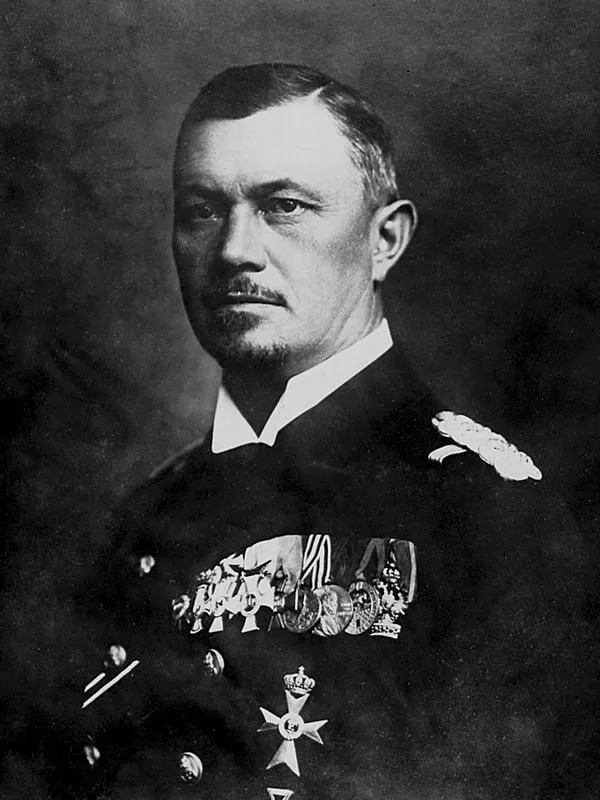
- Born:
- 30 September 1863, Obernkirchen (now Lower Saxony)
- Died:
- 26 November 1928, Marktredwitz (Bavaria)
- Author:
- Łukasz Skowroń
- Photo:
- The European Library, CC0, Wikimedia Commons

Reinhard Scheer commanded the German High Seas Fleet in the only great clash of battle fleets of the First World War. At Jutland in 1916 his smaller fleet inflicted heavier losses on the British than it suffered itself, and twice broke out of a trap set by the Grand Fleet. Scheer soon concluded, however, that even the most successful battle at sea would not force Britain to make peace, and he became one of the loudest advocates of unrestricted submarine warfare, which in 1917 drew the United States into the war. In the last months of the war he directed the whole German war at sea. The plan for a final battle of the fleet, prepared by him and Hipper in October 1918, provoked a mutiny of the sailors with which the revolution in Germany began.
Before the war
He was born on 30 September 1863 in Obernkirchen into a middle-class family, and thus without the aristocratic background and wealth that eased a career in the Imperial Navy. On 22 April 1879 he joined the Kaiserliche Marine as a cadet. In the 1880s he served in Africa and the Far East, taking part among other things in an expedition against a local chief in Kamerun. At that time he became friends with Henning von Holtzendorff, later fleet commander and Chief of the Admiralty Staff, who supported his career for years.
Scheer made a name for himself as a specialist in torpedo weapons and torpedo-boat tactics. He attracted the attention of Alfred von Tirpitz, who as State Secretary brought him into the Imperial Naval Office. Scheer commanded a torpedo-boat flotilla, headed the office’s central department and then commanded the battleship Elsass. From 1910 he was chief of staff of the High Seas Fleet under Holtzendorff, and was already working on principles for manoeuvring the whole fleet in battle. That same year he was promoted to rear admiral; in 1911–1912 he headed the department of the office that decided on the types of new ships, and at the beginning of 1913 he took over the II Battle Squadron. In December 1913 he became a vice admiral. He was stern and demanding, known in the navy as “the man with the iron mask”, but he valued initiative and was not afraid of responsibility.
1914–1915: squadron commander
He began the war in command of the II Squadron, made up of obsolete pre-dreadnoughts. At the end of 1914 he took over the III Squadron, the newest and most powerful battleships of the fleet, of the Kaiser and König classes. He was one of the officers who considered the fleet command too passive. After the raid on Scarborough and Hartlepool in December 1914 he criticised Admiral Friedrich von Ingenohl, who had turned back to port although he had had a chance to destroy an isolated part of the Grand Fleet. Ingenohl’s successor, Admiral Hugo von Pohl, was even more cautious, and Kaiser Wilhelm II was long unwilling to risk the fleet. Throughout 1915 the battleships rarely ventured far from the Heligoland Bight.
Commander of the High Seas Fleet
At the beginning of January 1916 Pohl fell seriously ill and Scheer, as the senior squadron commander, replaced him, formally taking command of the fleet on 24 January. He drew up a new plan for the war in the North Sea. The fleet was not to seek battle with the whole Grand Fleet, but to use sorties, airship raids, mines and submarines to lure parts of it out to sea and destroy them with superior force. On 23 February the Kaiser visited the fleet at Wilhelmshaven and approved this programme. Scheer went into action at once. In February his torpedo boats attacked British minesweeping sloops off the Dogger Bank, in March the fleet put out into the southern North Sea, and on 24–25 April the battlecruisers shelled Lowestoft and Yarmouth, with the battleships following behind them.
At the same time Scheer came into conflict with the government. When, after the torpedoing of the Sussex, submarines were to attack merchant ships only under prize rules, he withdrew them from the war on trade, judging that in that form it was too dangerous for them. The U-boats could instead cooperate with the fleet. Scheer planned a bombardment of Sunderland for May, which was to draw the battlecruisers out of Rosyth, and stationed submarines off the British bases. When the wind prevented the reconnaissance airships from taking off, he chose the fallback plan: a sortie by the battlecruisers towards the Skagerrak, with the battleships several dozen miles behind them.
Jutland
Scheer did not know that the British codebreakers of Room 40 were reading his signals and that the whole Grand Fleet had put to sea before his ships left port. On 31 May 1916 the battlecruisers of Vice Admiral Franz von Hipper, according to plan, lured the battlecruisers of David Beatty under the guns of the German battleships, and two British ships blew up. When Scheer set off in pursuit of Beatty, Beatty in turn led him straight onto the battleships of Admiral John Jellicoe.
At the Battle of Jutland, at about 6.30 p.m., Scheer saw a long line of British dreadnoughts firing at his ships out of the mist to the north and east. He ordered the 180-degree simultaneous turn of all ships that had been practised for years (Gefechtskehrtwendung), and the fleet vanished from British view. Less than half an hour later, to the enemy’s surprise, he turned east again. He himself wrote that he wanted to strike a second blow and possibly rescue the crew of the disabled cruiser Wiesbaden, while the British official history holds that he was more likely hoping to slip past astern of the Grand Fleet. His leading ships again came under the fire of the British line. Scheer turned away for the third time and, to cover the move, threw his torpedo boats and battlecruisers at the British with orders to ram the enemy. Jellicoe turned his battleships away from the torpedoes and contact was lost. During the night Scheer, determined to break through by the shortest route whatever the cost, passed through the British destroyers behind the Grand Fleet and on the morning of 1 June was safe off the Horns Reef.
The Germans proclaimed a great victory at the Skagerrak. Scheer was promoted to admiral and received the Pour le Mérite. In his report to the Kaiser of 4 July, however, he wrote that even the most successful battle would not force Britain to make peace, and that only submarine warfare against her trade, waged without restrictions, could do so.
After Jutland
Scheer did not give up fleet sorties. On 19 August 1916 he again set out towards Sunderland, but when an airship reported British ships to the south he turned towards them, moving away from the Grand Fleet, and in the end returned home. The two fleets did not fire a single shot at each other. In the autumn the submarines returned to the war on trade, and Scheer and his fleet became increasingly convinced that their main task was to cover the U-boats. He was among those who pressed Chancellor Theobald von Bethmann Hollweg, and when the decision for unrestricted submarine warfare was taken in January 1917, he welcomed it. Earlier, in October 1916, he had nonetheless opposed sending U-53 to the coast of the United States, fearing that it would give the Americans a pretext for war.
The idleness of the battleships, poor food and the gulf between officers and men led in the summer of 1917 to a mutiny in the fleet. Scheer confirmed death sentences on two of its leaders, Max Reichpietsch and Albin Köbis, and commuted three others to long prison terms. Both were shot in September. In the autumn part of the fleet took part in Operation Albion, the capture of the islands in the Gulf of Riga. In the North Sea Scheer turned to a new method: his cruisers and destroyers destroyed convoys bound for Norway in October and in December 1917. In April 1918 he led the whole fleet out towards the coast of Norway to destroy another convoy and its escort, but intelligence had got the dates wrong, the battlecruisers found no ships, and after a breakdown of the battlecruiser Moltke the fleet returned to port.
Seekriegsleitung
In August 1918, after the army’s defeats on the Western Front, Scheer carried out a thorough shake-up at the top of the navy. On 11 August the Kaiser appointed him Chief of the Admiralty Staff in succession to Holtzendorff and agreed to the creation of a Naval Warfare Command (Seekriegsleitung) with broad powers of command. Hipper took over the fleet, and Eduard von Capelle left the Imperial Naval Office. The next day Scheer met Paul von Hindenburg and Erich Ludendorff. They agreed that the last hope of a favourable end to the war was submarine warfare. The so-called Scheer Programme envisaged a several-fold increase in submarine production by 1919. Some historians regard it as a propaganda gesture rather than a realistic plan.
In October, as the new government of Prince Max of Baden was asking President Wilson for an armistice, Scheer, around 20–21 October, recalled the submarines from the war on trade, which was one of the American conditions. At the same time the Seekriegsleitung and the fleet command prepared Operations Order No. 19. The fleet was to strike at shipping off the Flanders coast and in the Thames estuary, and then fight a battle with the Grand Fleet. The government was not properly informed of the plan. The sailors, convinced that the admirals were sending them to their deaths for the sake of the fleet’s honour, refused to obey orders on the night of 29–30 October. The operation was called off, and the Kiel mutiny spread across the whole of Germany within a few days.
After the war
In December 1918 Scheer retired. In 1919 he published his memoirs of the High Seas Fleet in the World War, quickly translated into English, and later toured giving lectures on the “heroic struggle” of the German fleet. He settled in Weimar. In October 1920 a robber broke into his house, killed the admiral’s wife and a maid, wounded his daughter and then took his own life. After this Scheer withdrew from public life. In 1925 he published an autobiography, “From Sailing Ship to Submarine”. In 1928 he accepted an invitation from Jellicoe to visit England, but on 26 November he died suddenly in Marktredwitz. On his grave in Weimar, apart from his name and dates, only one word was carved: “Skagerrak”. His name was given to the heavy cruiser, the so-called pocket battleship Admiral Scheer, launched in 1933.
Assessment
Most historians regard Scheer as the ablest and most enterprising of the commanders of the High Seas Fleet. He brought a passive fleet to life, and at Jutland, in a position that threatened it with destruction, he kept his nerve and led it out of the trap. His turns under fire and his night breakthrough behind the Grand Fleet are praised as an example of the proficiency in training that he himself had built up over the years.
Critics point out that he twice let himself be surprised by the Grand Fleet, and that his second turn to the east nearly ended in disaster. His own accounts of the battle, written after the war, presented it in a more favourable light than the facts allowed. The most serious charges, however, concern strategy. Scheer was one of the chief advocates of unrestricted submarine warfare, which did not break Britain but brought the United States into the war. The plan for a final battle of the fleet in October 1918, prepared behind the government’s back while armistice negotiations were under way, is seen by many historians as an attempt to save the honour and future of the navy at the cost of the sailors’ lives. It led to the fall of the empire that Scheer had wanted to serve.
Sources
Spotted a mistake?Report an error
Commanded in battles
(02)Often appears with
People who appear in the same events.