1917: The Kerensky Offensive and its defeat
Operation Albion
- Dates:
- 11–20 October 1917
- Front:
- Eastern Front
- Location:
- Islands of the West Estonian Archipelago (Saaremaa, Muhu, Hiiumaa) with the Soela, Moon Sound and Irben straits and the Gulf of Riga, Livonia Governorate (now Estonia); points of departure at Libau, Windau and the Bay of PuckOn the battle map →
- Sides:
- German EmpireOskar von Hutier, Hugo von Kathen, Ludwig von Estorff, Ehrhard SchmidtRussian Republic and United KingdomMikhail Bakhirev, Dmitry Sveshnikov, Fyodor Ivanov
- Result:
- German victory. The Germans took three islands, opened the way into the Gulf of Riga and captured 20,130 prisoners and 141 guns. The Russians lost the battleship Slava and the destroyer Grom.
- Author:
- Łukasz Skowroń
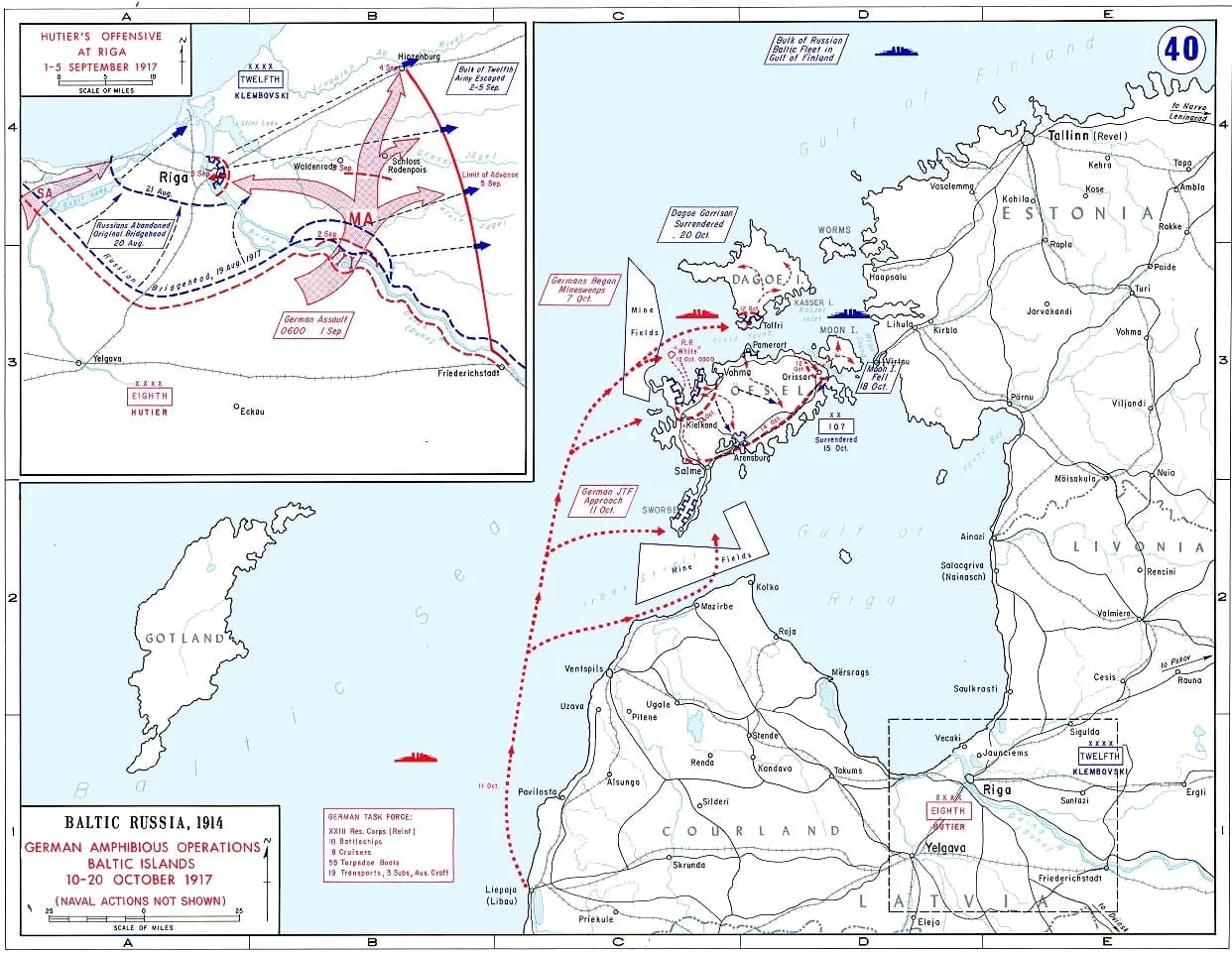
Operation Albion was the largest German amphibious operation of the First World War and the only one in which the army and the navy jointly planned and carried out so great an undertaking. In October 1917 a German naval force with ten dreadnoughts carried about 24,000 soldiers from Libau to the islands at the mouth of the Gulf of Riga. On 12 October it landed them on Saaremaa, in Tagga Bay. In less than ten days the Germans took Saaremaa, Muhu and Hiiumaa, and in the Moon Sound forced the Russian fleet to retreat. The Russian troops, demoralised after the revolution, mostly offered no resistance or quickly capitulated. Some ships and batteries, however, fought to the end. The Germans took more than 20,000 prisoners and themselves lost only a little over 50 killed in the fighting on land. The fall of the islands opened the Gulf of Riga to them and caused fear in Petrograd of an attack on the capital from the sea.
Name and dates
The Germans gave the operation the codename “Albion”, an old poetic name for the British Isles. In Russian and Soviet literature it is called the Moonsund operation or the Battle of Moon Sound (Моонзундская операция), after the strait between the island of Muhu and the mainland, and in German literature also simply the capture of the Baltic Islands. The islands then bore German names: Saaremaa was Ösel, Muhu was Moon and Hiiumaa was Dagö. We use the modern names and give the old ones at the first mention of places, because that is how they appear in sources of the period.
We adopt the dates 11–20 October 1917. The British chronology of the war records the start of operations against the islands under 11 October and the capture of Ösel as early as 12 October. In fact on 11 October the German force was still at sea, and the landing began at dawn on 12 October. The fighting on Saaremaa ended only on 15 and 16 October, when the troops surrounded in the eastern part of the island and on the Sõrve peninsula (Sworbe) capitulated. The Germans took Muhu on 18 October. The last Russians on Hiiumaa laid down their arms on the evening of 19 October according to German studies, and on 20 October according to Russian sources and the British chronology. Russia still used the Julian calendar, so in Russian documents the operation lasted from 28 September to 7 October. Some studies begin it only on 12 October, while German ones also count the preparations of late September as part of it.
Background
The Gulf of Riga had only two entrances. From the south it was the Irben Strait between Courland and Saaremaa, and from the north the shallow Moon Sound between Muhu and the Estonian mainland. Whoever held the islands controlled the gulf. From 1915 the Russians had turned them into a forward position for the defence of the Gulf of Finland and Petrograd. On Cape Zerel, at the tip of the Sõrve peninsula, stood Battery No. 43 with four 305 mm guns, covering the Irben Strait. A similar battery in the north of Hiiumaa defended the entrance to the Gulf of Finland, and batteries on Muhu and on the mainland guarded the Moon Sound. In the Irben Strait itself lay thousands of mines. In August 1915 the German fleet broke into the gulf for a few days, but could not stay there, because the islands remained in Russian hands. The islands, with 50,000–60,000 inhabitants, mostly Estonian peasants and fishermen, belonged to the Livonia Governorate. The land and local power were in the hands of the Baltic Germans.
After the capture of Riga at the beginning of September 1917, the left wing of the German Eighth Army rested on the shore of the gulf, while Russian ships and batteries still closed the sea route to the city to the Germans. The First Quartermaster General, Erich Ludendorff, wanted to keep striking at a weakening Russia without pause, as shortly before at Jakobstadt, to push it towards peace. Since the spring he had been urging the navy to a joint operation against the Åland Islands, Kronstadt or Saaremaa, and after the capture of Riga he accused it of passivity. The Admiralty for its part wanted to prove the usefulness of the big ships, which since Jutland had rarely put to sea, and to keep their crews in active service after the August unrest in the High Seas Fleet. According to German studies the decision to take the islands was made on 11 September, and around 18 September the Supreme Army Command issued the executive orders.
The landing was entrusted to Lieutenant General Ludwig von Estorff’s 42nd Infantry Division, reinforced by the 2nd Cyclist Brigade, Reserve Infantry Regiment No. 255, an assault battalion, artillery and engineers. The land forces as a whole were commanded by General of Infantry Hugo von Kathen, commander of XXIII Reserve Corps, subordinate to the commander of the Eighth Army, Oskar von Hutier. According to German figures this amounted to about 24,500 soldiers, 8,500 horses and 2,400 vehicles, with supplies for 30 days, carried on 19 transports. They were covered by a special naval force under Vice Admiral Ehrhard Schmidt, who in 1915 had led the attack on the Gulf of Riga. The flagship was the battlecruiser Moltke, and the chief of staff was Captain Magnus von Levetzow. Two squadrons were lent from the High Seas Fleet, the III under Vice Admiral Paul Behncke and the IV under Vice Admiral Wilhelm Souchon, ten dreadnoughts in all. To these were added nine light cruisers, about 50 torpedo boats and destroyers, dozens of minesweepers, six submarines, six airships and about a hundred aircraft. The Russians estimated that about 300 German vessels took part in the operation.
On the Russian side the islands came under the commandant of the Moon Sound position, Rear Admiral Dmitry Sveshnikov. On Saaremaa there were three infantry regiments: two from General Fyodor Ivanov’s 107th Infantry Division and one from the 118th Division. On paper they had about 24,000 soldiers, but in reality there were far fewer, and after the revolution soldiers’ committees undermined the officers’ orders. From the sea the islands were covered by Vice Admiral Mikhail Bakhirev’s Gulf of Riga naval forces: two old battleships, Slava and Grazhdanin (the former Tsesarevich), the armoured cruisers Admiral Makarov and Bayan, gunboats, a dozen or so destroyers, including modern ones of the Novik type, and three British C-class submarines. Bakhirev’s ships had experienced crews and had suffered less from revolutionary disorder than the rest of the Baltic Fleet, which since the March mutiny had largely obeyed its committees.
The German ships and transports were ready as early as 24 September in the Bay of Puck, Libau and Windau, but for more than two weeks storms raged over the Baltic. Meanwhile German minesweepers cleared the Irben Strait, losing several vessels to mines, and aircraft and airships bombed the batteries on the islands. On the night of 30 September to 1 October, after an air raid, the ammunition magazine of the Zerel battery blew up. About 110 gunners were killed. Russian intelligence, which was reading German wireless messages, knew of the preparations. On 10 October it warned that the attack would begin the next day.
Course
Sailing and landing, 11–12 October
On the evening of 10 October the dreadnoughts left the Bay of Puck, and on the morning of 11 October they joined the convoy from Libau. Schmidt and Kathen and their staffs boarded Moltke, and in the afternoon the ships from Windau joined. The force sailed north in four columns at nine knots, preceded by minesweepers. During the night the sea rose and the minesweepers fell behind. Schmidt, not wanting to lose surprise, ordered them out of the way and led the ships through unswept waters.
At about 3 a.m. on 12 October the battleships anchored off Tagga Bay in north-western Saaremaa. Before dawn the dreadnoughts Großer Kurfürst and Bayern were damaged by mines, and the steamer Corsica, carrying an infantry battalion, had to be beached. Shortly before six the ships opened fire and silenced the batteries on both sides of the bay. The infantry went ashore almost unopposed. The Russian regiment defending the coast fell apart at the first contact with the enemy. At the same time two dreadnoughts feigned a landing on the Sõrve peninsula, and at Pammana (Pamerort) on the northern shore the cyclists and the assault battalion landed. Estorff left the baggage trains and artillery on the beaches and set off at once into the interior of the island. By evening all the infantry was ashore, and the cyclists crossed Saaremaa and around midnight took Orissaare (Orissar) by the causeway linking Saaremaa with Muhu. In the Soela Strait between Saaremaa and Hiiumaa, German torpedo boats clashed with Russian destroyers and gunboats.
Capture of Saaremaa, 13–16 October
For a long time the Russian command did not know the situation. Sveshnikov sailed to the mainland for reinforcements, for which he was recalled, and the defence of the islands was taken over by General Nikolai Henrikson. The Russians abandoned Kuressaare (Arensburg), the island’s capital, which German patrols reached on the evening of 13 October, with the main forces entering a day later. Most of the garrison fell back east, towards the causeway. For two days a small detachment of German cyclists and assault troops at Orissaare beat off attacks by the Russians trying to break through to Muhu, and by Russian sailors attacking from the direction of Muhu. On 14 October German torpedo boats, supported by the fire of the dreadnought Kaiser, forced their way through the Soela Strait into the waters between the islands. In the fighting the Russian destroyer Grom sank. The Germans boarded her before she went down and found charts of the Russian minefields. On 15 October at about 3 p.m. the remnants of the 107th Division surrounded in eastern Saaremaa capitulated. More than 5,000 soldiers were taken prisoner, together with General Ivanov and his staff.
Meanwhile on the Sõrve peninsula the crews of the Zerel batteries, under fire from the dreadnoughts, were abandoning their guns. The soldiers’ committee judged further resistance pointless and on the evening of 15 October accepted the German terms of capitulation. On the morning of 16 October about 5,100 soldiers and 150 officers went into captivity, although part of the garrison had managed to damage the guns beforehand and escape by sea. The way through the Irben Strait lay open. Among the few German dead was the well-known poet Walter Flex, wounded on 15 October near Pöide and dying the following day.
Battle of Moon Sound, 16–17 October
On 16 October Behncke’s dreadnoughts König and Kronprinz passed through the swept channel in the Irben Strait and headed for the southern entrance to the Moon Sound. On the way the British submarine C27 torpedoed their minesweeper depot ship. On the morning of 17 October the Battle of Moon Sound took place. Slava, whose guns after modernisation had a longer range than those of the German ships, kept the minesweepers and dreadnoughts at a distance for two hours. When the German ships closed in, König hit Slava below the waterline with several shells, and Kronprinz damaged Grazhdanin. Bayan, Bakhirev’s flagship, was also hit. Slava took on more than a thousand tons of water and her draught increased so much that she could no longer pass through the shallow channel to the north. The Russians scuttled her near Kuivastu and sank several steamers in the channel to block the passage. During the night the Germans lost the torpedo boat S 64 to a mine.
Muhu and Hiiumaa, 17–20 October
On 17 October the Germans crossed to Muhu, where the demoralised Russian soldiers mostly fled to the harbour, hoping to be evacuated. The longest resistance was put up by a death battalion made up of volunteers from the Baltic Fleet. By 18 October the island was in German hands. At Kallaste about 5,000 soldiers were taken prisoner, while part of the garrison was carried off by Russian ships. On the evening of 17 October the Russian command ordered the fleet to withdraw to the Gulf of Finland. The garrison of Hiiumaa was to fight to the end to cover the withdrawal. From 15 October small German detachments had landed several times in the south of Hiiumaa, near Sõru (Serro), and returned to their ships after clashes with the defenders. On 18 October the Germans landed larger forces there. The Russians fell back to the harbour at Heltermaa, from where only a few could be evacuated. On 19 October at 4 p.m. Bakhirev’s ships, together with the transports, left the northern Moon Sound and, avoiding German submarine ambushes, reached the Gulf of Finland. On the evening of 19 October, or according to other sources on 20 October, the last troops on Hiiumaa capitulated. On 20 October the British submarine C32, cut off in the Gulf of Riga, unsuccessfully attacked a German net layer. Damaged by depth charges, she was blown up by her own crew off the Estonian coast the next day.
Losses
According to German figures the army lost 54 killed and 141 wounded, and the navy 156 killed and 60 wounded, mainly to mines. The torpedo boat S 64, seven minesweepers and nine trawlers and smaller vessels were sunk, and several ships, including the dreadnoughts Bayern and Großer Kurfürst, were damaged. The Germans reported taking 20,130 prisoners, 141 guns, 47 of them heavy, and 130 machine guns. The Russians lost the battleship Slava and the destroyer Grom, and the British the submarine C32. The number of Russian killed and wounded is not known. All sources agree that it was small compared with the number of prisoners. Russian studies give much higher losses for the German fleet, as many as several dozen vessels sunk and damaged, but these figures are not confirmed by German sources.
Significance
Operation Albion brought the Germans a complete victory at small cost. The Germans gained control of the Gulf of Riga and stood at the entrance to the Gulf of Finland, not far from Tallinn, then Reval, the main base of the Baltic Fleet. According to German studies, on 18 October Prime Minister Alexander Kerensky conferred at the headquarters of the Northern Front on the defence of the approaches to Reval and Petrograd. The fall of the islands only heightened the fear of a German march on the capital and became one of the arguments in the disputes that the Bolshevik coup ended a few weeks later. The Germans, however, did not intend to go further. The big ships returned to the North Sea at the beginning of November, and on the islands, named the Baltic Islands, a German administration was set up with a governor in Kuressaare. The German garrison remained there until December 1918.
For both sides the operation also mattered for their image. The German navy showed that it could work together with the army and recovered part of its prestige. Admirals Schmidt and Behncke, and Levetzow, received the Pour le Mérite. Historians compare Albion with the failed Allied landing at Gallipoli. The outcome, however, was decided not only by the thoroughness of the German preparations and crushing superiority at sea, but also by the disintegration of the Russian army. Most Russian soldiers on the islands no longer wanted to fight. It was different with some of the ships and batteries, which fought to the end. Soviet historiography presented the Battle of Moon Sound as a glorious victory of revolutionary sailors, who were said to have foiled a plot against the revolution and contributed to the Bolsheviks’ victory. Western historians stress rather that it was the last major operation on the Eastern Front before Russia’s exit from the war.
Spotted a mistake?Report an error