German Empire · The Central Powers
Oskar von Hutier
Commander of the XXI Corps (1915–1917), the 8th Army (1917) and the 18th Army (1917–1918), General of Infantry
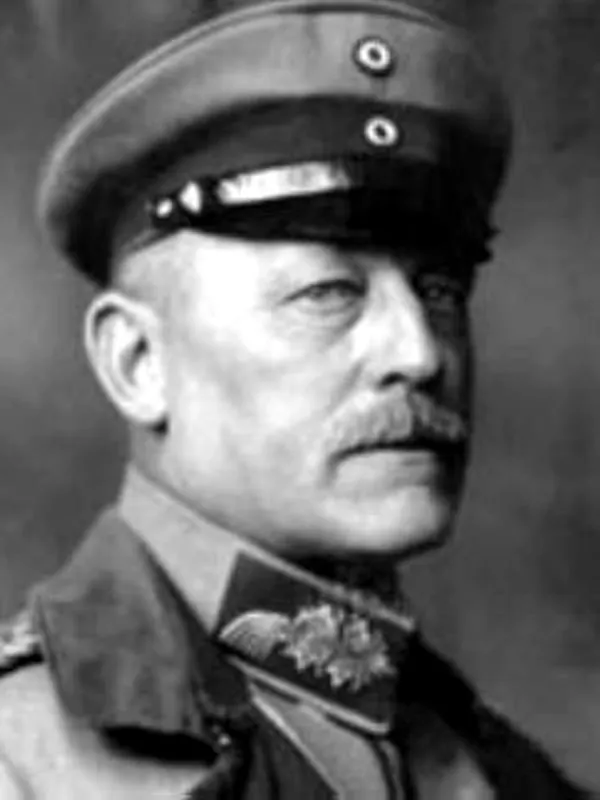
- Born:
- 27 August 1857, Erfurt (Prussia)
- Died:
- 5 December 1934, Berlin
- Author:
- Łukasz Skowroń
- Photo:
- Halsey, Francis Whiting, domena publiczna, Wikimedia Commons

Oskar von Hutier is one of the few German generals of the First World War whose name passed into military language. The French, and after them the British and Americans, called the German method of breaking through the front in 1917–1918 “Hutier tactics”: a short, violent bombardment with massive use of gas, and an infantry attack that did not stop at points of resistance. Hutier did indeed twice apply it with great success, at Riga in September 1917 and on the Somme in March 1918. Historians stress, however, that he was not its creator. He was, though, an efficient and demanding army commander, to whom Ludendorff entrusted tasks that called for boldness.
Before the war
He was born on 27 August 1857 in Erfurt. The family came from France: his grandfather was a French captain who settled in Erfurt, and his father, an engineer officer, was ennobled in Prussia in 1870 and rose to the rank of colonel. His mother was née Ludendorff, and in the literature Hutier is sometimes called a cousin of Erich Ludendorff. In 1875 he became a second lieutenant of infantry. After the War Academy he followed the typical path of a General Staff officer: he served in the Great General Staff, was first staff officer of a division in Strasbourg and of a corps in Königsberg, and then chief of staff of the III Corps. He also commanded a battalion and a regiment of the Hessian Guards in Darmstadt. In 1911 he became one of the Oberquartiermeister of the Great General Staff, and in 1912 he took over the 1st Guards Infantry Division in Potsdam.
1914–1917: from the Marne to Riga
With the 1st Guards Division, in Karl von Bülow’s 2nd Army, he marched through Belgium and northern France in 1914 and fought on the Marne, and in February 1915 his division was thrown into the First Battle of Champagne. In April 1915 he was transferred to the east, where he took over the XXI Corps in the 10th Army of General Hermann von Eichhorn. In September his divisions attacked in the Battle of Vilna. In March 1916 his corps defended the sector near Postavy during the Russian offensive at Lake Naroch, which collapsed with enormous losses. In January 1917 he took over Army Group “D” on the northern sector of the front and was promoted to General of Infantry, and in April he succeeded General Friedrich von Scholtz in command of the 8th Army, which stood on the Dvina near Riga.
In the summer of 1917, as the Russian army was disintegrating after the Kerensky Offensive, the German command decided to deal it another blow. At the beginning of August the Commander-in-Chief in the East, Prince Leopold of Bavaria, ordered Hutier to prepare a crossing of the Dvina above Riga. The army received extra corps, several divisions and a mass of heavy artillery and mortars, and the fire plan was drawn up by Lieutenant Colonel Georg Bruchmüller, an artillery specialist who had already developed in the east a method of short, carefully scheduled bombardment. On 1 September 1917, after several hours of hurricane fire with masses of gas shells, the German infantry crossed in boats and pontoons near Ikšķile. The Russian 12th Army managed to withdraw, and the Latvian Riflemen defended themselves stubbornly on the Little Jugla, but on 3 September the Germans entered Riga. The Battle of Riga did not produce the encirclement that had been hoped for, but it caused panic in Petrograd. Hutier received the Pour le Mérite. In October his army prepared the land forces for Operation Albion, in which the Germans occupied the islands of the Gulf of Riga.
Riga and “Hutier tactics”
Riga caught Ludendorff’s attention and became the starting point of a legend. A few weeks later similar methods were used at Caporetto, and at the end of November in the German counter-attack at Cambrai. The French press attributed them to Hutier and named them after him. In reality the new infantry tactics, based on storm troops (Stoßtruppen) and small groups bypassing points of resistance, had been developing since 1915 on the Western Front, in the assault battalions and in the experience of many divisions, and the bombardment method had been worked out by Bruchmüller. The American historian Bruce Gudmundsson points out that at Riga the infantry still attacked essentially in the old way, in skirmish lines of company strength, and that what was really new was the way the artillery was used. Hutier’s merit was that he gave Bruchmüller a free hand, prepared the operation carefully and conducted it with energy.
1918: the Spring Offensive
In December 1917 Hutier took over the newly formed 18th Army in the west, which became part of the army group of Crown Prince Wilhelm. Bruchmüller came with him. In the plan of Operation Michael Hutier’s army was to attack on the left wing, between Saint-Quentin and the Oise, and above all to cover the main attack on the British against the French. On 21 March 1918 it was this army that achieved the greatest success. It struck the weakest sector of General Hubert Gough’s British Fifth Army, broke through the front at Saint-Quentin, and crossed the Crozat Canal and the Somme. Ludendorff, encouraged by its progress, changed the plan and sent the 18th Army south-west. On 25 March Hutier took Noyon, and on 27 March he entered Montdidier. In less than two weeks his troops advanced about 60 kilometres and took tens of thousands of prisoners. For this success he received the oak leaves to the Pour le Mérite.
The breach was deep, however, but narrow and increasingly hard to supply. The artillery and transport became bogged down on the old battlefield of the Somme, and French reserves plugged one gap after another. On 4 April Hutier’s last attack, together with the 2nd Army, on the Avre, west of Moreuil, failed to reach Amiens. At the end of May the Americans of the 1st Division took the village of Cantigny from his troops. It was the first attack by a division of John Pershing’s army. On 9 June the 18th Army attacked in the Battle of the Matz, to join up the salients on the Somme and the Marne and threaten Compiègne. It gained a few kilometres, but the French defence did not collapse, and on 11 June a counter-attack by General Charles Mangin took back part of the German gains. The next day the attack was called off.
From the summer Hutier was only on the defensive. When the Battle of Amiens began on 8 August, the French threatened to encircle his troops at Montdidier. During the night of 9–10 August the 18th Army withdrew in good order, abandoning the town. It then fell back further, through the Noyon area, to the Hindenburg Line, and at the turn of September and October it abandoned Saint-Quentin. In November it was still fighting in the Battle of the Sambre. After the armistice Hutier led his army back to Germany.
After the war
At the beginning of 1919 he retired. From 1919 until his death he chaired the German Officers’ League, an organisation of officers of the old army, and was one of the advocates of the stab-in-the-back myth, according to which the German army had not been defeated in the field but betrayed by revolution at home. He died in Berlin on 5 December 1934 (some sources give 4 December). He was buried in Darmstadt.
Assessment
Hutier owes his fame above all to two operations, Riga and the first days of the Spring Offensive. Both showed that the front could be broken quickly, without a bombardment lasting many days that gave away the place of attack. Many older works, especially in English, therefore credited him with the authorship of the whole new tactics. Today’s historians, among them Gudmundsson and David Zabecki, regard this as a misunderstanding: storm tactics were the collective work of the German army, and the artillery side of the method was created by Bruchmüller. Hutier was rather one of the commanders who knew best how to make use of it.
His greatest success also had a bitter aftertaste. The 18th Army’s breakthrough in March 1918 led Ludendorff to scatter his forces in several directions instead of concentrating them on one objective. Hutier’s army went far but captured nothing of decisive importance, and its long, exposed front had to be given up in the summer under French pressure. After the war Hutier, like many generals of the imperial army, refused to accept the defeat and lent his authority to a myth that undermined the Weimar Republic.
Sources
Spotted a mistake?Report an error
Commanded in battles
(13)- 18 March – 28 April 1916Lake Naroch offensiveEastern Front
- 1–5 September 1917Battle of RigaEastern Front
- 11–20 October 1917Operation AlbionEastern Front
- 21–23 March 1918Battle of St QuentinWestern Front
- 21 March – 5 April 1918Operation MichaelWestern Front
- 25–26 March 1918Battle of NoyonWestern Front
- 26–27 March 1918Battle of RosièresWestern Front
- 4 April 1918Battle of the AvreWestern Front
- 9–14 June 1918Battle of the MatzWestern Front
- 8–11 August 1918Battle of AmiensWestern Front
- 8–15 August 1918Battle of MontdidierWestern Front
- 17–29 August 1918Second Battle of NoyonWestern Front
- 4 November 1918Battle of the SambreWestern Front
Mentioned in battles
(03)Often appears with
People who appear in the same events.