France · The Entente
Charles Mangin
Commander of the 5th Division (1914–1916), of a group at Verdun (1916), of the French 6th Army (1916–1917) and 10th Army (1918–1919), général de division
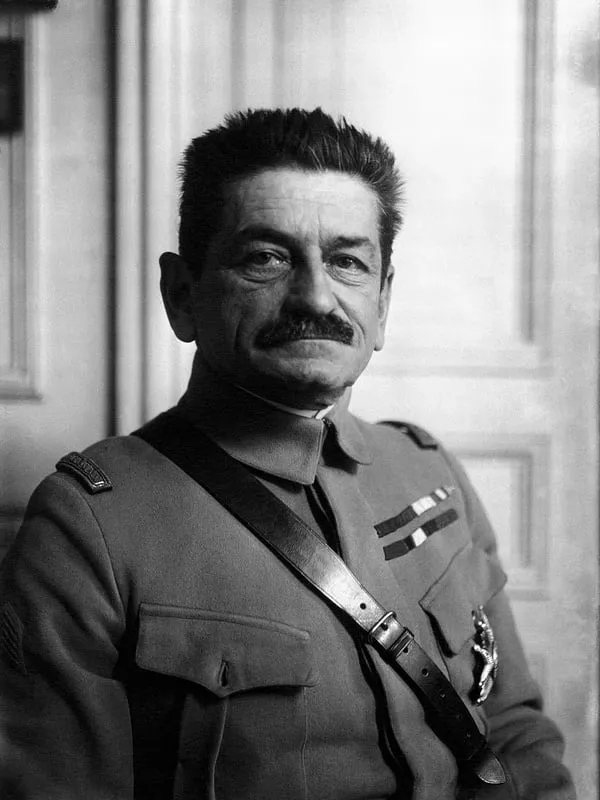
- Born:
- 6 July 1866, Sarrebourg (Lorraine)
- Died:
- 12 May 1925, Paris
- Author:
- Łukasz Skowroń
- Photo:
- Agence de presse Meurisse, domena publiczna, Wikimedia Commons

Charles Mangin was the most offensive-minded and at the same time the most controversial of the French generals of this war. An officer of the colonial infantry who had spent half his life in Africa and Asia, he won fame in October 1916, when his soldiers retook Fort Douaumont at Verdun in a few hours. A few months later, as commander of the 6th Army in General Nivelle’s failed offensive, he lost his post and became one of the scapegoats of the defeat. He returned in 1918 to lead the counter-attack on the Matz and the counter-offensive from Villers-Cotterêts that turned the tide of the Second Battle of the Marne. Soldiers and political opponents called him “the butcher”, and Georges Clemenceau, according to his secretary’s account, said of him that he waged war like a soldier and not like a civil servant, although Clemenceau himself believed that obedience was not for him.
Before the war
He was born on 6 July 1866 in Sarrebourg in Lorraine, which was annexed to Germany after the war of 1870–1871. His family opted for French citizenship and left. At his first attempt he failed to get into the officer school at Saint-Cyr, so he served as a private in the 77th Infantry Regiment; in 1886 he tried again, and this time he succeeded. As a second lieutenant he chose the marine infantry, that is, the colonial troops. From 1889 he fought in Senegal and French Sudan at the head of Senegalese tirailleurs, was wounded three times and learned the Bambara language. At the end of the 1890s he took part in Captain Jean-Baptiste Marchand’s expedition across Africa to Fashoda on the Nile, which nearly led to war with Britain in the Fashoda Incident. Later he served in Tonkin and again in West Africa.
In 1910 he published the book “La Force noire” (“The Black Force”), in which he argued that France, whose population was shrinking compared with Germany’s, should in the event of a great war in Europe raise a mass army from the inhabitants of West Africa. The idea had many opponents, but during the war France recruited, according to various estimates, between 170,000 and 200,000 soldiers in West Africa. In 1912, as a colonel under General Hubert Lyautey, he defeated the insurgents in Morocco and took Marrakesh. In August 1913 he became a brigadier-general.
1914–1916: from a brigade to Douaumont
He began the war as commander of the 8th Infantry Brigade. During the Battle of Charleroi his brigade retook, on 23 August, the village of Onhaye on the left bank of the Meuse, which had been seized by Germans who had crossed the river at Dinant. On 2 September he took over the 5th Infantry Division, with which he fought on the Marne and in 1915 in Artois. In June, in the Second Battle of Artois, after eight days of fighting for every house, his division captured the rest of the village of Neuville-Saint-Vaast. Even then he was famous for appearing in person in the front line and ruthlessly demanding that his subordinates attack.
In the spring of 1916 the 5th Division was sent to Verdun. On 22 May Mangin, with the approval of the new commander of the 2nd Army, General Robert Nivelle, led the first attempt to retake Fort Douaumont. The French artillery was too weak and the attack ended in a bloody defeat. Even so, Nivelle did not remove him. In June Mangin received the temporary rank of général de division and command of a corps, and from September he commanded a group on the right bank of the Meuse, from the river to Fort Tavannes.
This time the preparations took weeks. Mangin and Nivelle chose limited objectives, more than 600 guns were brought up, including super-heavy 400 mm railway guns, and the infantry rehearsed the attack on a replica of the ground. On 24 October, in fog, Mangin’s three divisions advanced close behind a creeping barrage and in a few hours recovered the ground that had taken the Germans eight months to capture, Fort Douaumont included. At the beginning of November the Germans abandoned Fort Vaux. On 15 December Mangin struck again, with four divisions, and by 18 December had pushed the Germans back from Douaumont by several more kilometres. In the two attacks the French took more than ten thousand prisoners. The December attack coincided with the German offer of peace negotiations, and in an order to his soldiers Mangin wrote that France had answered it “with the mouths of her guns and the points of her bayonets”.
1917: the Chemin des Dames and dismissal
The success at Verdun made heroes of Nivelle and Mangin, and the method of a short, carefully prepared attack seemed a recipe for victory. When Nivelle became commander-in-chief, Mangin took over the 6th Army on 19 December 1916. In the spring offensive it was to attack on the western flank of the Chemin des Dames ridge, from Laffaux to Oulches. Mangin was one of the few generals who believed without reservation in Nivelle’s promise that the front would break within 24–48 hours.
On 16 April 1917 his army attacked without tanks, in cold and sleet. The colonial corps, with many battalions of Senegalese tirailleurs, gained at most a few hundred metres on the slopes of the ridge, while Germans emerging from underground caves struck the attackers from the rear. Only when the Germans abandoned the threatened salient between Laffaux and Braye on 17 and 18 April did the 6th Army advance several kilometres, capturing many guns. The offensive as a whole failed, and losses were so heavy that Paris began looking for culprits. The Senegalese deputy Blaise Diagne accused Mangin of the pointless slaughter of African soldiers. On 29 April the government appointed Pétain Chief of the General Staff, and on 2 May Mangin, Nivelle’s closest associate, lost his command, a day before the first mutiny in one of his former divisions. A commission of inquiry later cleared him of most of the charges, but he remained without a post until the end of the year.
1918: the Matz, Soissons and the Rhine
He was restored to service by Clemenceau, who had become prime minister in November 1917. At the end of the year Mangin was given a corps, and in the spring of 1918 he was awaiting a new assignment when, on 9 June, the Germans attacked on the Matz towards Compiègne. General Émile Fayolle gave him five fresh divisions and about 140 tanks. Mangin promised to strike the very next morning, although part of the artillery was not due to arrive until the night, and on 11 June his counter-attack halted the German offensive and won back some of the lost ground. Soon afterwards he took over the 10th Army.
His army, hidden in the forests around Villers-Cotterêts, was to strike the western flank of the German salient on the Marne. Mangin pressed to attack as soon as possible, and when on 15 July the Germans launched their last great offensive and Pétain wanted to halt his preparations, Foch refused. At dawn on 18 July, without a bombardment lasting days, behind a creeping barrage and with hundreds of tanks, the French, Moroccan and American divisions of the 10th Army took the Germans by surprise and within a day broke into their positions, in places to a depth of several kilometres. The railway line through Soissons, on which the supply of the whole salient depended, was threatened, and the Germans had to fall back from the Marne. That day is regarded as the turning point of the war in the west. On 2 August Mangin’s soldiers entered Soissons.
In the second half of August the 10th Army attacked between the Oise and the Aisne in the Second Battle of Noyon and reached the Ailette, and in the autumn it drove the Germans out of the forests of Saint-Gobain and entered Laon on 13 October. At the beginning of November the army was moved to Lorraine, where together with the 8th Army it was to lead a new offensive towards the Saar. The armistice forestalled it. On 19 November 1918 Mangin’s troops marched into Metz, and on 11 December their commander reached the Rhine at Mainz.
After the war
In the occupied Rhineland Mangin, convinced that France should permanently detach the left bank of the Rhine from Germany, supported the Rhenish separatists, who in June 1919 proclaimed the Rhenish Republic in Wiesbaden. The British and Americans protested, the French government did not back the venture, and in the autumn of 1919 Mangin was recalled from the Rhine. His demand that African soldiers serve in the occupation forces became the pretext in Germany for a racist propaganda campaign about the “Black Shame” on the Rhine. From 1920 he sat on the Supreme War Council, went on a mission to South America and was then inspector-general of the colonial troops. He published the book “Comment finit la guerre” (“How the War Ended”). He died suddenly in Paris on 12 May 1925, and the right-wing press spread rumours of poisoning. In 1932 his remains were moved to Les Invalides. In June 1940 the Germans who entered Paris blew up his monument.
Assessment
Mangin divided opinion from the start. For his supporters he was a commander of temperament who understood that wars are not won on the defensive and who was among the first to show how to attack effectively: at Verdun with a carefully prepared attack with limited objectives, and in 1918 with surprise, tanks and a haste that gave the Germans no time to bring up reserves. French biographies stress that his well-prepared attacks at Verdun cost little. For his critics he was “the butcher” and “the man-eater”, who took no account of losses, especially among colonial soldiers, and who uncritically backed Nivelle’s unrealistic plans. He himself is said to have remarked that whatever one does, one loses a lot of men.
Historians also point out that his greatest victories were not his achievement alone. At Verdun the plan and the artillery were prepared by Nivelle’s staff, and in July 1918 the counter-offensive was planned, and defended against Pétain’s doubts, by Ferdinand Foch. Mangin, however, was the one best able to carry out such blows. His later policy in the Rhineland and his openly colonial views made him a symbol of French triumph in Germany, while in France he was long regarded as too independent a figure to be trusted fully.
Sources
Spotted a mistake?Report an error
Commanded in battles
(09)- 21 February – 18 December 1916Battle of VerdunWestern Front
- 24 October – 18 December 1916First Offensive Battle of VerdunWestern Front
- 16 April – 9 May 1917Second Battle of the AisneWestern Front
- 16 April – 9 May 1917Nivelle OffensiveWestern Front
- 9–14 June 1918Battle of the MatzWestern Front
- 15 July – 6 August 1918Second Battle of the MarneWestern Front
- 23 July – 2 August 1918Battle of the Soissonnais and of the OurcqWestern Front
- 8 August – 11 November 1918Hundred Days OffensiveWestern Front
- 17–29 August 1918Second Battle of NoyonWestern Front
Mentioned in battles
(02)Often appears with
People who appear in the same events.