France · The Entente
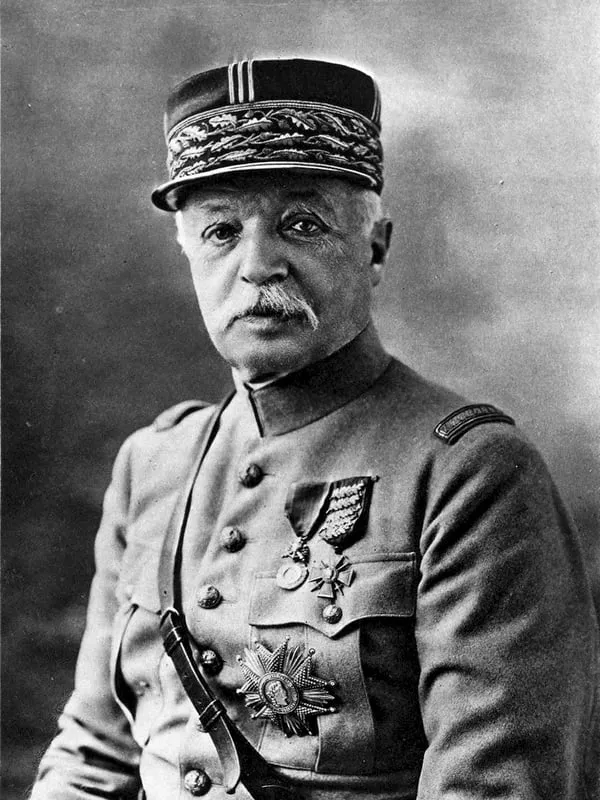
Émile Fayolle
Commander of the 6th Army (1916), Army Group Centre (1917), the French forces in Italy (1917–1918) and the Reserve Army Group (1918), Marshal of France
- Born:
- 14 May 1852, Le Puy-en-Velay (France)
- Died:
- 27 August 1928, Paris
- Author:
- Natalia
- Photo:
- autor nieznany, domena publiczna, Wikimedia Commons

Marie Émile Fayolle was 62 years old and had been retired for three months when he was recalled to the army in August 1914. Four years later he commanded an army group which in March 1918 helped to stop the German offensive towards Amiens and Paris, and in the summer and autumn drove the Germans back from the Marne towards the frontier. Along the way he led the French 6th Army in the Battle of the Somme, Army Group Centre in the difficult year of the mutinies, and the French forces sent to help Italy after Caporetto. He was a gunner and a teacher, cautious and methodical, convinced that the front had to be taken position by position rather than in a single assault. The diary he kept throughout the war, published in 1964, is among the most interesting French testimonies of those years.
Before the war
He was born on 14 May 1852 in Le Puy-en-Velay in Auvergne, the eldest of the six children of a lace merchant. He was educated at the Jesuit college in Saint-Étienne and, in 1873–1875, at the École polytechnique, from which he went into the artillery. He took part in the occupation of Tunisia in 1881, and in 1891 he graduated with distinction from the War College (École supérieure de guerre). From 1897 to 1908 he taught artillery tactics there, at the same time as Ferdinand Foch, who taught strategy. At the end of 1910 he became a brigadier-general and commanded the artillery of XII Corps, and then an artillery brigade. On 14 May 1914, his 62nd birthday, he retired.
1914–1915: Lorraine and Artois
At the start of the war Joseph Joffre brought him back into service as a brigade commander in the 70th Reserve Division, and on 13 August, after its commander was removed, Fayolle took over the whole division. Made up of older reservists, it fought on the hills in front of Nancy in the Battle of the Grand Couronné, where in September the French beat off the German attacks on Lorraine. At the end of September the division was moved by rail to the north, to the area of Lens, where at the beginning of October it struggled to halt the German advance towards Arras.
From then on Fayolle fought in Artois in the corps of General Philippe Pétain, with whom he was bound by friendship and a similar view of the war: both believed more in artillery than in the élan of the infantry. In May 1915, in the Second Battle of Artois, his division broke into Carency, and in the summer, when Pétain took over an army, Fayolle succeeded him at the head of XXXIII Corps. He led it in September in the Third Battle of Artois. His divisions took only the first line of German trenches, and he himself judged the battle a failure, caused by uncut wire and the fire of German machine guns.
The Somme
In February 1916 he took over the 6th Army, which stood on the Somme alongside the British and was subordinate to Foch’s army group. Under the original plans it was to carry out the main attack, but the Battle of Verdun took division after division from the French, and few were left for the attack of 1 July. Fayolle prepared the blow carefully, with an enormous superiority of heavy artillery on a narrow front. On the first day his corps on both banks of the river took all their assigned objectives, captured more than four thousand prisoners and lost few men, while to the north of them the British army lived through the blackest day in its history. On the south bank the Germans, who had not expected an attack there, lost their entire first position within a few days. The British official history held that a vigorous pursuit was possible at that point, but Fayolle and Foch treated the attack south of the river as secondary and did not want to get ahead of the British.
Later the 6th Army fought mainly on the north bank, shoulder to shoulder with the 4th Army of Henry Rawlinson. Co-operation was difficult. At Guillemont and Maurepas the two armies waited for each other: the French did not want to advance until the British had taken the village, and the British could not hold it without French progress. In September Fayolle’s army took Bouchavesnes on the Péronne–Bapaume road, and on 26 September, together with the British, Combles. At the end of September Fayolle concluded that without a new, careful artillery preparation he would get no further, and the autumn attacks on Sailly-Saillisel and the wood of Saint-Pierre-Vaast achieved little. Even so, his reputation as one of the best army commanders survived even the transfer of command from Joffre to Robert Nivelle.
1917: Army Group Centre and Italy
On 31 December 1916 Fayolle moved to the 1st Army, which in March 1917 followed the Germans as they withdrew to the Hindenburg Line. When, after the failure of the Nivelle offensive, Pétain became Chief of the General Staff and in May commander-in-chief, Fayolle succeeded him at the head of Army Group Centre. He commanded it during the months of the mutinies and the rebuilding of the army. In August, under his supervision, General Adolphe Guillaumat’s 2nd Army carried out a carefully prepared attack which recaptured at Verdun the heights of Mort-Homme and Hill 304. When his subordinates wanted to go further, Fayolle and Pétain decided that a new battle of attrition would not be worth it.
After the Italian defeat at Caporetto, on 16 November Fayolle was made commander of the French forces sent to Italy. He arrived there on 21 November and took over six French divisions. Together with Herbert Plumer’s British he shored up the new defensive line on the Piave and on Monte Grappa, and in the last days of the year his soldiers recaptured Monte Tomba. In a report of 26 December he judged that the Italian army, though beaten, could still field nearly 50 divisions. In March 1918 he returned to France.
1918: the Reserve Army Group
Pétain entrusted him with the Reserve Army Group, a reserve meant to support threatened sectors. A few days later, on 21 March, the Germans struck the British on the Somme. Fayolle was to receive eleven divisions, and from the night of 24 March he commanded all the Allied forces south of the Somme, including the remnants of General Hubert Gough’s British 5th Army. His divisions arrived at the front piecemeal, often without artillery, and the Germans took Noyon, Roye and Montdidier. In those days Fayolle ordered that there could be no endless retreat and that men must let themselves be killed where they stood. After the Doullens conference Pétain sent him a further ten divisions and ordered him to cover Amiens and keep contact with the British. At the beginning of April the front on the Avre stabilised.
In June, when the Germans attacked on the Matz towards Compiègne, Fayolle and Pétain were prepared. The defence had been moved back in depth, reserves waited behind the front, and on 11 June Fayolle gave five divisions and about 140 tanks to General Charles Mangin, whose counter-attack stopped the German advance. From July his group included the armies that led the counter-offensive in the Second Battle of the Marne. In August he directed the attacks at Montdidier and at Noyon, instructing his army commanders to pursue the Germans relentlessly but not to attack strongholds frontally, rather to outflank them and avoid needless losses. In the autumn his troops advanced in the centre of the Allied front, towards the Hindenburg Line and on towards Laon. On 10 July 1918 he received the Grand Cross of the Legion of Honour. On 19 November he rode into Metz at Pétain’s side, and from December his troops occupied the left bank of the Rhine with Mainz.
After the war
From 1920 he sat on the Supreme War Council, and from 1921 to 1924 he was inspector-general of aviation. On 19 February 1921 he received the baton of a Marshal of France, as one of the commanders to whom this honour came only after the war. According to French sources, in the same year he also received the Polish Silver Cross of the Virtuti Militari. In 1921 he led a mission of thanks to Canada and presented the Canadian government with the bust “La France” by Auguste Rodin. He died in Paris on 27 August 1928. After a state funeral he was laid to rest at Les Invalides.
Assessment
Fayolle was one of the oldest French generals of the war and one of those who most quickly understood that in trench warfare the artillery was decisive. English-speaking historians, among them William Philpott, point out that on 1 July 1916 it was his carefully prepared army that achieved the only clear success on the Somme, and see in him an example of the maturing of the French army, which in 1916 began to fight methodically. His critics, among them some of the British who fought alongside him, accused him of excessive caution, a slow pace and reluctance to exploit success. General Alfred Micheler, whose 10th Army stood on the south bank of the Somme in the autumn of 1916 with small reserves, even complained that he had been reduced to the role of a watchdog for Fayolle.
His diary, published as “Cahiers secrets de la Grande Guerre”, shows a sober man, often pessimistic and critical of his superiors, colleagues and politicians. Fayolle was not a commander of spectacular victories like Mangin, but in 1918, when the war became mobile again, he proved one of the most reliable executors of Foch’s and Pétain’s plans.
Sources
Spotted a mistake?Report an error
Commanded in battles
(16)- 1 July – 18 November 1916Battle of the SommeWestern Front
- 1–13 July 1916Battle of Albert (1916)Western Front
- 3–6 September 1916Battle of GuillemontWestern Front
- 15–22 September 1916Battle of Flers–CourceletteWestern Front
- 25–28 September 1916Battle of MorvalWestern Front
- 1–18 October 1916Battle of the Transloy RidgesWestern Front
- 20 August – 15 December 1917Second Offensive Battle of VerdunWestern Front
- 10 November – 26 December 1917First Battle of the PiaveItalian Front
- 21 March – 5 April 1918Operation MichaelWestern Front
- 25–26 March 1918Battle of NoyonWestern Front
- 26–27 March 1918Battle of RosièresWestern Front
- 9–14 June 1918Battle of the MatzWestern Front
- 15 July – 6 August 1918Second Battle of the MarneWestern Front
- 23 July – 2 August 1918Battle of the Soissonnais and of the OurcqWestern Front
- 8–15 August 1918Battle of MontdidierWestern Front
- 17–29 August 1918Second Battle of NoyonWestern Front
Mentioned in battles
(05)Often appears with
People who appear in the same events.
On the timeline
(21)1914
1916
1917
1918
March
- 26
- Germans take Albert, Chaulnes and RoyeOn 26 March 1918 the Germans took Roye and Chaulnes south of the Somme, and in the evening entered the ruins of Albert with its famous "Leaning Virgin".
- Key eventDoullens conferenceOn 26 March 1918, in the town hall at Doullens, the French and British entrusted General Foch with coordinating the Allied armies on the Western Front.