1916: The Battle of the Somme
Battle of Morval
- Dates:
- 25–28 September 1916
- Front:
- Western Front
- Location:
- Eastern end of the ridge above the Somme between Ginchy, Flers and Le Transloy. The villages of Morval (Pas-de-Calais department), Lesbœufs, Gueudecourt and Combles (Somme department), FranceOn the battle map →
- Sides:
- United Kingdom, New Zealand, British India and FranceDouglas Haig, Henry Rawlinson, Ferdinand Foch, Émile FayolleGerman EmpireRupprecht, Crown Prince of Bavaria, Fritz von Below
- Result:
- Anglo-French victory. The Allies took the last villages on the ridge between Combles and Gueudecourt and broke through the third German position, but tired troops and slow French progress prevented them from exploiting the success.
- Author:
- Natalia
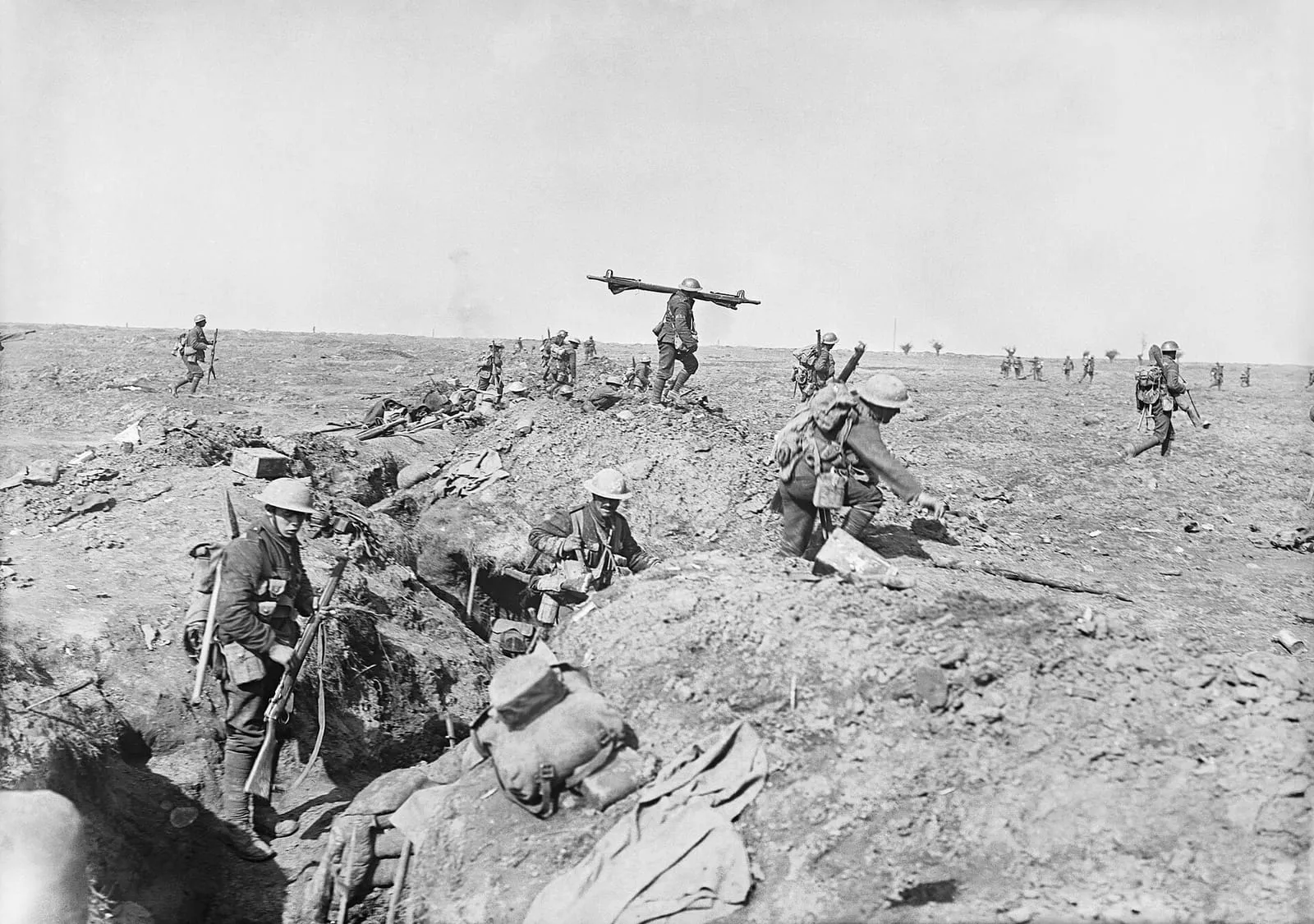
The Battle of Morval was the third great attack of the British Fourth Army in September 1916, during the Battle of the Somme. Its objectives were three villages that had not been taken ten days earlier at the Battle of Flers-Courcelette: Morval, Lesbœufs and Gueudecourt. At noon on 25 September, the first anniversary of the Battle of Loos, the infantry of General Henry Rawlinson went into the attack together with the French Sixth Army, which advanced on its right. Within three hours the British had taken Morval and Lesbœufs, and the next day, after remarkable co-operation between a tank, an aircraft, artillery and infantry, Gueudecourt as well. That same night the Germans abandoned Combles, which the British and French entered from two sides. The British official history judged the attack of 25 September the most successful operation of the Fourth Army since the dawn assault of 14 July. The success could not be exploited, however: there were no fresh divisions, the French advanced slowly, and the Germans managed to withdraw their artillery and build new lines of defence.
Name and dates
The name “Battle of Morval” and the dates 25–28 September 1916 were fixed after the war by the British Battles Nomenclature Committee. It covers the Fourth Army’s attack from Combles to the Albert–Bapaume road. The parallel attack of the Reserve Army on the Thiepval ridge, which began on 26 September, counts as a separate battle. The French made no such division, and their attack of 25–27 September was for them simply another stage of their autumn offensive on the Somme. Morval actually lies in the Pas-de-Calais department, just beyond the border of the Somme department. Times in the text are given in British time, following the British official history (Colonel Wilfrid Miles’s volume of 1938) and H. A. Jones’s history of the air war.
Background
On 15 September the British used tanks for the first time in history and took Flers, Martinpuich and High Wood. On the right wing of the Fourth Army, however, the attack stalled before a German redoubt the British called the Quadrilateral, on the ridge between Ginchy and Morval. The Guards did not reach Lesbœufs, and Gueudecourt remained in German hands. The 6th Division took the Quadrilateral only on 18 September. These three villages became the objective of the next attack.
Douglas Haig wanted to strike as soon as possible, and General Ferdinand Foch, commander of the French Northern Army Group, promised that this time the French would attack the village of Frégicourt east of Combles with a fresh division and try to take Sailly-Saillisel. The attack was first set for 21 September. Torrential rain, however, turned the battlefield into mud through which ammunition could be brought up only with difficulty, and the French were not ready in time. On 19 September Rawlinson announced that the attack was postponed by a day, and on 20 September by another, to 23 September. On 21 September Foch came to Haig and explained that the French Sixth Army had used up a great deal of ammunition repelling German counter-attacks and needed time to replenish it. It was agreed that the two armies would attack together on 25 September, not before noon, because the French wanted to use the good morning light for the final stage of the bombardment.
The Germans were in a difficult position. Since the end of August the German forces on the Somme had been commanded by the Crown Prince of Bavaria, Rupprecht, and the sector north of the river was held by the First Army of General Fritz von Below. According to the German official history, quoted by Miles, as early as the beginning of September Rupprecht doubted whether he could withstand the Allied pressure for long, and his chief of staff reckoned that a division lost its fighting value after fourteen days at the front. During the Battle of Flers-Courcelette all six German divisions between Combles and Thiepval had to be relieved. Facing the Fourth Army now were fresh divisions unfamiliar with the sector: the 51st and 52nd Reserve at Combles, Morval and Lesbœufs, the 6th Bavarian at Gueudecourt and the 50th Reserve further west. They were defending their third position, less developed than the lines taken on 15 September. According to some historians they expected the attack on 23 September, not on the 25th.
Plan
The Fourth Army was to advance between 1,100 and 1,400 metres in three stages, with hour-long pauses, and reach its final objectives before three in the afternoon. XIV Corps under General Lord Cavan was to take Morval and Lesbœufs. Cavan put four divisions into the line on narrow frontages, so that each could more easily push support forward: from the right, the 56th (London), the 5th, the 6th and the Guards Division. XV Corps under General Henry Horne was to take Gueudecourt with the 21st Division, while the 55th Division and the New Zealand Division covered its left flank. III Corps, on the army’s left wing, was only to improve its position by the Bapaume road. The infantry was to follow a creeping barrage, and the preparatory bombardment, heavier than before 15 September, began at seven in the morning on 24 September.
This time the British did not base their plan on tanks. Few serviceable Mark I machines remained, and Rawlinson judged that they could not be hidden in forward positions from dawn until noon. They were to wait in reserve and move only against the villages if the infantry needed help. Haig opposed the use of tanks at Gueudecourt, where the approach led across open ground easily swept by German artillery. Two brigades of the 1st Indian Cavalry Division waited near Mametz, ready to advance on Thilloy and Ligny-Thilloy if Lesbœufs and Gueudecourt fell before 6.30 p.m.
To the right of the British, the French Sixth Army of General Émile Fayolle was preparing, as the French official history put it, “a true general offensive, similar to that of 1 July”. Foch gave it artillery from the Tenth Army on the south bank of the Somme, several batteries and an air squadron from Verdun. Seven French divisions were to attack from Combles to the Somme, and I Corps, in co-operation with the 56th Division, was to envelop Combles from the east, through Frégicourt.
Course
25 September. The day was sunny, with a light haze. At 12.35 p.m. the barrage moved off, and the infantry behind it. XIV Corps, “admirably served by its artillery”, as the official history puts it, advanced methodically from objective to objective, without delays and almost without serious obstacles. The Germans who had survived the bombardment were surprised before they could offer resistance, and some fled without their weapons. The German barrage came down too late. Only the 2nd Battalion of the Grenadier Guards had to cut through wire by hand under fire, and the 1st Battalion of the East Surrey Regiment suffered heavy losses at a light-railway embankment north of Combles. By about three o’clock the British were in Morval and Lesbœufs, and an observer in a balloon reported that almost all the objectives had been taken only twenty-one minutes after the start of the final stage of the attack. The south-eastern corner of Morval fell in the evening.
Things went worse at Gueudecourt. In front of Gird Trench, part of the German third position, the 21st Division ran into uncut wire and the fire of machine guns that the Germans had pulled back from the front line before the bombardment and hidden in shell holes. The attack broke down, and the left wing of the Guards had to form a defensive flank facing north. The 55th Division and the New Zealanders did better, taking trenches north of Flers and capturing the headquarters of a Bavarian battalion. The cavalry did not move. Battalion commanders reported that the ground in front of them was empty, but Lord Cavan did not want to take risks given the uncertain situation on the flanks.
The French advanced more slowly. Their XXXII Corps took the village of Rancourt on the road from Péronne to Bapaume in the afternoon, but I Corps was stopped by machine guns on the south-eastern edge of Combles and at Frégicourt. Further south the attack achieved little. In the evening a disappointed Foch came to Haig. He explained that Fayolle’s advance on Sailly-Saillisel was blocked by the wood of Saint-Pierre-Vaast and asked whether he might pass troops through Morval to attack Sailly-Saillisel from the west. Haig at once offered to hand over both Morval and Lesbœufs to the French.
26 September. A German officer captured at Morval stated that the Germans would abandon Combles during the night. With the village caught in a pincer between the British in Morval and the French to the south, its defenders began to withdraw eastwards. During the night patrols of the 56th Division passed through the empty Bouleaux Wood, and at 2.10 a.m. red rockets and one green one rose over the German trenches, the signal for the rearguards to retire. Towards morning the Londoners entered Combles from the north, and the French 110th Infantry Regiment cleared the south-eastern part of the village, taking 200 prisoners. At dawn patrols of the two armies met in Combles. Many Germans fleeing along the valley towards Haie Wood came under machine-gun fire. During the night the French also took Frégicourt. According to the French historian General Palat, about 500 prisoners, 1,500 rifles, 2 million cartridges and 15,000 artillery shells were taken in Combles.
That same morning at Gueudecourt there was an action that the air historian H. A. Jones called an example of “perfect co-operation between aircraft, tanks, artillery and infantry”. Between the 21st Division and the Guards the Germans still held about 1,400 metres of Gird Trench. At about 6.30 a.m. a single tank came up from the direction of Flers and after seven o’clock moved along the trench, firing, followed by bombers of the 7th Battalion of the Leicestershire Regiment. The Germans were driven along the trench towards the Guards. The observer of an aircraft of No. 3 Squadron of the Royal Flying Corps called down artillery fire on the crowded defenders, and when it stopped the pilot came down low and machine-gunned the trench. Eight officers and 362 men, mostly of the 238th Reserve Infantry Regiment, surrendered, for British losses of five men.
Before noon a German counter-attack on the eastern edge of Gueudecourt was broken up by the fire of more than 60 British field guns, and hundreds of survivors fled without their weapons towards Le Transloy. In the afternoon a squadron of the 19th Lancers of the 1st Indian Cavalry Division and men of the South Irish Horse entered Gueudecourt on foot, and at about 4.30 p.m. they were joined by infantry of the Leicestershires, who dug in beyond the village in the evening. That day Second Lieutenant T. E. G. Scaife was killed, one of the best observers of contact patrol aviation, who had flown over the Somme since the first day of the battle. His aircraft was torn apart by an anti-aircraft shell and fell near Lesbœufs, in full view of the infantry whose movements Scaife had so often reported. On the right wing the 5th Division took some of the trenches east of Morval, but was stopped further on by fire from the direction of Sailly-Saillisel. The French attack on the Haie and Saint-Pierre-Vaast woods at 4 p.m. succeeded only on the flanks. That day, in the west, the Reserve Army’s attack on the Thiepval ridge began, which in Haig’s view was now of the greatest importance.
27–28 September. On the afternoon of 27 September, in worsening weather, XV Corps attacked the rest of Gird Trench north-west of Gueudecourt. The Liverpool Irish battalion of the 55th Division took its objective with light losses, as did two New Zealand battalions, but three companies of the Otago battalion were almost destroyed by artillery and machine-gun fire. III Corps occupied Twenty-Sixth Avenue trench without a fight and came up to Eaucourt l’Abbaye. The French twice, on 26 and 27 September, tried to advance on Sailly-Saillisel and each time gained little. Fayolle concluded that without careful artillery preparation he would achieve nothing more. 28 September passed mainly in shelling. From the newly won heights British gunners could see far into the German rear, while the Germans shelled the ruins of Morval, Lesbœufs and Gueudecourt. During the night of 27–28 September XIV Corps began handing over its right-hand sector, including Morval, to the French. The new boundary between the two armies ran north-east from the south-eastern edge of Lesbœufs, leaving Le Transloy to the British. The relief was completed on the morning of 29 September.
Casualties
Full casualties for this battle were not given. The divisions usually reported them for longer periods: the 5th Division 1,749 men for 19–26 September, the 56th Division 5,538 for the whole of September, the 55th Division 1,555 for 17–29 September, and the 1st Division over 1,400 from 20 September. The historians Robin Prior and Trevor Wilson estimate the losses of the ten British divisions in the attack itself at about 5,000 men, a small figure by the standards of the Somme. According to Haig’s notes, the Fourth Army and the Reserve Army together lost about 19,000 men from 25 September to 2 October. French losses were not separately recorded.
The Germans lost more. According to the German official history, cited by Miles, the losses of 25 and 26 September were the heaviest since 1 July. According to German regimental histories, several battalions of the 51st and 52nd Reserve Divisions and of the 6th Bavarian Division were practically destroyed. September was the bloodiest month of the whole battle for the German army. According to estimates cited by the historian Christopher Duffy, the First and Second Armies lost about 135,000 men that month. The British, however, captured only two field guns, because the Germans managed to withdraw their artillery in time.
Significance
The Battle of Morval showed how much the British army had changed since 1 July. An attack on limited objectives, with a heavy bombardment of relatively weak defences and infantry following close behind a creeping barrage, gave the British in a few hours villages that elsewhere had been fought over for weeks. With Morval taken, the whole main ridge above the Somme was in Allied hands, and before them opened a valley beyond which lay Bapaume. According to the historian William Philpott, Ludendorff called the fighting of 25–28 September the greatest engagement of the whole battle. The German high command, fearing a breakthrough between Bouchavesnes and Gueudecourt, sent five more divisions and a great deal of heavy artillery to the Somme.
There was no breakthrough, however. The French were held up in front of the wood of Saint-Pierre-Vaast and Sailly-Saillisel, and after the first day the Fourth Army, with no fresh divisions and with tired troops, could only edge forward towards the enemy’s new positions. The Germans dug further lines of defence on reverse slopes, out of sight of ground observation, and the weather was deteriorating. In October the British and French attacked these lines in mud and rain, in the Battle of the Transloy Ridges, and gained little more. The action at Gueudecourt on 26 September, on the other hand, went down in the history of aviation as a model example of co-operation between a tank, an aircraft, artillery and infantry, a foretaste of the tactics the British army perfected in the following years.
Spotted a mistake?Report an error