1916: The Battle of the Somme
Battle of the Somme
- Dates:
- 1 July – 18 November 1916
- Front:
- Western Front
- Location:
- Picardy, Somme department, France. The heights on both sides of the Somme and the Ancre between the towns of Albert, Bapaume and Péronne (Gommecourt, Beaumont-Hamel, Thiepval, Pozières, Longueval, Combles), and south of the Somme as far as the area of ChaulnesOn the battle map →
- Sides:
- British Empire, FranceDouglas Haig, Henry Rawlinson, Hubert Gough, Joseph Joffre, Ferdinand Foch, Émile Fayolle
- Result:
- Inconclusive. The Allies did not break through and advanced about 10 kilometres at most, but they relieved Verdun and inflicted losses on the German army from which it never recovered.
- Author:
- Łukasz Skowroń
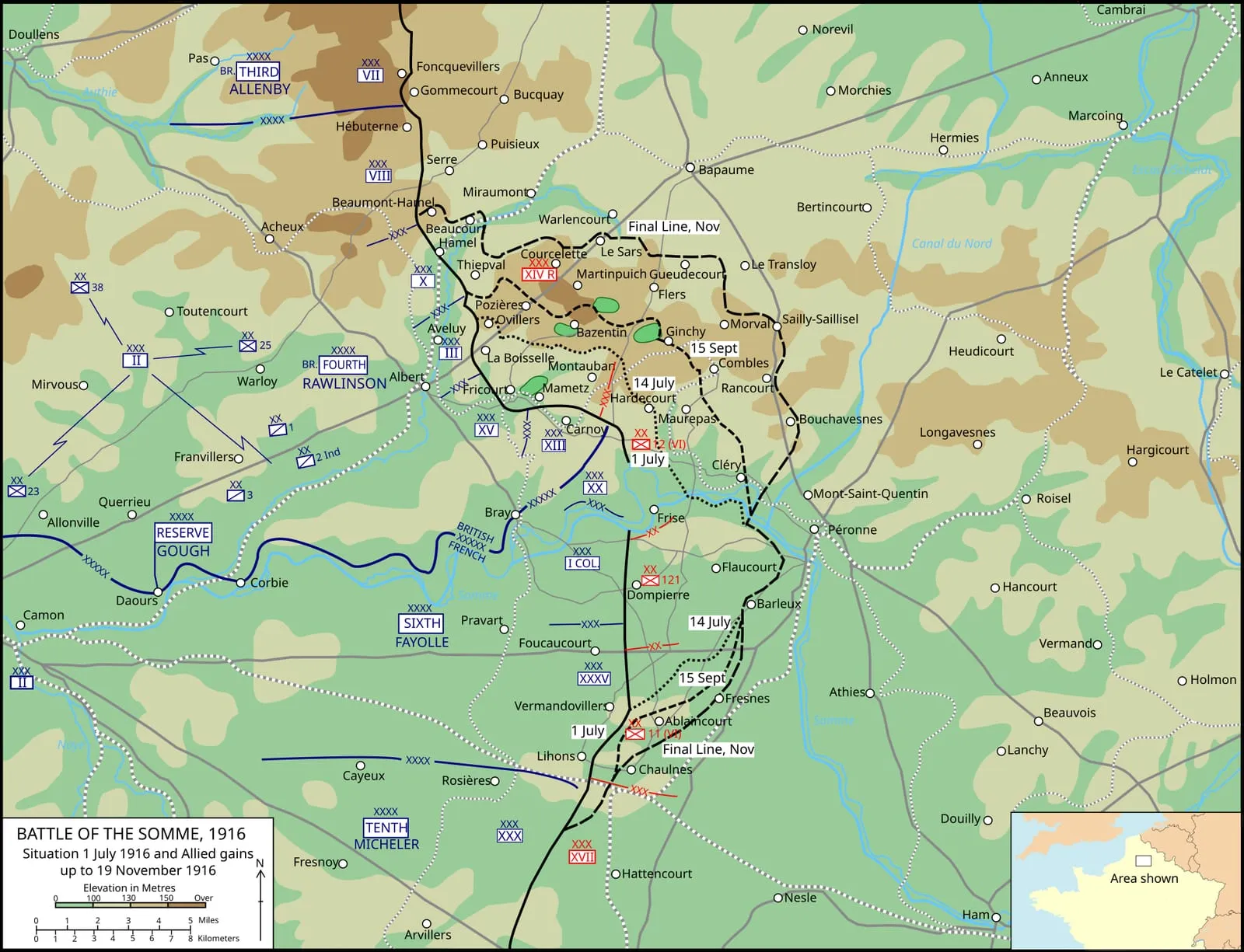
The Battle of the Somme was the largest battle fought by the British Army in the First World War and one of the bloodiest battles in history. On 1 July 1916, after a week-long artillery bombardment, the British Fourth Army and the French Sixth Army attacked the German positions on both sides of the river Somme in Picardy. The first day brought the British the heaviest losses in their history: more than 57,000 killed, wounded and missing, in exchange for a scrap of ground on the southern sector. The French, attacking alongside, won a clear success. Instead of the breakthrough the British commander-in-chief had hoped for, a battle of attrition began that lasted almost five months, fought over one village, wood and ridge after another. Soldiers from the whole British Empire fought in it: Australians at Pozières, South Africans in Delville Wood, Canadians at Courcelette, New Zealanders at Flers. In September tanks went into battle for the first time in history. When snow and mud ended the fighting in November, the Allies were at the furthest point about ten kilometres from their start line and had not even taken Bapaume, an objective of the first days. Yet the battle relieved Verdun and bled the German army so badly that in the spring of 1917 the Germans withdrew to a new, shorter defensive line. The two sides together lost more than a million men.
Name and dates
The British and French speak of the Battle of the Somme (Battle of the Somme, bataille de la Somme), the Germans of the battle on the Somme (Schlacht an der Somme) or simply of “the Somme”. We use the dates 1 July – 18 November 1916, from the first day of the infantry assault to the last British attack on the Ancre. This is how the British official history and most studies date the battle. The artillery bombardment began as early as 24 June and some German studies count the battle from that day, while local fighting went on for a few days after 18 November.
After the war the British Battles Nomenclature Committee divided the Battle of the Somme into more than a dozen battles and actions. The most important of them are: the Battle of Albert (1–13 July), the Battle of Bazentin Ridge (14–17 July), the Battle of Delville Wood (15 July – 3 September), the Battle of Pozières Ridge (23 July – 3 September), the Battle of Guillemont (3–6 September), the Battle of Ginchy (9 September), the Battle of Flers-Courcelette (15–22 September), the Battle of Morval (25–28 September), the Battle of Thiepval Ridge (26–28 September), the Battle of the Transloy Ridges (from 1 October), the Battle of the Ancre Heights (from 1 October to 11 November) and the Battle of the Ancre (13–18 November). The French did not use such a division. Their Sixth Army, and from September also the Tenth Army, carried out successive attacks on both sides of the river during this time.
Background
At the Chantilly conference in December 1915 the Allied commanders agreed that in 1916 they would strike simultaneously on all the main fronts. The French commander-in-chief, General Joseph Joffre, proposed a great joint Anglo-French offensive on the Western Front. He chose the sector on the Somme, where the two armies met. There was no important strategic objective there, no railway junction or industrial basin, and the German fortifications on the chalk hills were among the strongest on the whole front. Joffre, however, wanted the two armies to attack side by side, with France providing most of the troops for the offensive. The new commander of the British Expeditionary Force, General Douglas Haig, who had replaced John French in December 1915, would have preferred to attack in Flanders. He gave way, however, and on 14 February 1916 the two commanders agreed that the joint offensive on both sides of the Somme would begin around 1 July.
A week later the Germans attacked at Verdun. The battle, in which the French army was bleeding to death, overturned the Allied plans. The French had to send division after division to the Meuse, and their share in the Somme offensive shrank month by month. Although they were originally to provide most of the troops, in the end five French divisions went into the attack on the first day, against thirteen British. The main burden fell on the British, and the purpose of the offensive changed: above all, it was now to relieve Verdun. At the end of May Joffre pressed for the attack to begin as soon as possible. Haig would have preferred to wait until mid-August, when his new divisions would be better trained and the first tanks would arrive from the factories, but he agreed to 1 July. In June the Brusilov offensive began in the east, forcing the Germans to send part of their reserves there.
The plan: breakthrough or “bite and hold”
Haig entrusted the preparation of the attack to the commander of the new Fourth Army, General Henry Rawlinson. From the start there was a fundamental difference of opinion between the two generals. Rawlinson, who remembered the bloody attacks of 1915, including at Loos, proposed a step-by-step offensive in April: after a long, methodical bombardment the infantry would take the first German position to a depth of about two kilometres, hold it against counter-attacks under the cover of its own guns, and only then, after the artillery had moved forward, strike further. Such tactics are now called “bite and hold”. Haig judged that the plan lacked ambition and surprise. Under the influence of Joffre and Foch, who were convinced that the front could be broken with a single blow, he ordered the attack on the very first day to reach part of the second German position on the ridge from Pozières to Grandcourt, and on the right wing as far as the Montauban ridge. The cavalry under General Hubert Gough was to pass through the gap and roll up the German front northwards.
The British official history later compared the two concepts with two other battles: Rawlinson had in mind the kind of limited attack that General Plumer successfully carried out a year later at Messines, Haig a breakthrough like the one the Germans and Austrians achieved in 1915 at Gorlice. Rawlinson complied, although privately he thought the plan rested on too much optimism. The compromise proved the worst solution: the objectives were distant, and the artillery, spread over a wider and deeper belt of fortifications, in many places failed to destroy even the first line.
Forces and preparations
Most of the British soldiers were volunteers from Kitchener’s New Armies who had enlisted in the first months of the war. Many battalions were made up of so-called “Pals”, friends from one town, factory or club who had joined up together and were to fight together. They were full of enthusiasm but had only a year or so of training behind them and little front-line experience. Conscription, introduced in January 1916, had not yet had time to give the army new soldiers. Behind the front the British spent the whole spring building railways, roads, water mains, ammunition dumps and hospitals, digging assembly trenches and mine galleries under the German positions.
On the German side the front from the Somme to Gommecourt was held by the Second Army of General Fritz von Below. The Germans had been sitting on these hills since the autumn of 1914 and had turned them into a fortress. The first position consisted of several lines of trenches, belts of barbed wire tens of metres wide, fortified villages and redoubts, and in the chalk subsoil dugouts had been excavated to a depth of several, even a dozen or more metres, proof against the shells of most British guns. A few kilometres further back ran the second position, on the Guillemont – Longueval – Pozières – Thiepval ridge, and behind it work had begun on a third. The German command expected a British offensive, but the Chief of the General Staff, Erich von Falkenhayn, thought the main blow would fall further north, at Arras, and did not believe that the French, being bled at Verdun, would take part in it.
According to the official history, the British Fourth Army assembled 1,437 guns and howitzers, including 427 heavy pieces, and the French added about a hundred of their own. The bombardment began on 24 June. It was to last five days, but because of rain the assault was postponed from 29 June to 1 July and the bombardment extended to seven days. In that time, according to the official history, the British artillery fired 1,627,824 shells. The command believed that the fire would destroy the wire, the trenches and the spirit of the defenders, leaving the infantry merely to walk across no man’s land. That did not happen. There were too few guns for so wide a front, many shells were faulty and did not explode, gas shells were lacking, and the shells did not reach the deep dugouts.
The first day
On 1 July at 7.30 a.m., after mines were blown under the German positions, among them the largest, Lochnagar at La Boisselle, thirteen British divisions went into the attack on the front from Maricourt to Gommecourt. On the right wing, where the German defence was weaker and the bombardment more effective, the British took the villages of Montauban and Mametz. North of the Albert–Bapaume road the attack collapsed. The Germans came out of their dugouts in time and mowed down wave after wave of infantry with machine-gun and artillery fire. At Beaumont-Hamel the Newfoundland battalion from the Dominion of Newfoundland lost 710 men in a few dozen minutes. At Thiepval the 36th (Ulster) Division broke deep into the German positions but, unable to hold on without the support of its neighbours, had to withdraw, and in two days lost more than 5,000 men. On the north bank of the Somme the French XX Corps, and on the south bank the I Colonial Corps and XXXV Corps, took the whole first German position at small cost.
According to the British official history, the Fourth Army lost 57,470 men that day, including 19,240 killed and died of wounds. No other day in the history of the British Army has been so bloody.
Course: July
Battle of Albert. Haig did not break off the offensive. He rejected Joffre’s demand to renew the attack where it had failed and shifted the effort to the right wing, where the German defence had been dented. He handed the two northern corps over to Gough’s Reserve Army, which confined itself to local attacks. By 13 July, in a series of separate, costly attacks, the Fourth Army took Fricourt, La Boisselle, Contalmaison and Mametz Wood and came up against the second German position. On the south bank the French reached the bend of the Somme opposite Péronne. On the German side Falkenhayn announced that in positional warfare not a foot of ground could be given up, and any that was lost had to be retaken at once. Colonel Fritz von Loßberg, a defence specialist, became chief of staff of the Second Army. On 11 July, after the failed assault on Fort Souville at Verdun, Falkenhayn ordered a strict defensive there and began moving artillery and divisions to the Somme. The offensive had thus achieved its first aim.
The dawn attack (14 July). Having prepared the attack on the second position, Rawlinson risked something unprecedented: on the night of 13/14 July four divisions crept across no man’s land to within a few hundred metres of the German trenches and at 3.25 a.m., after a short and very heavy bombardment, attacked in the dark. Haig had at first considered the plan too bold for inexperienced divisions. The attack succeeded: the British took about five and a half kilometres of the German second position, with the villages of Bazentin-le-Grand, Bazentin-le-Petit and part of Longueval. In the evening even cavalry entered the battlefield, the Indian Deccan Horse and British dragoons, but the chance of a breakthrough was not exploited, and High Wood, almost empty in the morning, was occupied by the Germans before nightfall.
Delville Wood and Pozières. From 15 July General Lukin’s South African Brigade fought in Delville Wood near Longueval. For six days it held out in the wood under constant shelling and counter-attacks. According to the British official history, of the more than 3,100 men who had entered the wood, 780 answered the roll call on 21 July. The wood, which the soldiers called “Devil’s Wood”, was finally taken by the British only at the end of August. On 19 July, to draw German reserves away from the Somme, the British and Australians attacked in Flanders at Fromelles. The subsidiary attack ended in disaster. On 23 July the 1st Australian Division of the Reserve Army took the village of Pozières on the ridge, from which the German rear could be seen. For the next six weeks three Australian divisions, relieving one another in turn, beat off counter-attacks and pushed towards Mouquet Farm under the heaviest artillery fire they had experienced. According to the Australian official history they lost about 23,000 men there, and its author, Charles Bean, wrote that the Pozières ridge “is more densely sown with Australian sacrifice than any other place on earth”.
Course: August and September
Attrition. In August the battle turned into a series of small, costly attacks on individual villages, woods and trenches: Guillemont, Ginchy, High Wood, Delville Wood, Mouquet Farm. Haig justified this by the need to wear down the German forces before the next great blow. In London there was growing concern at the scale of the losses and the meagre gains. On the German side, the pressure on the Somme, the failed battle of Verdun and the entry of Romania into the war on 27 August cost Falkenhayn his post. On 29 August he was replaced by Paul von Hindenburg and Erich Ludendorff. As early as 19 July the German forces on the Somme had been divided into two armies: Below’s new First Army north of the river and the Second Army of General Max von Gallwitz south of it. Gallwitz also commanded the whole grouping, and at the end of August it was placed under the army group of the Crown Prince of Bavaria, Rupprecht.
Guillemont and Ginchy. On 3 September the British at last took the ruins of Guillemont, which they had been fighting for since the end of July, and on 9 September the 16th (Irish) Division took Ginchy. To their right the French, reinforced by the new Tenth Army south of the Somme, attacked on a broad front and on 12 September took Bouchavesnes on the Péronne–Bapaume road.
The first tanks (15 September). On 15 September Haig began the second great attack, the Battle of Flers-Courcelette. For the first time in history tanks went into battle. Of the 49 British Mark I tanks prepared, 36 reached the start line, and according to the British official history fewer than a dozen actually helped the infantry in the fighting. Even so, the sight of them terrified the German soldiers. An airman observer reported that “a tank is walking up the main street of Flers with many soldiers behind it”. That day the British took Flers, Martinpuich and finally High Wood, the Canadians took Courcelette, and the New Zealand Division fought its first battle on the Western Front. Raymond Asquith, son of the Prime Minister H. H. Asquith, was killed near Ginchy. The attack advanced about two kilometres, but once again brought no breakthrough.
Morval and Thiepval. In the Battle of Morval on 25–28 September the British took Lesbœufs and Gueudecourt, and on 26 September, together with the French, Combles. The same day the Reserve Army attacked Thiepval Ridge. The 18th Division took the ruins of the village of Thiepval, which on 1 July had been one of the most strongly defended points of the German first position, and the British and Canadians came up against the Stuff and Schwaben redoubts. By the end of September the Germans had been pushed off the high ground between the Péronne–Bapaume road and the river Ancre.
Course: October and November
In the autumn the rains began. The battlefield, churned up by millions of shells, turned into a sea of mud in which men, horses and guns sank. In October the Fourth Army attacked the ridges in front of Le Transloy and on 7 October took Le Sars, but further attacks in pouring rain brought a few hundred metres or nothing. The Reserve Army, renamed the Fifth Army at the end of October, fought for the heights above the Ancre, where after several weeks the Canadians took Regina Trench. In mid-October Joffre pressed for another great attack towards Bapaume, but Haig no longer had the strength for it. Meanwhile the French fought for Sailly-Saillisel north of the Somme and for the villages south of it, towards Chaulnes.
The final act was the Battle of the Ancre. On 13 November, in fog, the Fifth Army attacked on both banks of the river. The 51st (Highland) Division at last took Beaumont-Hamel, an objective of the first day of the battle, and the 63rd (Royal Naval) Division took Beaucourt the next day. At Serre the attack failed once again. Haig wanted a success that would hearten opinion at home and the allies in Russia and Romania, all the more so as the Allied commanders were meeting at Chantilly on 15 November. The last attack, on 18 November, took place in the first snowstorm of winter. With that the battle ended.
The German defence
For the German army the Battle of the Somme was a shock. The defensive principle that Falkenhayn announced on 2 July required the front line to be held at all costs and every lost trench to be retaken at once by immediate counter-attack. In practice this meant packing infantry into the forward lines under the fire of the superior British and French artillery, directed from the air by airmen who ruled the skies in the summer. Fresh divisions were thrown into the fighting as soon as they arrived, often without knowing the ground, and had to be relieved after a few days. German regiments lost half their strength or more in a single tour. The soldiers spoke of “the hell of the Somme”, and the battlefield, where units defended themselves no longer in trenches but in shell holes, became the symbol of a new “battle of matériel” (Materialschlacht), in which the outcome was decided by the mass of steel and ammunition.
In the autumn the Germans began to change their method of defence. More and more often they held the front line thinly and kept their main forces in depth, ready to counter-attack. The lessons of the Somme went into a new manual on the conduct of the defensive battle, issued in December 1916, which became the basis of the “elastic defence” of the following year. Their air arm regained superiority in the autumn thanks to new fighter squadrons and Albatros D.I aircraft, after months in which the Allies had ruled the skies following the end of the “Fokker Scourge”. On 28 October the most famous German fighter pilot, Oswald Boelcke, was killed over the Somme. In September Hindenburg and Ludendorff also ordered the construction of a new defensive line far behind the front, from Arras through Saint-Quentin to the Aisne. The Germans called it the Siegfriedstellung, the Allies the Hindenburg Line. In the spring of 1917 the German army withdrew to it, giving up without a fight the ground that had been fought over for five months on the Somme.
Losses
The casualty figures for the Somme have long been disputed. According to the British official history, by the end of November 1916 the British army had lost 419,654 killed, wounded, missing and prisoners, and the French 204,253. The figure for German losses is the most disputed. The tables of the German official history, compiled by division, give about 465,000, while the history itself speaks of “about 500,000”. The British official history argued that the Germans had understated their losses: Wilfrid Miles, in the 1938 volume, gave 660,000–680,000, but most historians consider this figure too high. Modern estimates most often fall in the range of about 430,000 to 600,000. Altogether the two sides lost more than a million men, including several hundred thousand killed.
At that price the Allies advanced about ten kilometres at the furthest point. They took neither Bapaume nor Péronne, which were to have been objectives of the first days of the offensive.
Significance
The assessment of the Battle of the Somme has divided historians for a hundred years. For decades the dominant image in Britain was of a senseless slaughter in which incompetent generals sent heroic volunteers to their deaths, “lions led by donkeys”. Haig became the symbol of this criticism, above all because of the first day, the stubborn renewal of attacks in August and the autumn attack in the mud. Other historians point out that the battle fulfilled its main tasks: it relieved Verdun, prevented the Germans from transferring larger forces to the east and wore down the German army. As German studies quoted in the British official history admitted, by the end of the battle what remained of the old, peacetime-trained German infantry had bled to death. A German staff officer, Captain von Hentig, is said to have called the Somme “the muddy grave of the German field army”. For the British Army, which in 1916 was only just learning to fight great battles, the Somme was a hard school. The experience with the creeping barrage, tanks, aircraft and small-unit tactics paid off in the following years, right up to the victorious Hundred Days Offensive of 1918.
In Britain the first day of the battle became a symbol of the whole war. It is remembered especially in Northern Ireland, where the Ulster Division fought, and in Newfoundland, where 1 July is observed as Memorial Day. Hundreds of war cemeteries stand on the battlefield. The largest monument is the memorial designed by Edwin Lutyens at Thiepval, unveiled in 1932, on which are carved the names of more than 72,000 British and South African soldiers who fell on the Somme and whose graves have not been found. At Beaumont-Hamel the Newfoundland memorial park has been preserved with original trenches. The battle also lives on in culture. As early as 21 August 1916 the documentary film “The Battle of the Somme” opened in British cinemas, and according to frequently cited estimates it was seen by about 20 million people within a few weeks. The young J. R. R. Tolkien fought on the Somme as a signals officer, and many scholars see his wartime experiences as one of the sources of the images of war in The Lord of the Rings.
Spotted a mistake?Report an error
Battles and phases
(12)- 1–13 July 1916Battle of Albert (1916)First phase of the Somme, 1–13 July 1916. In bloody fighting the British took La Boisselle, Contalmaison and Mametz Wood, below the German second line.
- 14–17 July 1916Battle of Bazentin RidgeOn 14–17 July 1916 the British 4th Army, after a night approach and dawn assault, took the German second line from Longueval to Bazentin-le-Petit on the Somme.
- 15 July – 3 September 1916Battle of Delville WoodFrom 15 July to 3 September 1916 the British and Germans fought on the Somme for Delville Wood by Longueval. The South Africans faced their hardest test there.
- 23 July – 3 September 1916Battle of Pozières RidgeFrom 23 July to 3 September 1916 three Australian divisions on the Somme took the village of Pozières and the windmill ridge, losing about 23,000 men.
- 3–6 September 1916Battle of GuillemontOn 3–6 September 1916 the British on the Somme took Guillemont, Falfemont Farm and Leuze Wood, for which they had fought without success since late July.
- 9 September 1916Battle of GinchyOn 9 September 1916 the Irish 16th Division took the ruins of Ginchy on the Somme, which the British had attacked in vain for a week. The flanks stalled.
- 15–22 September 1916Battle of Flers–CourceletteOn 15–22 September 1916 British and Dominion troops took Flers, Martinpuich, Courcelette and High Wood on the Somme. Tanks fought for the first time.
- 25–28 September 1916Battle of MorvalOn 25–28 September 1916 the British Fourth Army took Morval, Lesbœufs and Gueudecourt on the Somme, and Combles with the French. Its best attack since July.
- 26–28 September 1916Battle of Thiepval RidgeOn 26–28 September 1916 Gough's Reserve Army took Thiepval and Mouquet Farm on the Somme, but the Stuff and Schwaben redoubts were fought over for days more.
- 1–18 October 1916Battle of the Transloy RidgesOn 1–18 October 1916 the British Fourth Army attacked towards Le Transloy on the Somme in rain and mud. It took Eaucourt l’Abbaye and Le Sars, but no more.
- 1 October – 11 November 1916Battle of the Ancre HeightsFrom 1 October to 11 November 1916 Gough's Reserve Army, in rain and mud, took the Stuff and Schwaben redoubts and Regina Trench on the Thiepval ridge.
- 13–18 November 1916Battle of the AncreOn 13–18 November 1916 Gough's Fifth Army took Beaumont-Hamel, Beaucourt and Saint-Pierre-Divion on the Ancre. Serre held and snow ended the Somme battle.