1916: The Battle of the Somme
Battle of Bazentin Ridge
- Dates:
- 14–17 July 1916
- Front:
- Western Front
- Location:
- The ridge between Longueval and Bazentin-le-Petit, north of Montauban and Mametz Wood, with High Wood at its crest, Somme department, FranceOn the battle map →
- Sides:
- United Kingdom, British India and the Union of South AfricaDouglas Haig, Henry Rawlinson, Walter Congreve, Henry HorneGerman EmpireFritz von Below, Friedrich Sixt von Armin
- Result:
- British victory. The British took the German second position on a front of about 5.5 km but could not exploit their success. High Wood returned to German hands, and the fighting for Longueval and Delville Wood went on for weeks.
- Author:
- Łukasz Skowroń
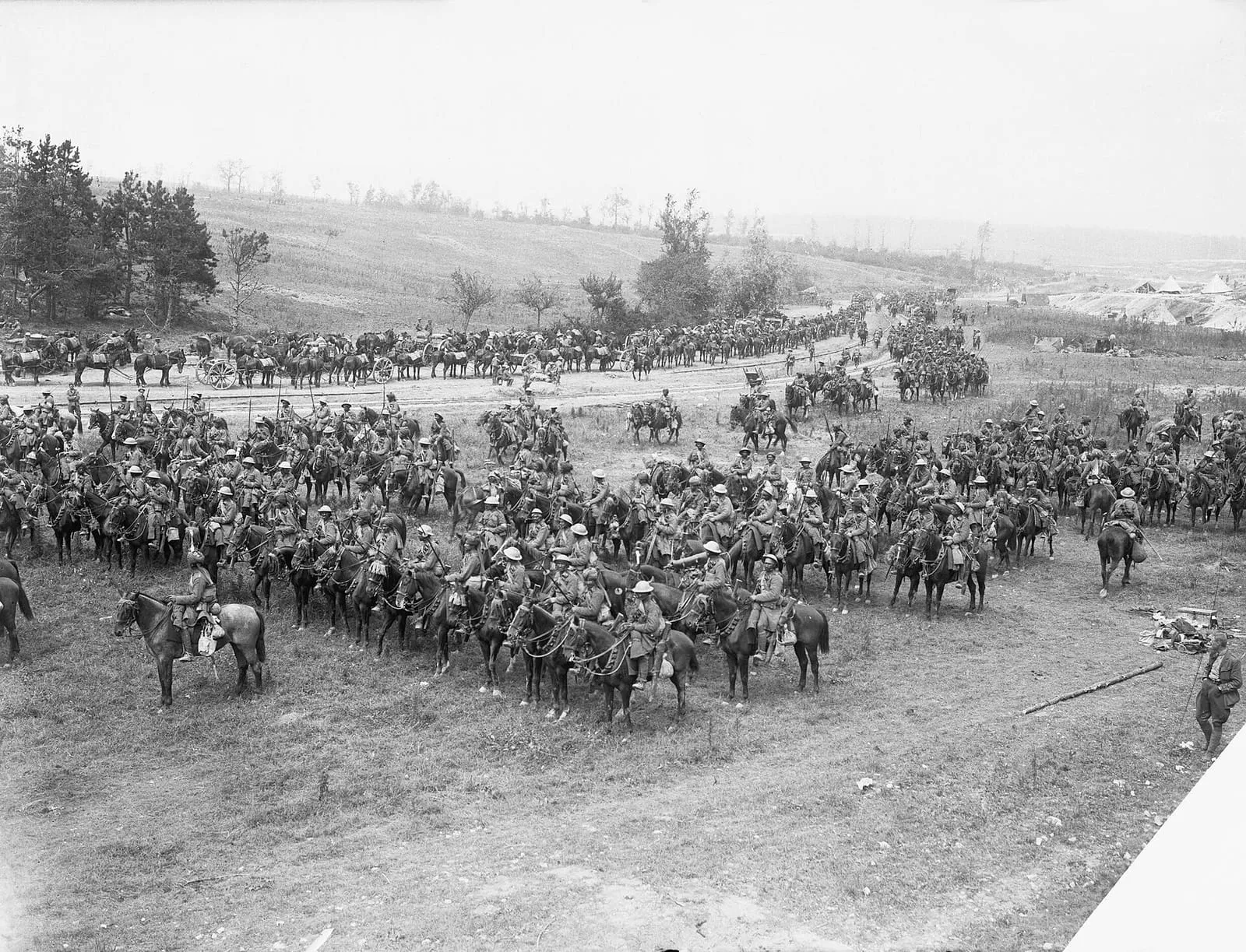
The Battle of Bazentin Ridge was the second great British attack of the Battle of the Somme. Two weeks after the disaster of the first day, General Henry Rawlinson, commander of the 4th Army, struck at the German second defensive position, which ran along a ridge from Longueval to Bazentin-le-Petit. He did it quite differently from 1 July: more than 22,000 soldiers of six brigades crossed no man’s land at night and formed up a few hundred metres from the German trenches, and at 3.25 a.m. on 14 July, after a hurricane bombardment of only five minutes, they went over to the assault. Within a few hours the British had taken both Bazentins and half of Longueval and stood on the crest of the ridge. In the evening even the cavalry went into the attack, for the first time in months on the Western Front. The success could not, however, be developed. By 17 July the Germans had brought up reinforcements and held High Wood and the northern part of Longueval, and the front came to a standstill again.
Name and dates
The name “Battle of Bazentin Ridge” and the dates 14–17 July 1916 were fixed after the war by the British Battles Nomenclature Committee. It covers all the fighting on those days from the right wing of the 4th Army to the river Ancre, and so also the completion of the capture of Trônes Wood on the morning of 14 July and the last fighting for Ovillers, which fell on 16 July. The British official history points out that these limits are arbitrary. The fighting for Longueval went on long after 17 July and cannot be separated from the Battle of Delville Wood, which the committee dated 15 July – 3 September, while the attacks on High Wood from 20 July are counted separately. Times in the text are given in British summer time, one hour earlier than German time.
Background
On 1 July the British 4th Army attacked in broad daylight after a week-long bombardment and, north of the Albert–Bapaume road, suffered a defeat, losing more than 57,000 men according to the official history. South of that road, however, alongside the French, it succeeded: it took Montauban and Mametz. Douglas Haig decided to reinforce precisely this sector. In the following days of the Battle of Albert the British, in costly and poorly co-ordinated fighting, captured Contalmaison, Mametz Wood and Trônes Wood in order to close up to the German second position. This ran along a ridge rising above a valley the British called Caterpillar Valley, from the Waterlot Farm sugar refinery through Longueval and the two villages of Bazentin (Bazentin-le-Grand and Bazentin-le-Petit) to Pozières. It was shallower and less strongly fortified than the first line, with fewer deep dugouts.
The Germans were in a difficult position at this time. Their 2nd Army under General Fritz von Below was losing men under the incessant fire of the British artillery, directed by aircraft of the Royal Flying Corps, which ruled the air. Regiments from different divisions were intermingled, and headquarters often did not know where its own line ran. On 11 July Erich von Falkenhayn, Chief of the German General Staff, ordered the 5th Army at Verdun to go over to a “strict defensive” and began moving artillery to the Somme. The British official history regards this as the achievement of the offensive’s first objective. The French on the north bank of the Somme, disappointed by the British failures of 7 and 8 July, held back their attacks until the British broke through the second position.
Rawlinson’s plan
On 8 July Rawlinson issued a preliminary order for the attack on the second position. After conferring with his corps commanders and with the agreement, as the official history puts it, of “the whole of infantry opinion”, he decided to attack at dawn, before the German machine-gunners could see far. General Walter Congreve’s XIII Corps, with the 9th (Scottish) and 3rd Divisions, was to cross in darkness a no man’s land some 1,100 metres wide and form up roughly 450 metres from the enemy. General Henry Horne’s XV Corps, with the 7th and 21st Divisions, was to attack from Mametz Wood, from where the German trenches were much closer. The left flank was covered by the 1st Division of III Corps, and the right by the 18th Division, which was still fighting for Trônes Wood.
Haig objected. He believed that the troops were too poorly trained, and many staff officers too inexperienced, to move two divisions almost a kilometre at night, form them up and lead them into the attack in the right direction. He proposed that XV Corps should first attack alone in the evening, with XIII Corps joining in later. Rawlinson and all the corps and division commanders, including Horne, who usually agreed with Haig, held to the original plan. Rawlinson wrote Haig a private letter, and on the morning of 12 July his chief of staff, General Archibald Montgomery, renewed the request by telephone. Haig gave way, persuaded also by his artillery adviser, who considered that the guns were performing well and that the dugouts of the second position could not be as deep as those of the first. He did, however, set conditions: XIII Corps was to prepare strongpoints on the slope, and the flanks were to be held firmly in Trônes and Mametz Woods.
The artillery preparation began on 11 July. There was a shortage of ammunition for the heavy howitzers, so daily allocations were strictly limited, but 2,000 rounds were brought up for each field gun. Because German aircraft did not appear, ammunition and supplies could be moved by day and night, and the dumps in Caterpillar Valley lay undiscovered between the lines for several days. Horne reported that cutting the wire would take until 14 July, so the attack was set for that day, the French national holiday. On the advice of the gunners of the 9th and 3rd Divisions, the usual half-hour hurricane bombardment before the assault, which merely warned the enemy, was dropped. It was to be replaced by five minutes of fire from all the guns, and the infantry were to follow close behind a creeping barrage made up solely of high-explosive shells with delay fuzes rather than shrapnel. The official history writes that this barrage proved so effective that from then on shrapnel alone was rarely fired.
The French thought the plan madness. On 12 and 13 July the staff of the French 6th Army repeatedly telephoned Rawlinson’s headquarters asking that the attack be abandoned, and on the evening of 13 July a British liaison officer brought a message from General Balfourier, commander of the neighbouring XX Corps, that a night approach was impracticable for such inexperienced troops. Montgomery replied that if the British were not on the Longueval ridge by eight o’clock the next morning, he would eat his hat.
Course of the battle
Night of 13/14 July. In the darkness sappers and staff officers marked out the start lines with white tapes and posted marker soldiers along them. At a quarter past midnight the battalions set off in single file across no man’s land, and each platoon, on reaching its marker, turned and formed up along the tape. On the morning of 13 July it had been discovered that the Germans were listening in to the telephones of the 62nd Brigade, so in the evening a false order cancelling the attack was passed to it by telephone. The Germans sent out no patrols. By three in the morning the six assault brigades stood some 350–450 metres from the enemy, almost without loss. Some battalions of the 3rd Division crawled even closer, to within 50–110 metres of the German trenches.
14 July, dawn. At 3.20 a.m. all the guns of XIII and XV Corps opened fire. When five minutes later the fire lifted deeper, the infantry of thirteen battalions, almost all from Kitchener’s New Armies, advanced through the morning mist. Surprise was almost complete. The 9th Division broke through two belts of wire, took the trenches and burst into Longueval, where it began fierce fighting among the ruins. The 3rd Division on its left halted in front of uncut wire, but when one company got in alongside and began clearing the trenches with grenades, it moved on and took Bazentin-le-Grand. The 7th Division took the first line at the very moment the fire lifted, and then Bazentin-le-Grand Wood. Its 22nd Brigade took Bazentin-le-Petit at about 7.30 a.m., capturing the staff of the Bavarian 16th Infantry Regiment and more than two hundred soldiers. The 21st Division took Bazentin-le-Petit Wood, although in its north-western corner the Germans held out until the evening. On the right wing the 18th Division at about 9.30 a.m. at last finished taking Trônes Wood.
The British took prisoner 42 officers, including two regimental commanders with their staffs, and about 1,400 men. By about 10 a.m. resistance in front of the 3rd and 7th Divisions had almost ceased. Several senior officers walked calmly up the slope towards High Wood on the crest of the ridge without seeing a single German. The commander of the 7th Division wanted to send his reserve brigade there, but the corps ordered that this task be left to the cavalry, and army headquarters forbade the 3rd Division to use its reserve for the pursuit. The official history judges this a mistake that was “in the highest degree unfortunate”: High Wood passed into British hands only after two months of bloody fighting.
14 July, day and evening. The 2nd Indian Cavalry Division set off from Morlancourt at 8.20 a.m., but across the cratered field cut by trenches it advanced so slowly that it reached the valley below Montauban only in the afternoon. Meanwhile in Longueval the Scots and the 1st South African Infantry, brought up from reserve, fought for every house, and mistaken reports that the whole village had been taken repeatedly halted and restarted further orders. At about 7 p.m. two battalions of the 91st Brigade at last advanced on High Wood, and on their right squadrons of the 20th Deccan Horse and the 7th Dragoon Guards from the Secunderabad Cavalry Brigade. The infantry entered the wood, in which there were few Germans, but could not take its northern part, through which a new German trench ran. The dragoons charged German infantry hidden in the corn, speared a dozen or so Germans with their lances and took 32 prisoner. They were helped by a Morane aircraft of No. 3 Squadron RFC, which fired on the Germans in the corn and dropped the cavalrymen a sketch of their positions. After dark the squadrons occupied a line from Longueval to the southern corner of High Wood.
The appearance of the cavalry caused panic in German headquarters. Reports reached corps and army headquarters that the British had broken through the front and reached the line Flers–High Wood–Martinpuich. During the night Below handed all his reserves to General Friedrich Sixt von Armin, who since the morning of 14 July had commanded the sector from Longueval to the Ancre. When it became clear that there had been no breakthrough, some of them were withdrawn. Sixt von Armin found the situation critical: “there were no rear positions, no switch lines, no communication trenches”. He ordered his troops to hold where they were and began building a defence in depth. The key proved to be a new line of trenches on the reverse slope of the ridge, called the Switch Line by the British, which ran from Flers through the northern part of High Wood to the Bapaume road. During the night of 14/15 July the Germans deepened it and wired it.
15 July. Rawlinson ordered the success to be exploited, but the Germans had already recovered. The cavalry was withdrawn at dawn, under cover of the mist. In High Wood the 91st Brigade could not move forward in the face of machine-gun fire from the Switch Line and beat off German counter-attacks. The 33rd Division, which was to take the Switch Line in front of Martinpuich, came under crossfire from the wood and by the afternoon had returned to its start positions. In the evening XV Corps headquarters, having no news from the 91st Brigade and believing its position worse than it was, ordered it to be withdrawn from the wood. By the morning of 16 July the brigade had left High Wood almost without fighting, taking its wounded, and the Germans reoccupied the wood. On the right wing the South African Brigade took most of Delville Wood, while the Scots fought in vain for the northern part of Longueval. On the left wing the 34th Division twice attacked Pozières and came to a halt a few hundred metres short of the village.
16–17 July. Rain and mud hampered movement, and poor conditions limited air observation. On 16 July Rawlinson concluded that an important success could now be achieved only by a new, carefully prepared attack on a broad front, and postponed it. That day units of X Corps of the Reserve Army completed the capture of Ovillers, taking the last 128 defenders prisoner. During the night of 16/17 July the 1st Division, in a night attack in the rain, took a stretch of the second position west of Bazentin-le-Petit Wood. An attack by the 9th Division and the South Africans on the northern part of Longueval and Delville Wood at two in the morning of 17 July broke down under the fire of hidden machine guns. On 17 July the ruined Waterlot Farm was taken, and in the evening an attack by the 34th Division at Pozières again failed. That same day Rawlinson met General Ferdinand Foch at Dury to agree the date of a joint Anglo-French attack.
Losses
According to the British official history, the attack cost the four assault divisions 9,194 killed, wounded and missing: 1,159 in the 9th Division, 2,322 in the 3rd Division, 2,819 in the 7th Division and 2,894 in the 21st Division, some of these figures covering the whole of 14–17 July. The 33rd, 34th and 1st Divisions and the South Africans in Delville Wood also suffered heavy losses in those days. Cavalry losses, according to the official history, amounted to 102 men and 130 horses. On the German side the Bavarian 16th Infantry Regiment alone lost almost 2,300 men on 14 July, and about 1,450 soldiers and officers were taken prisoner. Total German losses in this battle cannot be separated from the overall losses on the Somme.
Significance
The dawn assault of 14 July was one of the most successful British attacks of 1916. It showed that an army which two weeks earlier had suffered the greatest defeat in its history was capable of learning: the night approach, the short bombardment and the high-explosive barrage brought gains at losses many times smaller than on 1 July. On 16 July Haig congratulated the troops in an order of the day on “a very fine feat of arms”, and historians agree in attributing the success above all to the heavy and accurate bombardment on a relatively narrow sector. Some of them, such as Robin Prior and Trevor Wilson, stress, however, that the high command did not draw the right conclusions from it.
The battle was also a lost opportunity. When on the morning of 14 July the ridge lay open, the infantry waited for the cavalry, which arrived twelve hours later, and by the next day the Germans already had a new line of defence. From then on the British stood in a narrow, protruding wedge, under fire from three sides, with Delville Wood and Longueval on their right shoulder and Pozières on their left. Through the rest of July and the whole of August they fought gruelling battles for these places, and they took High Wood only on 15 September. The charge of the Deccan Horse and the dragoons, one of the few cavalry charges on the Western Front, raised great hopes, but showed rather how hard it was for horsemen to operate on a battlefield full of craters, trenches and machine guns.
Spotted a mistake?Report an error