Key event
First day on the Somme
- Category:
- Military operations
- Front:
- Western Front
- Date:
- 1 July 1916
- Author:
- Łukasz Skowroń
- Battle:
- Battle of the Somme
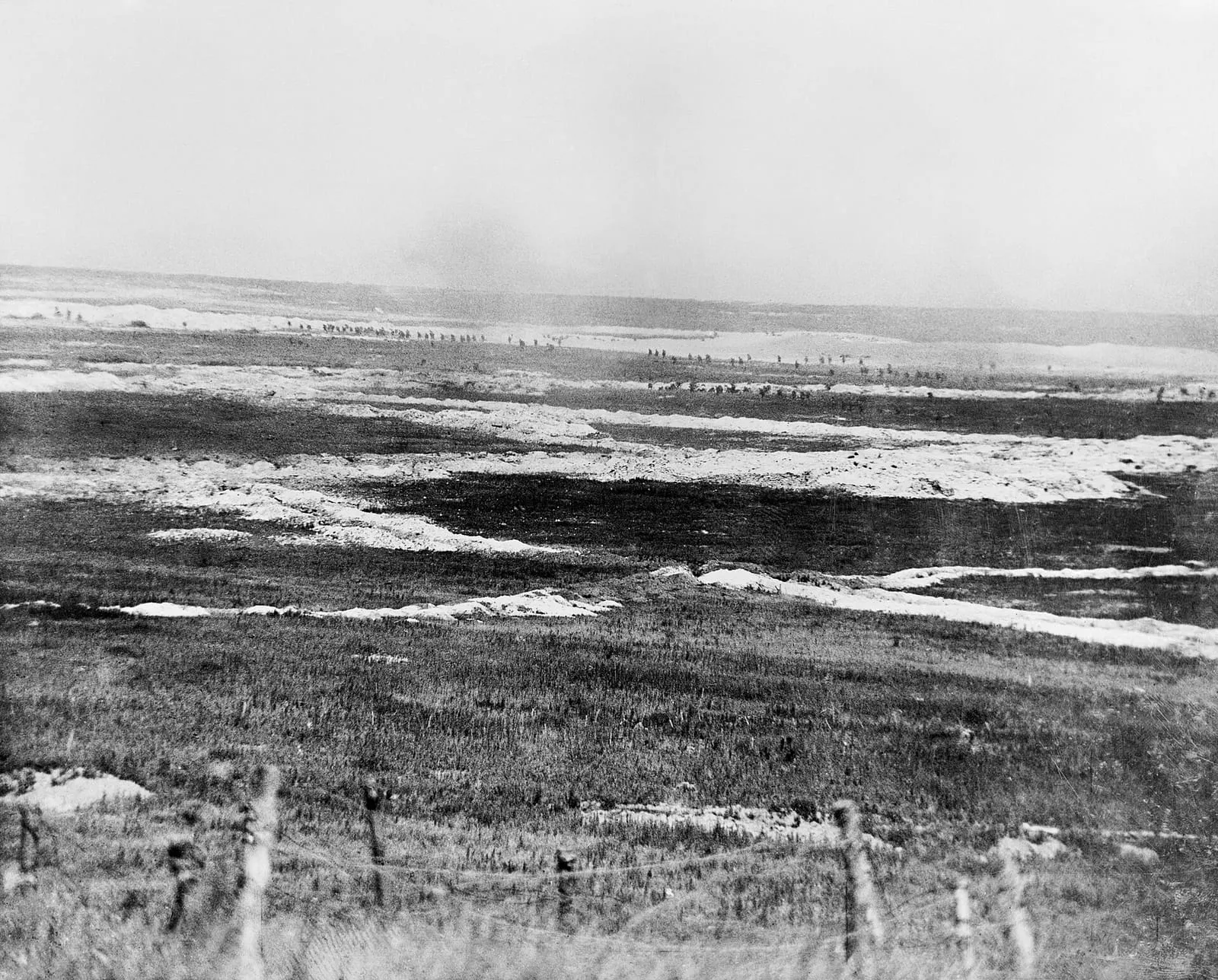
On Saturday 1 July 1916, at 7.30 a.m., British infantry left their trenches on a front more than 20 kilometres long, from Gommecourt in the north to Maricourt on the Somme. Beside them, on both banks of the river, the French Sixth Army moved off. So began the great offensive that the Allies had agreed at Chantilly in December 1915 and which, after the German attack at Verdun, was above all meant to relieve the French. The day ended in two different ways. In the south the French and the British right wing took all their objectives. North of the road from Albert to Bapaume the attack broke down almost everywhere under German machine-gun fire. According to the British official history, the British Army lost 57,470 men that day killed, wounded, missing and taken prisoner, including 19,240 killed and died of wounds. It was the bloodiest day in its history.
An army of volunteers
The main burden of the attack fell on the British Fourth Army of General Henry Rawlinson, which attacked with five corps from Maricourt to Serre. Further north, VII Corps of General Edmund Allenby’s Third Army was to make a subsidiary attack on the German salient at Gommecourt. Thirteen British divisions stood in the front line, and 64 battalions went over in the first wave. Facing them, the German 2nd Army of General Fritz von Below had on this sector, according to the British official history, about four and a half divisions. Most of its soldiers had held the same hills since the autumn of 1914 and for almost two years had turned them into a fortress with several lines of trenches, fortified villages and deep dug-outs.
The British Army, commanded since December 1915 by General Douglas Haig, was for the most part an army of volunteers. Alongside the regular and Territorial divisions, the divisions of Kitchener’s New Armies, made up of men who had enlisted in the first months of the war, went into battle in such numbers for the first time. Many battalions were so-called “Pals”: colleagues from one factory, office, sports club or small town, who had been promised that they would serve together. The British official history wrote with pride that never before had the ranks of a British army held so many of the best of all classes of the nation, and that they were “volunteers, not conscripts”. Conscription had indeed been introduced in January 1916, but the conscripts had not yet reached the front. This feature of the new battalions meant that the disaster of a single morning could fall on a whole town at once.
Seven days of bombardment
The offensive was preceded by the most powerful bombardment the British Army had yet carried out. It began on 24 June and was to last five days, but on 28 June, because of rain, the British and French commanders postponed the attack by 48 hours, from 29 June to 1 July. In seven days the British artillery fired, according to the official history, 1,627,824 shells. The command believed that the fire would destroy the wire, the trenches, the machine-gun nests and the spirit of the defenders, and that the infantry would only have to cross no man’s land and occupy the ruined positions. That is why the soldiers were to advance at a steady walk, in waves about 100 metres apart, and each carried, according to the official history, about 30 kilograms of equipment: ammunition, grenades, shovels, sandbags and supplies for several days.
The bombardment did great damage but did not meet expectations. There were too few guns for so wide and deep a belt of defences, many shells were obsolete or faulty and did not explode, and gas shells were lacking along the whole front. Above all, however, the artillery could not reach the German dug-outs, dug into the chalk to a depth of several, and sometimes more than ten, metres, some of them two storeys deep. Their garrisons survived the week of shelling crowded, hungry and exhausted, but alive.
During the night of 30 June to 1 July the assault battalions moved to their jumping-off positions. All of them were in place between 2 a.m. and 5.15 a.m., almost without loss, because the German artillery was nearly silent. This strengthened the belief that the bombardment had done its work. Some commanders wanted to attack at dawn, before the German riflemen could see their targets, and Rawlinson supported the idea, but the French firmly demanded an attack in full daylight so that the artillery could observe the effects of the final bombardment. According to the British official history they even wanted to move zero hour to nine o’clock. The day was fine and promised heat, and a morning mist still hung over the Somme valley. From 6.25 the British guns kept up hurricane fire, and eight minutes before the attack light Stokes mortars joined in.
Zero hour
The first signal was an explosion. At 7.20, ten minutes before the assault, sappers fired 18 tons of ammonal under the German redoubt on Hawthorn Ridge in front of Beaumont-Hamel. VIII Corps headquarters wanted the infantry to seize the crater before the main attack, but the early explosion warned the Germans, and the heavy artillery of the whole corps had to lift its fire to the rear at that time. At 7.28 two more mines went up at La Boisselle, including the largest of the day, Lochnagar, which tore in the ground a crater that is still visible today. More than a dozen smaller mines were fired along the whole front.
At 7.30 the artillery lifted its fire from the German front line, the officers blew their whistles, and in some battalions bugles sounded. The British official history describes the waves of infantry which, under a cloudless sky and with bayonets glittering in the sun, entered the screen of smoke and mist. Now began the race that decided the fate of the day. The attackers had a few minutes to reach the German trenches before the defenders came up out of the dug-outs. The Germans, drilled in leaving their dug-outs quickly, usually won. The history of Reserve Infantry Regiment 119, which defended Beaumont-Hamel, describes how its men waited on the steps of the dug-outs with rifles in their hands and, when the bombardment stopped, ran up to the surface: “In front of us wave after wave of British soldiers was climbing out of the trenches and coming towards us at a walk, their bayonets glistening in the sun.”
On many sectors the German gunners dragged their machine guns onto the ruined parapets or into shell holes in front of the trenches and fired at the lines of infantry as if on a firing range. The German artillery, which had held back and stayed hidden in the last days, laid a barrage on the British trenches and on no man’s land. Where no man’s land was wide and the wire only partly cut, wave after wave fell before going a hundred metres. Some battalions, especially in the Ulster Division and at Thiepval, crept closer to the enemy before zero hour, and Captain Wilfred Nevill of the 8th Battalion, East Surrey Regiment, at Montauban had his men kick footballs ahead of them. Nevill was killed in the attack, and his battalion reached its objective.
Gommecourt and Serre
On the northern edge of the attack two Territorial divisions of VII Corps, the 56th (London) and the 46th (North Midland), struck at the Gommecourt salient. The attack was above all meant to draw German reserves away from the main thrust. For its sake Haig even gave up retaking Vimy Ridge, lost in May. The Londoners, covered by smoke, broke into the German trenches and took three lines, but the 46th Division on the other flank was stuck in no man’s land, and its attack, renewed in the afternoon, also failed. Cut off on both sides, the Londoners fell back in the evening when they ran out of grenades. According to the British official history the subsidiary attack cost almost 6,800 men, and the Germans a little over 1,200.
At the village of Serre the attack was made by the 31st Division, composed almost entirely of “Pals” battalions from the north of England: from Leeds, Bradford, Barnsley, Accrington, Sheffield and County Durham. None of them had yet been in battle. The village on its hillock, its houses still roofed, overlooked their trenches. German fire began as early as 7.20, as the first waves were filing out through the gaps in their own wire. The official history writes that the lines moved off in perfect order and gradually melted away, the men falling in their ranks, mostly before they had gone the first hundred yards. Only small groups from the Accrington and Sheffield battalions broke into the German trenches, and some even into the village itself. All of them were killed or taken prisoner. According to frequently cited figures, the Accrington battalion lost 585 of about 720 men, 235 of them killed. The division lost about 3,600 men in all.
Beaumont-Hamel
At Beaumont-Hamel the attack was made by the 29th Division, veterans of Gallipoli, with the regular 4th Division beside it. The Germans, warned by the explosion at Hawthorn, occupied the crater and the trenches before the British reached them. The 4th Division took only the redoubt known as the Quadrilateral (German: Heidenkopf), from which it was driven out during the night. The commander of the 29th Division, wrongly informed that his men were in the German lines, threw his reserves into the fight. At 9.05 the 1st Battalion of the Newfoundland Regiment, the only battalion of the Dominion of Newfoundland on the Western Front, left its trenches at Beaumont-Hamel. It went forward alone, because the neighbouring battalion was held up in trenches choked with dead and wounded. Fire from Y Ravine fell on it before it had passed its own wire. According to the British official history the battalion lost 710 men, including all the officers who went into the attack. According to frequently cited figures, 68 men answered the roll call the next morning. According to some tallies, only the 10th Battalion, West Yorkshire Regiment, at Fricourt, suffered even heavier losses that day, 733 men.
Thiepval and the Ulster Division
On the heights above the river Ancre X Corps attacked. At the village of Thiepval itself, turned into a fortress, the 32nd Division took only a scrap of trench in the Leipzig Redoubt. German machine guns in the ruins of the château held off the rest. The official history quotes the opinion that on that day Thiepval could only have been taken by bullet-proof soldiers.
Next to it, between Thiepval and the river, the 36th (Ulster) Division attacked, formed largely from volunteers of the Protestant movement that before the war had armed itself against Irish Home Rule. For its soldiers 1 July was the anniversary of the Battle of the Boyne according to the old calendar. Their battalions crept before 7.30 to within a hundred metres of the German trenches and reached them before the defenders came out of the dug-outs. At about eight o’clock the Ulstermen broke into the great Schwaben Redoubt and took several hundred prisoners, and some of them got as far as the German second position at Grandcourt. It was the largest breach in the German front north of the Bapaume road, but the neighbouring divisions did not move. Under fire from Thiepval and from Saint-Pierre-Divion, without ammunition or reinforcements, the Ulstermen beat off counter-attacks all afternoon. At about 10 p.m. the last defenders of the redoubt withdrew to the German front line. The division lost 5,104 men.
La Boisselle and Ovillers
Along the road from Albert to Bapaume III Corps attacked. The 8th Division, which had several hundred metres of open ground to cross, was shattered at the village of Ovillers-la-Boisselle. At La Boisselle the 34th Division, with the Tyneside Scottish and Tyneside Irish brigades from around Newcastle, moved off just after the mines exploded. Some battalions had to advance more than a kilometre before even reaching their own front line, and were cut down on the way. Here the Germans had an additional warning, because during the night they had overheard part of a British telephone conversation. Handfuls of soldiers broke into the German positions beside the Lochnagar crater, and a few got as far as Contalmaison. The 34th Division lost 6,380 men, the most of any division that day, and the 8th Division more than 5,100.
Fricourt, Mametz and Montauban
On the British right wing the picture was quite different. XV Corps enveloped the village of Fricourt from two sides, although the attack on the village itself in the afternoon failed. The 7th Division, after a whole day of fighting, took the ruins of Mametz at 4.05 p.m. XIII Corps got furthest. The 18th Division took Pommiers Redoubt and the ridge above Mametz, and the 30th Division, made up largely of “Pals” battalions from Liverpool and Manchester, entered the abandoned village of Montauban at 10.05. According to the official history they found only a fox there. By eleven o’clock the battalions had occupied the trenches beyond the village, the last objective of the day. Here the bombardment, reinforced by French heavy artillery, had really destroyed the German defences, dug-outs and batteries. Bavarian Reserve Infantry Regiment 6, which held the sector, had, according to the captured diary of one of its officers, been “completely destroyed”.
The French success
The French did even better. The Sixth Army of General Émile Fayolle, part of the army group of General Ferdinand Foch, attacked north of the Somme with XX Corps at 7.30, together with the British. Under cover of thick mist its divisions took the whole German first position, and in the evening they captured the village of Curlu. South of the river the I Colonial Corps and XXXV Corps moved off only at 9.30, which completely surprised the Germans, who had not expected an attack there. Here the French heavy artillery outnumbered the German many times over. The French took, among other places, Dompierre and Becquincourt, and by evening they already stood before the German second position. According to the French account quoted by the British history, the Sixth Army reached all its objectives, exceeded them in several places and took more than 4,000 prisoners. Its losses were light, about 1,600 men according to some studies. The Germans had not believed that the French army, bled since February at Verdun, would be able to take part in a great offensive, and had not prepared for an attack on both banks of the Somme.
Evening and night
For long hours the command did not know what had really happened. The reports from the corps were mostly optimistic: they spoke of troops in Serre, at the station near Beaumont-Hamel and in Contalmaison, although only handfuls of men had got there, and they did not come back. Rawlinson spent the whole day at his headquarters in Querrieu by the telephone. At 7.30 p.m. he wrote in his diary that VIII Corps had everywhere been driven back to its own trenches, while XIII Corps had “done best”, and he estimated the losses at 16,000. They were almost four times as high. Haig noted in the evening that, according to further reports, few men of VIII Corps had even left their trenches. In reality, according to later calculations, the corps lost more than 14,000 men.
In the afternoon Haig visited Rawlinson and expressed his wish that the attack be continued the next day. Rawlinson proposed that the two northern corps, which had been defeated on the Ancre, be taken over by General Hubert Gough, who was waiting with a small staff to lead the cavalry into the gap in the event of a breakthrough. Haig agreed, and at 10 p.m. the Fourth Army issued orders for further attacks. Meanwhile thousands of wounded lay in no man’s land. After dark those who could crawled back to their own trenches, and stretcher-bearers went out for the rest. In several places, among them Beaumont-Hamel, doctors negotiated local truces with the Germans to collect the wounded. The field hospitals and ambulance trains were not prepared for such numbers of casualties, and some of the wounded waited days for help.
The toll
The British official history states that the first reports, based on roll calls, spoke of almost 62,000 casualties. After checking, when many of the missing had returned to their units, the figure was reduced to 57,470: 19,240 killed and died of wounds, 35,493 wounded, 2,152 missing and 585 prisoners. For these sacrifices, as the official history writes, the British Army gained only a strip of ground about five and a half kilometres wide and on average a kilometre and a half deep, although even so it was its biggest advance since the beginning of trench warfare. The British took 25 officers and 1,958 men prisoner. North of the Albert–Bapaume road, of all the ground they had won they held only the Leipzig Redoubt.
German losses for 1 July alone cannot be established precisely, because the Germans counted them in ten-day periods. The British official history states that from 1 to 10 July the 2nd Army lost more than 40,000 men on the Somme. For the first day itself the estimates vary: the British historian Martin Middlebrook put German losses on the British sector at about 6,000 killed and wounded and 2,200 prisoners, while other historians give about 10,000–12,000 men for the whole 2nd Army.
The British official history sought the causes of the defeat in the strength of the German defences, in artillery that was too weak and too dispersed, in the width of no man’s land and in tactics that made the overloaded infantry advance slowly in close waves, when everything depended on who reached the parapet first. It also pointed out that the place and date of the offensive had been imposed by the French because of Verdun, and the late hour of the attack by Generals Foch and Fayolle. The first day brought no breakthrough, but the battle had only begun. It lasted until November, and in July the fighting shifted to the southern sector, where on 1 July the Allies had managed to break into the German positions.
For the British, 1 July 1916 became a symbol of the whole war: of volunteer battalions from a single town that ceased to exist within minutes, and of a command that for a long time did not understand what had happened. In Newfoundland 1 July is observed as a day of remembrance for the fallen, and the names of the missing British and South African soldiers who died on the Somme are carved on the great memorial at Thiepval.
Remember the articles you have read? Only in this browser; nothing is sent anywhere.How it works
Read ·
Voices from the front
“We go up to the attack tomorrow. This will probably be the biggest thing yet. We are to have the honor of marching in the first wave. […] I am glad to be going in first wave. If you are in this thing at all it is best to be in to the limit. And this is the supreme experience.”
“So the day wore on and night came. Without—a night of glorious July summer, with palest saffron, flamingo and purple lights, and one gem-like star, a night of ineffable beauty and peace, and within—a vision of Hell, cruel flesh-agony, hideous writhings, broken moanings, a boy-child sitting up in bed gibbering and pulling off his head bandages, a young Colonial coughing up his last life-blood.”
Spotted a mistake?Report an error
Meanwhile
(04)Elsewhere in the same days.
- 1 July 1916 · Middle EastOttoman troops retake KermanshahOn 1 July 1916 the Ottoman XIII Corps entered Kermanshah, abandoned overnight by Baratov's Russians. Persian nationalists returned to the city.
- 30 June 1916 · Eastern FrontEnd of the battle of the StrypaThe British chronology ends the battle of the Strypa on 30 June 1916. Bothmer held the upper Strypa, and Shcherbachev's last big attack had failed on 21 June.
- 2 July 1916 · Eastern FrontBattle of Baranovichi beginsOn 2 July 1916 the Russian 4th Army began shelling Woyrsch's positions at Baranovichi. The Western Front's main blow, postponed for weeks, was under way.
- 3 July 1916 · Asia and the PacificRusso-Japanese agreement on the Far EastOn 3 July 1916 in Petrograd Sazonov and Motono signed a public convention on cooperation in the Far East, together with a secret alliance concerning China.
Related events
(04)The same battle, people or subject.
- 18 November 1916 · Western FrontEnd of the Battle of the SommeOn 18 November 1916, in the first snowstorm of winter, the British attacked on the Ancre for the last time. After four and a half months the Somme was over.
- 22 September 1916 · Western FrontEnd of the Battle of Flers–CourceletteOn 22 September 1916 the Battle of Flers–Courcelette ended. After a week of fighting in rain and mud the British were preparing to attack Morval and Thiepval.
- 14 July 1916 · Western FrontBattle of Bazentin Ridge beginsAt dawn on 14 July 1916, after a night approach and five minutes of shelling, the British took the German second position from Longueval to Bazentin-le-Petit.
- 17 July 1916 · Western FrontBattle of Bazentin Ridge endsOn 17 July 1916 the Battle of Bazentin Ridge ended. The British held the German second position but lost High Wood and failed to take all of Longueval.