Key event
The Lochnagar mine is blown
- Category:
- Military operations
- Front:
- Western Front
- Date:
- 1 July 1916
- Author:
- Natalia
- Battle:
- Battle of Albert (1916)
- Tags:
- Great Britain, British Army, Germany, trench warfare
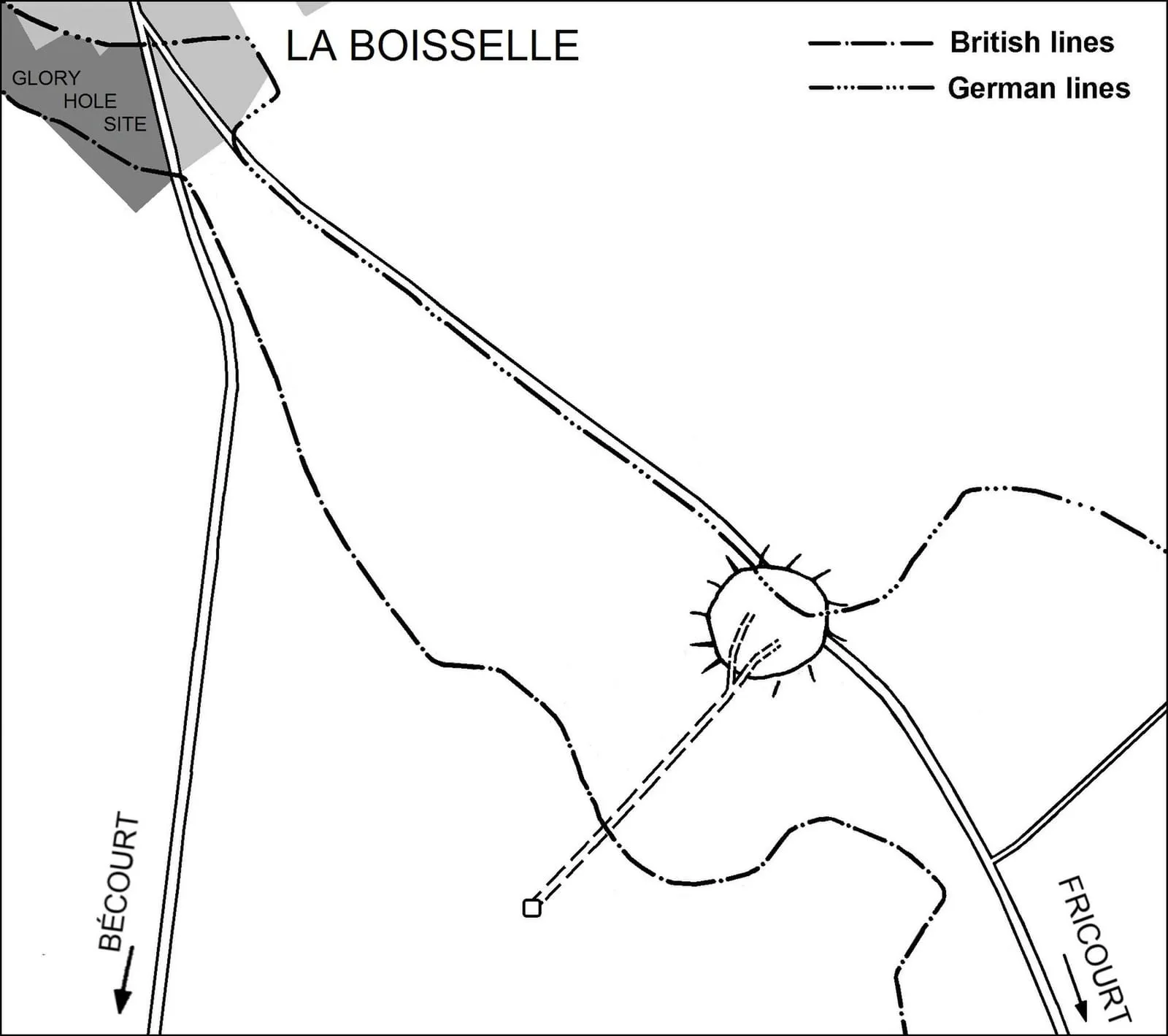
On 1 July 1916 at 7.28 a.m., two minutes before zero hour on the first day of the Battle of the Somme, British sappers fired a mine named Lochnagar beneath the German trenches south of the village of La Boisselle. Two charges, together 60,000 lb (about 27 tonnes) of ammonal, hurled earth, chalk and German dugouts into the air on the sector the Germans called the Schwabenhöhe. Together with its twin, the Y Sap mine on the other side of the village, these were the largest mines yet detonated on the Western Front. The explosion left a crater that has survived to this day as the Lochnagar Crater, one of the most visited memorial sites on the Somme. The blast, however, did not bring victory. The British 34th Division, attacking here, lost more men that day than any other division, and La Boisselle remained in German hands.
The war at La Boisselle
La Boisselle, a hamlet on the road from Albert to Bapaume, had lain on the very front line since the autumn of 1914. The French stopped the German advance here in 1914 and took the western edge of the village, but got no further. At the western end of La Boisselle, at a spot the French called L’îlot, the Germans Granathof and the British the “Glory Hole”, the trenches of the two sides were in places only a few dozen metres apart. Both sides therefore went underground. At Christmas 1914 French sappers dug the first shaft here, and according to studies of mine warfare several dozen mines were blown around L’îlot between April 1915 and January 1916. In the summer of 1915 the British took over the sector. Scots of the Black Watch, who were among the first to arrive, gave the trenches Scottish names. One of the communication trenches south of the village was named Lochnagar Street, probably after the mountain in the Scottish Grampians, and it later gave its name to the mine.
From 1915 the British had special Royal Engineers tunnelling companies for underground warfare, made up of professional miners. In the spring of that year their sappers blew Hill 60 near Ypres. Several of them were at work on the Somme, and as part of the preparations for the great offensive 19 mines of various sizes were prepared under the German front line. They were to destroy the most dangerous strongpoints and give the infantry cover from flanking fire.
The gallery under the Schwabenhöhe
La Boisselle lay in a German salient driven into the British line. The ruins of the village, with cellars turned into dugouts and surrounded by mine craters, were judged too strong to attack frontally. The plan was for the infantry to bypass the village on both sides, while two great mines destroyed the fortifications on the “shoulders” of the salient and with their high lips screened the attackers from flanking fire. The Y Sap mine was to go up north-east of the village and Lochnagar south-east of it, under the German Schwabenhöhe position.
Work on Lochnagar was begun in November 1915 by 185th Tunnelling Company, and in the spring of 1916 it was taken over by 179th Tunnelling Company. The British official history (Edmonds) credits both great mines at La Boisselle to 179th Company. The sappers dug an inclined shaft and from it a gallery that, according to the crater’s official website, was almost 300 metres long. They worked in complete silence. The official history describes how, barefoot, on a floor laid with sandbags, they prised out the chalk with bayonets fitted with lengthened handles. They caught every piece they broke off by hand and laid it on the ground, and if a miner had to hold the bayonet with both hands, a second soldier caught the lump. The spoil was carried out in sandbags passed from hand to hand along a line of men sitting on the floor of the gallery, and stacked against the wall to be used later for tamping the charge. Progress of 45 centimetres a day was considered a good result.
The Germans were digging too. According to some studies, at the beginning of February 1916 their camouflet, a small charge fired underground, killed a dozen or so sappers in the British galleries in this area. When the British were already loading the explosive, they could hear German miners working below them at Lochnagar and above them at Y Sap. Captain Stanley Bullock of 179th Company recalled the hours of listening with a geophone at his ears, in dead silence, “wondering whether the sound you hear is the Boche working quietly or the beating of your own heart”. After the battle it turned out that the German gallery had stopped only a few feet from the British one.
Under the Schwabenhöhe the gallery forked into a Y. At the ends of the branches, at a depth of about 16 metres and about 18 metres apart, the sappers cut two chambers and loaded them with 36,000 and 24,000 lb of ammonal, that is about 16 and 11 tonnes. The Y Sap mine held 40,600 lb (about 18 tonnes). Both were deliberately “overcharged”, so that the thrown-up earth would form high rims around the craters.
7.28
The morning of 1 July was fine. After a week of bombardment the British guns were firing at full strength, and the 34th Division waited in its trenches for the signal to attack. It was one of the divisions of Kitchener’s New Armies, made up entirely of volunteers, mostly from the north of England. Its 102nd Brigade consisted of the Tyneside Scottish battalions and its 103rd Brigade of the Tyneside Irish, raised from the inhabitants of Newcastle upon Tyne and the surrounding area, largely miners. The 101st Brigade included the 10th Battalion of the Lincolnshire Regiment, known as the Grimsby Chums, and two battalions of the Royal Scots from Edinburgh. All were “pals” battalions, in which men from one town or workplace enlisted and fought together.
At 7.28 Captain James Young of 179th Company closed the circuit. According to the official history, Lochnagar went up “successfully”, blowing the German garrison into the air. Second Lieutenant Cecil Lewis of No. 3 Squadron, Royal Flying Corps, who was circling over the front in a Morane-Saulnier L and watching the explosions from near Thiepval, described it years later in his memoir Sagittarius Rising: “At Boisselle the earth heaved and flashed, a tremendous and magnificent column rose up into the sky. There was an ear-splitting roar, drowning all the guns, flinging the machine sideways.” The column of earth rose, by his account, to almost 4,000 feet, about 1,200 metres, hung for a moment “like the silhouette of some great cypress tree” and fell away in a widening cone of dust. Clods of earth struck the aircraft. The bang was reportedly heard even in London, but such accounts are hard to verify.
The explosion left a crater with smooth sides and a flat bottom. The official history gives it as 90 yards (about 82 metres) across and 70 feet (about 21 metres) deep, with the lips around it rising to almost 5 metres. Today its diameter is usually given as about 90–100 metres. The explosion destroyed German dugouts along a stretch about 100 metres long. According to German accounts quoted by the British history, the Lochnagar blast “did much damage” and delayed the defenders’ emergence from their dugouts. The Y Sap mine, fired at the same time, caused no casualties according to the same accounts, because the Germans had earlier abandoned the trenches at that spot.
The 34th Division’s attack
The mine, however, could not do what the command expected of it. The British plan assumed that the week-long bombardment would destroy the fortifications and “wipe out” the defenders of La Boisselle. In fact the deep dugouts of the 110th Reserve Infantry Regiment, made up mainly of Badeners, survived almost untouched. The Germans also knew the attack was coming. At 2.45 a.m. their telephone listening post on the edge of the village intercepted part of a British order that pointed to an attack in the morning.
At 7.30 the whole infantry of the 34th Division, about 12 battalions in four columns, set off at once, including the Tyneside Irish battalions, which had to cover a long stretch of ground from the Tara–Usna ridge before they even reached their own front line. As soon as the artillery fire lifted, the Germans came out of their dugouts and manned the parapets. According to the official history, within ten minutes about 80 per cent of the men of the leading battalions had been killed or wounded. No man’s land here was 200 to 800 yards wide, and machine guns in La Boisselle and in Sausage Redoubt, on the southern flank, raked it from the side.
The column attacking between the crater and the village did best. The Tyneside Scottish and Tyneside Irish battalions set off immediately after the explosion, had less than 200 yards to run and got through the shattered trenches on the Schwabenhöhe, but fire from La Boisselle decimated them, and German counter-attacks pushed the remnants back to the third line of German trenches. The column south of the crater, with battalions of the Lincolnshire and Suffolk Regiments, set off late. According to the official history it was ordered to wait five minutes because of the explosion, which in fact was unnecessary, and in addition it had about 500 yards of no man’s land to cross. The Germans had time to man their positions calmly, and crossfire stopped it in front of the trenches. Some of the men, among them men from Grimsby, ran into the crater and consolidated it. North of the village the Tyneside Scottish battalions, which had almost 800 yards of open ground to cross, were almost wiped out before they reached the German trenches. All the battalion commanders of the 102nd Brigade were killed or wounded.
For many the crater became a trap. The wounded lying in it and those who had taken shelter there were shelled by the German artillery and, according to some accounts, by the British as well, until one of the soldiers waved a shirt at a passing aircraft. In the afternoon an attempt to clear Sausage Redoubt from the crater and the neighbouring sector failed. In the evening help reached the men on the Schwabenhöhe through a tunnel dug earlier under no man’s land, and during the night soldiers of the 19th Division began to arrive in the area of the crater. The wounded in the crater were evacuated only over the following days.
According to the official history, the 34th Division lost 6,380 officers and men on 1 July, the most of any British division that day. The Grimsby Chums lost nearly 500 men. III Corps, which attacked La Boisselle and neighbouring Ovillers, lost more than 11,000 men and took neither village. La Boisselle fell only after several days of fighting, when the 19th Division renewed the attack.
The Hawthorn Ridge mine
Lochnagar was not the only mine whose explosion went down in the history of that day. Eight minutes earlier, at 7.20, on the northern wing of the offensive near Beaumont-Hamel, 252nd Tunnelling Company blew 40,000 lb of ammonal under a German redoubt on Hawthorn Ridge. The commander of VIII Corps had wanted to fire this mine four hours before the attack, so as to have time to occupy the crater, but GHQ accepted a compromise: ten minutes before zero hour. The explosion was filmed by the cameraman Geoffrey Malins, and the shot went into the documentary The Battle of the Somme, which millions of people in Britain watched in the following months. Militarily the decision proved disastrous. The explosion and the lifting of the artillery fire alerted the Germans, who occupied the far lip of the crater before the British reached it. The official history admits that blowing the mine ten minutes before the attack “undoubtedly” harmed the chances of success.
The crater today
The Lochnagar crater survived the war. The writer John Masefield described the dazzlingly white chalk around it in his book The Old Front Line (1917). After the Second World War the smaller craters in the area were filled in, and for a time Lochnagar served as a motorcycle track and a rubbish dump. In 1978 it was bought by an Englishman, Richard Dunning, who wanted to save the site from being filled in. In 1986 a wooden cross made of timber from a church in Gateshead was erected on the rim of the crater, and in 2017 Dunning was appointed to the Order of the British Empire for services to the commemoration of the war.
Every year on the morning of 1 July a ceremony is held at the crater in honour of the British, French and German soldiers who fell, and poppy petals are scattered into the crater. According to its custodians, the site is visited by about 200,000 people a year. In 1998 the remains of Private George Nugent of the Tyneside Scottish, who was killed that morning, were found on the rim of the crater. He was buried with military honours in the nearby war cemetery at Ovillers-la-Boisselle.
Remember the articles you have read? Only in this browser; nothing is sent anywhere.How it works
Read ·
Spotted a mistake?Report an error
Meanwhile
(04)Elsewhere in the same days.
- 1 July 1916 · Middle EastOttoman troops retake KermanshahOn 1 July 1916 the Ottoman XIII Corps entered Kermanshah, abandoned overnight by Baratov's Russians. Persian nationalists returned to the city.
- 30 June 1916 · DiplomacyNew agreement with the Netherlands Overseas TrustAt the end of June 1916 London and the Netherlands Overseas Trust extended rationing to further goods, among them cocoa, tin, hides and asbestos.
- 30 June 1916 · Eastern FrontEnd of the battle of the StrypaThe British chronology ends the battle of the Strypa on 30 June 1916. Bothmer held the upper Strypa, and Shcherbachev's last big attack had failed on 21 June.
- 2 July 1916 · Eastern FrontBattle of Baranovichi beginsOn 2 July 1916 the Russian 4th Army began shelling Woyrsch's positions at Baranovichi. The Western Front's main blow, postponed for weeks, was under way.
Related events
(04)The same battle, people or subject.
- 17 July 1916 · Western FrontBattle of Bazentin Ridge endsOn 17 July 1916 the Battle of Bazentin Ridge ended. The British held the German second position but lost High Wood and failed to take all of Longueval.
- 21 May 1916 · Western FrontGerman attack on Vimy RidgeOn 21 May 1916, after a massive bombardment, the Germans took British trenches on Vimy Ridge and the mine shaft entrances. The British lost about 2,500 men.
- 30 June 1916 · Western FrontFrench retake ThiaumontOn 30 June 1916 the French 248th Infantry Regiment attacked the ruins of the Thiaumont work at Verdun. Sources differ on whether it took it and for how long.
- 3 September 1916 · Western FrontBattle of Delville Wood endsOn 3 September 1916, by British naming, the Battle of Delville Wood ended. An attack on the wood's eastern edge, supporting an assault on Ginchy, failed.