Key event
British capture Hill 60
- Category:
- Military operations
- Front:
- Western Front
- Date:
- 17 April 1915
- Author:
- Natalia
- Battle:
- Fighting for Hill 60
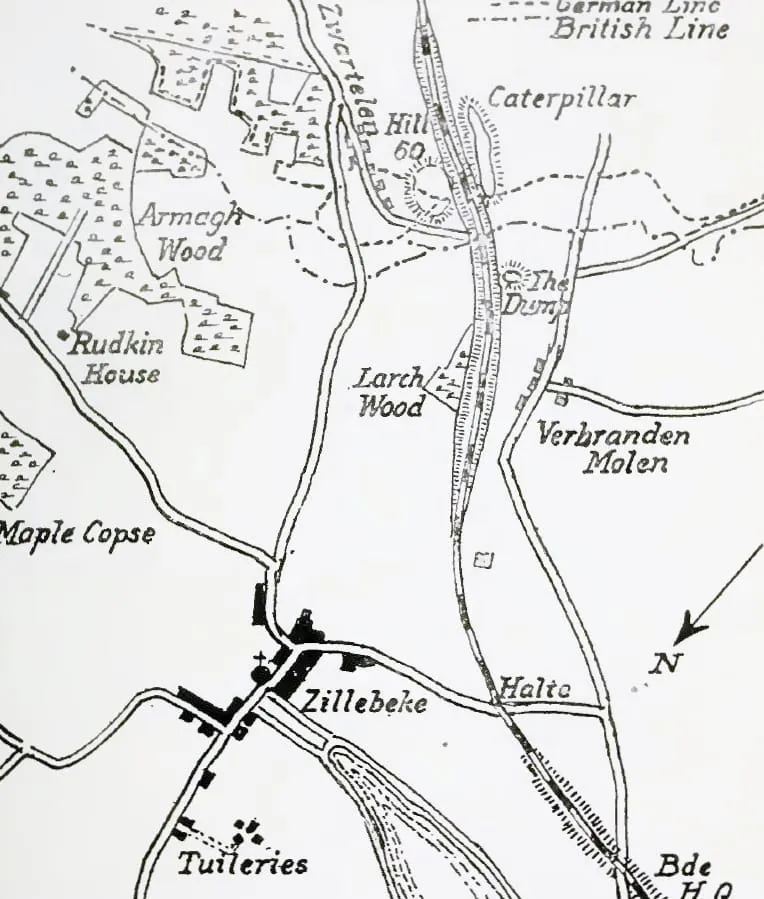
On 17 April 1915 at 7.05 p.m. the ground south-east of Ypres shook with several powerful explosions. British sappers had fired mines laid in tunnels under the German trenches on Hill 60, a small rise near the village of Zillebeke. Immediately afterwards infantry of the British 5th Division rushed into the craters and within a few minutes seized the summit, losing only a handful of men. It was the first large British mining operation on the Western Front. Holding the captured hill, however, cost far more than taking it.
A spoil heap overlooking Ypres
Hill 60 was not the work of nature. It had been piled up in the middle of the 19th century from earth excavated during the construction of the railway from Ypres to Comines, which here cut through a low ridge in a deep cutting. It took its name from the 60-metre contour on maps. Small as it was, the summit gave a view over Zillebeke and Ypres, and both sides contended for this observation point throughout the war. The Germans had taken the hill in the autumn of 1914, during the First Battle of Ypres, and held it all winter. In the spring it was defended by Saxons of the 105th Infantry Regiment of the German 30th Division, part of XV Corps.
The hill gave the Germans a view into the British lines on the southern edge of the Ypres salient. The French, who had held this sector during the winter, had tried to tunnel under the German trenches, and in February 1915 the British 28th Division of General Edward Bulfin, taking over the front, began to prepare a raid on the summit. The plan was then taken over by General Thomas Morland’s 5th Division.
Tunnels under the hill
At the beginning of March sappers of one of the new tunnelling companies of the Royal Engineers, formed from professional miners, often from the pits of Wales and northern England, set to work. Most accounts attribute the operation to the 173rd Tunnelling Company, although some sources also link the work under the hill with the 171st Company. The British were about 50 metres from the German line. From a shaft about 5 metres deep the sappers drove three galleries, each of which eventually exceeded 90 metres in length. They worked in silence, in cramped and damp conditions, listening for the Germans digging nearby.
By 10 April the mine chambers were ready. According to the British official history two charges of about 900 kilograms of explosive each were placed under the northern part of the German positions, two of about 1,200 kilograms each under the central part, and in the south one smaller charge of just under a quarter of a ton of guncotton. There the work was stopped, because the gallery had come close to a German tunnel. Sources differ on the number of mines: there is talk of five or of six. On 16 April aircraft of the British Royal Flying Corps helped the artillery register on the approaches to the hill.
Explosion and assault
On the evening of 17 April the 13th Brigade was preparing the attack. At 7.05 p.m. the first pair of mines was fired, and ten seconds later the rest. Earth, timber and bodies were flung nearly 100 metres into the air and fell within a radius of several hundred metres, even wounding some of the British waiting to attack. A platoon of Saxon infantry in the front line was almost entirely killed. Immediately after the explosions men of the 1st Battalion, Royal West Kent, and the 2nd Battalion, King’s Own Scottish Borderers, ran into the craters. The surviving defenders were bayoneted or taken prisoner, about twenty of them. According to the official history the attackers lost only seven men.
A Saxon reserve company tried to counter-attack at once, but the explosions had exposed its lines of approach. Some German soldiers fled, fearing that the mines had broken gas cylinders buried in the trenches. The Germans did indeed keep cylinders of chlorine in this sector, prepared for an attack that they eventually abandoned in favour of another sector of the front near Ypres. By half past midnight the British had dug two communication trenches to the new positions.
A night of counter-attacks
The Germans reacted quickly. Their artillery shelled the hill from three sides: from the ridge near Zandvoorde, from the spoil heap on the other side of the railway cutting, called by the British the Caterpillar, and from the area of Zwarteleen. At about 11 p.m. four German companies attacked frontally and from both flanks. British machine guns repulsed this attack, but on the right flank sappers and infantry managed to get close to the craters with grenades. Between 3.15 and 4 a.m. on 18 April three more counter-attacks followed.
In the course of 18 April artillery and machine-gun fire from the flank drove the British off the summit. In the evening, at about 6 p.m., two fresh battalions of the 13th Brigade, the 2nd Battalion, King’s Own Yorkshire Light Infantry, and the 2nd Battalion, Duke of Wellington’s, retook the summit. Before dawn on 19 April most of the brigade was relieved by the 15th Brigade. According to British figures the 13th Brigade lost 1,362 men in three days. Over the following days the defenders of the new position, among them men of the 1st Battalion, East Surrey, and of the London battalion Queen Victoria’s Rifles, repulsed further attacks. Four of them were awarded the Victoria Cross for the fighting of 20 and 21 April.
The gas dispute
The British reported that during the counter-attacks they smelled gas in the air, and attributed it to German shells. The German official history states that on 18 April new artillery shells filled with xylyl bromide, a tear agent, were used against the craters, but without much effect. Meanwhile a German communiqué of 17 April had already accused the British of using grenades and bombs with asphyxiating gas near Ypres, just as the French had been accused earlier. Each side accused the other of being first, and the fighting for Hill 60 served German propaganda as an additional argument. A few days later, north of Ypres, the Germans themselves released the first cloud of chlorine.
Hill 60 became a costly salient for the British, shelled from three sides. At the beginning of May the Germans attacked it using gas and on 5 May recovered the summit. For the next two years an underground war went on beneath the hill, until in June 1917, on the first day of the Battle of Messines, the British blew it up again, this time with mines many times more powerful.
Remember the articles you have read? Only in this browser; nothing is sent anywhere.How it works
Read ·
Spotted a mistake?Report an error
Meanwhile
(04)Elsewhere in the same days.
- 17 April 1915 · Military operationsSkirmish at Hafiz KorIn mid-April 1915 Mohmand tribesmen invaded British Indian territory near Shabkadar. Troops from Peshawar drove them back at Hafiz Kor.
- 16 April 1915 · Middle EastTurks occupy UrmiaOn 16 April 1915 Halil Bey's regular Ottoman troops reached Urmia in northern Persia. Since January the town had been held by Kurds and Turkish volunteers.
- 14 April 1915 · DiplomacyJapan reveals German peace feelersAccording to the British chronology, on 14 April 1915 Japan informed London of German attempts to persuade it to make a separate peace.
- 14 April 1915 · PoliticsHarcourt promises the dominions a voice on peaceOn 14 April 1915 Colonial Secretary Lewis Harcourt told the House of Commons that the British government would consult the dominions when peace talks came.
Related events
(04)The same battle, people or subject.
- 13 March 1915 · Western FrontEnd of the battle of Neuve ChapelleOn 13 March 1915 Haig halted the attack at Neuve Chapelle. The British held the village but did not reach Aubers Ridge. Shells had also run short.
- 25 May 1915 · Western FrontEnd of the Battle of FestubertOn 25 May 1915 the London 47th Division took a German trench at Festubert and French decided to halt the offensive. Ten days of fighting cost 16,600 men.
- 25 December 1914 · Western FrontChristmas truceAt Christmas 1914, on parts of the Western Front, soldiers stopped fighting of their own accord, left the trenches, exchanged gifts and buried the dead.
- 1 November 1914 · Western FrontGermans take MessinesIn the night and early morning of 1 November 1914 the Germans took Wytschaete and the Messines ridge. British cavalry left the town and fell back to Wulverghem.