1914: The fighting in Flanders
First Battle of Ypres
- Dates:
- 19 October – 22 November 1914
- Front:
- Western Front
- Location:
- Around Ypres (Ieper) in West Flanders, from Houthulst Forest and Bixschoote in the north to the Comines–Ypres canal in the south, BelgiumOn the battle map →
- Sides:
- United KingdomJohn French, Douglas Haig, Henry Rawlinson, Edmund AllenbyFranceFerdinand Foch, Victor d'UrbalGerman EmpireErich von Falkenhayn, Albrecht, Duke of Württemberg, Rupprecht, Crown Prince of Bavaria, Max von Fabeck
- Result:
- Allied defensive victory. The Germans failed to break the front and did not reach the Channel ports. A salient formed around Ypres and was held until 1918.
- Author:
- Łukasz Skowroń
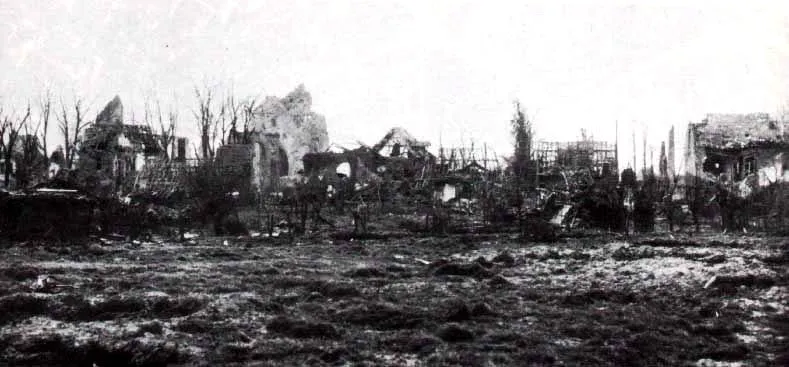
The First Battle of Ypres, fought from 19 October to 22 November 1914, was the last and largest battle of the race to the sea. Two offensives collided at the old Flemish town of Ypres. The Allies wanted to advance eastwards and turn the Germans’ northern flank, while the Germans, who had moved into Flanders a new army made up largely of volunteers, intended to break the front and reach the Channel ports. For five weeks the Germans attacked almost without pause, first to the north and east of the town, then to the south-east. Several times they came close to a breakthrough, but the British Expeditionary Force and the arriving French corps held the line. Ypres stayed in Allied hands, and the regular British army that had set out for France in August all but ceased to exist.
Name and dates
The name and dates of the battle were fixed after the war by the British Battles Nomenclature Committee. It decided that the “Battles of Ypres 1914” lasted from 19 October to 22 November and distinguished three battles within them: Langemarck (21–24 October), Gheluvelt (29–31 October) and Nonne Bosschen (11 November). At the same time, further south, the battles of La Bassée, of Armentières and of Messines were being fought under the same nomenclature, and in the north, between Diksmuide and the sea, the Belgians and French fought the Battle of the Yser. The British official history already regarded this division as artificial: from 19 October the fighting at Armentières and Messines was in practice part of a single great battle for Ypres, and the strongest German attacks cut across the boundaries drawn by the committee.
The French and the Germans divided the fighting differently. In the French tradition the Battle of Ypres and the Battle of the Yser together make up the first “Battle of Flanders” (bataille des Flandres). The German General Staff, in a book published in 1918, “Die Schlacht an der Yser und bei Ypern im Herbst 1914”, described them as the Battle of the Yser (the Fourth Army’s attack from Gheluvelt to the sea, 18–30 October) and the Battle of Ypern (the attack of the Fabeck group and the Sixth Army between the Lys and Polygon Wood, 30 October – 24 November), and the fighting to the south of them, up to 28 October, as the Battle of Lille. Later the name First Battle of Flanders (Erste Flandernschlacht) took hold in Germany. Polish works, like English ones, usually speak of the First Battle of Ypres.
Background
By mid-October 1914 the Western Front already stretched from Switzerland to French Flanders. Only the last gap, a few dozen kilometres wide, between the Lys and the North Sea remained free of trenches. After the capitulation of Antwerp the Belgian army withdrew to the Yser, and the British IV Corps of General Henry Rawlinson, which had landed in Belgium at the beginning of October, took up position at Ypres on 14 October. Meanwhile the rest of the British army was moving from the Aisne to the Allied left wing. Its II and III Corps and the Cavalry Corps were already advancing between La Bassée and Ypres.
The British commander-in-chief, Field Marshal John French, and General Ferdinand Foch, who coordinated the French armies in the north, were convinced that only weak German forces faced them. They planned an advance from Ypres eastwards, towards Roeselare, Torhout and Ghent, which was to cut off the German units on the coast and turn the enemy’s flank. The key role was to be played by the last British corps, the I Corps of General Douglas Haig, which was finishing detraining around Hazebrouck by 19 October.
The Germans had a similar plan. The new Chief of the General Staff, General Erich von Falkenhayn, decided to settle the war in the west with a blow in Flanders. He formed a new Fourth Army and sent it through Belgium towards Ypres and Nieuport, and from there to Dunkirk and Calais. At the same time the Sixth Army was to attack south of the Lys. Both sides underestimated the enemy’s strength, and neither expected to run into the other’s oncoming offensive on the same sector.
Forces
The Allies. In Flanders the British Expeditionary Force had seven infantry divisions and three cavalry divisions, and from the second half of October the divisions of the Indian Corps also began to join it. At Ypres itself fought Haig’s I Corps (1st and 2nd Divisions) and Rawlinson’s IV Corps (7th Division and 3rd Cavalry Division), and to the south of them the Cavalry Corps of General Edmund Allenby and III Corps. In November the remnants of II Corps were brought up from La Bassée to help. These were mostly superbly trained regular units, famous for their rapid and accurate rifle fire, but they were few in number and increasingly short of artillery ammunition.
From 20 October the French troops in the north came under General Victor d’Urbal, commander of a grouping called the Army Detachment of Belgium (Détachement d’armée de Belgique), renamed the Eighth Army on 16 November. At the start of the battle it consisted mainly of General de Mitry’s cavalry corps and two territorial divisions. From 23 October regular corps began to arrive: IX Corps, then XVI and XXXII Corps, as well as the 42nd Division by the sea. In time the French took over a large part of the front around Ypres. To the north of them, on the Yser, the exhausted Belgian army of King Albert I held out.
The Germans. The new Fourth Army was commanded by Duke Albrecht of Württemberg. Besides III Reserve Corps from Antwerp, it consisted of four entirely new reserve corps (XXII, XXIII, XXVI and XXVII), formed in August. They were filled with volunteers, often university and grammar-school students, alongside older reservists and soldiers of the Landwehr. Their training had lasted only a few weeks, and they lacked experienced officers, NCOs and artillery. South of the Fourth Army attacked the Sixth Army of Crown Prince Rupprecht of Bavaria. At the end of October Falkenhayn formed between the two armies a strike group under General Max von Fabeck, made up of experienced active divisions and supported by more than 250 heavy guns. On the decisive days the Germans had a clear numerical superiority at Ypres and an overwhelming superiority in heavy artillery.
Course of the fighting
19–20 October. On 19 October Rawlinson’s 7th Division moved on Menin, an important crossing on the Lys. Its 22nd Brigade had got to just over three kilometres from the town when airmen and cavalry reported strong German columns approaching from the north-east. These were the new reserve corps of the Fourth Army. Rawlinson called off the attack, and the 7th Division and 3rd Cavalry Division fell back to an arc from Zandvoorde through Kruiseik to Zonnebeke. The Germans drove the French cavalry out of Roeselare. On 20 October, as Haig’s I Corps marched from Hazebrouck and Poperinge to the Ypres area, the Fourth and Sixth Armies struck along the whole front from La Bassée to the sea.
21–24 October: the Battle of Langemarck. In accordance with French’s orders, on 21 October I Corps advanced north-east towards Poelkapelle and Passchendaele. After only a few kilometres it ran into the attacking German reserve corps and had to go over to the defensive on a line from Zonnebeke to Langemarck and Bixschoote. Over the following days the young German soldiers attacked in dense formations across open fields and suffered huge losses from British rifle fire. On 23 October the French 17th Division of IX Corps arrived and took over part of the line north of Ypres. On 24 October the Germans broke into Polygon Wood on the 7th Division’s sector, but a counter-attack by the 2nd Division drove them out.
25–28 October. The Allies tried to resume the advance. The French of IX Corps and the British 2nd Division moved slowly towards Passchendaele, but the gains were small. Meanwhile the Germans attacked the 7th Division’s projecting salient at Kruiseik, which was lost on 26 October. The 7th Division, worn out by continuous fighting, dwindled day by day. Falkenhayn, seeing that the Fourth Army’s attack had stalled and that on the Yser the Belgians had begun to flood the plain, decided to shift the main weight of the attack to the south-east of Ypres, where he sent the Fabeck group.
29–31 October: the Battle of Gheluvelt. At dawn on 29 October, in fog, the Germans attacked the crossroads near Gheluvelt (PL), on the Menin–Ypres road, and took it. The Bavarian 16th Reserve Infantry Regiment, in which Adolf Hitler served, took part in the fighting. On 30 October the Fabeck group’s attack began. The Germans captured Zandvoorde and Hollebeke, and the front came to within a few kilometres of Ypres. On 31 October came the crisis. Around noon the Germans took the village of Gheluvelt, and at 1.15 p.m. shells hit Hooge Château, where the commanders of the British 1st and 2nd Divisions were conferring. General Samuel Lomax was mortally wounded and several staff officers were killed. The British line on the Menin road was torn open. Salvation came from a counter-attack by the 2nd Battalion, Worcestershire Regiment. About 370 men advanced from Polygon Wood across open fields under fire, retook the grounds of Gheluvelt Château and linked up with the men still holding out there. The battalion lost 187 killed and wounded, but the front was closed. On the same day, to the south, the Germans broke into Messines.
1–10 November. The Germans kept attacking. On 1 November they took Messines Ridge and Wijtschate, and in the following days they attacked on both sides of the Comines canal. More French divisions arrived at the front and strengthened the British flanks, and on 5 November what was left of the 7th Division was relieved. On 10 November the Fourth Army struck the French north of Ypres and captured Diksmuide. On the same day new reserve regiments attacked at Bixschoote, west of Langemarck.
11 November: the Battle of Nonne Bosschen. The last great attack was preceded by the heaviest bombardment since the start of the battle. A dozen or so German divisions attacked on the front from Messines to Polygon Wood, and in the centre, along the Menin road, an elite division made up of Prussian Guard regiments, together with the 4th Division. The Guardsmen broke through the British line north of the road and entered Nonne Bosschen wood, about six kilometres from Ypres. They were stopped by the fire of gunners firing over open sights, supported by drivers and sappers fighting as infantry, and in the afternoon a counter-attack by the 2nd Battalion, Oxfordshire and Buckinghamshire Light Infantry drove the Germans out of the wood. The front was restored.
12–22 November. The fighting slowly died down. The Germans made a few more attacks on the French and the British, but the exhausted units of both sides had no strength left for more. The weather broke, and rain, frost and the first snow came. From 15 November French corps relieved the British I Corps, and the British took over a shorter sector further south. On 17 November Duke Albrecht halted the Fourth Army’s attacks, and some of the German troops began to be transferred to the Eastern Front. On 22 November German artillery set fire to the medieval Cloth Hall in Ieper. The British end the battle on that day.
The Langemarck myth
The German war communiqué of 11 November 1914 reported that “west of Langemarck young regiments, singing ‘Deutschland, Deutschland über alles’, charged the first line of the enemy positions and took it”. The attack in question took place on 10 November at Bixschoote, and the name Langemarck was probably chosen because it sounded German. The communiqué gave rise to the legend of student volunteers who went to their deaths with a song on their lips. In Germany the fighting was called the Kindermord, the “massacre of the innocents”, and the Langemarck myth was later used to educate the next generation, especially in the Third Reich.
Modern historians stress that the new reserve corps did not consist mainly of students. According to more recent research, volunteers made up at most about 30 per cent of their strength, and the rest were reservists and older Landwehr soldiers. The losses of the young regiments in October and November were nonetheless truly enormous. More than 44,000 German soldiers lie today in the Langemark German war cemetery.
Casualties
The losses are hard to separate from those of the simultaneous battles in Flanders, and sources give different figures. According to the British official history, the British Expeditionary Force lost 58,155 killed, wounded and missing between 14 October and 30 November, that is including the battles of La Bassée, Armentières and Messines. Some works estimate the losses in the Battle of Ypres alone at about 54,000. French losses are put at 50,000–85,000, and Belgian losses, suffered mainly on the Yser, at over 21,000.
German losses were never counted exactly. After the war the Reichsarchiv gave, with the caveat that the data were incomplete, 134,315 killed, wounded and missing in the battles the Germans called Lille, the Yser and Ypern, from 15 October to 24 November. This figure therefore also includes the fighting against the Belgians on the Yser and against the British at Armentières and Messines. The fighting at Ypres alone accounts, according to various estimates, for between about 80,000 and over 100,000 men. The three new reserve corps that fought at Ypres the longest lost roughly half their infantry.
Significance
The First Battle of Ypres closed the race to the sea. Neither side had managed to outflank the other, and a continuous line of trenches now ran from Switzerland to the North Sea coast. The war of movement in the west was over, and trench warfare began, which was to last until 1918. The failure in Flanders convinced Falkenhayn that a quick decision in the west was impossible.
For the British this was the battle in which their old regular army ceased to exist. From August to the end of November the British Expeditionary Force lost almost 90,000 men, whereas the infantry of the first seven divisions had initially numbered about 84,000. Of the roughly 12,000 soldiers of the 7th Division, just over 3,000 remained at the beginning of November. Their place was taken by reservists, volunteers of the Territorial Force, soldiers from India and later from Canada, and Kitchener’s growing New Armies.
The defence of Ypres also had symbolic significance. The Allies held one of the last Belgian towns, and around it formed a projecting bulge in the front, the so-called Ypres Salient, surrounded on three sides by the Germans, who held the surrounding heights. For the next four years some of the bloodiest fighting of the war took place here, including the Second Battle of Ypres in 1915, when the Germans used poison gas on a large scale for the first time, and the Third Battle of Ypres, known as the Battle of Passchendaele, in 1917. The town itself was reduced to ruins.
Spotted a mistake?Report an error
Battles and phases
(03)- 21–24 October 1914Battle of Langemarck (1914)From 21 to 24 October 1914 Haig's British I Corps at Ypres repulsed an attack by new German reserve corps, made up partly of volunteers.
- 29–31 October 1914Battle of GheluveltOn 29–31 October 1914 the Fabeck Group tried to break the front at Ypres. On 31 October the British line broke at Gheluvelt, but a counter-attack closed it.
- 11 November 1914Battle of Nonne BosschenOn 11 November 1914 the Prussian Guard broke the British line at Ypres and got into Nonne Bosschen, but was driven out. It was the last big German attack.