Key event
First Battle of Ypres begins
- Category:
- Military operations
- Front:
- Western Front
- Date:
- 19 October 1914
- Author:
- Łukasz Skowroń
- Battle:
- First Battle of Ypres
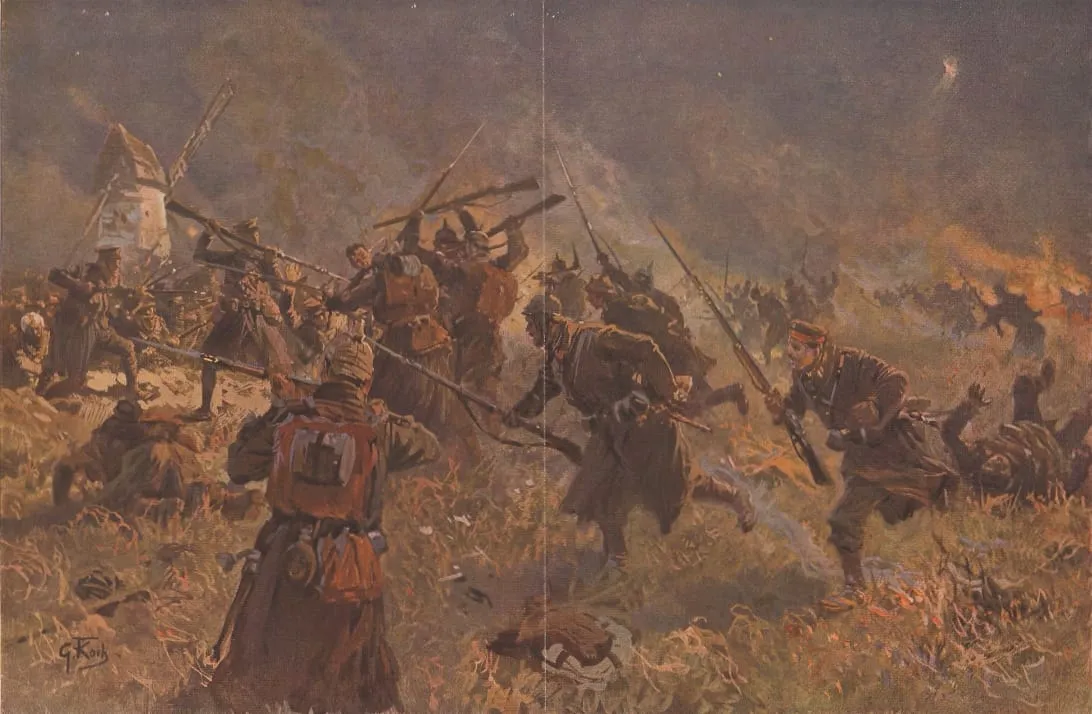
On 19 October 1914 the First Battle of Ypres began, the last and bloodiest battle of the Race to the Sea. This date was adopted after the war by the British Battles Nomenclature Committee. That day the British 7th Division advanced on Menin to turn the German flank, but instead of weak screens it ran into the head of a new German army that was approaching through Belgium towards Ypres. The attack was called off, and in the following weeks it was the Germans who attacked, trying to break through the front and reach the Channel ports.
Two offensives
In mid-October both the Allies and the Germans were preparing to attack in Flanders. Field Marshal John French and General Ferdinand Foch intended to advance east from Ypres towards Roeselare and Ghent, turn the northern German flank and cut off the German units on the Belgian coast. British intelligence estimated that there were at most three and a half corps north of the Lys, including the exhausted III Reserve Corps from Antwerp.
In reality a new German Fourth Army under Duke Albrecht of Württemberg was marching through Belgium. Besides the III Reserve Corps, it was made up of four reserve corps, the XXII, XXIII, XXVI and XXVII, formed in August from volunteers, reservists and Landwehr soldiers. The Chief of the German General Staff, General Erich von Falkenhayn, wanted to use them to break through the front between Ypres and the sea and take Dunkirk and Calais.
The attack on Menin
The most advanced Allied position was held by the British IV Corps of General Henry Rawlinson, which had reached Ypres a few days earlier. French’s headquarters pressed for his 7th Division to take Menin, a small town with an important crossing over the Lys, occupied by the Germans at the beginning of October. Rawlinson hesitated, because worrying reports were coming in from his left flank, but in the end it was settled that the attack would start on the morning of 19 October.
The commander of the 7th Division, General Thompson Capper, deployed three brigades on an arc from Kruiseik to Dadizele, facing south-east. On his left flank he was covered by the 3rd Cavalry Division of General Julian Byng, and further north by the French cavalry of General de Mitry. The day was overcast, which hampered aerial reconnaissance. The 22nd Brigade moved first, led by a battalion of the Royal Welsh Fusiliers. By noon it had advanced about three kilometres and approached the German trenches near Kezelberg, a little over three kilometres from Menin.
New corps approach
Meanwhile increasingly bad news was reaching Rawlinson’s headquarters. Byng’s cavalrymen had taken the village of Ledegem, but their neighbouring brigade ran into a strong German column approaching from the north-east and had to fall back together with the French. Airmen spotted more columns, each estimated at a division. At about 11.45 a.m. Rawlinson called off the attack on Menin. The order reached the 7th Division only at 1.05 p.m., when heavy artillery fire was already falling on the left flank of the 22nd Brigade. The brigade nevertheless managed to withdraw. The 7th Division lost just under two hundred men that day, half of them in the Welsh battalion.
That day the Germans attacked along the whole front of the Fourth Army. In the north the III and XXII Reserve Corps attacked the Belgians on the Yser, while the XXIII and XXVI Reserve Corps pushed back the French cavalry and took Roeselare. In the evening the British 7th Division stood on a line from Zandvoorde through Kruiseik to Zonnebeke, and its left flank was more than five kilometres behind its starting positions. Interrogation of prisoners showed that facing the British were divisions of the new reserve corps and that each of them was followed by another. Even so, French still underestimated the enemy’s strength.
I Corps arrives
The last British corps had just reached Flanders: I Corps of General Douglas Haig, brought over from the Aisne. On the evening of 19 October French gave Haig a written order: pass through Ypres, advance through Torhout on Bruges and push the Germans back towards Ghent. In the order he estimated that there was at most one enemy corps on the front from Menin to Ostend.
At dawn on 20 October Haig’s divisions set off from around Poperinge and Hazebrouck, forcing their way through crowds of refugees. In the evening the 2nd Division stood north-east of Ypres, with the 1st Division behind it, around Elverdinge. That same day the German Fourth and Sixth Armies attacked along the whole front from La Bassée to the sea. South of Ypres the Germans attacked Allenby’s cavalry and III Corps near Armentières, and at Ypres they twice stormed the positions of the 7th Division. The French cavalry fell back behind Houthulst Forest, exposing the British left flank, so Haig sent two Guards battalions to Zonnebeke and St Juliaan.
What came next
On 21 October I Corps advanced north-east as ordered, but immediately ran into the attacking German corps. The offensive planned by the Allies turned into a defensive battle that, with short pauses, lasted more than a month. The British, French and Belgians held Ypres, but at the cost of enormous losses. At Ypres the regular British Army bled to death, and the front in the west finally froze in trenches from Switzerland to the North Sea.
Remember the articles you have read? Only in this browser; nothing is sent anywhere.How it works
Read ·
Spotted a mistake?Report an error
Meanwhile
(04)Elsewhere in the same days.
- 19 October 1914 · Eastern FrontBattle of Warsaw endsAround 19 October 1914 the Germans began to withdraw from Warsaw. The British chronology ends the Battle of Warsaw on that day.
- 18 October 1914 · War at seaGrand Fleet leaves Scapa FlowOn 18 October 1914, fearing U-boats, the Grand Fleet began moving from Scapa Flow to Lough Swilly in Ireland and Loch na Keal on the island of Mull.
- 20 October 1914 · Eastern FrontBattle of Dęblin endsThe British chronology ends the Battle of Ivangorod, or Dęblin, on 20 October 1914. In reality the fighting there went on for another week.
- 20 October 1914 · War at seaSinking of the GlitraOn 20 October 1914 the German U-17 stopped and sank the British steamer Glitra off Norway. She was the first merchant ship sunk by a U-boat.
Related events
(04)The same battle, people or subject.
- 21 October 1914 · Western FrontBattle of Langemarck beginsOn 21 October 1914 the British I Corps advanced from Ypres towards Bruges. It ran into new German reserve corps and went over to the defensive that same day.
- 29 October 1914 · Western FrontBattle of Gheluvelt beginsOn 29 October 1914 the Germans attacked the crossroads at Gheluvelt on the Menin–Ypres road in fog. The next day Fabeck's group began its great offensive.
- 22 November 1914 · Western FrontEnd of the First Battle of YpresOn 22 November 1914 the First Battle of Ypres ended. The French took over the salient around the town and the bled-white British army a sector further south.
- 13 October 1914 · Western FrontAllies return to YpresIn mid-October 1914 Rawlinson's British IV Corps, falling back from Ghent, reached Ypres. French Territorial divisions took up positions beside it.