United Kingdom · The Entente
Julian Byng
Commander of the Canadian Corps (1916–1917) and the British Third Army (1917–1918), general
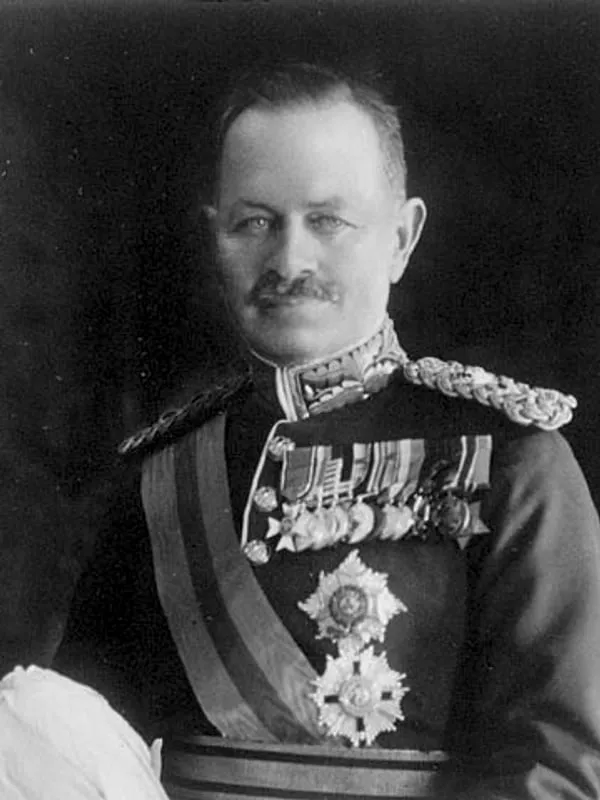
- Born:
- 11 September 1862, Wrotham Park (England)
- Died:
- 6 June 1935, Thorpe-le-Soken (England)
- Author:
- Łukasz Skowroń
- Photo:
- Rice studio / Library and Archives Canada, domena publiczna, Wikimedia Commons

Sir Julian Byng, from 1919 a baron and from 1928 Viscount Byng of Vimy, was one of the few British generals of the First World War whom the soldiers genuinely liked. He had neither a brilliant mind nor political talents, but he listened to his subordinates, cared about training and was not afraid of new methods. He commanded cavalry at Ypres, carried out the evacuation of Suvla and, as commander of the Canadian Corps, prepared the capture of Vimy Ridge, which Canadians still regard as the birth of their nation. His Third Army was the first to break the Hindenburg Line with massed tanks at Cambrai, and in 1918 it withstood the blow of the Spring Offensive and went forward in the Hundred Days Offensive. He put the name Vimy into his title, and then for five years was Governor General of Canada.
Before the war
He was born on 11 September 1862 at Wrotham Park near London, the youngest, thirteenth child of George Byng, Earl of Strafford. His grandfather had fought at Waterloo. At Eton he did poorly, and his father, who had a large family to support, could not buy him a commission in the regular army. Byng therefore started in the militia, and in 1883, through the patronage of the Prince of Wales, the future King Edward VII, he transferred to the 10th Hussars, the most expensive regiment in the army. He made up the missing money by buying polo ponies cheaply, schooling them and selling them at a profit. In 1884 he fought in the Sudan at El Teb and Tamai.
He graduated from the Staff College at Camberley, where he met future wartime commanders, among them Henry Rawlinson. In the Boer War he raised and led a regiment of light horse, and then a group of columns. In 1902 he married Evelyn Moreton, later a writer. He was then the first commandant of the cavalry school, commanded cavalry brigades and a Territorial division, and from 1912 the British troops in Egypt.
1914–1915: cavalry and Gallipoli
After the outbreak of war Kitchener summoned him from Egypt and gave him the new 3rd Cavalry Division. On 8 October 1914 it landed at Ostend and, together with the 7th Division, joined Rawlinson’s IV Corps, with which it reached Ypres. In the First Battle of Ypres Byng’s cavalrymen fought on foot in the trenches, among other places at Gheluvelt and Zandvoorde. In May 1915 he took over the Cavalry Corps, which during the Second Battle of Ypres also fought as infantry.
In August 1915, after the failure at Suvla, Ian Hamilton removed the commander of IX Corps, General Frederick Stopford. London sent Byng, who had a reputation as an energetic commander, to replace him. No further offensive took place, and when the evacuation of the peninsula was considered in the autumn, Byng believed that his sector could be abandoned without heavy losses, but that every week would make it harder. In December he prepared the evacuation of Suvla. He divided his forces into two parts, separated by a salt lake, and laid out successive lines of withdrawal. During the night of 18–19 December he personally supervised the embarkation of the last troops on the beach. The Turks noticed nothing and no one was killed. He then briefly commanded the defence of the Suez Canal, and in February 1916 returned to France as commander of XVII Corps.
The Canadian Corps and Vimy
In May 1916 Haig gave him the Canadian Corps. Byng, an Englishman and an aristocrat, at first aroused mistrust among the Canadians. He quickly won the confidence of the soldiers, however, who began to call themselves the “Byng Boys”. A few days after he took command the Germans captured Mount Sorrel near Ypres. The first counter-attack failed, so Byng prepared a second one carefully, with strong artillery support, and on 13 June recovered the lost positions. It was the first battle won by the Canadian Corps and the first test of the method he was later to develop. In September the Canadians moved to the Somme, where they took Courcelette and bled themselves white in the fighting for Regina Trench on the Ancre Heights.
In the winter of 1916 the corps moved to Vimy, and in January 1917 it was given the task of taking the whole ridge. Canadian officers, among them the commander of the 1st Division, General Arthur Currie, went to Verdun to study how the French had prepared their successful December attacks. From these lessons came the method remembered as the Canadians’ trademark. Behind the lines the ground of the attack was reproduced at full scale, every platoon rehearsed its task, even privates were given maps, and every soldier knew where he was to go. The gunners, under Lieutenant-Colonel Andrew McNaughton, prepared scientifically planned counter-battery fire. On 9 April 1917 four Canadian divisions attacked simultaneously, for the first time in history as a single body, and by 12 April took the whole of Vimy Ridge, which the French had failed to recapture in 1915. The corps lost more than 10,000 men, including about 3,600 killed.
The Third Army and Cambrai
In June 1917 Byng became commander of the British Third Army, and the Canadian Corps was taken over by Currie. In the autumn he adopted a scheme for a tank attack on dry ground, not churned up by shells, south-west of Cambrai, and expanded it into a plan to break through the front. On 20 November 476 tanks advanced on the Hindenburg Line without a days-long bombardment, and more than a thousand guns opened fire only at the moment of the attack, without prior registration. Surprise was complete, and church bells were rung in Britain. But the Battle of Cambrai then went badly. Byng had no reserves, the cavalry did not get across the canal, and the fighting for Bourlon Wood exhausted the infantry. On 30 November the Germans counter-attacked and took back most of the gains. In his report Byng claimed that there had been no surprise and laid the blame on the poor training of junior officers and men. That report is among the least creditable pages of his career.
1918: from retreat to victory
On 21 March 1918 the German Operation Michael struck Gough’s Fifth Army and the right wing of the Third Army. Byng was too long unwilling to give up the Flesquières salient, won at such great cost at Cambrai, as a result of which his army lost contact with the retreating Fifth Army. He had to fall back across the old Somme battlefield and give up Bapaume. His front, however, did not collapse. On 28 March at Arras he repulsed the attack of the German Seventeenth Army of Otto von Below, and in April he stopped the Germans on the Ancre.
In August, when the attack at Amiens began to lose momentum, Haig shifted the weight of the offensive to the Third Army’s front. On 21 August the Battle of Albert began. Haig considered Byng’s plan too cautious and urged him on, but his army then went forward almost without a break. On 12 September it took Havrincourt, which Byng regarded as the most important day of his command of the Third Army, and on 27 September, together with Currie’s Canadians, it forced the Canal du Nord. Then came the fighting at Cambrai, on the Selle and on the Sambre, in which the New Zealanders took the fortress of Le Quesnoy. The Third Army ended the war near Maubeuge.
After the war
In 1919 Byng was created Baron Byng of Vimy, and in November he retired from the army because he did not want to block the promotion of younger officers. In 1921 the King, on the advice of Prime Minister Lloyd George, appointed him Governor General of Canada. He was very popular: he travelled all over the country, was the first to choose Canadians as his aides-de-camp, and his wife donated to the NHL hockey league a trophy for sportsmanlike play that is still awarded today. In 1926 he refused Prime Minister William Lyon Mackenzie King a dissolution of parliament, which caused a constitutional crisis and hastened changes in the role of governors general throughout the Empire. Most legal historians today consider that he acted in accordance with the constitution. In 1928–1931 he was Commissioner of the London Metropolitan Police, which he reformed, and in 1932 he became a field marshal. He died on 6 June 1935 at his home, Thorpe Hall, in Essex.
Assessment
Byng is regarded as one of the best British army commanders of the war. Historians stress that he readily adopted new solutions: the methodical preparation of Vimy, the massed use of tanks and fire without registration at Cambrai. His ability to listen to subordinates and to support able men such as Currie and McNaughton made the Canadian Corps under his command one of the best formations on the Western Front. Reservations concern above all Cambrai, where he failed to guard against an obvious German counter-attack and then shifted the blame onto the soldiers, and March 1918, when he held on to the Flesquières salient for too long. Canadian historians stress in turn that the success at Vimy was the work of the whole corps and that the Canadians, with Currie at their head, had a greater share in it than the title “Lord Byng of Vimy” suggests.
Sources
Spotted a mistake?Report an error
Commanded in battles
(27)- 18 December 1915 – 9 January 1916Evacuation of GallipoliMiddle East
- 2–13 June 1916Battle of Mount SorrelWestern Front
- 15–22 September 1916Battle of Flers–CourceletteWestern Front
- 26–28 September 1916Battle of Thiepval RidgeWestern Front
- 1 October – 11 November 1916Battle of the Ancre HeightsWestern Front
- 9–12 April 1917Battle of Vimy RidgeWestern Front
- 9 April – 16 May 1917Battle of Arras (1917)Western Front
- 28–29 April 1917Battle of ArleuxWestern Front
- 3–4 May 1917Third Battle of the Scarpe (1917)Western Front
- 20 November – 7 December 1917Battle of CambraiWestern Front
- 21–23 March 1918Battle of St QuentinWestern Front
- 21 March – 5 April 1918Operation MichaelWestern Front
- 24–25 March 1918First Battle of BapaumeWestern Front
- 28 March 1918First Battle of Arras (1918)Western Front
- 5 April 1918Battle of the Ancre, 1918Western Front
- 8 August – 11 November 1918Hundred Days OffensiveWestern Front
- 21–23 August 1918Battle of Albert (1918)Western Front
- 21 August – 3 September 1918Second Battle of the SommeWestern Front
- 31 August – 3 September 1918Second Battle of BapaumeWestern Front
- 2–3 September 1918Battle of the Drocourt–Quéant LineWestern Front
- 12 September 1918Battle of HavrincourtWestern Front
- 12 September – 12 October 1918Battles of the Hindenburg LineWestern Front
- 18 September 1918Battle of ÉpehyWestern Front
- 27 September – 1 October 1918Battle of the Canal du NordWestern Front
- 8–9 October 1918Battle of CambraiWestern Front
- 17–25 October 1918Battle of the SelleWestern Front
- 4 November 1918Battle of the SambreWestern Front
Mentioned in battles
(07)Often appears with
People who appear in the same events.