Key event
Assault on Vimy Ridge
- Category:
- Military operations
- Front:
- Western Front
- Date:
- 9 April 1917
- Author:
- Natalia
- Battle:
- Battle of Vimy Ridge
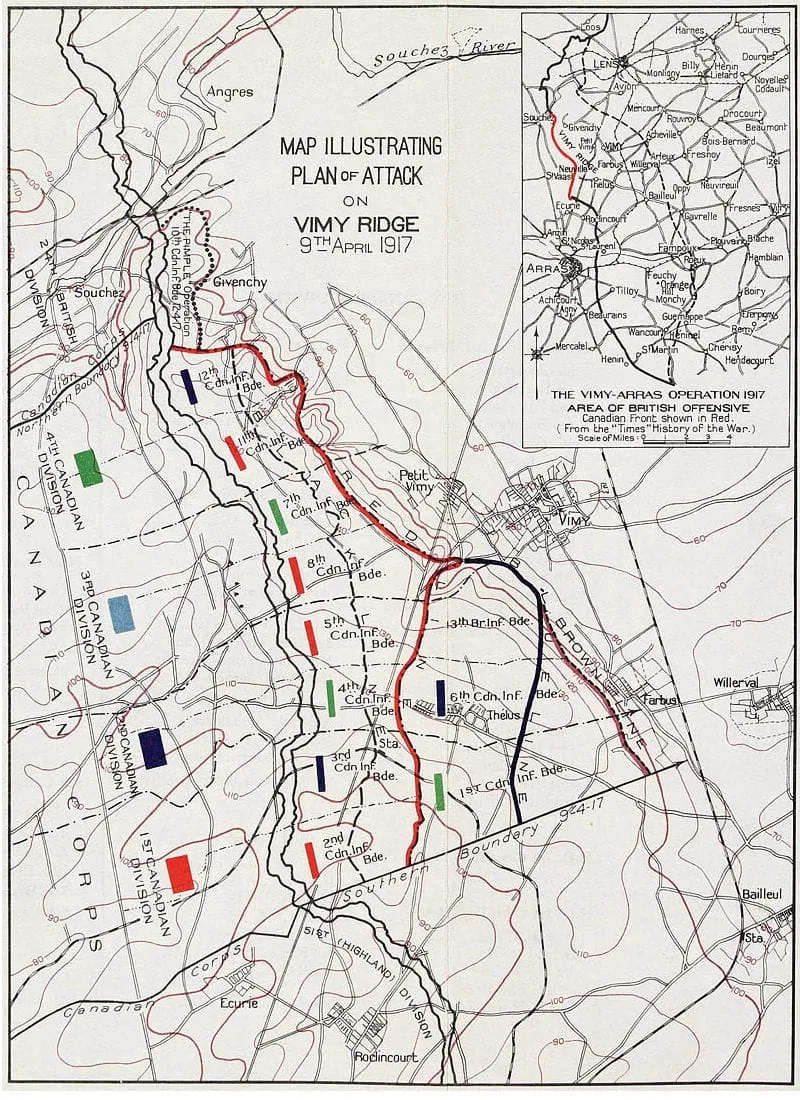
On 9 April 1917, Easter Monday, at 5.30 a.m., at the very moment the British Third Army went into the attack at Arras, the Canadian Corps attacked Vimy Ridge to its north. For the first time in history all four Canadian divisions went into battle together, side by side, with soldiers from every province of the country. Before them lay a ridge that had been fought over for two and a half years: in 1915 the French twice tried to take it and suffered enormous losses, and in May 1916 the British lost some of their trenches here. Within a few hours the Canadians took almost the whole ridge and descended its eastern slope above the Douai plain. By evening only the highest point, Hill 145, and the northern end of the ridge remained in German hands.
The night before the attack
The Canadians had been preparing for this day all winter. The corps was commanded by the British Lieutenant-General Julian Byng, and his plan laid out the attack to the minute, in four stages marked on the maps by coloured lines. Every battalion had rehearsed its task many times on ground reproduced behind the lines, and from 2 April the artillery had been pounding the German positions at full strength. The attack was originally to have gone in on Easter Sunday, but Douglas Haig postponed it by a day at the request of the French.
8 April was a fine, sunny day. After dark the battalions left the woods near Mont-Saint-Éloi and Villers-au-Bois and moved towards the front line, guided by stakes painted with luminous paint. Many of them covered the last stretch through underground passages cut in the chalk by British tunnelling companies. Through gaps cut in the wire the leading companies went out into no man’s land and lay down in shallow trenches and on the lips of craters, in places less than 100 metres from the German outposts. The British official history states that by 4 a.m. 30,000 men of 52 battalions had taken up their positions on a front about six kilometres long without raising a general alarm. One German company reported at 2.30 a.m. that the Canadian trenches were filling up, but the telephone cables were cut and the runner reached the battery too late. The soldiers were given a hot meal and a tot of rum. Towards morning the temperature dropped, and a north-westerly wind brought sleet.
The barrage
At 5.30 a.m., British time, every battery from Arras to the Lorette spur opened fire, and two mines exploded under the German trenches on the left wing. The Canadians were supported by 983 guns and mortars. For three minutes the field guns pounded the first German line, and then the wall of explosions moved forward about 90 metres every three minutes. Ahead of it 150 Vickers heavy machine guns swept a belt of ground further back with bullets, while the heavy guns hit the German batteries with high-explosive and gas shells. Many horses of the German artillery teams died from the gas, and the observation posts had been destroyed, so the German artillery fired blind and its shells fell far behind the attackers. The snowstorm blew at the Canadians’ backs and into the defenders’ faces.
The infantry followed close behind the barrage. The ground was terrible: water-filled shell holes, smashed trenches, remnants of wire and huge craters from earlier mines, which had to be skirted. In many places the Canadians reached a German trench before its garrison had time to come out of the dugouts. They left sentries at the exits from the tunnels and went on, while mopping-up parties behind them pulled out the prisoners.
The right wing: Thélus and the eastern slope
On the right wing Major-General Arthur Currie’s 1st Division and the 2nd Division reached the first objective, the Black Line, at about 6.15 a.m. The most dangerous opponents proved to be snipers and machine-gun crews, who fought to the end. Private William Milne of the 16th Battalion crawled up to one such nest and bombed it, and Sergeant Ellis Sifton of the 18th Battalion jumped into a trench with a hidden machine gun and bayoneted its crew. Both received the Victoria Cross, both posthumously, as they were killed later that day. The eight tanks that were to support the 2nd Division got stuck in the mud at the very start.
At 6.45 a.m. the attack moved on. The wind changed direction and blew smoke from Thélus onto the Bavarian defenders, who saw the Canadians only when they were right in front of them. In the ruins of the hamlet of Les Tilleuls the 21st Battalion found two German battalion headquarters in a large cave and took over 100 prisoners. At about 8 a.m. both divisions stood on the second objective, the Red Line. Later the reserve brigades, supported by the British 13th Brigade, passed through the ruined village of Thélus and Hill 135 and after 11 a.m. reached the third line. The Canadian official history describes how at that moment the clouds briefly parted and the sun lit up a ridge full of Canadian soldiers: “The Germans saw that the ridge was lost, the Canadians knew that it was won.” After a pause of an hour and a half the infantry went down the eastern slope, cut through the wire of the German second position with wire cutters, and in the woods above Farbus captured German batteries whose crews had fled. Among those taken prisoner was the commander of the 3rd Bavarian Reserve Regiment with his staff. From the crest and the eastern slope the Canadians looked out over the wide Douai plain.
Byng wanted to exploit the success and asked for cavalry, but the plan had not provided for it, and approval from headquarters came too late. Two patrols of Canadian light cavalry, sent towards the village of Willerval after 4 p.m., were almost wiped out.
The left wing: Hill 145
In the centre the 3rd Division met weak resistance and by 7.30 a.m. was already on the crest, on the edge of the Bois de la Folie. The 2nd Battalion, Canadian Mounted Rifles, of the 8th Brigade pulled 150 surprised Saxons out of one tunnel. Things went worse for the 4th Division on the left wing, which was to take Hill 145, the highest point of the ridge. The commander of the 87th Battalion had earlier asked the artillery to spare one stretch of German trench which he wanted to use once captured. It was from there and from deep dugouts that German machine guns cut down half of the battalion’s first wave, and then fired into the backs of those who had gone further. The 11th Brigade’s attack on the left wing collapsed, and the 54th Battalion, which had reached the crest, had to withdraw. The 3rd Division had to bend back its left flank to shield itself from fire from the hill.
In the north the 12th Brigade took the first trenches but then got stuck under fire from the hill known as the Pimple. Captain Thain MacDowell of the 38th Battalion took several dozen Germans prisoner from a dugout by persuading them that he was leading a large party, though he had only two soldiers with him. In the afternoon bombing parties, supported by mortars and machine guns, took the troublesome trench, and in the evening two companies of the 85th Battalion from Nova Scotia (Nova Scotia Highlanders), which had only just arrived in France, took the trenches on the western slope just below the summit without artillery support. The Germans held the summit itself and the dugouts on the eastern slope until the next day.
Evening
By midnight, according to the British official history, over 3,400 prisoners had been counted, and more were still coming in. German attempts to counter-attack failed. Colonel-General Ludwig von Falkenhausen, commander of the Sixth Army, had kept his reserve divisions several dozen kilometres behind the front, expecting a long battle as on the Somme. The battalions rushed up to the ridge arrived after dark and were used to plug gaps, and an attack by a Bavarian battalion on the northern slope of Hill 145 was dispersed in the night by the fire of a single Canadian machine gun. For General Erich Ludendorff, who celebrated his 52nd birthday on 9 April, it was a blow. “I had looked forward to the expected offensive with confidence, and was now deeply depressed,” he wrote.
In the first two days of the battle the Canadian Corps lost, according to its official history, 7,707 men, including 2,967 killed. Most of these losses fell on 9 April. The Canadians, who two years earlier had withstood a German gas attack at Ypres, took in a single day almost the whole ridge that neither the French nor the British had previously managed to recapture. Hill 145 fell on the afternoon of 10 April and the Pimple on 12 April.
Remember the articles you have read? Only in this browser; nothing is sent anywhere.How it works
Read ·
A voice from the front
“I watched the luminous hands of my watch get nearer and nearer to the fateful moment, for the barrage was to open at five-thirty. […] Five-twenty-nine! God help our men! Five-thirty! With crisp sharp reports the iron throats of a battery nearby crashed forth their message of death to the Germans, and from three thousand guns at that moment the tempest of death swept through the air.”
Spotted a mistake?Report an error
Meanwhile
(04)Elsewhere in the same days.
- 9 April 1917 · PoliticsProvisional Government on war aimsOn 9 April 1917 the Provisional Government declared that free Russia's aim was not conquest but a lasting peace. It was a compromise with the Petrograd Soviet.
- 8 April 1917 · DiplomacyAustria-Hungary breaks off relations with the USOn 8 April 1917 in Vienna Czernin handed the American chargé d'affaires his passports. As Germany's ally, Austria-Hungary broke off relations with the US.
- 10 April 1917 · War at seaSinking of the hospital ship SaltaOn 10 April 1917 the hospital ship Salta struck a mine laid by UC-26 off Le Havre and sank within minutes. Between 86 and 130 died, among them 9 nurses.
- 7 April 1917 · DiplomacyCuba and Panama declare war on GermanyOn 7 April 1917, a day after the USA, Cuba and Panama declared war on Germany. The Cuban Congress voted unanimously; in Panama the president decided.
Related events
(04)The same battle, people or subject.
- 9 June 1917 · Western FrontCurrie takes command of the Canadian CorpsOn 9 June 1917 General Arthur Currie officially succeeded Julian Byng in command of the Canadian Corps. He was the first Canadian to lead the whole corps.
- 3 May 1917 · Western FrontThird Battle of the Scarpe beginsAt 3.45 a.m. on 3 May 1917, still in darkness, three British armies struck again at Arras. They failed almost everywhere. Only the Canadians succeeded.
- 28 April 1917 · Western FrontCanadians capture ArleuxOn 28 April 1917 the Canadian 2nd Brigade took Arleux-en-Gohelle, the day's only success, as British attacks at Rœux, Gavrelle and Oppy failed.
- 15 August 1917 · Western FrontBattle of Hill 70 beginsAt dawn on 15 August 1917 the Canadian Corps took Hill 70 above Lens and then broke a series of German counter-attacks with artillery fire.