1917: Arras and the Nivelle Offensive
Battle of Vimy Ridge
- Dates:
- 9–12 April 1917
- Front:
- Western Front
- Location:
- Vimy Ridge between the Souchez valley and the Bailleul area, with Hills 145 and 135, the village of Thélus and the knoll called the Pimple, north of Arras, Pas-de-Calais department (France)On the battle map →
- Sides:
- Canada and the United KingdomDouglas Haig, Henry Horne, Julian Byng, Arthur CurrieGerman EmpireRupprecht, Crown Prince of Bavaria, Ludwig von Falkenhausen, Karl von Fasbender
- Result:
- Canadian victory. The Canadian Corps took the whole of Vimy Ridge, and the Germans withdrew onto the Douai plain, to the Oppy–Méricourt line. There was no breakthrough.
- Author:
- Łukasz Skowroń
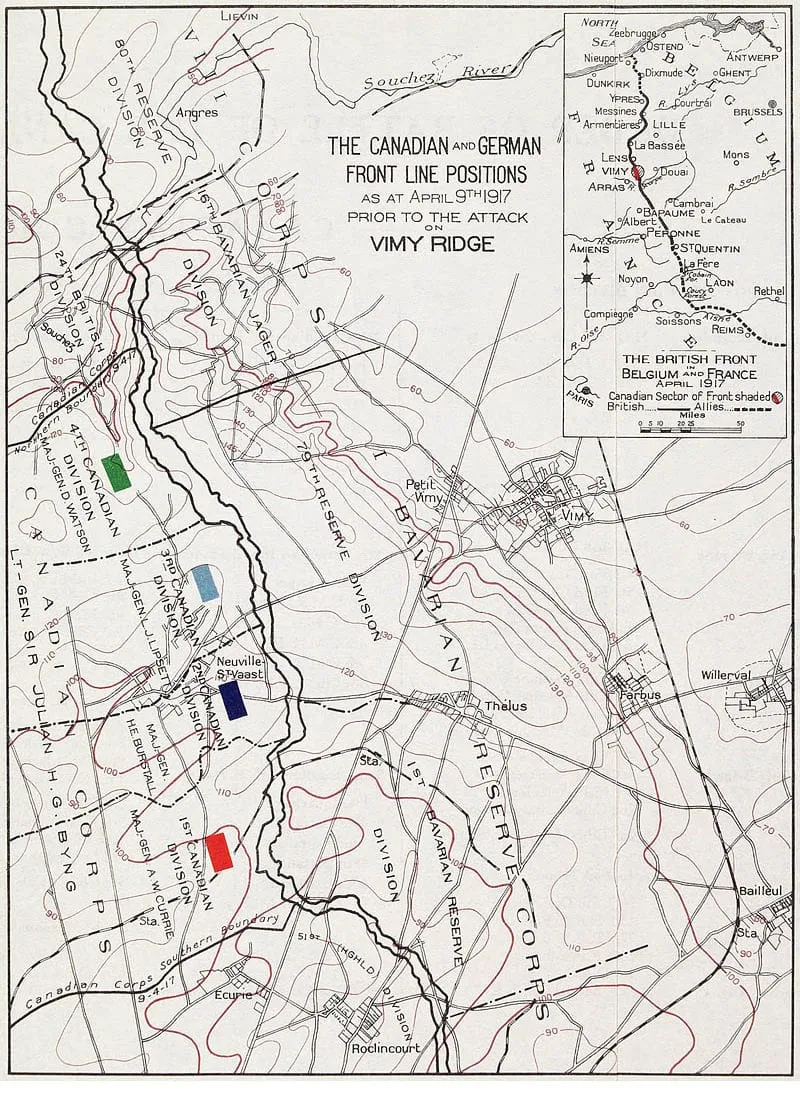
The Battle of Vimy Ridge was the northern part of the British offensive at Arras in the spring of 1917. The ridge, a low but steeply east-facing line of hills between Arras and Lens, had been in German hands since the autumn of 1914 and dominated the whole area. In 1915 the French had twice tried to take it, losing tens of thousands of men. On the morning of 9 April 1917, Easter Monday, in a snowstorm, all four divisions of the Canadian Corps, fighting together for the first time, went into the attack at once. After careful planning, weeks of preparation and behind a powerful creeping barrage, the Canadians took almost the whole ridge within a few hours. Its highest point, Hill 145, fell the next day, and on 12 April the last German strongpoint at its northern end, called the Pimple, followed. The Germans withdrew onto the plain. The victory cost the Canadians more than 10,000 killed and wounded and became one of the most important events in Canadian history.
Name and dates
We date the Battle of Vimy Ridge to 9–12 April 1917: from the attack of the Canadian Corps on Easter Monday to the capture of the Pimple, the last German strongpoint on the ridge. Most studies treat it this way. The name “Battle of Vimy Ridge” was given after the war by the British Battles Nomenclature Committee. Together with the First Battle of the Scarpe, fought on the same days by the Third Army to the south, it forms the first phase of the Battle of Arras. The Committee, and following it the Canadian official history (G.W.L. Nicholson, Canadian Expeditionary Force 1914–1919) and the British one (Cyril Falls, Military Operations France and Belgium 1917, volume I), on which this page mainly relies, count the battle up to 14 April, including the Canadians’ descent from the ridge after the Germans, who withdrew to the Oppy–Méricourt line on 13–14 April. Times are given in British time.
Background
Vimy Ridge runs for several kilometres from the valley of the small River Souchez in the north to the outskirts of Arras in the south. To the west it rises gently across open fields; to the east it falls steeply towards the flat plain of Douai, which it overlooks by about 60 metres. Its highest points are Hill 145 (named from its height in metres) in the central part and Hill 135 above the village of Thélus in the south. Whoever held the ridge could see Lens, Douai and the approaches to Arras. The Germans took it in October 1914, and from then on it shielded the coalfield around Lens. The Canadian official history calls it the keystone of the German defences, linking the new Hindenburg Line with the lines running north towards the coast.
The French Tenth Army attacked the ridge twice. In May 1915 the Moroccan Division reached the crest in its first assault but, without reserves, could not hold it. In September the French took Souchez and part of the slopes, but the ridge remained in German hands. In March 1916 the British took over the sector. Their tunnelling companies won the mine war underground, but above ground the Germans had the upper hand, and in May 1916 they captured a stretch of British trenches at the foot of the crest.
The Canadian Corps of Lieutenant-General Julian Byng, a Briton who had commanded it since May 1916, came to Vimy in the autumn of 1916, after heavy fighting on the Somme, including the battle for the heights above the Ancre. Earlier, at Ypres, the Canadians had gone through the gas attack of April 1915 and the victorious Battle of Mount Sorrel. Over the winter they held about 16 kilometres of front between Arras and Lens, facing the ridge, and carried out numerous raids on the German trenches there.
The attack on the ridge was built into the plan for the Allied spring offensive. Under the plan of General Robert Nivelle, commander-in-chief of the French armies since December 1916, the British were to attack at Arras a week before the main French blow on the Aisne and draw the German reserves onto themselves. Nivelle would in fact have preferred them not to attack so far north, but Douglas Haig, commander of the British armies in France, insisted on taking the ridge, because without it the Third Army, attacking south of it, would have German observers above its left flank. The dispute was settled at Calais in Haig’s favour. The task of the Canadian Corps, within General Henry Horne’s First Army, was thus above all to cover the left flank of the Third Army’s attack. When in March the Germans fell back to the Hindenburg Line, Vimy found itself at the very northern end of the new position and gained even greater importance.
Plan and preparations
On 19 January 1917 First Army headquarters entrusted Byng with taking the whole main ridge on a front about 6.5 kilometres wide. The Pimple at the northern end and the Bois en Hache wood on the other side of the Souchez valley were to be attacked later by the neighbouring British I Corps. Byng presented his plan on 5 March. The four Canadian divisions were to attack simultaneously, arranged in numerical order from right to left: the 1st Division of Major-General Arthur Currie, the 2nd Division of General Henry Burstall, the 3rd Division of General Louis Lipsett and the 4th Division of General David Watson. The British 5th Division was attached to the corps, its 13th Brigade to help the 2nd Division, as well as British artillery, engineers and labour units. The corps thus numbered about 170,000 men, including 97,184 Canadians.
The attack was divided into stages, marked by lines on the map in black, red, blue and brown, corresponding to successive German positions. The infantry was to reach the Black Line, the German forward zone, in 35 minutes. The Red Line ran in the north beyond the crest of Hill 145 and was the final objective of the 3rd and 4th Divisions, which were to take it by 7.05 a.m. On the right flank, where the ridge turned south-east and the distance was longer, the 1st and 2nd Divisions also had to pass the Blue Line, with Thélus and Hill 135, and the Brown Line, with the German second position in the woods on the eastern slope. If everything went according to the timetable, the whole ridge was to be in Canadian hands by 1.18 p.m., after a penetration of almost four kilometres into the German defences. Eight tanks were to support the 2nd Division at Thélus, but nobody expected much of them.
On this basis the most powerful artillery support yet given to a British corps was prepared. The Canadians were supported by 245 heavy guns and howitzers as well as 480 field guns and 138 light howitzers, with hundreds more barrels from the neighbouring I Corps. That gave one heavy gun to about every 18 metres of front and one field gun to about every 9 metres, roughly three times the density on the Somme. The preparatory bombardment began on 20 March, but for the first two weeks some batteries stayed silent to conceal the strength of the artillery. From 2 April the fire was at full strength. More than a million shells fell on the German positions, and the Germans called this period the “week of suffering”. The new No. 106 fuze, which exploded on contact with the ground, destroyed the wire effectively. The villages of Thélus, Farbus and Givenchy-en-Gohelle were razed to the ground, and the German troops in the front line often went without hot food for several days. The Canadian artillery, directed by Brigadier Edward Morrison, had earlier carefully located the German batteries, largely thanks to the airmen. According to the Canadian official history, 83 per cent of the roughly 212 guns facing the corps were located. The airmen of the Royal Flying Corps paid a high price for this, because the German Albatros D.III fighters were faster and better armed. The Canadians on the ground saw the red aeroplane of Manfred von Richthofen above them.
Underground, the British tunnelling companies cut more than a dozen subways through the chalk leading towards the front line: the Canadian official history lists eleven with a total length of about six kilometres, the Canadian Department of Veterans Affairs fourteen. The longest, Goodman, was more than 1.7 kilometres long. They were lit by electricity, carried telephone cables and water mains, and housed headquarters, ammunition stores and dressing stations. Old quarries, such as the Zivy Cave, could hold an entire battalion. Part of one of these tunnels, the Grange, can be visited today. The engineers repaired and built dozens of kilometres of roads, light railways and pipelines, because there was hardly any water in an area where about 50,000 horses had been concentrated.
The Canadians placed great emphasis on training. Behind the lines the ground of the attack was reproduced full size, with the German trenches marked by tapes and the strongpoints by flags, based on aerial photographs. The battalions rehearsed the attack there many times, with horsemen carrying flags standing in for the creeping barrage. Every soldier knew where he had to get to and what to do there. These methods show the influence of Nivelle’s December attack at Verdun, which a group of British officers, including Currie, had studied in January; Currie then described it in lectures to Canadian commanders. All winter the Canadians also raided the German trenches. Not always successfully: according to the Canadian official history, the large gas raid by the 4th Division on the night of 28 February to 1 March cost 687 men, including two battalion commanders. From 20 March until the attack, raids took place every night and cost about 1,400 men, but they provided detailed knowledge of the German defences.
German defence
The front from Cambrai to Lille was held by the German Sixth Army of Colonel-General Ludwig von Falkenhausen, part of the army group of Crown Prince Rupprecht of Bavaria. Vimy Ridge was defended by troops of three divisions: the Bavarian 1st Reserve Division, defending Thélus and the southern part of the ridge; the Prussian 79th Reserve Division, recently transferred from the Eastern Front, in the central part with Hill 145; and the Bavarian 16th Division facing Souchez and the Pimple. The first two belonged to the so-called Vimy Group, that is, the staff of General Karl von Fasbender’s I Bavarian Reserve Corps. Only five regiments stood in the trenches on the ridge, and many companies were well below strength.
The defence was built on the old principle of rigidly holding the line, not on the new elastic defence in depth that General Erich Ludendorff had been introducing since the winter. The forward zone, with three lines of trenches, deep dug-outs, concrete machine-gun nests and tunnels, lay on the narrow western slope in full view of the Canadians. The second position ran behind the ridge, in the woods of the eastern slope. The gravest mistake was the placing of the reserves. According to the British official history, the five divisions intended for the counter-attack stood 25–30 kilometres behind the front so as not to suffer from the bombardment. Falkenhausen assumed that the battle would be long, as on the Somme, that his front-line divisions would hold out, and he intended to relieve them with fresh ones on the evening of the second day of fighting.
Course: 9 April
The attack, originally set for 8 April, was postponed by a day by Haig at the request of the French. On the evening of Easter Sunday the Canadian infantry moved from the woods in the rear to their assembly positions, partly through the subways. By 4 a.m. about 30,000 men had taken up their positions, in places less than 100 metres from the German outposts, without raising a general alarm. Towards dawn sleet began to fall, driven by a north-westerly wind into the backs of the attackers and the faces of the defenders.
At 5.30 a.m. the 983 guns and mortars supporting the Canadians opened fire, and two mines exploded under the German trenches on the left flank. For three minutes the field guns pounded the German front line, then the barrage moved forward about 90 metres every three minutes. Ahead of it 150 Vickers machine guns swept a belt of ground reaching about 360 metres beyond it, while the heavy guns struck the German batteries with high-explosive and gas shells. The German response was weak and fell far behind the attackers. The first wave, about 15,000 men from 21 battalions, advanced through mud and shell holes right behind the barrage, and caught many defenders still in their dug-outs.
On the right flank the 1st and 2nd Divisions reached the Black Line at about 6.15 a.m., and the 3rd Division a few minutes later. Resistance came mainly from snipers and machine-gun crews in nests that had to be taken with grenades and the bayonet. Private William Milne of the 1st Division and Sergeant Ellis Sifton of the 2nd Division were awarded the Victoria Cross for this, both posthumously. The eight tanks got stuck in the mud at the very beginning. The 3rd Division stood on the crest of the ridge at 7.30 a.m., on the edge of the Bois de la Folie, and the 1st and 2nd Divisions reached the Red Line at about 8 a.m. In the afternoon, after passing the Blue Line with the ruins of Thélus and Hill 135, the reserve brigades went down the eastern slope towards the Brown Line, through the wire of the second position, and captured the German batteries in the woods above the village of Farbus. According to Nicholson, towards the end of the attack the sun came out for a moment and the Germans saw the ridge near Thélus covered with Canadian soldiers: “The Germans saw that the ridge was lost, the Canadians knew that it was won.” Soon afterwards it began to snow again.
Byng tried to exploit the success with cavalry, but it had not been provided for in the plan, and permission from headquarters came too late. Two patrols of Canadian cavalry, which set off at about 4.20 p.m. towards the village of Willerval, were almost wiped out. The German counter-attacks that day failed. Battalions hastily brought up from reserve arrived after dark, and the regimental commanders on the spot used them to plug gaps in their own line.
Course: Hill 145, 9–10 April
The hardest task fell to the 4th Division on the left flank: Hill 145, the highest point of the ridge, from which the Germans could see the whole valley behind the Canadian front. The summit was ringed by the first two trenches, and on the eastern slope the Germans had deep dug-outs called the Hangstellung. On the right flank of the 11th Brigade the 102nd Battalion took the forward slope, but on the left the attack broke down. The commander of the 87th Battalion had earlier asked the artillery to spare one stretch of German trench, which he wanted to use once it was taken. From this trench and the remaining dug-outs German machine guns cut down half of the first wave. The 12th Brigade, too, despite initial success, was held up by fire from the Pimple. Captain Thain MacDowell of the 38th Battalion forced several dozen Germans in a dug-out to surrender by persuading them that he had a large force behind him, although only two soldiers were with him, and was awarded the Victoria Cross for it.
At 1 p.m. bombing parties with Stokes mortars took the troublesome trench. In the evening two companies of the 85th Battalion (Nova Scotia Highlanders), newly arrived in France, took the second trench without artillery support and reached the summit itself. A night counter-attack by a Bavarian battalion from the Pimple was dispersed by the fire of a single Canadian machine gun. On 10 April at 3.15 p.m. two battalions of the 10th Brigade, the 44th and 50th, originally intended for the attack on the Pimple, crossed the summit and ran down the eastern slope, clearing the dug-outs and taking about 150 prisoners. Hill 145 was in Canadian hands, and with it the whole main ridge over a length of about 6.5 kilometres.
Course: the Pimple, 11–12 April
The Germans concluded that they would not regain the ridge. On 11 April Rupprecht, after consulting the new chief of staff of the Sixth Army, Colonel Fritz von Loßberg, ordered a withdrawal to the third position, the Oppy–Méricourt line and the sector around the western suburbs of Lens, on the plain, out of observation from the ridge. The last civilians were evacuated from the surrounding villages.
On 12 April at 5 a.m., in a snowstorm driven by a strong westerly wind, the 10th Brigade attacked the Pimple, now defended by a fresh battalion of the 5th Guard Grenadier Regiment. The 44th and 50th Battalions quickly occupied the ruined trenches, while the 46th Battalion on the left flank, above Souchez, lost half the men of its two attacking companies. By 6 a.m. the Pimple had been taken. At the same time the British 24th Division of I Corps took the Bois en Hache on the slope of the Lorette spur. The whole ridge was in Allied hands.
After the battle
On the night of 12 to 13 April the Germans abandoned their last positions at the foot of the ridge. On 13 April the Canadians descended onto the plain, occupied the villages of Givenchy, Vimy and Petit Vimy and reached the embankment of the Lens–Arras railway, and on 14 April they advanced about another kilometre. They were already firing captured German guns at the Germans. On 14 April Byng laid down a new defence line through Willerval and La Chaudière, which the corps held almost unchanged until the autumn of 1918.
Losses
The Canadian official history gives losses for the whole period 9–14 April, including the descent from the ridge on 13–14 April: in those days the Canadian Corps lost 10,602 men, including 3,598 killed and died of wounds. Most of these losses fell on the first two days (7,707, including 2,967 killed). The British 13th Brigade lost about 380 men on 9 April. Full German losses cannot be separated out. According to German figures quoted by Falls, the 79th Reserve Division lost 3,473 men from 1 to 11 April and the Bavarian 1st Reserve Division 3,133, not counting other units thrown into the fighting. Some studies estimate total German losses at about 20,000. The Canadians took more than 4,000 prisoners, 54 guns, 104 trench mortars and 124 machine guns.
Significance
According to the Canadian official history, the attack at Vimy, together with the first days of fighting on the Scarpe, gained more ground, prisoners and guns than any earlier British offensive on the Western Front. The Canadian official history calls Vimy a classic example of a carefully prepared attack on fortified positions in which, for the first time, the attackers not only took their objective but also held it. Strategically the victory changed little. There was no breakthrough, and the Germans, having withdrawn onto the plain, stood on a new and equally strong position. Some German commanders therefore regarded the battle as a draw at best.
For the Germans, however, it was a painful lesson. An inquiry ordered by the Supreme Army Command blamed the Sixth Army staff for not believing an attack was imminent, keeping the reserves too far back and using the artillery too late. The army’s chief of staff, Colonel von Nagel, lost his post as early as 11 April, and within two weeks Falkenhausen was moved to the post of governor-general of occupied Belgium. He was succeeded by General Otto von Below.
In Canada the battle grew into a symbol. For the first time the four Canadian divisions, with soldiers from every province, fought together and won where the French and British had previously failed. The French press called the ridge Canada’s Easter gift to France. In June 1917 Byng took command of the British Third Army, and the Canadian Corps for the first time came under the command of a Canadian, Currie. After the war Byng took the title Baron Byng of Vimy, and from 1921 to 1926 he was Governor General of Canada. On Hill 145, on land given by France to Canada in 1922, rose the national memorial with its two white pylons, unveiled on 26 July 1936 by King Edward VIII. Its walls are engraved with the names of 11,285 Canadian soldiers killed in France whose bodies were never found or identified. The view that Canadian national consciousness was born at Vimy spread especially in the second half of the 20th century. Some historians regard it as a myth attached to the battle years later, but Vimy’s place in Canadian memory is beyond dispute.
Spotted a mistake?Report an error