1915: The spring offensive in Artois
Second Battle of Artois
- Dates:
- 9 May – 18 June 1915
- Front:
- Western Front
- Location:
- Artois north of Arras, between the Notre-Dame-de-Lorette spur, Souchez, Neuville-Saint-Vaast and Vimy Ridge, and French Flanders between Festubert and Fromelles (Pas-de-Calais and Nord), FranceOn the battle map →
- Sides:
- FranceJoseph Joffre, Ferdinand Foch, Victor d'Urbal, Philippe PétainUnited Kingdom and British IndiaJohn French, Douglas HaigGerman EmpireRupprecht, Crown Prince of Bavaria, Erich von Falkenhayn
- Result:
- Inconclusive. The French took the Lorette spur, Carency, Ablain-Saint-Nazaire and Neuville-Saint-Vaast, but did not hold Vimy Ridge or break the front.
- Author:
- Łukasz Skowroń
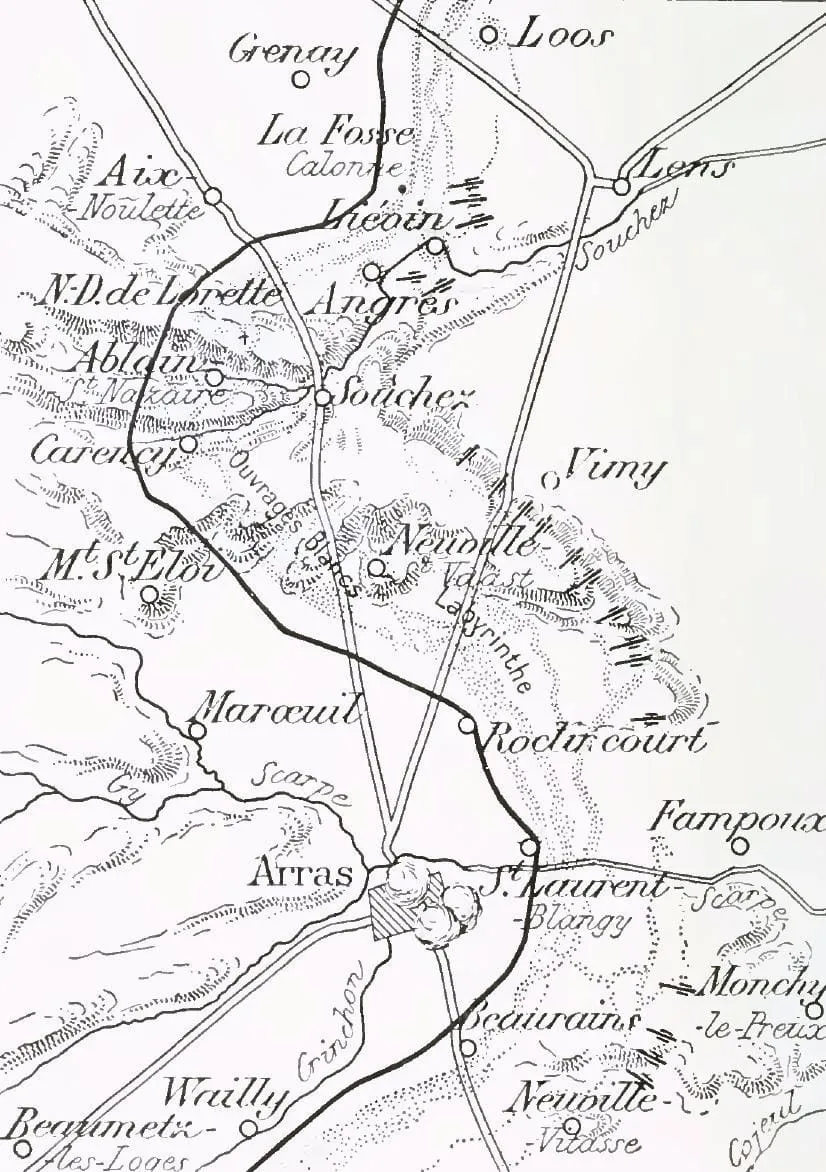
The Second Battle of Artois was the largest Allied offensive on the Western Front in the spring of 1915. On 9 May the French 10th Army of General Victor d’Urbal attacked north of Arras to take Vimy Ridge, from which the Germans had dominated the surrounding country since the autumn of 1914. The same day, further north, the British First Army attacked. On the first day the XXXIII Corps of General Philippe Pétain advanced about four kilometres in less than two hours and its leading units stood on the crest of Vimy Ridge. The reserves, however, were too far away, and the Germans had time to close the breach. Then for more than five weeks the French fought for individual villages, hills and strongpoints. They took the Notre-Dame-de-Lorette spur and several heavily fortified villages, but did not take Vimy Ridge, and the losses on both sides ran into hundreds of thousands of men.
Name and dates
On this page we adopt the dates 9 May – 18 June 1915, following the British chronology of the war on which our timeline is based, and part of the English-language literature. On 18 June the last great attack on Vimy Ridge collapsed and General Ferdinand Foch halted the offensive. French sources end the battle variously: the archives of the Pas-de-Calais department give 19 June, while the French Wikipedia and accounts of the 10th Army’s operations speak of local fighting until 22–25 June, when d’Urbal finally suspended operations.
The name of the battle is not uniform either. In British and Polish literature it is usually the Second Battle of Artois, because the first is the name given to the fighting of the autumn of 1914 or, in some works, to the French attacks at the turn of 1914 and 1915. The French speak of the Battle of Artois of May and June 1915, and the Germans of the Battle of Loretto (Lorettoschlacht), after the Notre-Dame-de-Lorette spur, which was fought over the longest. The British attacks of these weeks, the battles of Aubers Ridge and Festubert, have their own names and we describe them separately.
Background
After the First Battle of Artois in the autumn of 1914 the front settled just east and north of Arras. The Germans held Vimy Ridge, which drops steeply towards the Douai plain, and the eastern part of the Notre-Dame-de-Lorette spur, and at the foot of these heights the fortified villages of Carency, Ablain-Saint-Nazaire, Souchez and Neuville-Saint-Vaast. The French winter attacks in Artois and in Champagne brought no breakthrough, and the British attack at Neuve Chapelle in March showed that the first line could be taken, but that it was hard to go further.
In the spring of 1915 the Germans were moving more and more divisions to the east, where on 1 May their offensive at Gorlice began. The commander-in-chief of the French army, General Joseph Joffre, decided that this had to be exploited and that it would at the same time help the Russians. The detailed plan was prepared by Foch, who commanded the group of armies in the north. The main attack was to be made by the 10th Army, which General d’Urbal had taken over on 2 April. It was reinforced to more than a dozen infantry divisions and given about 780 field guns and 293 heavy guns, far more than in the winter battles. The main blow was to be struck by the three central corps on a front about six kilometres wide, between Carency and La Targette, with Vimy Ridge between Souchez and Farbus as the objective of the first day. Once it was taken, the French were to descend into the Douai plain. North of the La Bassée canal the British First Army of General Douglas Haig was to attack at the same time.
The French, unlike the British, gave up surprise in favour of firepower. The bombardment of the German positions began on 3–4 May and was meant to be slow and methodical. The attack was set for 7 May, but it was postponed twice because of rain and mist. In the end the bombardment lasted six days. Facing the 10th Army were four divisions of the German 6th Army of Crown Prince Rupprecht of Bavaria, from the XIV Corps and the I Bavarian Reserve Corps, in fortifications built throughout the winter.
Course
9 May. From 6 a.m. the French artillery kept up its heaviest bombardment, and at 10 a.m. the infantry went into the attack on a front more than ten kilometres long. In the centre of Pétain’s XXXIII Corps the Moroccan Division of General Ernest Blondlat, with regiments of the Foreign Legion, Algerian tirailleurs and Zouaves, went through all the German lines in a single bound. At about 11 a.m. its leading units reached Hill 140, the highest point of Vimy Ridge, and individual groups went down as far as Givenchy-en-Gohelle and the edge of Petit Vimy on the far side. To their left the 77th Division reached the edge of Souchez, and the 70th Division of General Émile Fayolle broke into the southern part of Carency. To the right the XX Corps took the hamlet of La Targette before noon, captured 350 prisoners and broke into Neuville-Saint-Vaast. In the attack on the German trenches near La Targette and Neuville-Saint-Vaast most of the Polish company of Foreign Legion volunteers, known as the Bayonnais, were killed or wounded.
The success, however, proved too quick. The nearest corps reserves stood at Mont-Saint-Éloi and Acq, about eight kilometres from the ridge, and the army reserves further still. Before they arrived, the Germans brought machine guns and artillery up to the ridge, which caught the French in flanking fire. The French artillery, which was running out of ammunition, could not support them effectively, and the advanced units lost contact with the rear. In the afternoon they withdrew from the ridge to the road running from Souchez to Neuville-Saint-Vaast. The XXXIII Corps alone took about 1,500 prisoners on 9 May. Elsewhere the attack failed. In the south, in front of the heavily fortified trench complex known as the Labyrinth, the XVII and X Corps stalled almost at once under machine-gun fire, and the XXI Corps on the Lorette spur and the IX Corps near Loos gained little. The British attack on Aubers Ridge collapsed within a few hours.
10–15 May. The French tried to renew the attack, but there was no longer any surprise. As early as the night of 9–10 May the Germans moved two reserve divisions from the British front, and by 15 May they had assembled thirteen divisions opposite the 10th Army. On 10 May the commander of the 77th Division, General Ernest Barbot, was mortally wounded. The attack on Hills 140 and 119 on 11 May collapsed, and the exhausted Moroccan Division had to be relieved. On the flank, however, there was progress. On 12 May the 70th Division, after several days of fighting, took Carency, which the Germans had turned into a fortress with underground passages, and captured about a thousand prisoners. The same day the XXI Corps took a strongpoint on the Lorette spur north-east of the ruins of the chapel, and the Germans abandoned most of Ablain-Saint-Nazaire. On 15 May Foch decided to continue the offensive methodically: first to win a suitable starting position, and only then to strike at Vimy Ridge again.
The second half of May and early June. The fighting now resembled a siege. The German artillery, reinforced from 13 May, gained the upper hand over the French, and at the end of May the Germans counter-attacked along the whole front. The French advanced house by house and trench by trench, with grenades and bayonets. According to French sources, on 22 May the XXI Corps secured the Notre-Dame-de-Lorette plateau, and at the end of May the XXXIII Corps took the last houses of Ablain-Saint-Nazaire and, in fighting at the turn of May and June, the sugar refinery near Souchez. On 30 May the assault on the Labyrinth began, which the 53rd Division took three weeks to capture. After eight days of fighting for every house, on 9 June the 5th Division of General Charles Mangin took the rest of Neuville-Saint-Vaast.
16–18 June. After a bombardment of several days, interrupted by feigned preparations for an assault, at about noon on 16 June the 10th Army attacked again on a front about 10 kilometres long, from Souchez to the area south of Neuville-Saint-Vaast. The Moroccan Division again went through the first German lines and came up to the ridge, and the XXI Corps advanced on the Lorette spur towards Angres. On the other sectors the attack was stopped by barrage fire and machine guns, often hidden on the reverse slopes, beyond the observation of the French artillery. German counter-attacks took back much of what had been gained. On 17 June the 53rd Division took the remains of the Labyrinth, but the attacks on the ridge made no progress. After the failed attack of 18 June Foch halted the offensive. D’Urbal carried on local attacks for a few more days, and around 25 June the front stabilised.
Losses
According to French figures, between 9 May and 16 June the 10th Army lost 2,260 officers, of whom 609 were killed, and 100,240 other ranks, including 16,194 killed, 63,619 wounded and more than 20,000 missing, about 102,500 men in all. The British lost about 28,000 in the battles of Aubers Ridge and Festubert. German losses are estimated at 65,000–75,000 men. English-language works, based on German figures, give more than 73,000, and French ones about 65,000 killed, wounded and missing plus several thousand prisoners. By their own figures the French took more than 7,400 prisoners and captured 24 guns and 134 machine guns. According to the French official history the artillery of the 10th Army fired more than 2.6 million shells.
Significance
The French regained a dozen or so square kilometres of ground, including the Lorette spur and several villages that the Germans had considered impregnable. The first day of the battle showed that a long, methodical bombardment could prepare the way for the infantry through the whole zone of German fortifications. It also showed that reaching the objective was not enough: reserves had to be at hand to hold and exploit the gains before the enemy brought up reinforcements. The French command concluded that next time it had to attack on an even wider front and with even more artillery. The autumn offensive in Champagne and the Third Battle of Artois were based on this conviction.
The battle established the reputation of General Pétain, who on 21 June 1915 took command of the 2nd Army. For Poles its symbol is the fate of the Bayonnais. Most of them fell on 9 May near La Targette and Neuville-Saint-Vaast, and their bullet-riddled banner is kept today by the Polish Army Museum. In 1933 a monument to the Polish volunteers was unveiled at La Targette. On the slopes of the Lorette spur the largest French war cemetery was created. Vimy Ridge remained in German hands until April 1917, when the Canadians took it in the Battle of Vimy Ridge.
Spotted a mistake?Report an error
Battles and phases
(02)- 9 May 1915Battle of Aubers RidgeOn 9 May 1915 Haig's British First Army attacked Aubers Ridge to support the French in Artois. In a single day it lost over 11,000 men and gained nothing.
- 15–25 May 1915Battle of FestubertOn 15–25 May 1915 the British First Army renewed its attack in Artois, at night and after a long bombardment. It won a few hundred metres of mud for 16,000 men.