Key event
Second Battle of Artois begins
- Category:
- Military operations
- Front:
- Western Front
- Date:
- 9 May 1915
- Author:
- Łukasz Skowroń
- Battle:
- Second Battle of Artois
- Tags:
- France, Germany, Ferdinand Foch, Arras
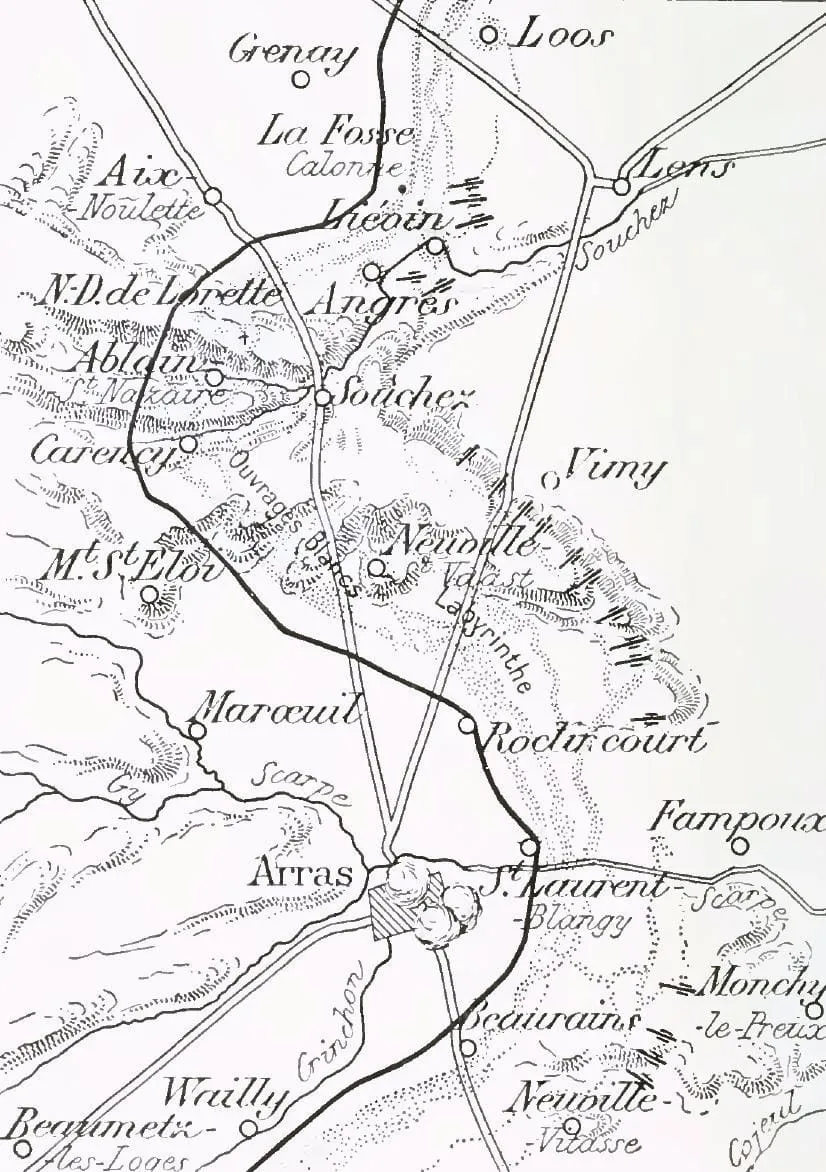
At 10 a.m. on 9 May 1915 the French Tenth Army of General Victor d’Urbal went over to the attack north of Arras. The objective was the heights of Vimy, from which the Germans had been observing the whole area since the autumn of 1914. Thus began the Second Battle of Artois, the largest Allied offensive in the west in the spring of 1915. On the morning of the same day, a few dozen kilometres further north, the British attacked Aubers Ridge. The first hours brought the French a success not seen on the Western Front for months.
Six days of bombardment
The offensive was planned by General Ferdinand Foch, commanding the French armies in the north, on the orders of the commander-in-chief, General Joseph Joffre. The aim was to exploit the moment when the Germans were transferring divisions to the east, where their offensive at Gorlice had been under way for a week, and to help the Russians. The Tenth Army was reinforced to more than a dozen divisions and over a thousand guns, including almost 300 heavy ones. Unlike the British, the French did not count on surprise. For several days their artillery had been methodically destroying the German trenches and wire. The attack was set for 7 May, but rain and mist delayed it twice, so the bombardment lasted six days in all. 9 May dawned fine. At 6 a.m. the fire reached its greatest intensity, and at 10 a.m. the artillery lifted it deeper and the infantry left the trenches.
On Vimy Ridge
The greatest success in the centre was achieved by the XXXIII Corps of General Philippe Pétain. Its Moroccan Division, in which soldiers of the Foreign Legion, Algerian tirailleurs and Zouaves fought, went through all the German lines in one bound. In less than two hours it advanced about four kilometres, and at about 11 a.m. its leading units stood on Hill 140, the highest point of the ridge. Some groups even went down the other side as far as Givenchy-en-Gohelle. Before them lay the open plain of Douai. On their left the 77th Division reached the edge of Souchez, and the 70th Division broke into the fortified village of Carency. On their right XX Corps took the hamlet of La Targette and 350 prisoners before noon, and in the afternoon broke into Neuville-Saint-Vaast, where by evening it had taken half the village.
In the ranks of the Foreign Legion a Polish company of volunteers went into the attack; they were called the Bayonne men because they had trained in Bayonne. It took German trenches near La Targette and Neuville-Saint-Vaast, but lost about three-quarters of its strength. Its French commander, Captain Osmont d’Amilly, was killed.
The breach closed
Success came faster than anyone expected, and that is what undid it. The nearest reserves of Pétain’s corps stood about eight kilometres behind the front line, and the army reserves still further back. The first battalions of Zouaves began to enter the fight only after 3 p.m. Meanwhile the Germans brought machine guns and artillery up to the flanks of the breach and caught the forward units in crossfire. The French artillery was running out of ammunition. In the afternoon the exhausted soldiers of the Moroccan Division had to come down from the ridge and dug in along the road from Souchez to Neuville-Saint-Vaast, roughly halfway from their starting positions. Even so, XXXIII Corps took about 1,500 prisoners and several guns that day.
On the other sectors the attack went worse. On the southern wing, in front of the fortifications known as the Labyrinth, XVII and X Corps were stopped almost at once by the fire of intact machine guns and suffered heavy losses. In the north XXI Corps gained little on the Notre-Dame-de-Lorette spur, and IX Corps, which had broken into Loos, had to withdraw.
The German command reacted quickly. That same night it moved two reserve divisions to Vimy, and more in the following days. There was no longer any surprise. The next day began the bitter fighting for individual villages, hills and strongpoints that was to last more than five weeks.
Remember the articles you have read? Only in this browser; nothing is sent anywhere.How it works
Read ·
Spotted a mistake?Report an error
Meanwhile
(04)Elsewhere in the same days.
- 9 May 1915 · DiplomacyWilson on the sinking of the LusitaniaAfter the Lusitania was sunk President Wilson long kept silent. On 10 May 1915 in Philadelphia he said that a man could be "too proud to fight".
- 9 May 1915 · DiplomacyChina accepts Japan's demandsOn the night of 8–9 May 1915 Yuan Shikai's government accepted the Japanese ultimatum. In China 9 May was named the Day of National Humiliation.
- 8 May 1915 · Eastern FrontBattle of Sanok and Rzeszów beginsOn 8 May 1915 the Russians, driven from the Wisłoka, tried to halt the Central Powers' pursuit on the Wisłok. They were to die in their positions, not retreat.
- 8 May 1915 · Middle EastEnd of the Second Battle of KrithiaOn 8 May 1915 New Zealanders, Australians and French renewed the attack on Krithia. Thousands of killed and wounded bought gains measured in hundreds of metres.
Related events
(04)The same battle, people or subject.
- 18 June 1915 · Western FrontSecond Battle of Artois endsOn 18 June 1915 Foch halted the offensive near Arras. The last attack on Vimy Ridge failed, and the French had lost more than 100,000 men in the battle.
- 25 September 1915 · Western FrontThird Battle of Artois beginsOn 25 September 1915 the French Tenth Army again attacked Vimy Ridge. The left wing reached Souchez, but on the rest of the front the attack broke down.
- 4 October 1914 · Western FrontBattle of Arras endsOn 4 October 1914 Maud'huy considered retreating from Arras, but Joffre forbade it and sent Foch north. Arras was saved, and the Germans took Lens.
- 27 September 1914 · Western FrontFirst Battle of Artois beginsOn 27 September 1914 the Race to the Sea reached Artois. The French and Germans began fighting for Arras, Lens and the heights that shaped the front for years.