France · The Entente
Philippe Pétain
Commander of the Second Army at Verdun (1916), commander-in-chief of the French Army (1917–1918), Marshal of France
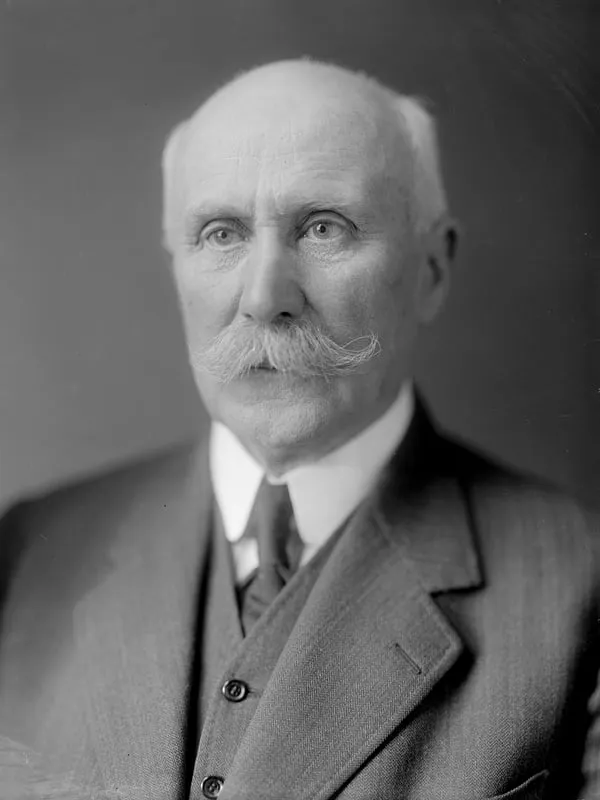
- Born:
- 24 April 1856, Cauchy-à-la-Tour (France)
- Died:
- 23 July 1951, Port-Joinville, Île d’Yeu (France)
- Author:
- Łukasz Skowroń
- Photo:
- Harris & Ewing, domena publiczna, Wikimedia Commons

Philippe Pétain made an unprecedented career during this war. In August 1914 he was a 58-year-old colonel preparing for retirement, because his superiors considered him an officer with no future. Four years later he was a Marshal of France. Before the war he was one of the few critics of the doctrine of the offensive at all costs and he kept repeating that “firepower kills”. The war proved him right. In 1916 he organised the defence of Verdun, and in May 1917, after the failure of the Nivelle Offensive, he took command of an army in which mutinies had broken out, and restored its ability to fight. The soldiers saw in him a commander who did not send them to their deaths needlessly. Politicians and allies accused him of pessimism, and in 1918 he had to yield precedence to Foch. The same authority of the victor of Verdun led him in 1940 to head a state that embarked on collaboration with Germany. That is why his biography is today one of the most painful in France.
Before the war
Henri Philippe Benoni Omer Pétain was born on 24 April 1856 in Cauchy-à-la-Tour in the Pas-de-Calais department, into a peasant family. He lost his mother as an infant and was brought up by relatives. He attended Catholic schools, and in 1876 he entered the military academy at Saint-Cyr. For twenty years he served in battalions of chasseurs à pied, then alternately on staffs and in regiments. He never fought in the colonies.
He was promoted slowly. As an instructor at the musketry school, and later as a lecturer in infantry tactics at the École supérieure de guerre, he opposed the then fashionable doctrine of the offensive to the last. He taught that infantry would not get through the fire of machine guns and guns until the artillery had destroyed the target, and that an attack had to be carefully prepared. According to accounts, when at the 1913 manoeuvres a general ordered the infantry to storm machine-gun positions with the bayonet, Pétain commented on it as a demonstration of mistakes that a modern army could not afford to make. In 1911 he took over the 33rd Infantry Regiment in Arras, in which one of the young officers was Second Lieutenant Charles de Gaulle. In the spring of 1914, still a colonel, he commanded a brigade at Saint-Omer. The ministry refused him promotion to general, and he had already bought a house in which he intended to live in retirement.
1914–1915: from brigade to army
The war changed everything. Pétain’s brigade, part of General Charles Lanrezac’s Fifth Army, fought in Belgium and during the retreat, and on 29 August took part in the counter-attack at Guise. Joffre ruthlessly removed incompetent commanders and looked for new ones. On 31 August Pétain became a brigadier general and took over the 6th Infantry Division, with which he fought on the Marne. In October he was given XXXIII Corps in Artois.
On 9 May 1915, the first day of the Second Battle of Artois, Pétain’s corps, with the Moroccan Division in the lead, advanced about four kilometres in less than two hours and reached Vimy Ridge. It was the greatest success of the French infantry since the Marne, but the reserves were too far back and the Germans recovered the ridge. Pétain drew the conclusion that a breakthrough in a single blow was an illusion, and that the war would be won by a series of carefully prepared attacks with limited objectives. On 21 June 1915 he took over the Second Army. In the September offensive in Champagne, according to French sources, he obtained a postponement of the attack in order to prepare it better, and when losses mounted he broke off attacks that had no chance of success. His reputation as a cautious, methodical commander who spared his soldiers was already established by then.
Verdun
On 21 February 1916 the Germans struck at Verdun. Within a few days they took the first positions and Fort Douaumont. Joffre’s chief of staff, General Noël de Castelnau, decided to defend the right bank of the Meuse and sent there the Second Army, which was in reserve. Pétain, summoned to Chantilly on the morning of 25 February, took command of the defence during the night of 25–26 February. According to a popular story, a staff officer found him at night in a Paris hotel, with a woman whom Pétain later married. In his first days in command he fell ill with pneumonia and directed the defence from his bed.
Pétain quickly restored order. He divided the front into sectors, forbade fruitless counter-attacks on Douaumont, had the forts reoccupied and rearmed, and concentrated the artillery so that it could strike the attackers from both banks of the Meuse. The most important thing was supply. Verdun was linked to the rear only by a narrow-gauge railway and the road to Bar-le-Duc. Pétain organised on it an unbroken flow of lorries, which day and night carried soldiers, ammunition and food. The writer Maurice Barrès called this road the Sacred Way (Voie Sacrée). Pétain also introduced a rotation of divisions, called the noria: instead of keeping them under fire until they bled to death, he relieved them after a short period of fighting. In this way most of the French Army passed through Verdun, and Verdun became a shared experience of a whole generation. On 10 April he ended his order of the day with the words “Courage… on les aura!” (“Courage… we’ll get them!”).
Joffre was increasingly dissatisfied. He wanted to save divisions for the offensive on the Somme, while Pétain constantly demanded reinforcements and was in no hurry to counter-attack. At the beginning of May 1916 the commander-in-chief promoted him to command Army Group Centre and gave the Second Army to the energetic General Robert Nivelle. Pétain remained responsible for Verdun, but the battle was directed by Nivelle and General Charles Mangin, who in the autumn retook Fort Douaumont and Vaux. It was they who reaped the laurels. The French historian Marc Ferro wrote that two traditions of Verdun arose: that of the commanders and politicians, who attributed the victory to Nivelle, and that of the soldiers, who knew only Pétain.
In December 1916 the government of Aristide Briand, looking for a successor to Joffre, passed over Pétain. Both the prime minister and President Raymond Poincaré considered him too cautious a pessimist and chose Nivelle, who promised to break through the front within two days. At the conference at Compiègne on 6 April 1917 Pétain argued for an attack with limited objectives.
1917: the mutinies
The Nivelle Offensive on the Aisne, launched on 16 April 1917, brought gains, but no breakthrough, and enormous losses. The Minister of War, Paul Painlevé, who had long preferred Pétain, on 29 April made him chief of the general staff and adviser to the government, and on 15 May commander-in-chief of the French armies. Pétain took over the army at the moment when mutinies were spreading through it. Soldiers of several dozen divisions refused to go up to the front line, although they agreed to defend the trenches. They demanded leave, better food and an end to senseless attacks, and in some units also peace.
Pétain acted on two fronts. On 19 May he issued a directive in which he stated that breaking through the front was “for the time being” impossible, and announced only attacks with limited objectives, prepared by artillery. He improved the leave system, food and billets for units at rest, toured the divisions and talked to the soldiers. At the same time he did not shrink from severity. According to research by the French historian Guy Pedroncini, courts martial sentenced more than 3,400 soldiers in connection with the mutinies, 554 of them to death, but about 50 sentences were carried out. By August the army had calmed down, and the Germans did not learn in time of the scale of the crisis. The burden of the fighting in 1917 passed to the British.
Pétain did not intend to wait idly for long. It was said that he was waiting “for the tanks and the Americans”: for the Renault FT light tanks and for the army of the United States, whose commander, General John Pershing, he received at his headquarters in June 1917. In August General Adolphe Guillaumat’s Second Army, in the offensive at Verdun, recovered Mort-Homme and Hill 304, and in October the Sixth Army took Malmaison and drove the Germans off the Chemin des Dames. Both operations, carefully prepared and supported by powerful artillery, brought large gains at moderate cost and restored the army’s self-confidence. In December Pétain ordered the preparation of defence in depth: the front line was to be held by weak forces, and the main battle was to be fought further back, beyond the range of the German artillery.
1918: in Foch’s shadow
On 21 March 1918 the Germans struck at the British in Picardy (Operation Michael). Pétain sent successive divisions to help, but during the night of 24–25 March at Dury near Amiens he told Haig that in the event of a further advance his troops would fall back to the south-west to cover Paris. Haig feared that the Allied armies would be separated. Clemenceau then remembered Pétain’s words that the Germans would beat the English in the open field and then beat the French too, and asked the President whether a general ought to speak like that. At the Doullens Conference on 26 March the coordination of Allied operations was entrusted to Ferdinand Foch, and in April Foch became Allied commander-in-chief. Pétain agreed to this at once, although from then on he had to carry out Foch’s directives. On the evening of 26 March he cancelled his orders for a retreat and sent further divisions to the defence of Amiens.
On 27 May the Germans broke through the French front on the Aisne and reached the Marne. The defeat is attributed above all to the fact that the commander of the Sixth Army, General Denis Duchêne, kept his troops in the front line, contrary to Pétain’s directives, but in Paris the politicians demanded the head of the commander-in-chief as well. In the summer the government, according to French studies, took away his right to appeal against Foch’s decisions. On 15 July in Champagne the last German offensive broke against the defence in depth organised by General Henri Gouraud’s Fourth Army in accordance with Pétain’s method. Three days later Mangin’s counter-offensive began. Pétain wanted to postpone it further, but Foch countermanded his order. From August the French armies under his command took part in the offensive that pushed the Germans back towards the frontier. In August, when Foch received his marshal’s baton, Pétain received only the Médaille militaire.
In the autumn Pétain was preparing a great Franco-American offensive in Lorraine, set for 14 November. He considered the armistice of 11 November premature. On 19 November, as he watched the troops entering Metz, he learned that he would become a marshal. The decree was issued on 21 November, and on 8 December in Metz President Poincaré presented him with the baton.
After the war
From 1920 to 1931 Pétain was vice-president of the Supreme War Council, that is, the designated commander-in-chief in the event of war, and the most important soldier in France. In 1920 he married Eugénie Hardon. In 1925 he commanded the French forces in the Rif War in Morocco. He supported the construction of fortifications on the eastern frontier, from which the Maginot Line grew, and in 1934 he was Minister of War. In 1929 he was elected to the Académie française.
In May 1940, during the German invasion, the 84-year-old marshal joined the government, and on 16 June he became prime minister and asked the Germans for an armistice. On 10 July parliament gave him full powers. As head of the French State based at Vichy, he pursued a policy of collaboration with Germany, and his government introduced anti-Jewish laws and took part in the deportation of Jews. In 1945 a court sentenced him to death for treason, a sentence that General de Gaulle, his former subordinate, commuted to life imprisonment. Pétain died in prison on the island of Yeu on 23 July 1951, at the age of 95, and was buried there.
Assessment
Pétain was one of the most outstanding French commanders of this war. Historians such as Robert Doughty and Guy Pedroncini credit him with a better understanding of positional warfare than most generals had: of the importance of artillery, supply, defence in depth and the soldiers’ morale. At Verdun he organised a defence that withstood the heaviest attack of the war, and in 1917 he saved the army from disintegration without shedding as much blood as repression might have shed. His attacks in the second half of 1917 and his defence in depth in 1918 were among the finest achievements of the French Army.
Critics point to the darker side of his character. Clemenceau found his pessimism unbearable, and the crisis of March 1918 showed that at a moment of danger he thought above all of the French Army and Paris, and less of Allied unity. Foch was bolder, and it was he who led the offensive that ended the war. Many historians see in the defeatism of 1918 a foreshadowing of his attitude in 1940. Charles de Gaulle summed up his life by saying that it had been successively banal, glorious and deplorable, but never mediocre. In France the two halves of this biography, Verdun and Vichy, are still hard to reconcile.
Sources
Spotted a mistake?Report an error
Commanded in battles
(18)- 9 May – 18 June 1915Second Battle of ArtoisWestern Front
- 25 September – 6 November 1915Second Battle of ChampagneWestern Front
- 21 February – 18 December 1916Battle of VerdunWestern Front
- 24 October – 18 December 1916First Offensive Battle of VerdunWestern Front
- 16 April – 9 May 1917Nivelle OffensiveWestern Front
- 17 April – 20 May 1917Third Battle of ChampagneWestern Front
- 20 August – 15 December 1917Second Offensive Battle of VerdunWestern Front
- 23 October – 1 November 1917Battle of La MalmaisonWestern Front
- 21 March – 5 April 1918Operation MichaelWestern Front
- 25–26 March 1918Battle of NoyonWestern Front
- 27 May – 6 June 1918Third Battle of the AisneWestern Front
- 9–14 June 1918Battle of the MatzWestern Front
- 15 July – 6 August 1918Second Battle of the MarneWestern Front
- 20–31 July 1918Battle of the TardenoisWestern Front
- 23 July – 2 August 1918Battle of the Soissonnais and of the OurcqWestern Front
- 8 August – 11 November 1918Hundred Days OffensiveWestern Front
- 17–29 August 1918Second Battle of NoyonWestern Front
- 26 September – 11 November 1918Meuse–Argonne offensiveWestern Front
Mentioned in battles
(06)Often appears with
People who appear in the same events.
On the timeline
(60)The 40 most important of 60 events. All tagged “Philippe Pétain” (15) →
1915
1916
1917
March
April
May
- 03
- Key eventThird Battle of the Scarpe beginsAt 3.45 a.m. on 3 May 1917, still in darkness, three British armies struck again at Arras. They failed almost everywhere. Only the Canadians succeeded.
- Key eventStart of the French Army mutiniesOn 3 May 1917 near Soissons about 1,000 men of the 2nd Colonial Division shouted "Down with the war!". After Nivelle's defeat, mutinies swept the army.
- 04
- French retake CraonneOn 4 May 1917 the French 36th Division took the ruins of Craonne and broke onto the Californie plateau, one of the last successes of the Nivelle offensive.
- Third Battle of the Scarpe endsOn 4 May 1917 the British pulled the last troops out of the failed Scarpe attack. In Paris Haig and the French agreed the time for a breakthrough had passed.