United Kingdom · The Entente
David Lloyd George
Chancellor of the Exchequer (1908–1915), Minister of Munitions (1915–1916), Secretary of State for War (1916), Prime Minister of the United Kingdom (1916–1922)
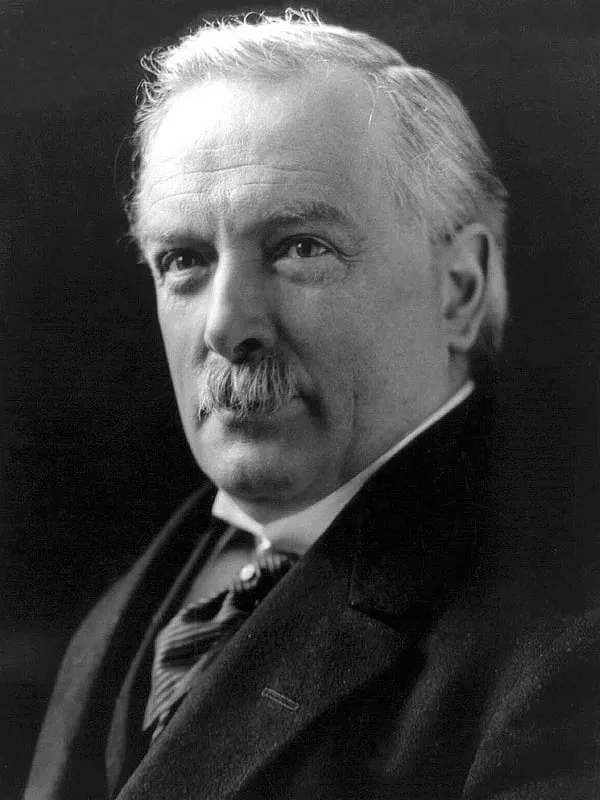
- Born:
- 17 January 1863, Manchester (England)
- Died:
- 26 March 1945, Llanystumdwy (Wales)
- Author:
- Łukasz Skowroń
- Photo:
- Harris & Ewing, domena publiczna, Wikimedia Commons

David Lloyd George was the most dynamic British politician of the First World War and stood in the front rank of its leaders throughout. A radical Liberal and Welsh solicitor, known before the war for social reform and a dislike of armaments, in 1915 he built the Ministry of Munitions from scratch, in 1916 he succeeded Kitchener at the War Office, and in December of that year he pushed Herbert Henry Asquith from power and took over the government. As Prime Minister he created a small War Cabinet, forced convoys on the admirals and a unified command on the allies. All the while, however, he was in conflict with his own generals, Douglas Haig and William Robertson, whose strategy he distrusted but whom he could not, or dared not, dismiss. He won the war, but broke his own party in the process.
Before the war
He was born on 17 January 1863 in Chorlton-on-Medlock, a district of Manchester, into the family of a Welsh schoolmaster. His father died when David was little more than a year old, and his mother returned with the children to her home village of Llanystumdwy in north Wales. He was brought up by his uncle, a shoemaker, lay preacher and ardent Liberal. Welsh was the future Prime Minister’s first language. Lloyd George became a solicitor, and in 1890, aged 27, he entered the House of Commons for Caernarvon Boroughs, which he represented for 55 years. He made his name as a champion of Welsh distinctiveness, an enemy of the Anglican Church and the great landowners, and, during the Boer War, as a bold critic of the war whom a crowd in Birmingham very nearly harmed.
In 1905 he became President of the Board of Trade, and in 1908 Chancellor of the Exchequer in Asquith’s government. His “People’s Budget” of 1909, which raised taxes on the richest to pay for pensions and the navy, provoked a war with the House of Lords and a constitutional crisis. In 1911 he carried the National Insurance Act. That same year, during the Agadir crisis (PL), he gave a speech at the Mansion House warning Germany that Britain would not allow herself to be treated as a power of no account. In 1913 the Marconi share scandal very nearly destroyed him. From 1913 his secretary and long-time partner was Frances Stevenson, whose diary is an important source for the history of the war.
1914–1915: the Treasury and munitions
In July 1914 Lloyd George did not believe in war. As late as 23 July he told the House of Commons that relations with Germany were better than they had been for years. In the divided Cabinet he was among the waverers, and many hoped he would lead the opponents of intervention. The German ultimatum to Belgium decided the matter: the defence of a small nation gave him and many Liberals a principle in whose name they could support the war. Only two ministers resigned, and Britain declared war as a united country. In September Lloyd George gave a celebrated speech at the Queen’s Hall in London on the rights of small nations.
As Chancellor of the Exchequer he mastered the financial panic of the first days of the war by declaring a moratorium, and in November he presented the first war budget, which doubled income tax. In February 1915 in Paris he agreed with the French and Russian ministers on the joint financing of the war. He soon went beyond his own department, however. From the beginning of 1915 he argued in memoranda that instead of banging their heads against a wall on the Western Front the Allies should strike at Germany’s weaker allies, for example in the Balkans, and he supported the plan to attack the Dardanelles. Above all he warned that the army did not have enough shells. In March 1915 he negotiated with the trade unions the renunciation of strikes and of some craft rules in the munitions industry, and in the spring he campaigned against drunkenness among workers, arguing that Britain was fighting Germany, Austria and drink. He even persuaded King George V to give up alcohol as an example.
In May 1915 the shell crisis and the resignation of Lord Fisher led to the formation of a coalition government, and Lloyd George became head of the new Ministry of Munitions. He started in an empty house in Whitehall Gardens with two tables and a chair. He brought industrialists and engineers into the ministry, divided the country into munitions areas, and the act of 2 July gave him power over factories working for the army. Within a year the ministry became the largest buyer, seller and employer in the country. Historians point out that part of the rise in output came from orders already placed by the War Office, but it was Lloyd George who won fame as the man who gave the army its shells. In the autumn of 1915 he came out in favour of conscription, which estranged him from many Liberals, and in January 1916 Parliament passed the first conscription act.
Secretary for War
After Kitchener’s death Lloyd George took over the War Office in July 1916. It was, however, a curtailed office: since December 1915 the government’s sole adviser on strategy had been the Chief of the Imperial General Staff, General William Robertson. The new minister could only look on as the Battle of the Somme consumed hundreds of thousands of men. In September, visiting the front, he questioned General Ferdinand Foch as to why the British were losing more men than the French, which Haig regarded as disloyalty. At the same time, at the end of September, he declared in an interview with the American journalist Roy Howard that the war must be fought to a knock-out, a reply to President Woodrow Wilson’s ideas of mediation.
In the autumn of 1916 Lloyd George concluded that Asquith’s government would lose the war. Together with the Conservative leader Andrew Bonar Law and Edward Carson he demanded that the war be directed by a small council under his chairmanship. After a week of disputes, compromises and leaks to the press, Asquith resigned, and on 7 December 1916 Lloyd George became Prime Minister. He governed with the support of the Conservatives, the Labour Party and part of the Liberals, as most of his party’s leading politicians stayed with Asquith.
Prime Minister: the War Cabinet and Nivelle
The new Prime Minister changed the way the country was governed. The war was directed by a five-member War Cabinet that met almost daily, and its secretariat under Maurice Hankey for the first time kept minutes and saw that decisions were carried out. New ministries of shipping, food, labour and national service were created, often headed by businessmen from outside politics. From March 1917 an Imperial War Cabinet met in London with the dominion prime ministers. In his first speech as Prime Minister he rejected the German peace offer, saying that to accept it without knowing the terms would be to put one’s head into a noose.
The Conservatives insisted, however, that Haig remain in his post, and the Prime Minister had to look for other ways. Captivated by the new French commander, General Robert Nivelle, who promised to break through the front in two days, at the Calais conference in February 1917 he tried to subordinate Haig to him, without the generals’ knowledge. It ended in a compromise for the duration of the spring offensive, but the Nivelle offensive collapsed, and Haig and Robertson never trusted the Prime Minister again.
Convoys and Passchendaele
In the spring of 1917 the greatest danger was the submarine war. In April German U-boats sank more than 800,000 tons of shipping, and the Admiralty under Admiral John Jellicoe considered convoys impracticable. Lloyd George, won over to them by Hankey and some younger officers, went to the Admiralty on 30 April. According to his memoirs, it was this visit that broke the admirals’ resistance. Naval historians see it more cautiously, as the admirals were already changing their minds, but the convoy system was introduced over the following months, and losses began to fall. In December 1917 the Prime Minister secured Jellicoe’s removal.
In the summer of 1917 Haig argued that an offensive in Flanders could clear the Belgian coast and break the Germans. The Prime Minister preferred to wait for the Americans or to send guns to Italy, but he could persuade neither Haig and Robertson nor most of the Cabinet. In July the War Policy Committee reluctantly agreed to the attack, on condition that it did not turn into a second Somme. The Third Battle of Ypres bogged down in the mud and cost the British Army, by various estimates, between 245,000 and 275,000 killed, wounded and missing. The Prime Minister could have stopped it but did not. Hankey even recorded a suspicion that he let it go on in order to discredit the generals. Lloyd George later called it in his memoirs one of the greatest disasters of the war and never forgave Haig for it.
The Supreme War Council and war aims
The Italian defeat at Caporetto gave him his opportunity. At the Rapallo conference on 7 November 1917 the Allied Supreme War Council was set up, and its British military representative was General Henry Wilson, a friend of Foch and a rival of Robertson. On 12 November in Paris the Prime Minister gave a speech in which he spoke ironically of “victories” bought at enormous cost and confessed that, looking at the casualty lists, he sometimes wished it had not been necessary to win so many of them. It caused a storm in London, but the government survived the debate. In December Lloyd George was able to announce the capture of Jerusalem, which he had wanted as a Christmas present. His government also issued the Balfour Declaration, of which the Prime Minister was an ardent supporter.
On 5 January 1918, at a trade union conference in Caxton Hall, he set out the war aims: the restoration of Belgium, Serbia and Romania, the return of Alsace and Lorraine, an independent Poland and a league of nations, but with no intention of destroying Germany. Three days later President Wilson announced a similar programme in his Fourteen Points. At the beginning of 1918 Lloyd George also restricted the flow of soldiers to France so that Haig could not start a new offensive. When Robertson opposed placing an Allied reserve in the hands of the council at Versailles, the Prime Minister, against the wishes of the King and part of the press, removed him and replaced him with Henry Wilson.
1918: crisis and victory
On 21 March 1918 the Germans struck on the Somme, and the British Army fell back several dozen kilometres. Critics accused the Prime Minister of having weakened the front by holding back reinforcements. Lloyd George acted quickly, however: he sent Lord Milner to France, who at the Doullens conference agreed to entrust the coordination of the armies to Foch; within a few weeks he moved hundreds of thousands of soldiers across the Channel from home; and he asked Wilson to hasten the arrival of the Americans. The April Military Service Act extended conscription to Ireland, which never came into force but drove the Irish into the arms of Sinn Féin.
In May General Frederick Maurice accused the Prime Minister, in a letter to the press, of having misled Parliament about the strength of the army in France. On 9 May Asquith demanded a select committee of inquiry, but Lloyd George replied with one of his finest speeches and the motion was defeated by 293 votes to 106. Historians now believe that the Prime Minister used inaccurate War Office figures, but politically he won. In the summer the Allied armies went over to the offensive, and in the autumn Lloyd George came down with Spanish flu. On 11 November the Armistice of Compiègne was signed. The Prime Minister announced it in the House of Commons, and in the election of 14 December 1918 his coalition won a crushing victory. Most of the seats, however, went to the Conservatives, and Asquith’s Liberals were routed.
After the war
In 1919 Lloyd George was one of the Big Three at the peace conference in Paris, alongside Wilson and Clemenceau. In the Fontainebleau memorandum he warned against too harsh a peace and resisted giving Danzig to Poland, although in the election campaign his coalition had promised that Germany would pay for the whole war. In 1921 he concluded the treaty with the Irish that gave rise to the Irish Free State. His support for Greece in the war with Turkey ended in the Chanak crisis, and in October 1922 the Conservatives broke up the coalition and the Prime Minister resigned. He never returned to power, although from 1926 to 1931 he led the reunited Liberals. Between 1933 and 1936 he published his six-volume “War Memoirs”, which sharply attacked Haig and Robertson. At the beginning of 1945 he was created Earl Lloyd-George of Dwyfor. He died on 26 March 1945 at Llanystumdwy.
Assessment
For many contemporaries he was “the man who won the war”. Historians credit him with achievements that even his critics do not deny: energy, boldness in bringing in experts from outside politics, the expansion of munitions production, convoys, more efficient government and a unified Allied command. His biographer John Grigg, author of a four-volume biography, rated Lloyd George’s war leadership very highly.
The dispute concerns above all his relations with the generals. Haig’s defenders, such as John Terraine, accused him of undermining the commanders while having no better strategy of his own, of concealing his intentions from them and, in the spring of 1918, of very nearly bringing about defeat by holding back reinforcements. The generals’ critics reply that it was precisely his distrust that saved hundreds of thousands of men from further offensives in the style of the Somme and Passchendaele. Most historians agree that a Prime Minister who distrusted his commanders and yet did not bring himself to remove them bears part of the responsibility for Passchendaele. His memoirs, written years later to prove himself right, also raise doubts. The most lasting price of his victory was the split in the Liberal Party, which after 1918 never regained its former position.
Sources
Spotted a mistake?Report an error
Mentioned in battles
(09)Often appears with
People who appear in the same events.
On the timeline
(113)The 40 most important of 113 events. All tagged “David Lloyd George” (59) →
1911
1914
1915
January
February
March
May
June
July
- 02
- Munitions of War ActOn 2 July 1915 the British Munitions of War Act came into force. It banned strikes in the armaments industry and placed factories under state control.
- Ministry of MunitionsFrom 2 July 1915 Lloyd George's Ministry of Munitions, at work for a few weeks, could take control of factories and direct workers to jobs.