Key event
Foch becomes Allied commander-in-chief
- Category:
- Military
- Front:
- Western Front
- Date:
- 14 April 1918
- Author:
- Łukasz Skowroń
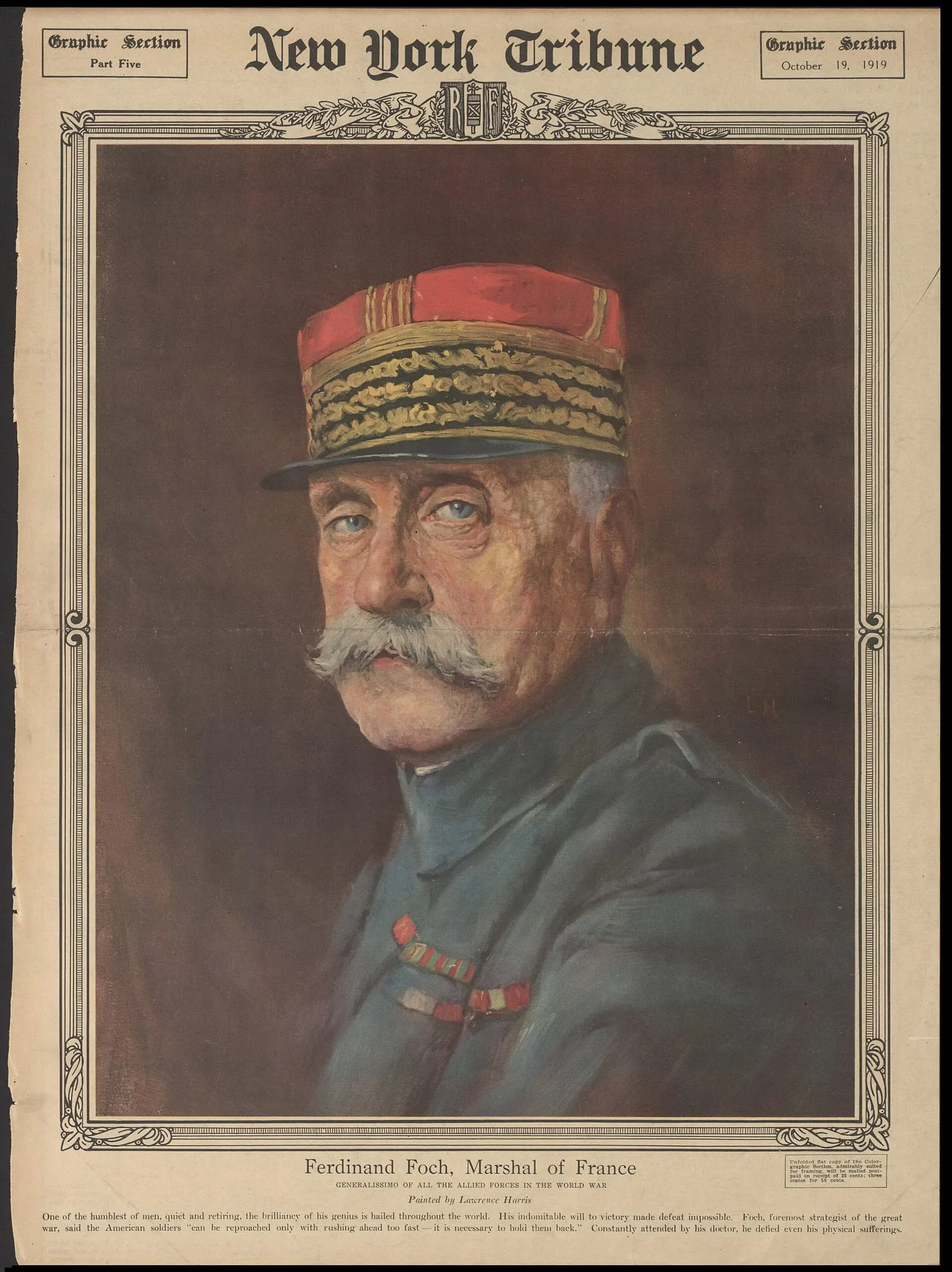
On 14 April 1918 General Ferdinand Foch received the title of “commander-in-chief of the Allied armies in France” (Général en chef des Armées alliées en France). The French and British governments agreed on it in an exchange of letters, without a new conference. The title gave Foch no new powers, but it gave a name to what had been slowly taking shape for three weeks: after almost four years of war the Allied armies on the Western Front had a common commander. That same day Foch exercised his authority in a way the British found painful. At a meeting at Abbeville he refused Field Marshal Douglas Haig relief for the exhausted British divisions which had been holding out for five days against the German offensive in Flanders.
From Doullens to Beauvais
The road to this title began at the moment of greatest danger. After the British front on the Somme was broken on 21 March, the French Prime Minister Georges Clemenceau and the British minister Lord Alfred Milner signed an agreement at Doullens on 26 March entrusting Foch with coordinating the action of the Allied armies. Foch, however, could only advise and persuade. On 3 April at Beauvais the British, French and American governments gave him “the strategic direction of military operations”. The commanders-in-chief, Haig, General Philippe Pétain and General John Pershing, retained control of the tactical employment of their armies and the right to appeal to their own governments.
The British had long resisted the idea of a common commander. As late as November 1917 Prime Minister David Lloyd George assured the House of Commons that he was firmly opposed to it. On 9 April 1918, defending the Doullens and Beauvais agreements in Parliament, he explained that a generalissimo in the full sense of the word was unthinkable. Such a commander would have strategic, tactical and administrative authority, and the last of these, the right to appoint and dismiss generals, could not be entrusted to a foreigner at the head of a national army. He nevertheless called unity of strategic direction a fundamental condition of victory.
The title
According to the British official history, a suitable title for Foch was agreed by correspondence, and from 14 April he bore the style “Général en chef des Armées alliées en France”. In English it was usually rendered as “General-in-Chief”, because the term “Commander-in-Chief” was used by Haig himself as commander-in-chief of the British forces in France. The next day Haig learned from London that Foch’s new title “in no way alters your mutual relations” as previously laid down. Pétain remained commander-in-chief of the French army, and Pershing of the American.
Foch’s authority did not extend to the Belgian army. King Albert I personally commanded his troops and under the Belgian constitution could not place them under the orders of a foreign general. Foch could only make requests of the Belgians. That same day he asked the chief of staff of the Belgian army, General Gillain, to prepare to extend the Belgian front southwards, as far as Ypres, when General Herbert Plumer’s British Second Army withdrew from its forward positions east of the town. The Belgians agreed to cooperate with the British. The Italian front also remained outside Foch’s authority for the time being.
The Abbeville meeting
Meanwhile the news from Flanders was bad. On 9 April the Germans attacked on the river Lys, broke the front of the Portuguese Corps and within a few days took Armentières, Merville and a large part of the plain in front of the railway junction of Hazebrouck. In an order of the day dated 11 April Haig wrote that his soldiers were fighting with their backs to the wall. The British divisions, most of them still worn out by the battle on the Somme, were melting away, and the distance separating the Germans from Calais and Dunkirk was shrinking. Foch sent north a cavalry corps and two infantry divisions under General Robillot, and the French Tenth Army of General Paul Maistre was marching to the Doullens area. For Haig this was not enough.
On Sunday 14 April, at 11 a.m., Haig, his chief of staff General Herbert Lawrence, Foch, his chief of staff General Maxime Weygand, the head of the British liaison mission to Foch, General John Du Cane, and Lord Milner, who had come over from England specially, met at Abbeville. Haig presented a note from his staff and explained that because of heavy losses the British divisions were vanishing before his eyes, and the remaining soldiers were utterly tired. The German reserves were intact, the British exhausted. The French reserves, meanwhile, stood too far away to stop the Germans if they made for Calais. Haig was convinced that the German high command intended to decide the war by destroying the British army.
Foch replied by recalling the tenacity with which the British had defended themselves at Ypres in October and November 1914. He categorically refused to relieve troops in the middle of a battle. Such an operation would immobilise both the relieving and the relieved units for several days, at a time when reserves were barely sufficient. The French reserves, positioned so that they could move wherever the Germans struck, would be badly used if they got stuck in Flanders, and the enemy could attack at any point on the front. Finally, to the astonishment of those present, he declared: “La bataille d’Hazebrouck est finie” (the Battle of Hazebrouck is over).
Before the end of the meeting Haig wrote out his demands by hand and handed them to Foch. He asked for four divisions of the Tenth Army to be moved to the Béthune–Lillers line, with General Micheler’s Fifth Army troops behind them, so that they could support the British along the whole sector from Hazebrouck to the Somme. In the evening Foch replied that one division of the Tenth Army would be placed north of Frévent, from where it could reach a threatened sector within a day if necessary, and that a suitable place was being sought for a second. Haig answered in writing that he considered these steps insufficient and demanded the further transfer of French troops to the Cassel area, because the Germans were throwing fresh divisions from their reserve into the battle.
The next morning Foch explained his reasoning to Clemenceau and Milner. According to his intelligence the Germans had 48 divisions in reserve, more than before the start of the offensive in Flanders, and could strike at short notice anywhere between Noyon and Arras. He considered the sector between Montdidier and the river Luce particularly threatened, since German divisions stood thickly there and had not begun to dig in. The British official history admits that Foch’s decision cost the British army many lives and its commanders many anxious hours, but judges that his appreciation of the situation and his resistance to very strong pressure command admiration. The British front was bent but not broken, and since the Portuguese had left the line on 9 April the Germans had been advancing slowly.
Significance
Foch was not a generalissimo in the full sense of the word. He could not appoint or dismiss generals of foreign armies, and every commander-in-chief could appeal against his orders to his own government. His authority rested on trust and on the fact that he controlled the French reserves. The dispute at Abbeville showed, however, that he did not intend to be merely a supplier of reinforcements to whoever asked for them most loudly. He wanted to husband his reserves for a future counter-offensive and to throw them in where the fate of the whole front was being decided. In the very next days, as the Germans approached the hills of Flanders, French divisions began to take over British sectors near Kemmel.
Foch’s powers gradually grew. On 2 May, at a session of the Supreme War Council at Abbeville, his coordinating authority was extended to the Italian front as well, although the Italian Prime Minister Vittorio Emanuele Orlando would not agree to hand him command of the Italian army. In the summer, when the Allies went over to the offensive, Foch received the baton of a Marshal of France, and in the autumn he led the Allied armies to victory.
Remember the articles you have read? Only in this browser; nothing is sent anywhere.How it works
Read ·
A voice from the front
“We come back by way of Sarcus, where General Foch has his headquarters. He is in very good form; he saw Clemenceau and Lord Milner today at Beauvais. He is pleased to be recognised as commander-in-chief of the Allied armies, but he would like an official investiture and a letter of command, and he is right. Haig has completely stepped aside before him.”
Translated · Original (fr)
Nous revenons par Sarcus où est installé le général Foch. Il est en très bonne forme ; il a vu Clemenceau et lord Milner aujourd’hui à Beauvais. Il est satisfait d’être reconnu général en chef des armées alliées, mais il voudrait avoir une investiture officielle et une lettre de commandement, et il a raison. […] Haig s’est complètement effacé devant lui.
Spotted a mistake?Report an error
Meanwhile
(04)Elsewhere in the same days.
- 14 April 1918 · DiplomacyCzernin resignsOn 14 April 1918 Count Ottokar Czernin resigned as foreign minister of Austria-Hungary. He was brought down by the Sixtus affair, which he himself had set off.
- 13 April 1918 · Military operationsGermans take HelsinkiOn 12–13 April 1918 the Baltic Division took Red Helsinki after street fighting. The White government declared the Germans had come to Finland at its request.
- 15 April 1918 · War at seaSecond Kattegat raidOn 15 April 1918 British light forces again broke into the Kattegat and sank ten German armed trawlers. Their crews were rescued.
- 12 April 1918 · PoliticsUnited Baltic dietsOn 12 April 1918 in Riga a united council of Livonia and Estonia, dominated by Baltic Germans, asked for a monarchy in personal union with Prussia.
Related events
(04)The same battle, people or subject.
- 3 February 1918 · DiplomacySupreme War Council's powers extendedAt their Versailles session the Allies decided to create a general reserve under a committee headed by Foch. The committee first met on 3 February 1918.
- 26 March 1918 · Western FrontDoullens conferenceOn 26 March 1918, in the town hall at Doullens, the French and British entrusted General Foch with coordinating the Allied armies on the Western Front.
- 3 April 1918 · Western FrontBeauvais ConferenceOn 3 April 1918 at Beauvais the French, British and US governments gave General Foch the strategic direction of operations on the Western Front.
- 17 April 1918 · Western FrontStart of the First Battle of Mount KemmelOn 17 April 1918 the Germans attacked the Flanders hills near Kemmel and the Belgians at Merkem. British, Australians, French and Belgians beat off the attacks.