Key event
Start of the Battle of the Lys
- Category:
- Military operations
- Front:
- Western Front
- Date:
- 9 April 1918
- Author:
- Natalia
- Battle:
- Battle of Estaires
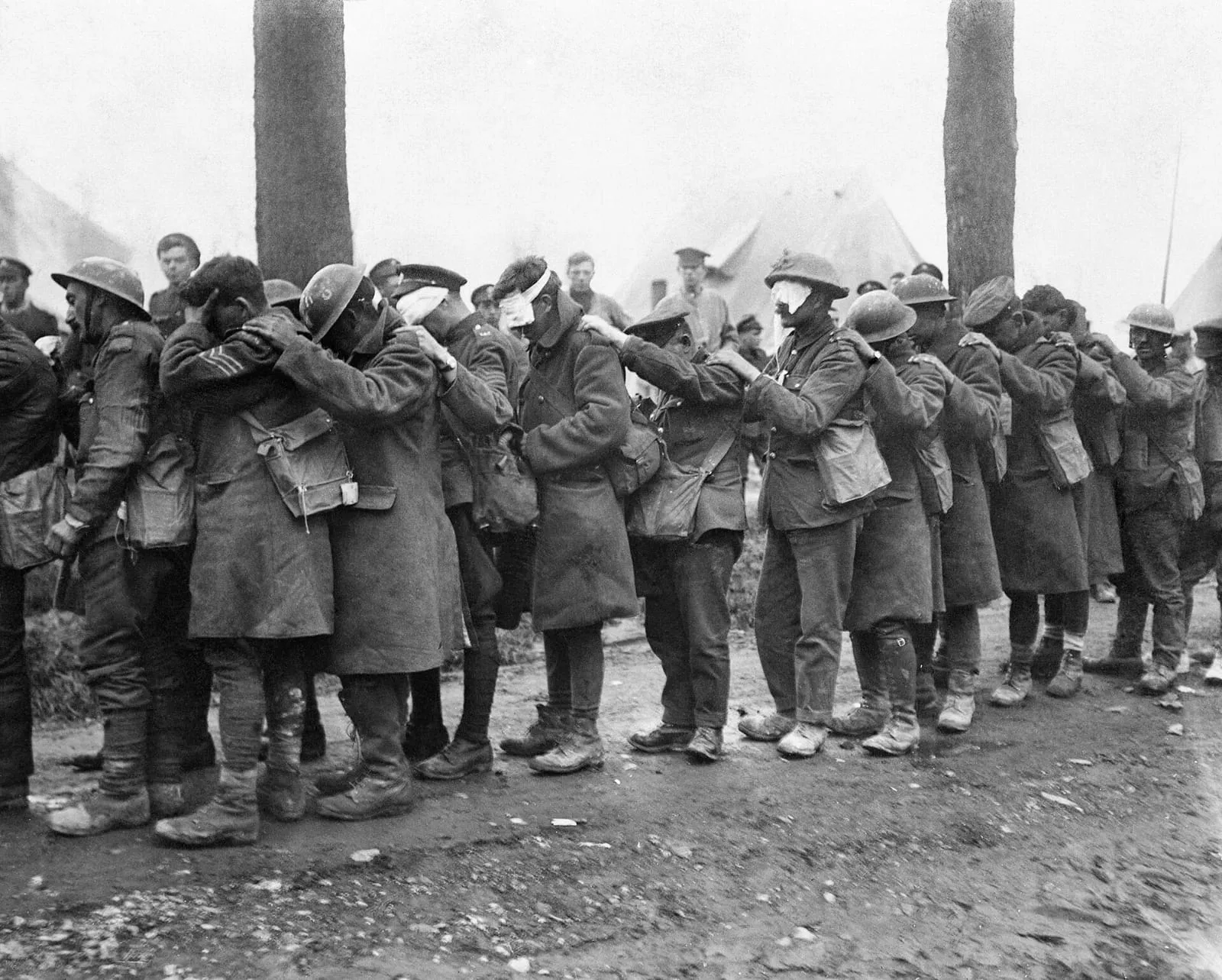
On Tuesday 9 April 1918, at 4.15 a.m., in darkness and thick fog, the artillery of the German Sixth Army opened fire on the front from the La Bassée Canal to Armentières, in French Flanders. So began the Battle of the Lys, the second great offensive of the spring of 1918, which Erich Ludendorff had prepared in haste after calling off Operation Michael before Amiens four days earlier. After four and a half hours of bombardment the German infantry struck at the sector held by the Portuguese. Within a few hours the Portuguese 2nd Division had ceased to exist as an organised force, and the Germans reached the rivers Lawe and Leie (Lys) and crossed the Lys at one point. On the southern flank, however, the British 55th Division held all its positions at Givenchy and Festubert, and by evening the British, throwing in their last reserves, had closed the breach with a thin line along the rivers. Times are given after the British official history.
Before the attack
The Lys sector was regarded as quiet. Since the winter of 1914–1915 the front had hardly moved here, and the flat, marshy ground, where sandbag breastworks were built instead of trenches, was usually unfit for a large attack until May. The spring of 1918, however, was exceptionally dry. Since the autumn of 1917 the front near Neuve-Chapelle and Laventie had been held by the Portuguese Expeditionary Corps, which had received no replacements for months. In April only General Manuel Gomes da Costa’s 2nd Division, reinforced to four brigades, remained in the line, and the 1st Division had been withdrawn to the rear. The 2nd Division had about 21,000 men; it was short of almost 6,000 soldiers and over a hundred officers, and morale in its ranks was very poor. It was to defend about 9 kilometres of front. The commander of the British XI Corps, General Richard Haking, advised replacing it at once with a British division. According to the British official history he wanted to do so as early as the night of 7–8 April, but at the request of the commander of the 51st Division, which after the March fighting had not even had time to re-equip, he postponed the relief by two days. On 8 April it was decided that the Portuguese would be relieved by the British 50th Division and a brigade of the 55th Division, starting on the night of 9–10 April.
Signs of an attack had been multiplying for several days. Airmen saw increased traffic on the roads behind the German front, and aerial photographs showed footbridges prepared over the streams opposite the Portuguese. On the night of 7–8 April the Germans drenched Armentières with mustard gas shells: according to British estimates 30,000–40,000 fell on the town, and the British 34th Division had over 900 gassed. The misty 8 April, by contrast, was disturbingly quiet. Haking told his artillery commander that he feared an attack at the very moment when he would be taking the Portuguese out of the line. British intelligence, however, expected the main blow near Arras and on Vimy Ridge, and on the Lys at most a subsidiary attack, although on 8 April General Henry Horne, commander of the First Army, reported to Haig that everything pointed to an attack the next day.
Bombardment and assault
On 9 April a fog lay over the plain so thick that in the morning one could see no more than 40 metres. The bombardment, again directed by Lieutenant Colonel Georg Bruchmüller, ran much as on 21 March. First phosgene and high-explosive shells struck the batteries, crossroads and command posts, down to battalion headquarters. One of the first shells to fall on Lestrem hit the house where General Gomes da Costa was quartered. Telephone communication with the Portuguese front was cut within ten minutes, and an aide-de-camp whom the general sent on horseback with an order for the reserve brigade took an hour to force his way two kilometres through darkness and confusion. By about 6 a.m. the roads behind the front were already choked with fugitives: civilians, artillery drivers, rear-service soldiers and part of the Portuguese reserve brigade. From 8 a.m. the bombardment shifted to the trenches, at 8.35 a.m. the mortars joined in, and at 8.45 a.m. the German infantry went in to the assault behind a creeping barrage. Portuguese accounts state that the attack began as early as 7 a.m.
Four German divisions struck the Portuguese. As early as about 7.30 a.m. the British on both flanks saw Portuguese soldiers falling back from the front line, and between 9 and 10 a.m. most of the garrisons of the forward zone passed through the British positions about 5 kilometres behind the old front. German regimental accounts say that the first trenches were taken almost without resistance and that prisoners were taken only in the second and third lines. It was not so everywhere. According to German accounts the posts at Richebourg-l’Avoué and Neuve-Chapelle held out until almost 11 a.m., and on the right flank the Portuguese 10th Regiment held on until mortar fire had killed most of the defenders. Portuguese tradition remembers Private Aníbal Milhais, who with a Lewis gun is said to have covered the retreat of Portuguese and Scottish soldiers and was later awarded the Order of the Tower and Sword, the highest Portuguese military decoration. By about 11 a.m. all that remained of the whole division on the battlefield were the Portuguese gunners manning British batteries, a tunnelling company and small groups that had joined the British. The flight was so swift that the bridges prepared for demolition were not blown in time. Later 894 officers and 13,252 men were collected from the scattered units. The Germans claimed to have taken 6,000 prisoners.
Givenchy
The fighting went differently in the south, where the 55th Division, made up of Lancashire Territorials, stood beside the Portuguese. They defended Givenchy, the ruins of a village on a low rise churned up by years of mine warfare, and Festubert. Their commander, General Hugh Jeudwine, had spent two months preparing the defence: strongpoints with concrete machine-gun nests, wire put up night after night so as to steer the attackers into the fire, and an underground tunnel with quarters for two battalions. Every platoon knew whether it was to hold its post or counter-attack, and the line of resistance was to be held at all costs. Even before the assault, when the Portuguese began to fall back, the division bent back its left flank along the boundary of the Portuguese sector. At about 10 a.m. the Germans broke into the ruins of the church at Givenchy and got close to the canal, but counter-attacks threw them back. When the fog thinned in the afternoon, the wire was found to be hung with bodies. In the pockets north and south of Givenchy 641 Germans were taken prisoner, including two battalion commanders, along with over a hundred machine guns and a military band with its instruments, which according to the British official history was to have led the regiment into Béthune. Two junior officers of the 55th Division, Joseph Collin and John Schofield, killed that day, were posthumously awarded the Victoria Cross. By evening the division had built a continuous flank facing north-east, as far as the Lawe.
On the Lawe and the Lys
Into the gap left by the Portuguese Haking first threw what he had to hand. The 11th Cyclist Battalion and the 1st King Edward’s Horse manned the strongpoints near Lacouture and Bout Deville in the morning. A brigade of the 51st Division that was to relieve them went the wrong way in lorries because of a mistake in orders and arrived only around noon. The cyclists and cavalrymen, surrounded on both sides, held out until 5.30 p.m., when they received the order to withdraw, and then fell back behind the Lawe, having lost half their men. The British official history judged that it was their tenacity that prevented the German success from turning into a complete breakthrough and gave the brigades of the 51st and 50th Divisions time to man the line of the rivers. On the northern flank the Germans followed the retreating Portuguese in the fog, and the soldiers of the British 40th Division, who had seen the greenish Portuguese uniforms for the first time only a few days earlier, held their fire for a long time, not knowing who was who. The Germans outflanked the division. Of the Welsh battalion that stood nearest the Portuguese, two officers and twenty men survived, and an East Surrey battalion, surrounded on three sides, held out in some of its posts until the afternoon. The 12th Battalion of the Suffolk Regiment held Fleurbaix for a long time, but the remnants of the 40th Division were pushed back to the Lys.
In the afternoon the Germans reached the rivers. At Bac-Saint-Maur the British blew the permanent bridge and two of the three temporary bridges at 2.15 p.m., but at about 4 p.m. part of a German regiment crossed to the other bank by the third, surviving one. During the night a British brigade from the reserve of the neighbouring corps counter-attacked there in the dark and recovered some ground. At Estaires a Durham Light Infantry battalion held a bridgehead until evening; it was then withdrawn to the north bank and the main bridge was blown. A German attempt to cross the Lawe near its confluence with the Lys was repulsed. By the morning of 10 April the British XI and XV Corps, having used up all their reserves, had ringed the German breach, about 16 kilometres wide and almost 9 kilometres deep, with a thin line running along the Lawe and the Lys. In the evening the glow of burning Armentières, Estaires and Merville hung over the valley.
Evening
The reports that reached Crown Prince Rupprecht of Bavaria in the evening sounded so good that he ordered the Sixth Army to push as far as possible beyond the Lys during the night, even with infantry alone and part of the field artillery. Later reports were more modest: the Lys had been crossed only at Bac-Saint-Maur. The attack had been hampered by the fog, ditches and hedges, and the German creeping barrage had quickly run away from its own infantry. The tanks that had been prepared did not go into action either, because the ground proved too soft for them. On the British side, however, nobody had any illusions. Horne had no reserves left, and the only help could come from divisions taken from other sectors. The Germans, moreover, had a second blow in reserve: as early as the evening of 8 April the Supreme Army Command had ordered the Fourth Army to attack the next day after the Sixth Army, north of Armentières, against the Messines Ridge.
For Portugal 9 April became the darkest day of the war. Gomes da Costa and the corps commanders had long warned Lisbon that their soldiers, without replacements and without relief, would not withstand a serious attack, but the defeat shook the country all the same. Many disputes and myths grew up around the battle. Older Portuguese studies gave thousands killed, while more recent research speaks of a few hundred killed and about 6,000 prisoners. The British official history, though it does not spare the Portuguese, recalls that the British command had reckoned since December 1917 that they would not withstand an attack, and that only the speed of their retreat had surprised it.
Remember the articles you have read? Only in this browser; nothing is sent anywhere.How it works
Read ·
Voices from the front
“On 9 April, the anniversary of the great crisis at Arras, our assault troops rose from the mud-choked positions on the Lys front from Armentières to La Bassée. Not in broad waves of attack but mostly in small parties and the narrowest columns, they waded through a morass torn up by shells and mines, between deep, water-filled shell craters or along the few reasonably firm strips of ground, towards the enemy lines.”
Translated · Original (de)
Am 9. April, am Jahrestage der großen Krisis von Arras, erhoben sich aus den verschlammten Stellungen an der Lys-Front von Armentières bis La Bassée unsere sturmbereiten Truppen. Freilich nicht in breiten Angriffswellen sondern meist in kleinen Abteilungen und in schmalsten Kolonnen wateten sie durch einen von Granaten und Minen zerwühlten Morast, zwischen tiefen, mit Wasser gefüllten Geschoßtrichtern oder auf den wenigen einigermaßen festen Geländestreifen den feindlichen Linien entgegen.
“Among them were two poor little girls of ten, from the hamlet there, one of whom, with both legs shattered and other wounds, soon breathed her last. How sorry I felt for those two children, […] one of them dead, while the other looked at her timidly, almost furtively, as if afraid that all the men around her might scold her for looking at her companion.”
Translated · Original (pt)
Entre êstes viam-se duas pobres rapariguinhas de dez anos, ali do logarejo, uma das quais, com ambas as pernas esfaceladas e outros ferimentos, em breve exalava o seu derradeiro suspiro. Que pena me fizeram essas duas crianças, […] e uma delas morta, enquanto a outra a olhava timidamente, quási às furtadelas, como se receiasse que todos aqueles homens que a rodeavam lhe pudessem ralhar, por ela estar olhando para a sua companheira.
Spotted a mistake?Report an error
Meanwhile
(04)Elsewhere in the same days.
- 10 April 1918 · War at seaShelling of MonroviaOn 10 April 1918 the German U-cruiser U-154 shelled Monrovia, destroying the French radio station, having first sunk Liberia's only warship.
- 10 April 1918 · MilitaryThird Military Service ActOn 10 April 1918 the Commons passed on second reading a bill raising the conscription age to 51 and allowing conscription to be extended to Ireland.
- 10 April 1918 · DiplomacyGerman-Turkish settlement treatyOn 10 April 1918 Germany and Turkey exchanged in Berlin the ratifications of the settlement treaty and nine other treaties replacing the capitulations.
- 10 April 1918 · DiplomacyPact of RomeOn 10 April 1918 a congress of the nations oppressed by Austria-Hungary adopted a joint declaration in Rome and endorsed the Italian–Yugoslav agreement.
Related events
(04)The same battle, people or subject.
- 15 April 1918 · Western FrontGermans take BailleulOn 15 April 1918 the Germans took the Ravelsberg ridge east of Bailleul. That night the British left the town, which in later months was reduced to ruins.
- 28 March 1918 · Western FrontGerman attack at ArrasOn 28 March 1918 the Germans attacked at Arras in Operation Mars. The British defence held; in the evening Ludendorff called it off and turned to Amiens.
- 25 March 1918 · Western FrontGermans capture NoyonOn 25 March 1918 Hutier's army broke the French reinforcements on the Oise and entered Noyon in the evening. The gap between the French and British widened.
- 21 March 1918 · Western FrontOperation Michael beginsOn 21 March 1918, after a five-hour bombardment and in thick fog, three German armies broke the British front on the Somme. The British lost over 38,000 men.