Germany · The Central Powers
Paul von Hindenburg
Chief of the General Staff of the Field Army (1916–1919), field marshal, President of the Reich (1925–1934)
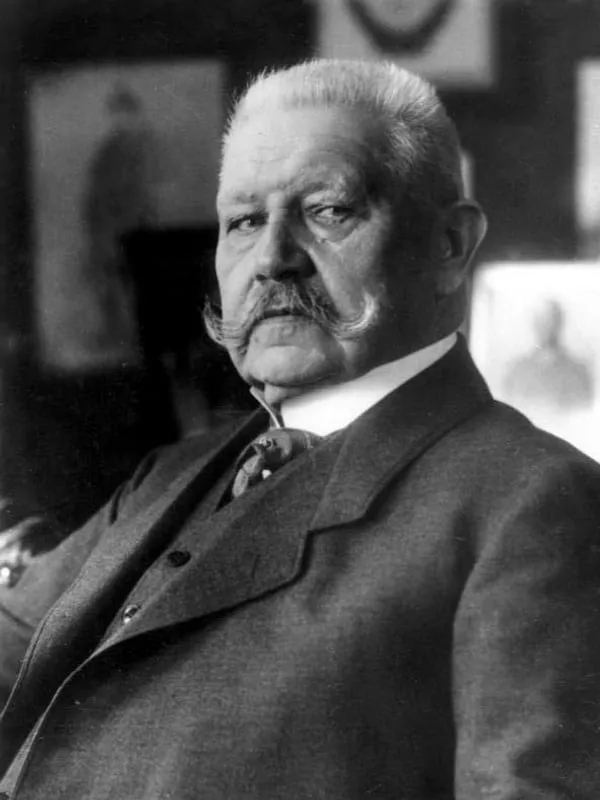
- Born:
- 2 October 1847, Posen
- Died:
- 2 August 1934, Neudeck (now Ogrodzieniec, Poland)
- Author:
- Natalia
- Photo:
- Bundesarchiv, Bild 183-C06886, CC BY-SA 3.0 DE, Wikimedia Commons

Paul von Hindenburg entered the war as a retired general of whom few outside the army had heard. Within a few days he was the most famous man in Germany. The victory at Tannenberg in August 1914 made him the “saviour of East Prussia” and a living symbol of German strength. Together with his chief of staff Erich Ludendorff he formed the most famous command partnership of the war: Hindenburg supplied calm, authority and a name, Ludendorff energy and plans. From August 1916 the two directed the entire German army, and their influence on politics was so great that contemporaries already spoke of a military dictatorship. Hindenburg came through defeat with his legend intact, and his later role as President of the Reich, who in 1933 appointed Hitler chancellor, cast a shadow over his whole biography.
Before the war
He was born on 2 October 1847 in Posen, where his father, a Prussian officer of the von Beneckendorff und von Hindenburg family, was stationed. He grew up in a military and Protestant tradition. He passed through the cadet corps at Wahlstatt and in Berlin, and in 1866, as a young lieutenant of the Guard, fought the Austrians at Königgrätz, where a bullet pierced his helmet and grazed his head. In the Franco-Prussian War he fought at Saint-Privat and Sedan, and on 18 January 1871 he was at Versailles for the proclamation of the German Empire.
He then had a solid but unspectacular career: the War Academy, the General Staff, the War Ministry, command of a regiment, chief of staff of a corps in Koblenz, commander of a division in Karlsruhe. In 1903 he took command of IV Corps in Magdeburg. He was regarded as a good organiser and an expert in tactics, and his name appeared among the candidates for Chief of the General Staff. In 1911, at the age of 63, he retired at his own request and settled in Hanover. When war broke out, he sought a posting in vain.
Tannenberg
In August 1914 the commander of the Eighth Army in East Prussia, General Maximilian von Prittwitz, lost his nerve after the clash with the Russians at Gumbinnen and wanted to withdraw behind the Vistula. The Chief of the General Staff, Helmuth von Moltke, decided to replace him. Erich Ludendorff, the hero of Liège, was chosen as chief of staff, and as the commander meant to balance him, a calm pensioner from Hanover. On 22 August Hindenburg received a telegram asking whether he was ready to take command, and replied briefly that he was. That night he boarded a train in which Ludendorff was already waiting for him, and on 23 August he arrived at Marienburg.
The new commanders adopted the plan prepared by an Eighth Army staff officer, Lieutenant Colonel Max Hoffmann: leave a thin screen against the Russian First Army of Paul von Rennenkampf and throw the main forces against the Second Army of Alexander Samsonov. In the Battle of Tannenberg on 26–30 August Samsonov’s army was encircled and destroyed, and its commander took his own life. The Germans took more than 90,000 prisoners. The battle was named after the village of Tannenberg, now Stębark, to symbolically avenge the defeat of the Teutonic Knights at Grunwald in 1410. Accounts differ as to who proposed the name, but Hindenburg readily adopted it and tended the legend of the victory.
The operational idea of the battle was not his, and its course was largely decided by Ludendorff. Hindenburg nevertheless had a merit that must not be underestimated: at moments when his chief of staff lost his self-confidence, he kept calm and took responsibility upon himself. Hoffmann, who cared for neither of them, would show visitors round the battlefield after the war, pointing out where the field marshal had slept before the battle, after the battle and during the battle. In the first days of September the Eighth Army struck at Rennenkampf and in the Battle of the Masurian Lakes drove the Russians out of East Prussia. Hindenburg was made colonel general and received the Pour le Mérite, and his name was given to streets, squares and warships.
Ober Ost
In September 1914, after Austria-Hungary had lost the Battle of Galicia, Hindenburg took command of the new Ninth Army in Silesia and led it across the Kingdom of Poland to the Vistula. At Warsaw and Dęblin, however, the Russians gathered superior forces and forced him to retreat. On 1 November Hindenburg became commander-in-chief of all German forces in the east, Ober Ost for short. In November his troops struck the Russian flank, which led to the Battle of Łódź, and on 27 November the Kaiser promoted him to field marshal. In February 1915, in the Winter Battle of the Masurian Lakes, the Germans destroyed the Russian Tenth Army but failed to decide the war in the east.
Hindenburg and Ludendorff were convinced that the decision had to be won precisely here, and throughout 1915 they quarrelled with Moltke’s successor, Erich von Falkenhayn. They demanded large reinforcements and encircling manoeuvres, while Falkenhayn refused out of regard for the Western Front. In January 1915 Hindenburg even demanded the chief of staff’s dismissal and threatened to resign. Kaiser Wilhelm II, who valued Falkenhayn and disliked Ludendorff, did not grant this demand, but could not afford to lose the most popular commander in Germany. The great victory at Gorlice in May 1915 was won by the troops of August von Mackensen, who answered to Falkenhayn. Hindenburg’s armies meanwhile occupied Lithuania and Courland, took Kovno and Grodno, but at Vilna failed to encircle the Russians.
On the occupied lands of Lithuania, Courland and north-eastern Poland a military state, Ober Ost, was set up, governed from headquarters in Kovno. The administration was in practice run by Ludendorff, and its aim was to squeeze as much food, timber and labour out of the country as possible for Germany. Meanwhile the cult of Hindenburg grew. In September 1915 a wooden statue of the field marshal more than twelve metres high, the “Iron Hindenburg”, was set up on the square in front of the Reichstag in Berlin, and people hammered nails into it in return for donations to war causes. In March 1916 his troops repulsed the Russian offensive at Lake Naroch, and in the summer, after the Austrian defeat in the Brusilov offensive, his command was extended to a large part of the Eastern Front, including Austro-Hungarian troops.
At the head of the army
When Romania entered the war on 27 August 1916, Falkenhayn lost the Kaiser’s confidence. On 29 August at Pless Hindenburg became Chief of the General Staff of the Field Army, and Ludendorff First Quartermaster General with joint responsibility for all decisions. Thus began the Third OHL, the third leadership of the Supreme Army Command. The division of roles was clear: Hindenburg represented the army before the Kaiser and the public, while Ludendorff ran the staff and in practice conducted the war. Hindenburg nevertheless signed the most important documents, and it was his authority that made the Supreme Command’s demands impossible to ignore.
The new leadership changed course. The attack at Verdun was halted, and in the west construction began on a new defensive position, to which the Germans withdrew in the spring of 1917 and which the British called the Hindenburg Line. The Hindenburg Programme was to double the output of ammunition and triple that of guns and machine guns, and the Auxiliary Service Law of December 1916 made all men aged 17 to 60 liable to compulsory labour. The Supreme Command also backed the Act of 5 November, counting on Polish recruits, who did not, however, materialise.
The OHL’s influence on politics kept growing. Hindenburg and Ludendorff demanded unrestricted submarine warfare, and when Chancellor Theobald von Bethmann Hollweg hesitated, Hindenburg gave him to understand that in military matters he would do what he thought right. On 9 January 1917 the Kaiser agreed to unrestricted submarine warfare, which in April brought the United States into the war. In July 1917 the two generals threatened to resign if Bethmann stayed in office, and the Kaiser gave way. The new chancellor was Georg Michaelis, whom many historians regard outright as the Supreme Command’s candidate. The following years are called the “silent dictatorship” of the OHL, although some historians point out that the generals never formally took over the government and also ran up against the limits of their power.
Defeat
After Russia left the war the OHL imposed the Treaty of Brest-Litovsk on the Bolsheviks and the Peace of Bucharest on Romania. In the spring of 1918 Ludendorff threw the army into great offensives in the west, beginning with Operation Michael. In March the Kaiser awarded Hindenburg the Star of the Grand Cross of the Iron Cross, a decoration received before him only by Field Marshal Blücher for the wars against Napoleon. The offensives, however, brought only territorial gains and enormous losses. After the defeat at Amiens on 8 August, Hindenburg at the conference at Spa judged the situation more optimistically than Ludendorff and still believed the army would hold on French soil.
At the end of September came the collapse. On 28 September Ludendorff went down to Hindenburg’s room in the Hotel Britannique at Spa and announced that an armistice had to be requested immediately. The field marshal replied that he had intended to tell him the same. The next day the two presented this demand to the Kaiser. In October, however, Hindenburg signed together with Ludendorff an order to the army rejecting President Wilson’s terms, and when the chancellor demanded Ludendorff’s departure, the Kaiser accepted the general’s resignation but kept Hindenburg. Ludendorff felt that his old comrade had betrayed him and refused to ride back with him in the same car.
On 9 November at Spa, as revolution broke out in Berlin, Ludendorff’s successor General Wilhelm Groener told the Kaiser that the army no longer stood behind him. Hindenburg was mostly silent, and when news came from Berlin, he advised Wilhelm II to leave for the Netherlands, as he could no longer vouch for his safety. The Kaiser crossed the border the next day. Hindenburg remained at the head of the army and worked with Friedrich Ebert’s new government to bring the troops home in good order.
After the war
In the winter of 1918/1919 the Supreme Command moved to Kassel and then to Kolberg. In June 1919, when the government was weighing whether to accept the Treaty of Versailles, Hindenburg judged armed resistance hopeless, but left it to Groener to pass this on to the politicians. Soon afterwards he retired from the service. On 18 November 1919, before the National Assembly’s committee investigating the causes of the defeat, he declared that the army had been “stabbed in the back”, citing the words of some English general. He thus became one of the chief proponents of the stab-in-the-back myth, although it was he himself who had demanded an armistice in September 1918.
In 1925, at the age of 77, he was elected President of the Reich as the candidate of the right. In 1932 he won again, this time with the support of the republican parties, against Adolf Hitler. From 1930, however, he governed through presidential cabinets resting on decrees, and on 30 January 1933 he appointed Hitler chancellor and in the following weeks signed the decrees that allowed the Nazis to destroy democracy. He died on 2 August 1934 on his estate of Neudeck in East Prussia, now Ogrodzieniec near Kwidzyn. He was buried in the Tannenberg Memorial near Hohenstein. In 1945 the Germans took his coffin west, and today he rests in St Elizabeth’s Church in Marburg.
Assessment
In his lifetime Hindenburg was for millions of Germans a symbol of loyalty, duty and steadfastness, an “ersatz emperor” onto whom they projected feelings that Wilhelm II no longer inspired. Historians judge him far more harshly. His military achievements are largely credited to Ludendorff and Hoffmann, and his role in the victories is often reduced to his signature and authority. The British historian John Wheeler-Bennett, author of the classic biography, called him the “wooden titan”, in reference to the Berlin statue.
More recent research, however, does not see him merely as a figurehead. The German historian Wolfram Pyta has shown that Hindenburg consciously built and guarded his own myth, and that his power in 1916–1918 was a particular form of charismatic authority. He knew how to use his popularity against the Kaiser and the chancellors, and joint responsibility for the decisions of the Third OHL, from submarine warfare to the Treaty of Brest-Litovsk, rests on him too. After the defeat he shifted the blame onto others just as deftly, first onto the politicians and revolutionaries, and to some extent onto Ludendorff as well. The German journalist and historian Wolfgang Niess wrote that it is hard to name another commander in history who so successfully evaded responsibility for a lost war.
Sources
Spotted a mistake?Report an error
Commanded in battles
(17)- 23–30 August 1914Battle of TannenbergEastern Front
- 5–15 September 1914First Battle of the Masurian LakesEastern Front
- 25–29 September 1914Fighting on the NiemenEastern Front
- 28 September – 8 November 1914Battle of Warsaw and DęblinEastern Front
- 11 November – 6 December 1914Battle of ŁódźEastern Front
- 30 November – 17 December 1914Battle of the BzuraEastern Front
- 7–22 February 1915Winter Battle in MasuriaEastern Front
- 16 February – 22 August 1915Defence of OsowiecEastern Front
- 22–27 February 1915First Battle of PrzasnyszEastern Front
- 13–26 July 1915Battle of the Narew and BiebrzaEastern Front
- 13–17 July 1915Second Battle of PrzasnyszEastern Front
- 9 September – 1 November 1915Battle of DvinskEastern Front
- 9 September – 2 October 1915Battle of VilnaEastern Front
- 18 March – 28 April 1916Lake Naroch offensiveEastern Front
- 1 July – 18 November 1916Battle of the SommeWestern Front
- 21 March – 5 April 1918Operation MichaelWestern Front
- 8 August – 11 November 1918Hundred Days OffensiveWestern Front
Mentioned in battles
(18)- Battle of Gumbinnen
- Battle of Bolimów
- Battle of Šiauliai
- Siege of Kovno
- Battle of Verdun
- Brusilov offensive
- Battle of Tutrakan
- Battle of the Transloy Ridges
- First Offensive Battle of Verdun
- German retreat to the Hindenburg Line
- Capture of Baghdad
- Battle of Mărășești
- Eleventh Battle of the Isonzo
- Battle of Polygon Wood
- Battle of Skra-di-Legen
- Battle of the Drocourt–Quéant Line
- Battles of the Hindenburg Line
- Battle of the Selle
Often appears with
People who appear in the same events.
On the timeline
(68)The 40 most important of 68 events. All tagged “Paul von Hindenburg” (25) →
1914
1915
January
February
April
May
July
- 13
- Central Powers' great offensive in the east beginsOn 13 July 1915 the Germans struck from East Prussia towards the Narew. An offensive began that was to drive the Russians out of the Kingdom of Poland.
- Second Battle of Przasnysz beginsOn 13 July 1915, after a bombardment of several hours from some 800 guns, Army Group Gallwitz broke the Russian First Army's main defence line at Przasnysz.
August
September
- 09
- Start of the Battle of DvinskOn 9 September 1915 the right wing of the German Niemen Army set off for Dvinsk, to reach the Dvina and cover the attack on Vilna from the north.
- Start of the Battle of VilnaOn 9 September 1915 the German 10th Army struck north of Vilna, into the gap between two Russian armies. General Garnier's cavalry pushed into the breach.