German Empire · The Central Powers
Max Hoffmann
First general staff officer of the 8th Army and of Ober Ost (1914–1916), chief of staff to the Commander-in-Chief East (1916–1918), major-general
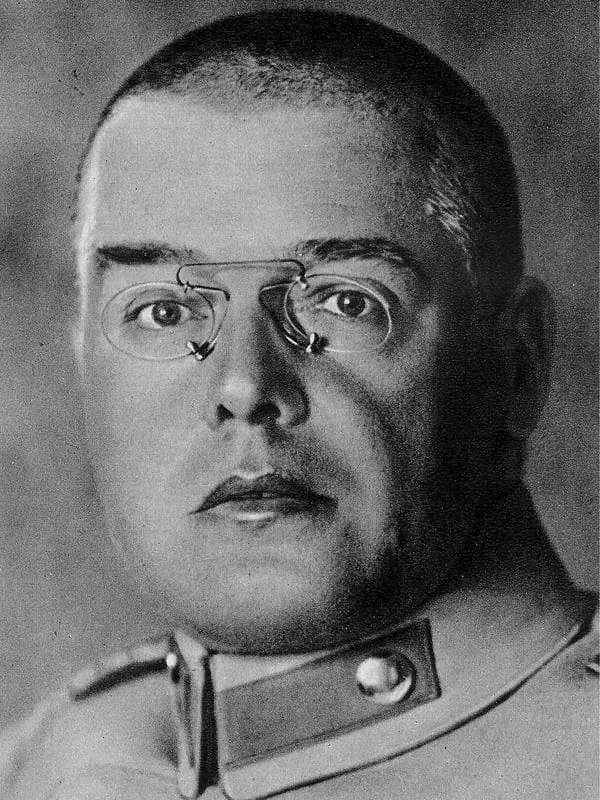
- Born:
- 25 January 1869, Homberg (Hesse)
- Died:
- 8 July 1927, Bad Reichenhall
- Author:
- Łukasz Skowroń
- Photo:
- M. Hoffmann, domena publiczna, Wikimedia Commons

Max Hoffmann never commanded an army, yet he was among the men who most shaped the fortunes of the Eastern Front. In August 1914, as a lieutenant-colonel on the staff of the 8th Army, he drew up the plan by which the Germans crushed the Russians at Tannenberg. For the next two years he was the closest collaborator of Hindenburg and Ludendorff, and from 1916, as chief of staff to Prince Leopold of Bavaria, he in effect directed the whole front from the Baltic to the Carpathians. At the end of 1917 it was he who talked to the Bolsheviks about an armistice, and at the conference in Brest-Litovsk he became for the Russians the embodiment of German power. His memoirs and diaries still shape the picture of the war in the east, not least because of how mercilessly he judged his superiors in them.
Before the war
He was born on 25 January 1869 in Homberg on the Efze in Hesse, the son of a judge. He attended the gymnasium in Nordhausen, in 1887 joined an infantry regiment as a volunteer, and a year later became a second lieutenant. His fellow officers remembered him as a poor horseman and fencer, but a sharp man. From 1895 to 1898 he studied at the War Academy in Berlin, then spent half a year in Russia learning the language. From 1899 he worked in the Russian section of the Great General Staff and quickly gained a reputation as an expert on the Tsarist army.
During the Russo-Japanese War he was a German observer with the Japanese army in Manchuria. He became famous there for a row with a Japanese general who would not let him onto a hill from which the fighting could be watched. After his return he was first general staff officer of a division in Königsberg, lectured at the War Academy and worked out the expected plan of a Russian offensive against Germany. In 1913 he became a lieutenant-colonel. For several years he lived in Berlin in the same house as Erich Ludendorff, which later made their cooperation easier.
1914: Tannenberg
On mobilisation Hoffmann became first general staff officer, that is, head of the operations section, of the 8th Army, which was to defend East Prussia. After the unsuccessful clash at Gumbinnen on 20 August the army commander, General Maximilian von Prittwitz und Gaffron, panicked at the news that a second Russian army was approaching from the south and spoke of retreating behind the Vistula. Hoffmann opposed this. He knew from intercepted Russian wireless messages, often sent in plain text, that the armies of Paul von Rennenkampf and Alexander Samsonov were separated by a wide gap and were not cooperating. He proposed leaving only a weak screen against Rennenkampf and moving the main forces south by rail and on foot against Samsonov. Some of the orders were issued even before the change of command.
Prittwitz was dismissed, and Paul von Hindenburg and Ludendorff, who arrived at the 8th Army on 23 August, adopted the plan. In the Battle of Tannenberg Samsonov’s army was encircled and destroyed, and in September, at the Masurian Lakes, the Germans drove Rennenkampf’s army out of East Prussia. Who was really the author of the victory was argued over for decades. Hoffmann claimed the plan for himself, Ludendorff the execution, and legend gave Hindenburg everything. Historians today accept that the general idea of the manoeuvre came from Hoffmann, and that Ludendorff carried it out with great energy.
1914–1916: at the side of Hindenburg and Ludendorff
Hoffmann stayed with Hindenburg and Ludendorff as head of operations, first in the 9th Army, which in the autumn of 1914 fought before Warsaw and at Łódź, and from November in the supreme command of all German forces in the east, that is, Ober Ost (PL). He believed that if the Chief of the General Staff, Erich von Falkenhayn, gave them more troops, they could defeat Russia in one great encirclement. Falkenhayn, who did not believe this possible, was from then on as important an adversary for Hoffmann as the Russians. In February 1915 Ober Ost fought the Winter Battle of Masuria, in which the Russian XX Corps was encircled, but the main weight of that year’s fighting shifted to Galicia, where after the breakthrough at Gorlice August von Mackensen was in command. Hoffmann himself admitted in his notes, moreover, that the Russian army could not be destroyed completely as long as Germany was fighting in the west at the same time.
In the autumn of 1915 the Ober Ost staff moved to Kovno. Hoffmann was then building fortifications on the new front line and, as he wrote in his letters, crawled through every trench. In March 1916 that line held against the Russian attack at Lake Naroch. When in June the Brusilov offensive shattered the Austro-Hungarian front in Volhynia, Ober Ost had to give up its reserves to the south. At the end of July Hindenburg’s command was extended over part of the Austro-Hungarian front, and his headquarters moved to the fortress of Brest-Litovsk.
Chief of staff in the east
On 29 August 1916 Hindenburg and Ludendorff took over the supreme command in place of Falkenhayn. Command in the east passed to Field Marshal Prince Leopold of Bavaria, and Hoffmann, by then a colonel, became his chief of staff. He valued the prince as a sensible soldier and a good superior who left him a free hand. In time they came to command the troops of all four Central Powers on the front from the Baltic to the Carpathians.
After the February Revolution Hoffmann wanted to strike at the weakening Russian army, but the supreme command, preoccupied with the west, gave him little. He did, however, expect a Russian offensive and prepared a response to it. When in July 1917 the Kerensky offensive broke through the Austro-Hungarian front near Brzeżany and Stanisławów, the Germans struck the Russian flank from near Złoczów on 19 July. The idea for this counter-offensive in Eastern Galicia is usually credited to Hoffmann himself. Within two weeks the Russians lost almost the whole of eastern Galicia, and Hoffmann received the oak leaves to the Pour le Mérite. On 1 September Oskar von Hutier’s 8th Army crossed the Dvina and took Riga, and in October troops and the fleet occupied the islands of the Gulf of Riga. On 30 October 1917 Hoffmann became a major-general.
The armistice and Brest
When in November 1917 the Bolsheviks seized power in Petrograd and their new commander-in-chief, Nikolai Krylenko, sent envoys across the front, Hoffmann reported this to Ludendorff. Asked whether one could talk to such people, he replied that one could, because the supreme command needed troops and this was the easiest way to get them. At Brest he chaired the military delegation of the Central Powers in the talks with the delegation of Adolph Joffe. He rejected Russian demands, such as the evacuation of the islands of the Gulf of Riga, as terms put to a defeated side, but readily agreed to a ban on moving troops to the west, because the orders to send most of the eastern army there had been issued before the talks began. The armistice was signed on 15 December.
At the peace conference Germany was represented by the State Secretary Richard von Kühlmann, while Hoffmann spoke for the supreme command. He had no powers to negotiate, but he knew Russian, he was the host, and he was where decisions were made. At the end of December he told Joffe that the principle of peace without annexations did not apply to Poland, Lithuania and Courland, which in the German view had separated themselves from Russia. Count Ottokar Czernin saw in him a combination of expertise and calm with a considerable dose of Prussian brutality. When Leon Trotsky took over the Soviet delegation, Hoffmann made a sharp speech on 12 January 1918: a government based on force had no right to talk of self-determination, and the German command would not give up Courland, Lithuania, Riga and the islands. In Germany and in Russia it was said afterwards that he banged his fist on the table as he spoke. He himself denied this, and Czernin recorded that Hoffmann had long polished this “unfortunate speech” and was proud of it. It nevertheless provoked outrage on the left and gave arguments to the workers who at the end of January went on strike in Germany and in Austria. On 18 January Hoffmann spread out before Trotsky a map with the line of the German demands. Trotsky later wrote that Hoffmann was the only serious element of reality in those negotiations.
When on 10 February Trotsky announced that Russia was ending the war but would not sign a peace, Hoffmann was the only one present to argue that this was in fact a denunciation of the armistice. The supreme command saw it the same way, and on 18 February German troops moved forward. In Operation Faustschlag the troops of Ober Ost, travelling mainly by rail and motor vehicle, occupied Livonia, Estonia and vast areas of Belarus and Ukraine within a few days. Hoffmann called it the most comical war he had ever known. On 3 March he signed the Treaty of Brest-Litovsk together with the envoy Frederic von Rosenberg.
The quarrel with Ludendorff
On Polish questions Hoffmann was moderate. He did not want Germany to annex the broad strip of the Kingdom of Poland demanded by the supreme command, because he believed that almost two million new Polish subjects would bring the Reich nothing but trouble. At the turn of 1917 and 1918 Wilhelm II, who considered him the best expert on eastern affairs, asked his opinion over lunch and backed his proposal of a narrow border strip. Hindenburg and Ludendorff threatened to resign; the Kaiser gave way on the border but refused to remove Hoffmann, as Ludendorff demanded. Ludendorff paid him back with a press campaign in which Hoffmann was portrayed as Kühlmann’s tool, and his wife, a painter from a banking family of Jewish descent, as a person with liberal and “Jewish” connections. Hoffmann remarked that great men are sometimes very small.
His moderation had its limits, however. He supported German domination of the Baltic countries and Ukraine, called the Crimea the future German Riviera, and in 1918 urged in vain that the Treaty of Brest-Litovsk be torn up and the Bolsheviks overthrown by force. The supreme command meanwhile was creating separate administrations for Ukraine and the Baltic countries, and the role of Ober Ost was shrinking. After the armistice Hoffmann directed the return of the eastern army to Germany.
After the war
Soon after the war he left the army and settled in Berlin. He wrote books: Der Krieg der versäumten Gelegenheiten (1923), in which he settled accounts with Falkenhayn and Ludendorff, and Tannenberg wie es wirklich war (1926), in which he stressed his own part in the victory. Together with the industrialist Arnold Rechberg he campaigned for a joint intervention by the Western powers and Germany against Soviet Russia. The Reichswehr did not support these plans. He died suddenly on 8 July 1927 at the spa of Bad Reichenhall. He was buried in the Invalids’ Cemetery in Berlin. His diaries were published in 1929.
Assessment
Many historians regard Hoffmann as one of the most gifted staff officers of his generation. The plan for Tannenberg, the defence of the front in 1916 and the counter-stroke in Galicia in 1917 show a man who knew the enemy better than almost anyone on the German side and knew how to use that knowledge. His memoirs, however, must be read with caution. He wrote them to emphasise his own merits and to belittle Hindenburg, Ludendorff and Falkenhayn, and some of his stories, such as the one about a brawl between Samsonov and Rennenkampf at Mukden, are regarded by historians as gossip.
At Brest Hoffmann showed more political sense than Ludendorff and, according to German biographers, sided with Kühlmann more often than with the supreme command. At the same time it was his hard-line performances and the map with the line of demands that became for the world the symbol of a dictated peace, which the German left saw as a negation of the assurances of a peace without annexations, and which the Bolsheviks used in their propaganda. He was also ready for the dismemberment of western Russia and German domination of its former lands, though he preferred to achieve this indirectly, through dependent states, rather than through open annexation.
Sources
Spotted a mistake?Report an error
Commanded in battles
(02)Mentioned in battles
(03)Often appears with
People who appear in the same events.