Key event
Armistice of Brest-Litovsk
- Category:
- Diplomacy
- Front:
- Eastern Front
- Date:
- 15 December 1917
- Author:
- Łukasz Skowroń
- Tags:
- Russia, Germany, October Revolution, peace initiatives
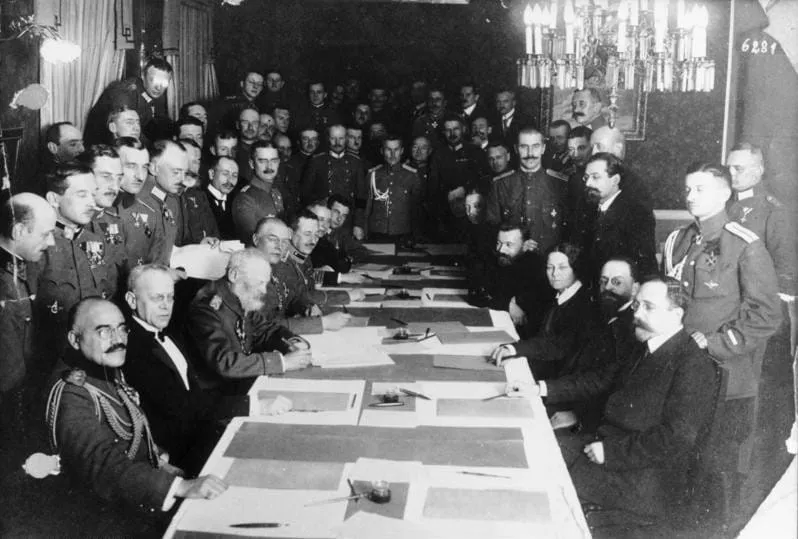
On 15 December 1917 (2 December in the Julian calendar), at Brest-Litovsk, the headquarters of the German supreme command in the East, plenipotentiaries of the Russian supreme command signed an armistice agreement with representatives of the commands of Germany, Austria-Hungary, Bulgaria and Turkey. The armistice was to come into force at noon on 17 December and last until 14 January 1918, and, unless either side denounced it, to be extended automatically. It covered the whole land front from the Baltic to the Black Sea, the Caucasus front in Asia, the Baltic east of the 15th meridian and the whole of the Black Sea. For Russia, which had been fighting Germany, Austria-Hungary and Turkey since the autumn of 1914, and Bulgaria as well since the autumn of 1915, this meant leaving the war in practice. The British chronology of the war records the signing of the armistice under this date and the start of its validity under 17 December. We describe both events here together, as well as the resumption of the negotiations on 13 December.
From ceasefire to armistice
Lenin’s government demanded an armistice on 21 November, and at the end of the month the envoys of the new commander-in-chief, Nikolai Krylenko, crossed the German lines and came back with consent to talks. The negotiations began at Brest on 3 December. The Soviet delegation, led by Adolph Joffe, then demanded a six-month armistice, the evacuation of German troops from the islands at the entrance to the Gulf of Riga taken in October, and a ban on moving troops from the Eastern Front to other fronts. The chairman of the Central Powers’ delegation, the chief of staff of the Eastern command, General Max Hoffmann, rejected the demand concerning the islands as a condition that could only be put to a defeated enemy. He proposed an armistice of 28 days. Another dispute proved the hardest, however. Joffe had instructions to conclude an armistice on all fronts, in the name of all the belligerents, which Hoffmann could not accept without authority from the Entente. The Russians, for their part, would not sign an armistice for themselves alone without Petrograd’s consent.
It ended in a provisional ceasefire from 7 to 17 December and a week’s break in the talks. The commissar for foreign affairs, Leon Trotsky, used it to notify the Allied embassies of the negotiations once more on 6 December. He wrote that by the time they resumed more than a month would have passed since the decree on peace, and that this was enough time for the Allied governments to define their position. If they refused, they must declare “clearly and precisely, before all mankind” for what aims the peoples of Europe were to shed their blood in the fourth year of the war. No reply came. On 12 December, in a further statement, Trotsky laid the responsibility for a separate armistice on the governments that had refused to state their own terms, and warned that a separate armistice was not yet a separate peace, but threatened to become one.
The negotiations of 13–15 December
The Soviet delegation returned to Brest on 12 December. On the morning of 13 December (30 November Old Style) the plenary sessions resumed; they lasted until the afternoon and, according to German communiqués, continued the next day as well. This time the Russians came ready for a separate armistice. The disputes were chiefly over three matters: troop transfers, operations at sea and fraternisation between the soldiers. On the first the Central Powers imposed their own wording. On naval matters they were more accommodating. They agreed to fraternisation on condition that it was “organised”.
The Russians could speak of a success, because the ban on transfers was included in the text. Hoffmann admitted later in his memoirs, however, that he had agreed to it without difficulty as early as the beginning of December, because even before the negotiations orders had been issued to send most of the Eastern army to the Western Front. He could therefore promise that during the armistice Germany would take no troops from the East apart from those already on the move or under orders to go.
What the agreement provided
The text, drawn up in German and Russian, had eleven articles. The armistice began at noon on 17 December, that is at 2 p.m. Russian time, and lasted until noon on 14 January 1918 (1 January Old Style). From the 21st day either side could denounce it at seven days’ notice, and without such notice it remained in force indefinitely. The parties undertook not to increase the number of units at the front and on the islands of the Moon Sound, and not to regroup them for an offensive. Until 14 January no troops were to be transferred on the sector from the Black Sea to the Baltic “unless the transfer had already begun at the moment the armistice was signed”. This proviso gave the Germans a loophole, which they used.
The demarcation lines were to be the forward wire entanglements of both sides, and the strip between them became no man’s land. Article IV permitted, “for the development and consolidation of friendly relations between the peoples”, organised contacts between the soldiers. On the sector of each Russian division two or three meeting points could be set up, marked with white flags and open from sunrise to sunset. No more than 25 unarmed men from each side could be present at them at any one time. They could exchange news and newspapers, pass on open letters, and sell and barter articles of daily use. One clause of this article also concerned the Poles: the question of the return of demobilised soldiers whose homes lay behind the enemy’s line was postponed to the peace negotiations, which also applied to “members of Polish units”.
At sea, attacks on the enemy’s ports and coasts ceased, and in the waters covered by the armistice also on shipping. The Russian fleet could not cross the demarcation lines southwards, nor the warships of the four allied powers northwards. The Russian government guaranteed that Entente warships north of these lines would behave in the same way. Armistice commissions were set up to settle military matters at Riga, Dvinsk, Brest, Berdichev, Kolozsvár, Focșani and Odessa, with direct telegraph links. The agreement annulled the ceasefire of 5 December and all local agreements. In Article IX the parties undertook to begin peace negotiations immediately after the armistice was signed, and in Article X the Turks and the Russians declared themselves ready to withdraw their troops from neutral Persia. A separate annex provided for the immediate exchange of interned civilians and of prisoners unfit for further service.
Russia leaves the war
On 15 December Krylenko ordered the commanders and committees of all fronts to cease hostilities without waiting for the full text of the agreement. On the Romanian front the Armistice of Focșani had already been in force for several days, and in the following days a similar agreement was concluded with the Turks in the Caucasus. Over much of the Eastern Front there had in any case been no fighting for a long time. The Russian army was disintegrating, soldiers were going home en masse, and fraternisation with the enemy had been going on for months.
For the Germans the armistice was a great strategic victory. In the following weeks they could transfer more and more divisions to the West and prepare the great spring offensive. Historians point out, however, that the concession on fraternisation had its price. The Bolsheviks used the meeting points for propaganda, and revolutionary German-language newspapers, printed by the Bolsheviks in enormous runs, reached German and Austro-Hungarian soldiers. Rear Admiral Vasily Altfater, military adviser to the Soviet delegation, is said to have warned Hoffmann that his army had melted away before his eyes under the influence of this propaganda and that the same would happen to the German army. Hoffmann wrote that he merely laughed.
For the Allies the armistice was a breach of the undertaking of 1914 that none of them would conclude a separate peace or armistice, but in practice they washed their hands of the matter. “As Russia has entered into separate negotiations,” the prime minister, David Lloyd George, said in the House of Commons on 20 December, “she must, of course, be responsible herself for the terms concerning her own territories.” The peace negotiations at Brest were to begin a week after the armistice was signed. The armistice lasted until 18 February 1918, when the Germans resumed hostilities and within two weeks forced Russia to accept their terms.
Remember the articles you have read? Only in this browser; nothing is sent anywhere.How it works
Read ·
A voice from the front
“At six o'clock I drove to General Hoffmann to pay him a visit, and heard from him interesting details about the psyche of the Russian delegates and the manner of the armistice he had so happily concluded. I had the impression that the general combines expertise and energy with great skill and calm, but also with a good deal of Prussian brutality, which enabled him to bring the Russians, despite their initial resistance, to a very favourable armistice.”
Translated · Original (de)
Um sechs Uhr fuhr ich zu General Hoffmann, um ihm meinen Besuch abzustatten, und hörte von ihm interessante Details über die Psyche der russischen Delegierten und die Art und Weise des von ihm so glücklich abgeschlossenen Waffenstillstandes. Ich hatte den Eindruck, daß der General mit Sachkenntnis und Energie eine große Geschicklichkeit und Ruhe, aber auch viel preußische Brutalität verbindet, welche es ihm ermöglicht haben, die Russen trotz der anfänglich erhobenen Widerstände zu einem sehr günstigen Waffenstillstand zu bewegen.
Spotted a mistake?Report an error
Meanwhile
(04)Elsewhere in the same days.
- 15 December 1917 · PoliticsProclamation of the Moldavian Democratic RepublicOn 15 December 1917 the Sfatul Țării in Kishinev proclaimed Bessarabia the Moldavian Democratic Republic, an equal part of a federal Russian republic.
- 16 December 1917 · DiplomacyCuba declares war on Austria-HungaryOn 16 December 1917 Cuba proclaimed a state of war with Austria-Hungary. President Menocal's request passed both houses of Congress in a few days.
- 17 December 1917 · PoliticsCanadian general electionOn 17 December 1917 Borden's Union government won Canada's election, in effect a plebiscite on conscription. Laurier's Liberals took 62 of 65 seats in Quebec.
- 12 December 1917 · MilitarySaint-Michel-de-Maurienne derailmentOn the night of 12/13 December 1917 a train carrying French soldiers on leave from Italy derailed and burned in the Alps. At least 425 men died.
Related events
(04)The same battle, people or subject.
- 3 December 1917 · Eastern FrontArmistice negotiations open at Brest-LitovskOn 3 December 1917 at Brest-Litovsk Adolph Joffe's Bolshevik delegation sat down to armistice talks with the Central Powers' officers under Gen. Hoffmann.
- 27 November 1917 · Eastern FrontRussian envoys cross the German linesNear Dvinsk three envoys of Krylenko crossed the front to the Germans. On 27 November 1917 they returned with consent to armistice talks set for 2 December.
- 5 December 1917 · Eastern FrontTemporary armistice on the Eastern FrontOn 5 December 1917 at Brest-Litovsk Russia and the Central Powers signed a ten-day ceasefire, from 7 to 17 December. Talks were suspended for a week.
- 21 November 1917 · Eastern FrontBolsheviks propose an armisticeOn 21 November 1917 Lenin's government told the high command to offer the enemy an armistice, and the Allied embassies got Trotsky's note. Dukhonin refused.