Austria-Hungary · The Central Powers
Ottokar Czernin
Austro-Hungarian Minister in Bucharest (1913–1916), Foreign Minister of Austria-Hungary (1916–1918)
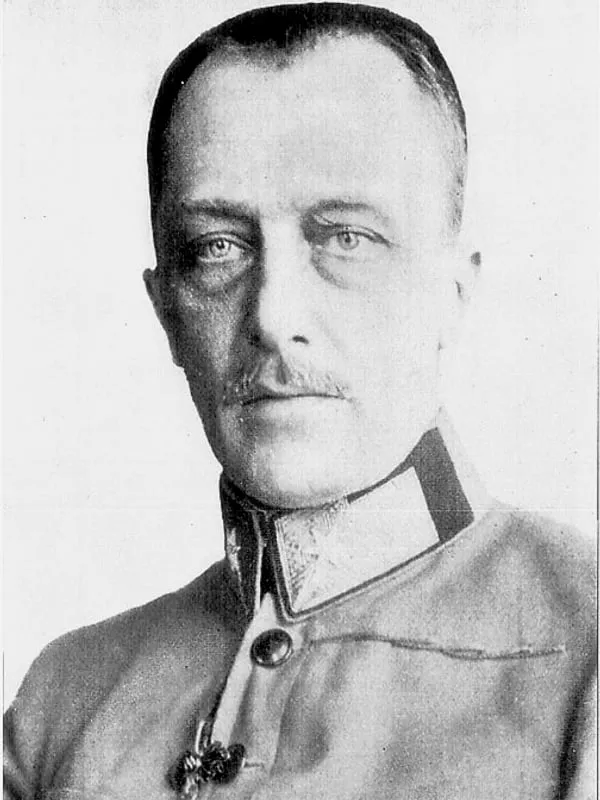
- Born:
- 26 September 1872, Dymokury (Bohemia)
- Died:
- 4 April 1932, Vienna
- Author:
- Łukasz Skowroń
- Photo:
- autor nieznany, domena publiczna, Wikimedia Commons

Count Ottokar Czernin directed the diplomacy of the Habsburg monarchy for sixteen months, from December 1916 to April 1918, at a time when it was being decided whether Austria-Hungary would survive the war. He believed that the state would not last another wartime winter, and throughout this time he spoke of peace, but he never dared to break with Germany, in whose alliance he saw the last guarantee of the old order. As the “minister of peace” he agreed to unrestricted submarine warfare, at Brest-Litovsk he signed the “bread peace” with Ukraine, which outraged the Poles, and in Romania he imposed the peace of Buftea. He fell over a scandal he himself had provoked, when he publicly attacked the French prime minister and brought about the disclosure of his own emperor’s secret peace efforts.
Before the war
He was born on 26 September 1872 at Dymokury, in German Dimokur, in central Bohemia, into one of the oldest families of the Bohemian aristocracy. After grammar school in Chomutov and service in a dragoon regiment he briefly studied law at the German university in Prague. In 1897 he married Countess Maria Kinsky and entered the diplomatic service. He worked as an attaché in Paris and from 1899 as secretary of legation in The Hague, but in 1902 he broke off his career, officially because of a lung illness, and returned to his Bohemian estates.
From 1903 he sat in the Bohemian Diet as a representative of the conservative German great landowners. He quickly made a name for himself as a defender of the “monarchical principle”, an opponent of universal suffrage and parliamentarism, and at the same time a supporter of strong central authority against dualism, which gave Hungary almost complete autonomy. These views brought him close to the heir to the throne, Archduke Franz Ferdinand. From 1905 Czernin was one of his closest advisers and wrote memoranda for him on the reconstruction of the monarchy, and according to many historians the archduke saw him as a future head of government. In 1912 the emperor appointed him a life member of the Austrian House of Lords.
In the autumn of 1913, at the archduke’s wish, Czernin returned to diplomacy as minister in Bucharest. He was regarded as an enemy of the Hungarians and his appointment met with opposition in Budapest, but in the end the prime minister, István Tisza, agreed to it. His task was to find out what the secret alliance with Romania was worth, and he soon concluded that it could not be relied on in the event of war. The Romanians looked to their compatriots in Hungarian Transylvania rather than to their obligations towards Vienna.
Bucharest 1914–1916
When war broke out, Romania declared neutrality, and the only defender of the alliance in Bucharest was the aged, pro-German King Carol I, who died in October 1914. For two years Czernin helped to keep up this neutrality, counting on the supporters of the Central Powers in Romanian politics. According to some studies he advised Vienna to buy Romania’s continued neutrality with concessions in Transylvania and Bukovina, but the Hungarian government would not hear of it. The prime minister, Ion Brătianu, played for time and bargained with the Entente. On 27 August 1916 it was to Czernin that Romania’s declaration of war was handed in Bucharest, after which the minister returned to Vienna.
Minister for peace
In Vienna Czernin joined a group of aristocrats in the House of Lords who demanded that parliament be convened and the war ended on the basis of a return to the pre-war state of affairs. The new emperor, Charles I, Franz Ferdinand’s nephew, knew him from his uncle’s circle and shared his conviction that the monarchy needed a quick peace. On 22 December 1916 he appointed him foreign minister in place of István Burián. The Austrian biographical dictionary and some studies give the date as 23 December.
The first weeks brought setbacks. The Entente rejected the Central Powers’ peace offer, and in January 1917 Czernin published in Vienna a note blaming the enemy for the continued bloodshed. When Germany decided to resume unrestricted submarine warfare, the emperor and the minister had doubts but gave way, because without the Austro-Hungarian bases on the Adriatic a campaign in the Mediterranean would have been impossible. In April, after the United States entered the war, Czernin broke off relations with Washington.
In parallel the emperor was conducting his own secret diplomacy. Through his brother-in-law, Prince Sixtus of Bourbon-Parma, he passed to the President of France in March 1917 a letter in which he promised to support France’s “just claims” to Alsace-Lorraine. Czernin knew the course of the talks and met Sixtus twice, but how much he knew about the letter itself remains disputed. He later claimed that he had not known its key sentence. In April 1917 the Allies at the conference of Saint-Jean-de-Maurienne considered a separate peace with Austria, citing Czernin’s public statements about his desire for peace, but Italy would not agree to any revision of the gains promised to it.
Czernin’s best-known document from this period is a memorandum on the strength of the monarchy, which he handed to the emperor on 12 April 1917 and which Charles sent to Wilhelm II. The minister wrote that Austria-Hungary’s military strength was nearly exhausted, its reserves of manpower and raw materials were running out, and the population was starving. He warned that if the monarchs of the Central Powers did not make peace within a few months, the peoples would make it over their heads, and that the revolution in Russia might prove contagious. The memorandum reached the deputy Matthias Erzberger and according to many historians contributed to the Reichstag’s peace resolution in July. Czernin also tried to persuade the Germans to cede at least part of Alsace-Lorraine to France and to withdraw from Belgium, and in return he offered them Austria’s renunciation of the Kingdom of Poland, and even of Galicia. Berlin did not agree.
His policy was, however, ambiguous. Austrian and German historians stress that Czernin never ruled out territorial gains should the war end in victory, and in Berlin his warnings of the monarchy’s imminent collapse were treated as blackmail or as proof that “Count Czernin has lost his nerve”. On 2 October 1917 in Budapest he delivered a celebrated speech in which he named general disarmament, arbitration courts and the freedom of the seas as the basis of a new Europe, which brought him close to the ideas of President Woodrow Wilson.
Brest and Bucharest
The Bolshevik revolution gave Czernin the opportunity he had been waiting for. At the end of November 1917 he accepted the offer of negotiations from Lenin’s government, and on 20 December he arrived at Brest-Litovsk. On 25 December, presiding over the talks, he announced on behalf of the Central Powers their acceptance of the formula of a peace without forcible annexations or indemnities, on condition that all the belligerent states adhered to it. In reality the Germans decided: State Secretary Richard von Kühlmann and General Max Hoffmann, who soon made clear to the Russians that Germany did not intend to give up the occupied lands. In dealing with Trotsky and Joffe, Czernin was often no more than an intermediary between them and the Germans.
The situation at home weighed on him. In January 1918 a great strike broke out in Austria and Hungary, and Vienna was receiving less and less grain. Czernin compared the monarchy to a man jumping from the third floor of a burning house without reckoning whether he would break one leg or both. On 24 January he replied with a speech to Wilson’s Fourteen Points, milder in tone than the address of Chancellor Hertling, which the president appreciated. The most urgent matter, however, was Ukrainian grain. On 1 February Czernin recognised on behalf of the Central Powers the Ukrainian People’s Republic, and on 9 February he signed a peace treaty with it, which he himself called the “bread peace”. He paid for the grain with the Chełm land, granted to Ukraine, and with a secret undertaking to create a separate crown land out of the Ukrainian part of Eastern Galicia and Bukovina.
The Poles regarded this as betrayal. Demonstrations took place in the Kingdom of Poland and in Galicia, Jan Kucharzewski’s government in Warsaw resigned, and the former II Brigade of the Legions broke through the front at Rarańcza to the Russian side. Czernin knew that he was losing the support of the Polish deputies in the Vienna parliament, but judged hunger in Vienna to be the greater danger. Soon afterwards he went with Kühlmann to Romania, where on 24 February he opened negotiations. On 27 February, at a railway station in Moldavia, he presented King Ferdinand I with a 48-hour ultimatum, and on 5 March Romania signed the preliminary peace of Buftea. Czernin argued at the time, against some of the German leaders, that a lasting peace could be concluded only with the legitimate monarch, not by toppling one dynasty after another. In the spring of 1918 he was at the height of his fame and was considered the most skilful diplomat of the Central Powers.
The Sixtus affair
On 2 April 1918 Czernin addressed a delegation of the Vienna city council. He defended the Treaty of Brest-Litovsk, attacked the Czech politicians, and said of France that the prime minister, Georges Clemenceau, had recently asked him about peace terms and had broken off the talks because he would not give up Alsace-Lorraine. Clemenceau replied that Czernin was lying and recalled an attempt made a year earlier by a person “of much higher rank”. The minister did not understand the warning, or perhaps he thought the French were bluffing. After a further exchange of communiqués, on 11 April Clemenceau published the emperor’s letter.
Czernin was saving above all himself and the alliance with Germany. He induced the emperor to give his word of honour that the key sentence of the letter had been forged, and according to the accounts of Empress Zita and the court he even urged him to hand over power to a regent for a time on account of a supposed illness. Charles refused, and on 14 April Czernin resigned. Burián returned in his place. According to some historians he was then close to a nervous breakdown.
After the war
In October 1918, in the House of Lords, the former opponent of the Czechs called for the recognition of Czechoslovak and Yugoslav states so that peace could be concluded as quickly as possible. After the break-up of the monarchy the Czechoslovak land reform took away his estates in Bohemia. He settled in Austria, in the Salzkammergut. In 1919 he published his memoirs, Im Weltkriege (In the World War), quickly translated into English, in which he defended his policy and presented the war as a harbinger of world revolution. From 1920 to 1923 he sat in the Austrian National Council as a deputy of the small Democratic Party. He died in Vienna on 4 April 1932.
Assessment
Historians judge Czernin fairly severely. They credit him with more imagination and energy than his predecessors, Leopold Berchtold and Burián, but reproach him for nervousness, vacillation and a tendency to sudden turns, which robbed his policy of credibility with both his enemies and his ally. The Austrian officer and historian Edmund Glaise-Horstenau wrote of the “stormy haste” with which the minister gave way to new impressions, and the Viennese politician Josef Redlich considered him a man of the seventeenth century who did not understand the times he lived in. German and Austrian works stress that Czernin, an opponent of democracy and internal reform, saw the alliance with Germany as the guarantee of the survival of the old order, and that was why he could not break free of it, even though he himself foretold defeat.
His defenders point out that the minister of a monarchy ever more dependent on Berlin had very little freedom of action, that he was one of the first leaders of the Central Powers to say openly that the war could not be won, and that the treaties with Ukraine and Romania at least gave Austria a hope of food. Even they admit, however, that the “bread peace” did not solve the problem of hunger and ruined the monarchy in the eyes of the Poles, and that the Sixtus affair, provoked by his own carelessness, destroyed what little chance of a separate peace remained and made Austria-Hungary an even more subordinate partner of Germany.
Sources
Spotted a mistake?Report an error
Often appears with
People who appear in the same events.
On the timeline
(31)1915
1916
1917
1918
January
- 05
- Lloyd George on war aimsOn 5 January 1918 Lloyd George set out British war aims to trade unionists, demanding a restored Belgium and independent Poland and a league of nations.
- Brest-Litovsk peace talks suspendedOn 5 January 1918 Berlin announced that the Brest talks were broken off, as the Bolsheviks wanted them moved to Stockholm. Days later Trotsky came after all.