Austria-Hungary · The Central Powers
István Burián
Foreign Minister of Austria-Hungary (1915–1916, 1918), joint Minister of Finance (1903–1912, 1916–1918)
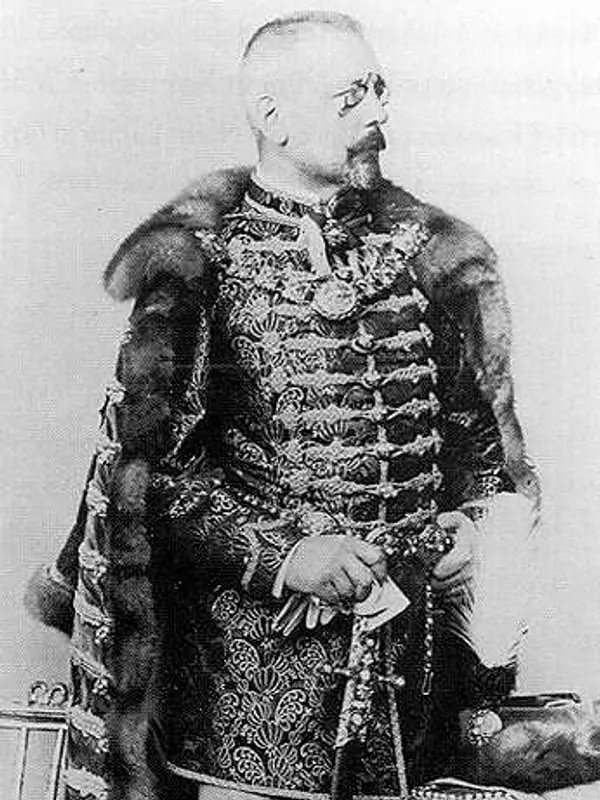
- Born:
- 16 January 1851, Stomfa, now Stupava (Hungary, now Slovakia)
- Died:
- 20 October 1922, Vienna
- Author:
- Łukasz Skowroń
- Photo:
- Lipót Strelisky, domena publiczna, Wikimedia Commons

Baron István Burián, in German Stephan Burián von Rajecz, directed the diplomacy of the Habsburg monarchy twice: from January 1915 to December 1916 and from April to October 1918. He was a professional diplomat of the old school, an expert on the Balkans and the closest confidant of the Hungarian Prime Minister István Tisza. In his first term he failed to stop Italy and Romania from joining the Entente, but he won Bulgaria over to the Central Powers and pressed for the union of the Kingdom of Poland with the monarchy. In his second, as Austria-Hungary was already falling apart, he tried in vain to bring about peace. Contemporaries and historians reproached him for pedantry and inflexibility, though no one questioned his integrity or his knowledge of his craft.
Before the war
He was born on 16 January 1851 in Stomfa, in German Stampfen, today Stupava near Bratislava, into an old family of minor Hungarian nobility. Some sources give the year 1852, but most works, including the German national biography, accept 1851. He graduated from the Consular Academy in Vienna and began in the consular service in Alexandria, Bucharest, Belgrade and Sofia. In 1882–1886 he headed the consulate general in Moscow, in 1887–1895 he represented Austria-Hungary in Sofia, capital of the Principality of Bulgaria, and then he was minister in Stuttgart and, in 1897–1903, in Athens. He gained a reputation as the monarchy’s foremost expert on Balkan affairs. In 1891 he married Olga, daughter of General Géza Fejérváry, later Prime Minister of Hungary. The marriage was childless. In 1900 he received the title of baron.
In 1903 he became the monarchy’s joint Minister of Finance. This office financed the common affairs of Austria and Hungary, but above all it administered Bosnia and Herzegovina, occupied since 1878. Burián ran it during the Bosnian crisis, when in 1908 the monarchy annexed the province. He tried to govern gently and to win over the local elites, and he gave Bosnia and Herzegovina a provincial diet, but his reforms were criticised in Vienna as going too far, and they did not pacify the country anyway. In 1912 he left office.
In June 1913 he joined Tisza’s government as minister to the King’s person, that is, the representative of the Hungarian government at the court in Vienna. After the assassination in Sarajevo in July 1914 he mediated between the Foreign Minister Leopold Berchtold, who was pushing for war with Serbia, and Tisza, who at first opposed it. In the end Tisza gave way, and from then on Burián was his chief adviser on foreign affairs.
Foreign Minister: Italy
At the turn of 1914 and 1915 Berchtold, under German pressure, was ready to give Italy part of the Trentino in return for its neutrality. Tisza opposed this, and on 13 January 1915 Emperor Franz Joseph I, on his recommendation, appointed Burián as Berchtold’s successor. The monarchy gained a minister who, like Tisza, rejected territorial concessions at the expense of its own lands.
Burián argued that Italian demands for compensation under the Triple Alliance treaty did not concern Austrian territory, and he dragged out the negotiations with the Italian Foreign Minister Sidney Sonnino. He gave way step by step, but always too late. In February he agreed only to talk; in March, after the surrender of Przemyśl and under heavy pressure from Berlin, he accepted the principle of ceding part of the Trentino, but only after the war, and he agreed to an earlier handover only when Rome was already demanding far more. Irritation grew in Berlin. Chancellor Theobald von Bethmann Hollweg wrote in April that he did not want to bind Germany’s fate to Baron Burián’s imprudence. Some historians believe that the minister never believed Italian neutrality could be preserved and wanted only to postpone war for as long as possible. In April Italy signed the secret Treaty of London with the Entente, on 4 May it renounced the Triple Alliance, and on 23 May the Italian ambassador handed Burián the declaration of war.
Bulgaria, Poland and Romania
Burián had greater success in the Balkans, which he knew best. In the autumn of 1915 Bulgaria allied itself with the Central Powers and joined the combined attack on Serbia, which opened the land route to Turkey. At the same time, however, Burián, in line with Tisza, did not want to promise the Bulgarians territory too generously, and he rejected any concessions to Romania in Hungarian Transylvania. Romania, which no offer from Vienna satisfied, declared war on Austria-Hungary in August 1916.
Burián’s main war aim was the so-called Austro-Polish solution, that is, the union of the Kingdom of Poland with the Habsburg monarchy. After the capture of Warsaw he obtained in Berlin in August 1915 the preliminary consent of the Germans to such a plan. In his talks with Bethmann he presented Poland as a burden the monarchy was taking on out of necessity rather than as a prize. The Germans soon withdrew their consent, and in the summer of 1916 the two politicians agreed only on the principle of creating a separate Kingdom of Poland. It was proclaimed by the Act of 5 November 1916, brought forward at the demand of Erich Ludendorff.
Burián constantly demanded that Germany treat the monarchy as an equal partner, which annoyed Berlin, while the monarchy had less and less strength to back up such demands. He opposed unrestricted submarine warfare. In matters that directly concerned the United States, such as the demand for Ambassador Dumba’s recall or the sinking of the Ancona by a submarine flying the Austro-Hungarian flag, he ultimately gave way to the Americans so as not to provoke a break in relations. He also had to answer the memoranda of the Chief of the General Staff, Franz Conrad von Hötzendorf, who demanded the incorporation of the whole of Serbia and Montenegro into the monarchy. Tisza, whose views Burián usually shared, was against annexing further millions of Slavs.
In the autumn of 1916, convinced that the war could not be decided by arms, on 17 October at Pless he presented Bethmann with a draft joint peace offer on moderate terms, including the restoration of Belgium. The Germans accepted the idea but refused to state terms. The offer announced on 12 December therefore contained nothing concrete, and the Entente rejected it. A few days later Burián ceased to be minister. The new Emperor Charles I, who had come to the throne after the death of Franz Joseph, wanted his own man and on 22 December appointed Count Ottokar Czernin minister. The same day Burián took over the joint Ministry of Finance, which he knew well.
Return in 1918
After the Sixtus affair, which exposed the Emperor’s secret efforts to obtain a separate peace, Czernin had to go. On 16 April 1918 Charles entrusted the Foreign Ministry to Burián for the second time. The old diplomat, known for his loyalty to the alliance, was to restore Berlin’s confidence. On 7 May he signed the Peace of Bucharest with Romania, and on 12 May he accompanied the Emperor to Spa, where the two monarchies agreed on a closer political, military and economic union. Burián insisted that the new agreements should depend on Austrian interests in Poland being taken into account.
In the summer, when the German offensive in the west collapsed and the monarchy began to disintegrate from within, the minister concluded that it would not survive another winter of war. At the conference at Spa in August he urged a swift peace move, and when the Germans delayed, on 14 September he sent his own note to all the belligerents proposing confidential talks in a neutral country. President Woodrow Wilson rejected it at once. On 4 October Burián, together with the Germans, asked Wilson for an armistice on the basis of the Fourteen Points. He agreed to Emperor Charles’s manifesto on the reconstruction of Austria as a federal state only on condition that it did not include Hungary, and he later admitted that the manifesto’s effect had been catastrophic. When Hungary announced that it was breaking its union with Austria, he no longer saw a role for himself. On 24 October 1918 he resigned, and Count Gyula Andrássy became minister. In 1918 Charles also made him a count. A week after his departure, on 31 October, mutinous soldiers shot Tisza dead in Budapest.
After the war
Burián settled in Vienna and took no further part in politics. After the war he was attacked above all by Ludendorff, who blamed Austro-Hungarian diplomacy for the alliance’s failures. In 1919–1920 Burián wrote memoirs of his years in office, published in German in 1923 and in English in 1925 under the title “Austria in Dissolution”. He died on 20 October 1922 in Vienna and was buried in the Central Cemetery.
Assessment
Most historians judge Burián harshly. The Hungarian historian István Diószegi wrote that even as a practical politician he remained a doctrinaire who forced a changing reality into theoretical schemes and who, after a failure, did not change his method but merely devised a new scheme. The German national biography calls him a statesman inclined to hesitation and a stranger to courting popularity. Critics point out that his legalism and pedantry in the negotiations with Italy and Romania contributed to the monarchy gaining two new enemies, and that his Hungarian perspective, especially his defence of the integrity of Transylvania, did not always serve the interests of the state as a whole.
Some more recent scholars view him more leniently. Marvin Fried of the London School of Economics acknowledges that Burián was accused of doctrinairism and narrow, Balkan horizons, but stresses that he had a clear vision of defending the prestige, integrity and great-power position of the monarchy and defended it consistently against mounting pressure from outside and within. It is also pointed out that no minister could have bought Italian neutrality at a price Rome would have considered sufficient, and that Burián was one of the few politicians of the Central Powers who were already seeking peace on moderate terms in the autumn of 1916. His two terms show above all how little the diplomacy of a monarchy ever more dependent on its German ally could achieve.
Sources
Spotted a mistake?Report an error
Often appears with
People who appear in the same events.