Key event
Peace of Bucharest
- Category:
- Diplomacy
- Front:
- Balkan Front
- Date:
- 7 May 1918
- Author:
- Łukasz Skowroń
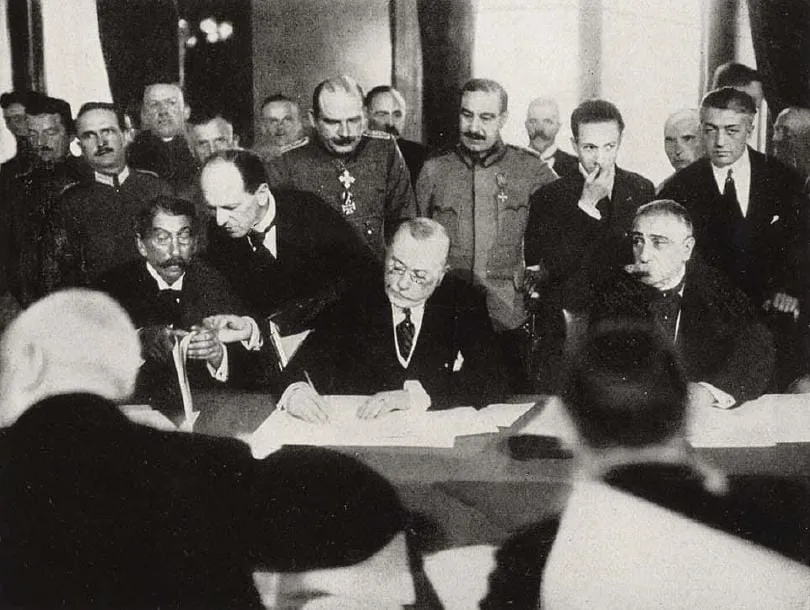
On 7 May 1918 (24 April by the Julian calendar, which Romania used) a peace treaty between Romania and Germany, Austria-Hungary, Bulgaria and Turkey was signed in the Cotroceni Palace in occupied Bucharest. It was signed for Romania by the prime minister Alexandru Marghiloman, the foreign minister Constantin Arion and two plenipotentiaries, Mihail Burghele and Ion Papiniu. The Central Powers were represented by, among others, the German Foreign Secretary Richard von Kühlmann, the Austro-Hungarian foreign minister István Burián and the Bulgarian prime minister Vasil Radoslavov. Some contemporary publications, among them American law journals and Current History, gave the date as 6 May, but the treaty itself is dated 7 May, and historians accept that date.
The peace turned into a final treaty the preliminary terms of Buftea, accepted on 5 March by General Averescu’s government. The negotiations on the details were conducted by the cabinet of Marghiloman, who was regarded in Berlin and Vienna as a politician with whom an agreement could be reached. On the same day a whole series of supplementary agreements was signed: a treaty on consular relations, compensation, amnesty and prizes, two economic treaties with Germany and with Austria-Hungary, railway agreements with Austria and with Hungary, and an agreement on the shipyard at Turnu Severin. It was these, not the main document, that determined how deeply Romania would be subordinated to the victors.
Dobruja and the Carpathians
The most important territorial provisions were contained in Articles 10 and 11. Romania ceded to Bulgaria southern Dobruja, which it had won in 1913 after the Second Balkan War, together with a “frontier rectification”, that is, a strip of northern Dobruja roughly as far as the Rasova–Agigea line. The rest of the region, up to the Danube and its southern St George branch, Romania ceded to all four Central Powers jointly. This created a condominium whose future was left for later, because Bulgaria demanded the whole of Dobruja, while Turkey demanded compensation for this on the Maritsa. The Danube delta remained with Romania, and the Central Powers undertook to secure it a “safe trade route” to the Black Sea via Cernavodă and Constanța. American commentators pointed out that the pipeline from the oilfields to Constanța also ran through the condominium.
On the border with Hungary Romania agreed to a “rectification” in favour of Austria-Hungary, marked on an attached map. In practice this meant handing over the ridges and passes of the Carpathians, with extensive state forests. Marghiloman managed to reduce Vienna’s original demands considerably and to limit them mainly to mountain areas, although according to some studies a few localities, among them the area around Predeal, also fell within the new borders. Estimates of the area the country lost ranged at the time from 5,000 to 15,000 square kilometres. According to later calculations it was in fact about 5,400 km². State property in the ceded lands passed to the new owners without compensation. The parties mutually renounced reimbursement of war costs.
Army and occupation
The military clauses developed the provisions of Buftea. Five Romanian divisions, the 11th to the 15th, were to be disbanded. Two infantry divisions stationed in Bessarabia and two cavalry divisions could remain on a war footing as long as the operations of the Central Powers in Ukraine continued. The remaining eight divisions were reduced to a lower peacetime strength: the infantry could number no more than 20,000 men, the cavalry 3,200 and the artillery 9,000. Surplus guns, machine guns, horses and ammunition came under the supervision of the Central Powers’ command. The demobilised army had to remain in Moldavia.
Wallachia with Bucharest remained under occupation, with no set end date. Article 14 stated that the occupied territories would be evacuated “at a date to be fixed later”, and until then up to six divisions could be stationed there, not counting formations engaged in the economic exploitation of the country. After ratification their upkeep was to be borne by Romania. An official of the occupation administration was to be attached to every Romanian minister, and the railways, post and telegraph remained under military administration until further notice. A separate agreement was to define the occupation command’s share in the management of the National Bank of Romania.
Oil and grain
For Germany the economic provisions were the most valuable. The occupation command kept the right to requisition grain, pulses, fodder, wool, cattle and meat from that year’s harvest, as well as timber and oil. The economic agreements secured Romania’s agricultural surpluses for Germany and Austria-Hungary for the following years. The most notorious was the oil agreement. The exclusive right to drill and exploit the state oil lands around Ploiești went to a company in which more than three-quarters of the capital was to belong to Germans and Austrians. It was not subject to Romanian law on foreign companies, and in disputes with it German courts could have the final say. The lease was to last many decades; the literature usually speaks of 90 years, and the Entente press of the time even wrote of 99.
The treaty also provided for a new Danube convention. The European Commission of the Danube, which since 1856 had supervised navigation at the river’s mouth, was henceforth to include only the riparian and Black Sea states, and thus not Britain, France and Italy. Article 28 was unexpected. At the demand of the Central Powers Romania undertook that difference of religion would not affect civil rights, and even before ratification it was to pass a law granting citizenship to, among others, Jews, who had until then been treated as foreigners, if they had served in the army during the war or had been born in the country and lived in it.
Bessarabia
The treaty was silent on Bessarabia, apart from consenting to keep two mobilised divisions there. According to Romanian historians, however, the Central Powers promised outside the treaty that they would not oppose its union with Romania, voted in Chișinău on 9 April. In Bucharest and Iași this was presented as compensation for Dobruja and the Carpathians, although the Romanians stressed that Bessarabia was not a payment but the return of land taken by Russia in 1812. Paradoxically, then, the defeated kingdom came out of the war with a larger territory than before it.
Reactions and the fate of the treaty
In Germany the peace was greeted with triumph. Wilhelm II telegraphed Kühlmann that the conclusion of peace with Romania filled him with “joyful satisfaction”, because peace now reigned on the whole Eastern Front, and awarded him the Order of the Crown, First Class. For the Romanians it was a humiliating peace. The country kept its dynasty and formal independence, but in practice became a German source of raw materials. Germany’s allies were not satisfied either: the Bulgarians, who had not received the whole of Dobruja, regarded the treaty as a defeat, and in June, largely for this reason, Radoslavov had to resign.
The treaty never fully came into force. King Ferdinand I refused to sign it. As early as 10 May parliament was dissolved by royal decree, and the chambers elected in the new elections approved the treaty on 28 June and 4 July, but the monarch never promulgated it, and the instruments of ratification were never exchanged. By the end of May the British government had declared in the House of Commons that the Entente powers regarded this peace as void. When in the autumn the Central Powers began to lose, Romania re-entered the war on 10 November 1918. A day later the Armistice of Compiègne obliged Germany to renounce the treaties of Bucharest and Brest-Litovsk, which the Treaty of Versailles confirmed in 1919.
Remember the articles you have read? Only in this browser; nothing is sent anywhere.How it works
Read ·
A voice from the front
“Overhead the stars vied with the lights on the graves. It was a wonderful picture, all those white crosses and the tiny lights beneath the trees in full blossom. When at last I got back to my bed, it was long before I could sleep, as I kept thinking of all those brave young fellows lying so peacefully beneath the ground, so blissfully unaware of our poor country’s torture.”
Spotted a mistake?Report an error
Meanwhile
(04)Elsewhere in the same days.
- 7 May 1918 · Middle EastBritish take KirkukOn 7 May 1918 the British entered Kirkuk unopposed after the Turks left it overnight. Lack of supplies made them withdraw from the town by 24 May.
- 8 May 1918 · Eastern FrontGermans occupy RostovOn 8 May 1918 the Germans entered Rostov-on-Don, abandoned by the Bolsheviks, without a fight. Insurgent Cossacks took power on the Don.
- 5 May 1918 · PoliticsFrench becomes Lord Lieutenant of IrelandIn early May 1918 Field Marshal John French became Lord Lieutenant of Ireland, to govern it as a "military viceroy" during the conscription crisis.
- 9 May 1918 · War at seaSecond Ostend raidOn the night of 9/10 May 1918 the British scuttled the old cruiser Vindictive in the entrance to Ostend harbour. The wreck blocked only part of the channel.
Related events
(04)The same battle, people or subject.
- 5 March 1918 · Balkan FrontPeace of BufteaOn 5 March 1918 at Buftea Romania signed a preliminary peace with the Central Powers. It ceded Dobruja and accepted a border correction and demobilisation.
- 21 June 1918 · Balkan FrontRadoslavov resignsOn 21 June 1918 Tsar Ferdinand appointed Malinov's government. Radoslavov's cabinet, which took Bulgaria into the war and failed over Dobruja, stood down.
- 9 April 1918 · PoliticsUnion of Bessarabia with RomaniaOn 9 April 1918 the Sfatul Țării in Kishinev voted by 86 votes to unite Bessarabia with Romania, subject to autonomy and land reform.
- 18 March 1918 · PoliticsMarghiloman becomes prime minister of RomaniaOn 18 March 1918 King Ferdinand entrusted the government to the Germanophile Alexandru Marghiloman. Constantin Arion became foreign minister.